Affichage des articles dont le libellé est EMALS. Afficher tous les articles

mardi 11 septembre 2018

China's New Aircraft Carrier

It is not clear when the Type 002 will be launched and eventually commissioned, but the Chinese are thought to have a set a goal of having four carrier strike groups in operational service by 2030.
By Dave Majumdar
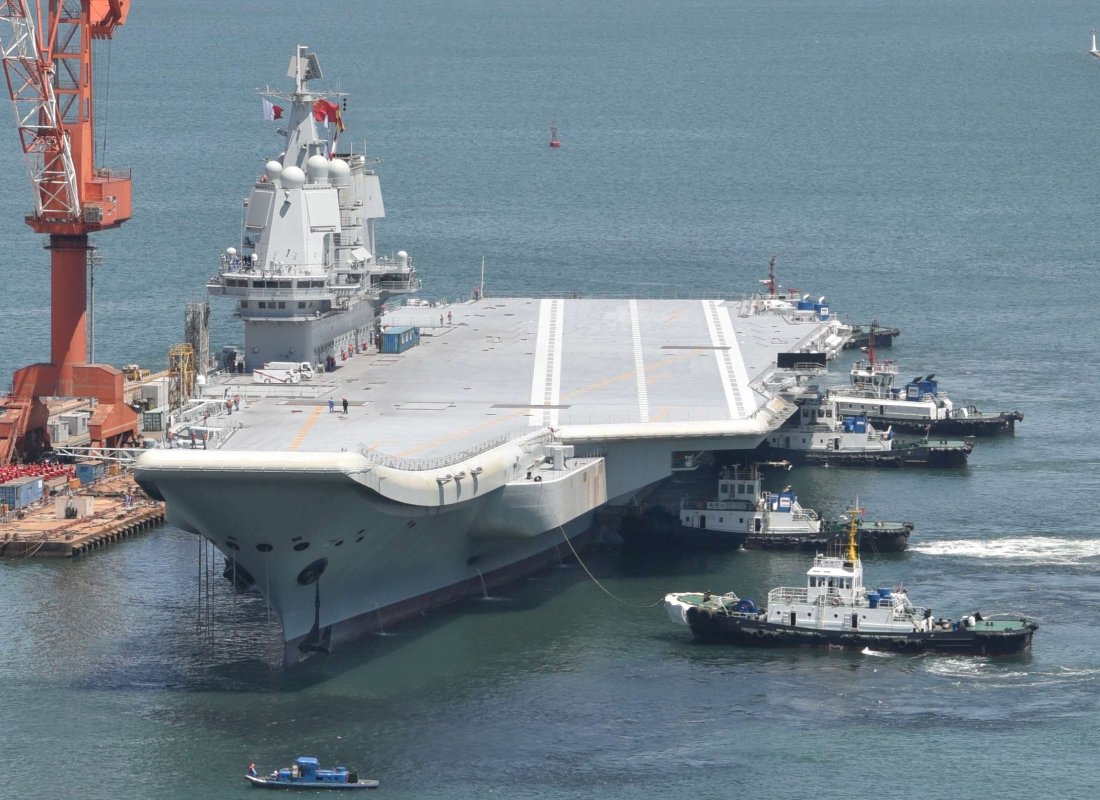

China has apparently started construction of its third aircraft carrier, but details about the new vessel are scant. 
However, unlike the two previous Chinese carriers, the Type 001 Liaoning—formerly the Soviet Kuznetsov-class Varyag—and the Type 001A Shandong, the new Type 002 ship will be equipped with catapult launch systems similar in concept to those found onboard U.S. Navy vessels.
The Chinese are known to be working on the development of an Electromagnetic Aircraft Launch System (EMALS ) hardware similar to those found onboard the latest USS Gerald R. Ford-class aircraft carriers, but development of those advanced electromagnetic catapults has proven to be difficult even for the United States. 
According to Chinese media, Beijing intends to forego conventional steam catapults and move directly to EMALS technology. 
Assuming, that the Chinese are moving forward with an EMALS-equipped vessel, it is an indication that Beijing’s third carrier will be of an indigenous design—albeit one likely aided by technology gleaned from the United States through espionage.
“China is expected to begin construction on its first catapult-capable carrier in 2018, which will enable additional fighter aircraft, fixed-wing early-warning aircraft, and more rapid flight operations,” reads the Pentagon’s 2018 report to Congress on the Chinese military .
Indeed, Chinese media reported earlier this year that the Shanghai Jiangnan Shipyard Group was given the green light to start construction on China’s third carrier. 
“But the shipyard is still working on the carrier’s hull, which is expected to take about two years,” a Chinese defense industrial source told the South China Morning Post . 
“Building the new carrier will be more complicated and challenging than the other two ships.”
There are few specific details available about the specifications of the Type 002. 
However, Chinese media have suggested that the new vessels would displace roughly 80,000-tons, which is comparable in size to the now-retired USS John F. Kennedy (CV-67). 
At a displacement of roughly 80,000-tons, the prospective Chinese aircraft carrier would be similar in size to the nuclear-powered Project 1143.7 Orel-class design, the only example of which, Ulyanovsk, was scrapped on the ways after the Soviet Union collapsed at the end of 1991.
Given that China acquired Liaoning and all of her blueprints from a newly independent Ukraine, it is possible that Beijing also acquired the design for Ulyanovsk from Kiev under a similar arrangement. 
Beijing’s engineers would have benefited greatly from the acquisition of such technology from the fragmented remains of Soviet Union, having never previously designed or built a combat vessel of such a massive scale. 
Moscow had completed development of most the critical technologies—such as steam catapults—needed for a fully capable carrier on Ulyanovsk before the implosion of the Soviet state.
Even if Beijing did not obtain the design for Ulyanovsk, the Chinese are clearly benefiting from Soviet technological developments that they gleaned from Liaoning. 
Indeed, Chinese media is reporting that Ukrainian engineers have been assisting Beijing’s shipbuilders with the development of the new carriers. 
“China has set up a strong and professional aircraft carrier team since early 2000, when it decided to retrofit the Varyag to launch as the Liaoning, and it hired many Ukrainian experts ... as technical advisers,” a Chinese defense industry source told the South China Morning Post.
Nonetheless, there are indications that Beijing is looking towards the West for inspiration for the Type 002, particularly for the design of ships’ topsides. 
“The new vessel will have a smaller tower island than the Liaoning and its sister ship because it needs to accommodate China’s carrier-based J-15 fighter jets, which are quite large,” a Chinese defense industry source told South China Morning Post. 
“It has been suggested that they look to Britain’s warship, the HMS Queen Elizabeth, which has two small tower islands on the deck. That would create more space for the runway and aircraft, but no final decision has been made yet.”
It is not clear when the Type 002 will be launched and eventually commissioned, but the Chinese are thought to have a set a goal of having four carrier strike groups in operational service by 2030.

lundi 30 janvier 2017

Why China Fears America's New Ford-Class Aircraft Carriers

By Kyle Mizokami

In 2009, the U.S. Navy finally began construction of the first new type of aircraft carrier in nearly thirty-five years. 
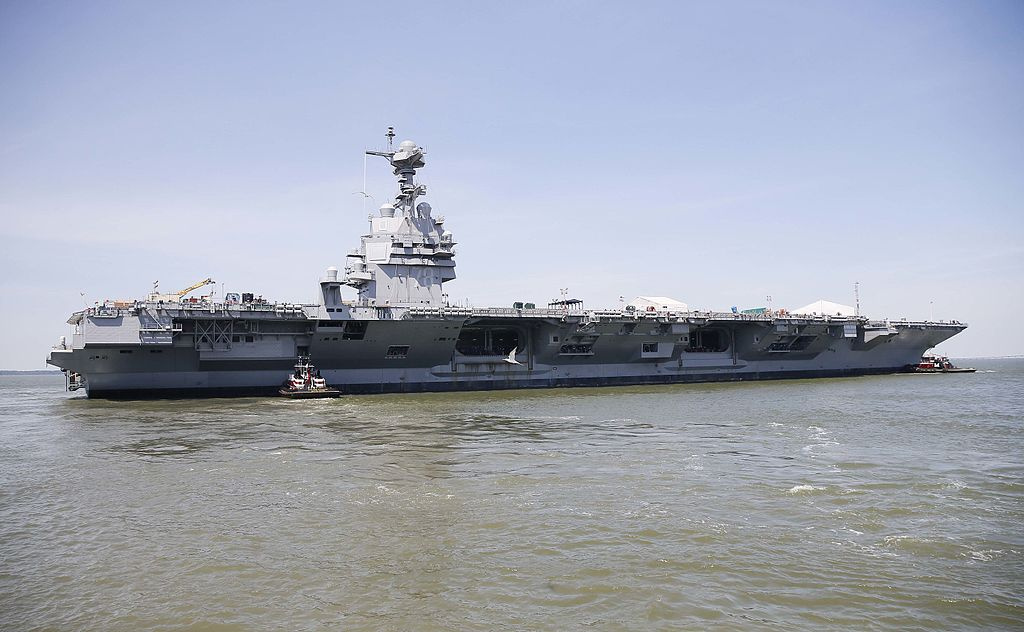
Named after former president and naval aviator Gerald R. Ford, the USS Ford fully takes the nuclear supercarrier into the twenty-first century. 
The technological innovations built into the new ship, while causing the inevitable delays involved in building a first-in-class vessel, will keep the Navy’s unique fleet of super flattops the largest and most advanced in the world for the foreseeable future.
USS Ford follows in the steps of the highly successful Nimitz-class carriers. 
Construction began in 2009 at Huntington Ingalls Industries in Newport News, Virginia—the same location where the Ford’s predecessors were built. 
Indeed, the Ford class resembles the Nimitz ships in many ways: they measure 1,106 feet long versus the Nimitz’s 1,092 feet. 
Both classes weigh the same: approximately one hundred thousand tons fully loaded. 
Layout is similar, too, with an island on the starboard side, four catapults and an angled flight deck.
The ship is powered by two new-design AB1 nuclear reactors. 
The reactors are manufactured by Bechtel, which beat out longtime naval reactor giants General Electric and Westinghouse for the reactor contract. 
Together, the two reactors create six hundred megawatts of electricity, triple the two hundred megawatts of the Nimitz class. 
That’s enough electricity to power every home in Hampton, Virginia; Pasadena, California; or Syracuse, New York.
Ford is going to need that power, not only to reach its estimated top speed of thirty-plus knots but also the new Electromagnetic Aircraft Launch System (EMALS), which uses electric currents to generate strong magnetic fields that can quickly accelerate an aircraft to takeoff speeds. 
The system is touted as easier on aircraft, extending their service lives, easier to maintain in general and capable of generating up to 25 percent more sorties than the older steam catapult system.
The new carrier will also use a new system to land aircraft. 
The new Advanced Arresting Gear uses a water turbine and induction motors to halt the momentum of landing carrier aircraft. 
Like EMALS, the AAG is expected to be more reliable than the existing aircraft arresting system on Nimitz-class ships and easier on airframes.
Ford will also have the most modern radar systems in the fleet. 
The Ford will have the new Dual Band Radar, which combines both the X-Band AN/SPY-3 Aegis radar and the S-Band Volume Surveillance Radar. 
DBR is capable of search, track and multiple missile illumination, detecting enemy aircraft and missiles and then guiding Evolved Sea Sparrow Missiles (ESSM) to intercept.
For self-defense, Ford will have two Mk. 29 missile launchers with eight ESSM each, and two Rolling Airframe Missile launchers. 
It will also have four Phalanx Close-In Weapon Systems for point defense against aircraft, missiles and small ships, and four M2 .50 caliber machine guns. 
Ford’s generous electrical capacity means that the ship could someday mount laser self-defense weapons. 
Powered by the ship’s nuclear reactors, such a system would have a virtually limitless ammunition supply, vastly increasing the ship’s defensive capability.
The carrier air wing will form the carrier’s primary means of deploying both offensive and defensive firepower. 
The Ford class will embark two squadrons of ten to twelve F-35C Joint Strike Fighters, two squadrons of ten to twelve F/A-18E/F Super Hornets, five EA-18G Growler electronic attack jets, four E-2D Hawkeye airborne early-warning and control aircraft, and two C-2 Greyhound carrier onboard delivery (COD) planes. 
It will also carry eight MH-60S Seahawk helicopters. 
Down the road, it will embark the MQ-25 Stingray refueling and intelligence collection drone, the eventual planned sixth-generation fighter to replace the Super Hornet, and, if Sen. John McCain has his way, a new long-range strike drone. 
The V-22 Osprey tiltrotor is also set to replace the C-2 Greyhound in the COD role.
Ford’s entry into active service will once again raise the Navy’s carrier force to eleven ships. 
The Navy’s carrier fleet is unique in having a congressionally mandated minimum force level: U.S. Code § 5062 states, “the naval combat forces of the Navy shall include not less than 11 operational aircraft carriers.” 
For, now the Navy is operating with a waiver.
More ships will follow. 
USS John F. Kennedy, the second aircraft carrier to bear the name of the thirty-fifth president of the United States, is under construction at Newport News and expected to enter service in 2020. 
The third carrier, Enterprise, is expected to begin construction next year and will join the fleet in the early 2020s. 
The current push by President Donald Trump and the chief of naval operations to a 350–355-ship fleet will likely include at least one additional Ford-class carrier in the near term.
Designed with the latest technology, Ford is not without problems. 
Both EMALS and the Advanced Arresting Gear System have run into considerable problems, and the Navy briefly pondered finishing Kennedy with a more traditional, proven arresting gear system. Despite developmental delays, it appears both new takeoff and landing systems are nearly ready. According to the Navy, Ford is 99 percent done and 93 percent of testing is complete. 
Ford is scheduled for delivery to the Navy this April.