Affichage des articles dont le libellé est The Manchurian President. Afficher tous les articles

dimanche 14 mai 2017

The Manchurian President

Experts pan Trump’s ‘early harvest’ trade deal with China 
Trump is outplayed by Beijing as ‘gigantic’ agreement draws derision 
By Shawn Donnan in Washington
Résultat de recherche d'images pour "clown trump"
Mongolism: Donald Trump had touted the 'early harvest' deal as 'Herculean' 

From the moment he descended an escalator at Trump Tower almost two years ago and announced his presidential candidacy, Donald Trump has vowed to put the US back on a winning path in its trade dealings with China.
“I beat China all the time. All the time,” he declared to cheers that day in June 2015. 
But did Trump just get outplayed in his first trade negotiation with China?
A deal announced on Friday by officials in Beijing and Washington was billed as “gigantic” and “Herculean” by his administration in its efforts to reset the relationship between the world’s two largest economies.
It also marked a major de-escalation from Mr Trump’s bellicose campaign rhetoric and widespread fears that he might set off a trade war.
To former US officials, Trump advisers, business executives and other close watchers of the US-China relationship, however, this was a poor deal in which Beijing had simply reheated old promises.
They say it raises questions about the Trump administration’s strategic wherewithal and the very negotiating muscle the president has so often touted. 
“This is disappointing on many levels,” says Dan DiMicco, former chief executive of US steelmaker Nucor and a campaign adviser to Trump.
“We are rewarding China before stopping their massive trade cheating.”  
“They got played,” was the blunter assessment of one former US official.
The “early harvest” deal rolled out on Friday saw China agree to resume imports of US beef that were suspended in 2003, in a move that US cattle ranchers hailed as “historic” but which Chinese leaders had already agreed to last September.  
Beijing also committed to open its market to foreign-owned credit rating agencies and credit card companies — a pledge that addressed long-running US gripes but also resembled previous promises.
Ahead of China’s 2001 accession to the World Trade Organisation, it had agreed to open credit cards — or the broader market for electronic payments made in renminbi — to foreign-owned companies such as Visa and MasterCard.
For its part the US has agreed to encourage natural gas sales to Chinese buyers and opened the door to imports of cooked chicken from China. 
More importantly, it offered its endorsement for Beijing’s “Belt and Road” project to revive the ancient trade route to Europe by sending a delegation to a Beijing summit that started on Saturday. 
That move upended the arm’s-length approach of the Obama administration and left the Trump administration struggling to explain why Trump was embracing a project many see as Beijing’s latest effort to replace the US as a trading and military power in the Asia-Pacific region. 
According to the administration, the deal — part of a 100-day plan hatched by Trump and Xi Jinping during the Florida summit in April — will turn out to be the first of many.
But experts say that in its impatience to get a deal done, the new US administration had given up many key points of leverage that would have been useful for future negotiations. 
Meanwhile, in the name of reducing a trade deficit with China worth more than $300bn last year, the administration showed no signs of addressing bigger strategic economic issues such as Beijing’s efforts to force US companies to use Chinese technology or to buy US companies in key sectors. 
“[The Trump administration has] a single metric for trade success and that’s ‘have we reduced the trade deficit with a country?’, says Robert Atkinson, head of the Information Technology and Innovation Foundation, a Washington-based think-tank.
And the Chinese fundamentally don’t care about the deficit. They are willing to give that away. What they care about is dominance in advanced industries.” 
Rufus Yerxa, president of the US National Foreign Trade Council, acknowledges that progress on some longstanding issues has been encouraging. 
“But there are a lot of major concerns about the way China is operating and the things that China does,” he says, pointing to Chinese restrictions on tech products and cloud computing. 
“It’s a bit concerning that those issues aren’t front and centre,” he says. 
Mr DiMicco says that with its promise to sell more natural gas to China, the Trump administration risked undermining what is now an important competitive advantage for US industry — cheap energy costs — and the manufacturing renaissance it has promised.  
“When the gas exports [to China] get large enough, which they will, it will drive up natural gas prices for our domestic manufacturers, and negatively impact our reshoring efforts,” he says. 
It also could have longer-term consequences for the US, he warns.
“We do not want to have a colonial-like trade relationship with China whereby we try to balance our trade by sending them raw materials and farm products and they send us increasingly high-technology products.” 

jeudi 11 mai 2017

The Manchurian President

Senators to Trump: Show Resolve with Beijing in South China Sea
BY DAN DE LUCE

Senators from both sides of the aisle wrote to Donald Trump on Wednesday urging him to take a tougher line with Beijing in the South China Sea, calling for more U.S. naval patrols to uphold navigation rights in the disputed waterway.
The appeal, backed by three Republicans and four Democrats, reflects growing concern in Congress that the Trump administration could be ceding strategic ground to China.
The letter obtained by Foreign Policy expresses concern that the United States had not carried out patrols upholding “freedom of navigation” in the strategic South China Sea since October 2016. 
Last year, Pentagon officials privately complained that the Obama administration limited its ability to patrol the disputed waters; Rex Tillerson initially promised a much tougher line against Chinese antics in the South China Sea, but none has yet materialized.
“We therefore urge your administration to take necessary steps to routinely exercise freedom of navigation and overflight in the South China Sea, which is critical to U.S. national security interests and to peace and prosperity in the Asia-Pacific region,” the letter said.
The administration has so far rebuffed requests from the U.S. Pacific Command to conduct freedom of navigation operations in the South China Sea, congressional staffers and Pentagon officials say, despite earlier vows by Trump and his aides to assert American interests against China.
The U.S. Navy routinely sails through international waters to assert the principle of freedom of navigation, even pushing back against excessive claims by allies, if needed. 
But the patrols have taken on added political weight in the contested South China Sea, where tensions are running high because of Beijing’s vast island-building campaign and its expansionist territorial claims.
Given mixed signals from an erratic White House, the lawmakers wanted to send a message that there was a “bipartisan center of gravity” on the issue, a Democratic congressional aide told FP.
The senators were trying “to provide ballast for the administration as it engages in the region,” the aide said, adding: “We thought it was important to weigh in and also to try to help shake things loose in the administration on this.”
The letter cites a series of “aggressive” and “troubling” actions by China in the waterway, including building artificial islands on disputed reefs, ramming commercial fishing boats, and issuing warnings to aircraft and ships in international airspace and waters.
“All of these measures raise serious questions about China’s commitment to regional security, the free flow of commerce, and freedom of navigation and overflight,” it said.
In an elaborate dredging operation, China has built up a network of artificial islands on disputed reefs and atolls in recent years, constructing runways and deep harbors that can accommodate military aircraft, naval warships, and missile launchers.
Commercial satellite images published this week showed China is preparing new land-based missile sites at a naval base at the tip of Hainan Island in the South China Sea. 
The Chinese military reportedly has deployed multiple anti-ship missile launchers on the western side of the base, and the satellite photos indicated it was making preparations for missile sites on the eastern side of the base. 
The work at the forward base would help China project its military power at a much greater distance into the western Pacific.
The letter was signed by Sen. Bob Corker (R-Tenn.), the Republican chairman of the Senate Foreign Relations Committee; Sen. Marco Rubio (R-Fla.); Sen. Cory Gardner (R-Colo.); Sen. Benjamin Cardin (D-Md.), the ranking Democrat on the Foreign Relations Committee; Sen. Jack Reed (D-R.I.); Sen. Edward Markey (D-Mass.); and Sen. Brian Schatz (D-Hawaii).
A bipartisan group of senators sent a similar letter to the previous administration last year, urging — unsuccessfully — then-President Barack Obama to expand naval patrols in the South China Sea. But Obama’s deputies were reluctant to jeopardize cooperation with China on climate change and other issues.

The Manchurian President

Trump’s Mixed Signals on South China Sea Worry Asian Allies
By JAVIER C. HERNÁNDEZ

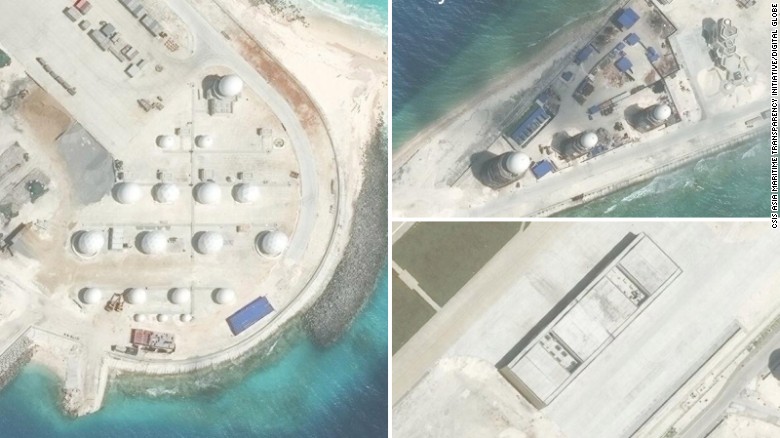
Fiery Cross Reef in the South China Sea last month. China now has the ability to deploy warplanes and mobile missile launchers on several islands in the region.CreditCenter for Strategic and International Studies, via Digital Globe.

BEIJING — South Korea wants to discuss unease about an American antimissile system on its soil. Taiwan is eager to buy weapons. 
The Philippines hopes to find out whether the United States plans to challenge China in the South China Sea.
Leaders across Asia are looking to Washington for guidance on a variety of pressing diplomatic issues.
But Trump’s erratic approach to policy making and his focus on one issue — North Korea’s nuclear weapons program — are creating anxiety and confusion in the region.
In South Korea, Trump has angered the public with several remarks, including his suggestion that the country, an ally for over six decades, pay for an antimissile system built by the Americans to deter North Korea. 
Moon Jae-in, who was elected president on Tuesday, has vowed to seek a more conciliatory approach with the North, setting up a potential rift with American policy.
In other parts of Asia, including the Philippines, Taiwan and Vietnam, Trump’s willingness to bend to China is fueling worries that the United States will stop trying to counter China’s growing influence in the region.
Washington has been the main critic of China’s efforts to build fortresses atop reefs, rocks and islands in the South China Sea. 
But the Trump administration, wary of angering Beijing, recently decided to suspend patrols of islands and reefs claimed by China. 
“The South China Sea is now China’s lake,” said Carlyle A. Thayer, an emeritus professor at the University of New South Wales in Australia.
Trump’s credibility among Asian allies is now at stake.
He may jeopardize longtime economic and security alliances if he does not show a willingness to look beyond North Korea.
Trump also risks pushing countries in the region closer to Beijing if he does not demonstrate that the United States intends to vigorously challenge China’s territorial claims in the sea.
Trump's lack of assurances to Asian allies and his efforts to please China have created the appearance that his foreign policy is negotiable.

Rex W. Tillerson, center, with Southeast Asian foreign ministers in Washington last week. He has tried to reassure allies that freedom-of-navigation patrols will continue.

Antonio T. Carpio, a Supreme Court justice in the Philippines, said he understood Trump’s focus on North Korea. 
But he said he worried about the “permanent concessions China extracts from Trump.
“Trump’s emerging transactional foreign policy is not reassuring,” he wrote in an email.
South Korea represents one of the more serious rifts that Trump will confront. 
Mr. Moon rose to power by vowing a conciliatory approach to North Korea, saying efforts by the United States and others to impose strict sanctions had fallen short. 
Trump favors applying maximum pressure on Mr. Kim’s government.
In Taiwan, officials worry that the Trump administration may delay arms sales, including F-35 stealth fighter jets, for fear of inflaming tensions with China. 
China considers Taiwan part of is territory, and it has repeatedly warned the United States against selling weapons to the island.
Trump has already shown a willingness to use Taiwan as a bargaining chip with China. 
Before he took office, he publicly questioned whether the United States should uphold the “One China” policy. 
But he later backed down, apparently in an effort to curry favor with Xi Jinping.
China has used Trump’s first few months in office to reinforce its position in the sea, a vast waterway through which over $5 trillion in trade passes each year. 
China says historical maps show it owns virtually the entire sea, despite overlapping claims by several smaller countries, including Indonesia, the Philippines and Vietnam.
China now has the ability to deploy warplanes and mobile missile launchers on several islands, according to satellite images provided by the Center for Strategic and International Studies in Washington. 
It has recently put the finishing touches on airport hangars and radar systems.
Trump’s young administration has sent mixed signals on how it will approach the dispute. 
During the campaign, Trump criticized China’s actions in the sea. 
Secretary of State Rex W. Tillerson has suggested that China should be denied access to the islands it built.
But The New York Times reported last week that top Pentagon officials recently turned down a request for an American warship to sail within 12 nautical miles of Scarborough Shoal, a disputed reef claimed by the Philippines and China.

Aboard the guided-missile cruiser Chancellorsville in the South China Sea last year. The Pentagon recently rejected a request for an American warship to sail near a reef claimed by both the Philippines and China.

Cheng Xiaohe, an associate professor of international studies at Renmin University in Beijing, said the Trump administration’s decision to halt patrols would send a message that “China’s claims in the sea should be respected and the United States will not challenge that.”
Other countries that claim territory in the sea disagree. 
Many see it as a patriotic mission to defend territory there against China, and they have grown angry over frequent confrontations with Chinese ships.
Diplomats in the region saw hope in President Barack Obama’s talk of sending more American military and economic resources to Asia. 
But they were disappointed as China’s building projects continued unabated.
Trump’s tough talk on China promised a fresh start. 
Tillerson went as far as to say during his confirmation hearing that China’s island-building in the South China Sea was “akin to Russia’s taking of Crimea” and pledged to block access to the islands.
But the administration has yet to follow through. 
And power dynamics are quickly shifting, with the Philippines, once one of America’s strongest allies in the region, publicly distancing itself from the United States and embracing China.
Trump’s credibility in the region has also been hurt by his decision to abandon the Trans-Pacific Partnership, a trade pact that was expected to have significant benefits for Southeast Asia.
China, on the other hand, has promised to double down on its investment in the region. 
“China sees a golden opportunity to step into the vacuum of leadership in the region,” said Alexander L. Vuving, a professor at the Daniel K. Inouye Asia-Pacific Center for Security Studies in Honolulu.

jeudi 4 mai 2017

The Manchurian President

US is steering clear of South China Sea: Since Trump took power, no freedom of navigation exercises have taken place
By Barbara Starr and Ben Westcott
Donald Trump
The Trump administration appears to be easing up on Beijing in the South China Sea, in what is being seen as another concession to China by the new US president who hopes for a solution in North Korea.
Since Trump took office, the sole request by US military to sail a warship close to artificial islands China has built in the contested waters has been turned down by the Pentagon, a senior defense official told CNN Wednesday.
Freedom of navigation operations in the South China Sea were regularly authorized by the Obama administration, with US navy vessels sailing within 12 nautical miles of China's artificial islands at least three times in the past year-and-a-half.
The official said the denial -- first reported by the New York Times -- was partly due to an effort inside the Pentagon to turn down the temperature of operations that could be viewed as antagonizing China or North Korea.
Analysts say it's the latest in a series of efforts by Trump to appease China.
China has described the operations as a serious breach of law and an intentional provocation.

Trump backs down on China

The last publicly announced freedom of navigation operation was in October 2016, four months before Trump took power.
Prior to his inauguration, Trump's point man on foreign policy promised stern action in the South China Sea against China's island building and militarization.

South China Sea: Aircraft hangars, radar installed on artificial islands

At his confirmation hearing, US Secretary of State Rex Tillerson said the Trump administration might take a more aggressive approach to the South China Sea.
"Building islands and then putting military assets on those islands is akin to Russia's taking of Crimea. It's taking of territory that others lay claim to," Tillerson said in January.
He even hinted that Chinese access to the artificial islands could be restricted by US vessels.
But as relations between Trump and Xi Jinping have improved, the South China Sea has fallen out of the spotlight.
Trump backed down on his pledge to label China as a currency manipulator on his first day in office, while early in his presidency he quickly agreed to honor the "one China" policy which Beijing considers a necessity.
In the past week, Trump even said he'd call Xi for permission before he spoke to Taiwan's leader over the phone again.

Ceding to China
Mike Chinoy, non-resident senior fellow at the University of Southern California's US China Institute, told CNN that Beijing would be thrilled by the administration's decision to hold off testing China in the South China Sea.
"I think if you're sitting in Beijing you have to be very pleased that Donald Trump is in the White House because he is ceding to China a great deal in terms of clout and advantage," Chinoy said.
"In the meantime, countries in Asia that have wanted substantial American presence to counterbalance the growing clout of China ... are going to calculate that they can't count on the US in the way they did before."
The recalculation has already started for some countries.

At the Association of Southeast Asian Nations (ASEAN) leader summit in Manila in April, China scored a major victory when the joint statement seriously watered down the denunciation of its island-building in the South China Sea.
"ASEAN cannot maintain its position in dealing with China... unless the pressure is on China by the maritime powers," Carl Thayer, regional security analyst and emeritus professor at the University of New South Wales, told CNN.
Pentagon spokesman Capt. Jeff Davis told CNN Wednesday that US forces operated in the Asia-Pacific region on a daily basis, "including in the South China Sea."
"All operations are conducted in accordance with international law and demonstrate that the United States will fly, sail, and operate wherever international law allows," he said.
The Pentagon said the US military will continue with regular freedom of navigation operations but in the future Davis said "these operations will be released publicly in the annual FONOPS report, and not sooner."
This would mark a significant change from the Obama administration which publicly discussed South China Sea operations on a routine basis.

mercredi 3 mai 2017

The Manchurian President

Trump’s Turn Toward China Curtails Navy Patrols in Disputed Zones
By HELENE COOPER

The Chancellorsville, a United States guided missile cruiser, in the Luzon Strait after a patrol of the South China Sea last year. 

WASHINGTON — Six weeks ago, the United States Pacific Command requested permission from senior American officials for a United States warship to sail within 12 nautical miles of Scarborough Shoal, a disputed reef in the South China Sea that is claimed by the Philippines and China.
The Navy had good reason to think the request would be granted. 
During last year’s campaign, Donald J. Trump labeled President Barack Obama as weak in defending international waters in the South China Sea, where Beijing has started a sharp military buildup to reclaim land, install runways and haul equipment onto reefs and shoals it claims as its own. 
Secretary of State Rex W. Tillerson, during his confirmation hearing in January, called for China to be denied access to the artificial islands. 
And foreign policy experts and Asia watchers braced for a return to routine Navy patrols within China’s self-proclaimed territorial waters, something Mr. Obama allowed sparingly.
But instead, the Pacific Command request — and two others by the Navy in February — was turned down by top Pentagon officials before it even made it to Trump’s desk. 
More than 100 days into the Trump presidency, no American Navy ship has gone within 12 miles of any of the disputed islands in the South China Sea, Defense Department officials said.
The decision not to challenge China’s territorial claims represents a remarkable deference toward Beijing from an administration that is increasingly turning toward Xi Jinping for help amid the crisis in the Korean Peninsula. 
It remained unclear on Tuesday whether it was Defense Secretary Jim Mattis; Gen. Joseph F. Dunford Jr., the chairman of the Joint Chiefs of Staff; or one of their deputies who turned down the three requests. 
Defense officials said the White House was not involved.
Robert Daly, the director of the Kissinger Institute on China and the United States at the Wilson Center, said of the Navy excursions, officially known as freedom of navigation operations, or Fonops: “All of the language, combined with the fact that the Republican foreign policy establishment had been critical of Obama for not carrying out enough Fonops, means there was a wide expectation that Trump would put down a marker early. And that hasn’t happened.”
The simmering crisis in North Korea seems to have changed the Trump administration’s earlier assumptions on how to handle China. 
Trump campaigned on being tough on Beijing, promising that he would label China a currency manipulator and would go after Beijing on trade.
But with North Korea escalating its provocative behavior the past three months, attempting nine missile launches on six occasions since Trump came to power, his administration has adopted a conciliatory air with Beijing as Trump seeks help to rein in Pyongyang.
With each missile launch, Trump’s newfound affection for the Chinese leader, Mr. Xi, has increased. Last week, after the most recent launch, Trump wrote on Twitter: “North Korea disrespected the wishes of China and its highly respected president when it launched, though unsuccessfully, a missile today. Bad!”
Decisions to deny the Navy’s requests to sail within 12 nautical miles of disputed islands in the South China Sea were fairly routine during the Obama administration. 
In fact, Mr. Obama came under sharp criticism from Republicans for suspending such excursions for more than two years, out of concern that they would further raise tensions with Beijing.
In October 2015, the Obama administration sent a guided missile destroyer, the Lassen, within territorial waters near Subi Reef, one of several artificial islands that China has built in the disputed Spratly Islands chain. 
At the time, Mr. Obama’s White House played down the episode and directed Defense Department officials not to talk about it publicly, wanting to avoid escalating a conflict.
Such hesitancy prompted harsh words from Trump during the presidential campaign. 
In an interview with The New York Times in March 2016, Trump said that Beijing had built in the South China Sea “a military fortress, the likes of which perhaps the world has not seen.”
“Amazing, actually,” he said. 
“They do that at will because they have no respect for our president and they have no respect for our country.”
Tillerson came to office saying that China’s island-building campaign was “akin to Russia’s taking of Crimea.” 
He said that the Trump administration was “going to have to send China a clear signal that, first, the island-building stops” and, “second, your access to those islands also is not going to be allowed.”
That denial of access is now on the back burner. 
In fact, said Mr. Daly, of the Wilson Center, China has continued to militarize the islands and has bomb-proofed airplane hangars that were built on the reclaimed islands, as well as brought in additional equipment.
Chinese officials have maintained that such action does not constitute militarizing the islands. 
They say the islands are Chinese territory and Beijing therefore cannot militarize land it already owns. 
The United States and other countries disagree.
The Chinese have not yet begun construction on Scarborough Shoal. 
American officials have long viewed doing so as something of a red line, and have cautioned Chinese counterparts that any building on the shoal would be viewed as provocative.
Mr. Obama warned Mr. Xi at a March 2016 meeting in Washington not to start building an island at Scarborough Shoal. 
Late last year, an unusually large number of Chinese vessels were positioned close to the disputed reef, renewing American concerns.
A Defense Department official described the Pacific Command request last month to conduct a naval excursion within 12 nautical miles of Scarborough Shoal as a signal to the Chinese that building on the atoll remained a red line for the United States. 
The official, who spoke on condition of anonymity to discuss sensitive operations more frankly, added that Navy officials believed the request to be in line with what the Trump administration wanted.
But Defense Department officials also said that Mattis and the Pentagon leadership wanted to look carefully at the strategic implications of such excursions on overall national security policy. 
While Mattis is far from opposed to the freedom of navigation trips, he is reviewing the American security posture around the world, Defense Department officials said.
Additionally, Washington’s hope that China will rein in North Korea has called into question the timing of the next freedom of navigation sail.

samedi 22 avril 2017

The Manchurian President

Is Trump On China's Payroll? If So, Impeach Him
By Anders Corr

Wednesday brought a wave of news about Trump’s increasingly cozy relationship with China, including on his indirect financial connections. 
The press digested, uncomfortably, Trump’s claim that Korea actually used to be a part of China.” 
He repeated that Chinese propaganda to the press after he got it direct from Xi Jinping. 
Also Wednesday, reports revealed that Sheldon Adelson, the billionaire gambling boss with casinos in Macao, China, gave $5 million to Trump’s inaugural committee. 
This is the largest single gift ever given for a U.S. president’s inauguration. 
Journalist Matt Isaacs has asked, “Is dirty money spent by corrupt Chinese officials at Macau casinos flowing into our elections, at least indirectly? ” 
The mix of Chinese money and Trump’s softening on China is worrisome, and if a causal relationship can be proved, Trump should be impeached. 
He isn’t good for the Republican Party, and the Democrats will oblige.
Frames of Xi Jinping, Donald Trump and Vladimir Putin are display in a photo shop in Beijing on April 17, 2017. 

Trump’s administration is softening on China’s ally North Korea, and according to experts, might accept a freeze on North Korea’s nuclear weapons development, rather than an outright ban. 
That would be no real change, as North Korea’s decades-long pattern of playing the U.S. is oscillation between promises of a freeze, and breaking those promises. 
Trump’s phantom aircraft carrier strike group supposedly steaming toward North Korea didn’t help. 
Since Mar-a-Lago, Trump has had mostly good things to say about China. 
He seems to have forgotten that China is sacking U.S. technology to build its military, and the military of North Korea that now threatens us.
Trump’s offer to give China a good economic deal if China helps with North Korea is a chump deal, and we are the chumps. 
It will not be popular with Republican voters. 
It rewards China for the threat China created. 
Rather, Republicans should hold China responsible for anything North Korea does, including nuclear strikes. 
Trump should demand of China that it start acting responsibly and uphold the international laws to which it, and its allies, are already bound. 
Trump should call China’s bluff. 
No more Mr. Nice Guy. 
Obama tried that, and it failed.
But Trump has become the quintessential Mr. Nice to China. 
He doesn’t seem to notice that countries like the Philippines and Vietnam, since Trump’s election, are getting increasingly authoritarian. 
That President Duterte of the Philippines, whose drug war has been responsible for up to 6,000 extrajudicial killings, likens himself to President Trump, should be a warning signal. 
An impeachment complaint has been filed against Duterte, who is under China’s influence
Trump’s fate could be the same.

Trump was sitting pretty at Mar-a-Lago with Xi earlier this month. 
Like Duterte, Trump did not appear to care much about China’s human rights abuse or lack of democracy. 
“Donald Trump’s first meeting with Xi Jinping was all about business,” declared the Economist.
Let’s face it. 
Trump is soft on China. 
Trump denied it on April 18, four days after press reports that he was getting chummy with pro-China business interests, including Boeing
But 55 percent of voters in a February poll doubted his honesty. 
The Trump family business connections to China exploded shortly after his election. 
Trump’s son-in-law, Jared Kushner, almost sealed a $400 million deal with a Chinese company for investment into a New York property. 
This was mixed with Kushner’s back-channel political deals with China’s Ambassador to the U.S.

After the election, Trump met with Alibaba’s Jack Ma and Henry Kissinger, who has taken a consistently pro-China stand and has served as a liaison between China and international business interests. 
All that business talk seems to have had an effect. 
Trump flip-flopped on calling China a currency manipulator, and on the One-China policy. 
Rex Tillerson’s proposed blockade of China’s militarized South China Sea artificial islands was toned down and now seems forgotten.
To ice the cake, on Wednesday China’s Foreign Ministry jumped to defend China’s speedy granting of trademarks to Ivanka Trump. 
She got them on the day she sat at dinner with Xi. 
Donald Trump, too, got his brands trademarked in China shortly after the election. 
That’s all worth money, and it raises a question. 
Is China trying to put Trump on its payroll, even indirectly? 
If China succeeds, the American people are getting reamed and should fight back hard. 
This includes impeachment.
Sadly, the swamp has come to Washington like never before, and Trump appears to be the blond creature most at home in its increasingly surreal waters. 
It is not a run-of-the-mill, money-green swamp. 
It could be a red tide. 
We need a Constitutional Amendment and a new set of tough laws that will keep money and foreigners out of U.S. politics, before foreigners start running the show. 
This especially applies to Russia and China.
Vice President Mike Pence is a clean Republican who would make a great President, and could get elected for two more terms. 
He could pardon Trump, who would return to cable with better ratings, and more Twitter followers, than ever. 
Except for Xi, that’s a win-win outcome for all.

mercredi 19 octobre 2016

The Manchurian President

“I am Chinese”: Rodrigo Duterte explained the Philippines’ shift in the South China Sea to China’s CCTV
By Echo Huang Yinyin and sabella Steger
Homecoming. 

Rodrigo Duterte, Beijing’s new best friend, has swiftly pivoted away from the US and into China’s arms, and arrived in Beijing today for a high-profile visit where he’s promised to improve economic and diplomatic ties between the two countries.
Since he was elected little over 100 days ago, Duterte has trashed the US and played up links between the Philippines and China, even repeatedly bringing up the fact that he has a Chinese grandfather who came from Xiamen.
In a 20-minute interview broadcast by Chinese state broadcaster CCTV on Oct. 18 (though it was recorded in Manila on Oct. 13), Duterte and host Shui Junyi discussed a range of issues, but the interview was dominated by the two countries’ territorial dispute in the South China Sea and Manila’s about-face over the dispute.
Duterte’s predecessor, Benigno Aquino III, challenged Beijing’s aggression in the South China Sea in an international tribunal and won, with a July 12 ruling by the Permanent Court of Arbitration in the Hague invalidating China’s sweeping maritime claims
It was a huge victory for the Philippines and supported by Western allies like the US and Australia, but Duterte seems uninterested in using the result to rally international pressure against China—despite once vowing to ride into the South China Sea on a jet ski while waving the Philippine flag.
“I am Chinese.”

In the CCTV interview, Duterte maintained that he wasn’t “breaking away” from the US, but that he was merely being “pragmatic” and wants to be “friends with everybody.” 
On the Hague tribunal he said, “if it costs a third world war, what might be the point of insisting on the ownership of the waters? It does not bring prosperity.”
Ahead of his visit, Duterte played down the dispute over fishing rights in the South China Sea with China, pledging instead to only discuss trade issues. 
Reuters reported Wednesday, however, that Beijing is considering granting conditional fishing rights to the Philippines in Scarborough Shoal, which China seized from the Southeast Asian country in 2012.
“Someday, the South China Sea will just be what, China Sea?… 100 years from now, [the South China Sea] might be meaningless… the ocean cannot feed…[the] human race,” Duterte told CCTV. “Your fish is my fish. We will talk, we will resolve, it is not the time to go to war.”
Shui asked how sincere his new diplomatic approach was, to which Duterte responded: “Maybe because I am Chinese and I believe in sincerity.” 
He added that one quarter of the Philippine population is of Chinese descent, and that at a recent business forum, “everybody [was] shouting” to accompany him to China.