Affichage des articles dont le libellé est El Salvador. Afficher tous les articles

lundi 10 septembre 2018

Chinese Peril

U.S. Recalls Top Diplomats From Latin America as Worries Rise Over China’s Influence
By Edward Wong
Jean Manes, ambassador to El Salvador, is one of three diplomats in Latin America who have been recalled to Washington.

WASHINGTON — The United States has recalled three chiefs of mission from Latin American nations that cut diplomatic ties with Taiwan in favor of recognizing China.
The move comes as American officials have expressed growing unease over China’s rising influence in the region.
The diplomats, who represent the United States in the Dominican Republic, El Salvador and Panama, will meet with leaders in Washington “to discuss ways in which the United States can support strong, independent, democratic institutions throughout Central America and the Caribbean,” a spokeswoman for the State Department, Heather Nauert, said in a written statement on Friday.
For decades, Taiwan and China have competed for recognition. 
In 1979, the United States switched its support and officially established sovereign relations with China, and many other countries followed. 
But Washington has supported any decisions by nations to continue recognizing Taiwan, a self-governing island that China wants to bring under Communist Party rule.
In recent years, China has had success in courting Taiwan’s diplomatic partners. 
Only 17 nations recognize Taiwan; outside the Vatican and Swaziland, they are all islands in the Pacific and the Caribbean or countries in Latin America.
American officials have expressed growing concern over the shift. 
The United States sells arms to Taiwan and maintains a diplomatic presence there, called the American Institute in Taiwan, now housed in a new $250 million compound. 
American officials see Taiwan’s de facto independence as an important hedge against Chinese dominance in the Asia-Pacific region — what the United States now calls the Indo-Pacific as it tries to strengthen ties with South Asian nations to balance against China.
Last month, El Salvador severed ties with Taiwan, prompting the White House to accuse China of “apparent interference” in El Salvador’s domestic politics. 
American officials fear that the four nations in Central America that still recognize Taiwan — Belize, Guatemala, Honduras and Nicaragua — could soon follow. 
Last May, Burkina Faso switched recognition to China, leaving Swaziland as the lone holdout in Africa.
In June 2017, Panama cut ties with Taiwan, which surprised the United States government. 
The American ambassador to Panama at the time, John Feeley, said he learned about the switch from the president, Juan Carlos Varela, only an hour or so before Varela announced it, and only because he had called Varela to discuss an unrelated matter.
Mr. Feeley, who left his post in March and is now a consultant for Univision, said in an interview on Saturday that the recall of top American diplomats was significant.
The diplomats returning to Washington are Robin Bernstein, ambassador to the Dominican Republic; Jean Manes, ambassador to El Salvador; and Roxanne Cabral, the chargé d’affaires in Panama. 
A State Department official said they would return to their posts by Sept. 14.
Wang Yi, center, China’s foreign minister, and Hugo Martinez, right, El Salvador’s foreign minister, at a conference in Santiago, Chile. Last month, El Salvador severed diplomatic ties with Taiwan in favor of recognizing China.

The move “is an appropriate and serious signal by the U.S. government to those three countries and to the Chinese government that it is now reviewing the implications of the diplomatic switch and is worried that U.S. interests could be jeopardized,” Mr. Feeley said.
“My sense is that they will be most focused on the issue of industrial and commercial espionage and the possibility of Beijing using its embassies to expand that activity in those countries and the Caribbean Basin,” he added.
China is now the world’s second-largest economy and is expected to overtake the United States as the largest one in 10 to 15 years.
It is difficult for any nation, especially a small one, to decide not to recognize the sovereignty of China.
China and Taiwan have long engaged in what some observers call “checkbook diplomacy” to woo countries by offering aid or other incentives. 
China’s financial packages have increased in recent years, especially as it has promoted infrastructure projects abroad and related loans and contracts as part of what it calls its Belt and Road Initiative.
Jorge Guajardo, a former Mexican ambassador to China, said on Saturday that the recall was “heavy handed.” 
The United States should not be surprised as Latin American governments push back against American requests, he added, when President Trump has continued to alienate the people of Latin America.
“Trump has openly and systematically offended Latin American countries and their people,” Mr. Guajardo wrote in an email. 
“He labels us as rapists and criminals, has never traveled to the region as president, has deported and separated families, and threatened to cut all sort of aid. China comes with an offer of friendship and economic development (albeit one that I don’t think will pan out). Why the surprise?”
The United States has yet to fill some ambassador posts in the region, including those in Mexico and Panama, Mr. Guajardo noted, whereas China has assigned ambassadors in all Latin American nations with which it has diplomatic relations.
“Save a few countries in Latin America, the region as a whole has a historical preference for the U.S. as the main ally,” he said.
“This changed when Trump assumed the presidency. It was his call, his choice, to turn away from the region.”
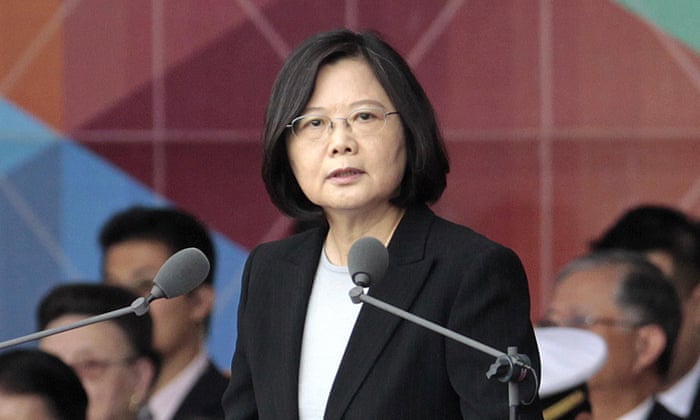
China has grown more strident over the issue of Taiwan since Tsai Ing-wen, a strong critic of Beijing, became president of Taiwan in May 2016. 
Chinese officials have worked to erase any recognition by corporations of Taiwan’s sovereignty. 
For example, they successfully pressured international airlines this summer, including those in the United States, to list just “Taipei,” a city designation, in their booking systems rather than phrases that included “Taiwan,” as was the case for decades.
Last month, Ms. Tsai made state visits to Belize and Paraguay to try to strengthen ties with those nations.

samedi 25 août 2018

White House Criticizes China Over El Salvador Recognition

By Austin Ramzy
El Salvador’s acting foreign minister, Carlos Castaneda, left, and his Chinese counterpart, Wang Yi, at a ceremony in Beijing Tuesday to mark the establishment of diplomatic relations between the two countries.

HONG KONG — The White House on Thursday accused China of “apparent interference” in El Salvador’s domestic politics after the Central American nation established diplomatic ties with Beijing this week.
The statement also sharply criticized El Salvador, saying the United States would re-evaluate its relationship with the country.
The Trump administration’s comments are its strongest pushback to date on China’s efforts to curb the international recognition of Taiwan, the self-ruled democracy Beijing claims as part of its territory. 
They also reflect a growing unease about China’s growing influence in a region where the United States has long been the dominant force.
El Salvador severed ties with Taiwan on Tuesday, leaving Taiwan with just 17 formal diplomatic partners. 
China has stepped up its campaign to woo Taiwan’s diplomatic partners since Tsai Ing-wen was elected Taiwan’s president in 2016, replacing a more pro-Beijing leader.
The White House comments were far sterner than those made by the State Department after other countries in the region, including Panama and the Dominican Republic, switched ties from Taiwan to China.
It accused El Salvador’s government of making the decision, which “affects not just El Salvador, but also the economic health and security of the entire Americas region,” without transparency months before an election.
“The El Salvadoran government’s receptiveness to China’s apparent interference in the domestic politics of a Western Hemisphere country is of grave concern to the United States, and will result in a re-evaluation of our relationship with El Salvador,” it said.
The White House’s toughened its tone toward countries that have shifted recognition from Taiwan to China this summer after Burkina Faso made the switch in May.
“Previously it was unusual for the U.S. government to make such remarks, if for no other reason that the U.S. itself made this switch in 1979,” said Ross Darrell Feingold, a Taipei-based consultant who advises on political risk in Asia.
Taiwan’s embassy in San Salvador. El Salvador’s decision to cut ties leaves the Taipei government with just 17 formal diplomatic partners.
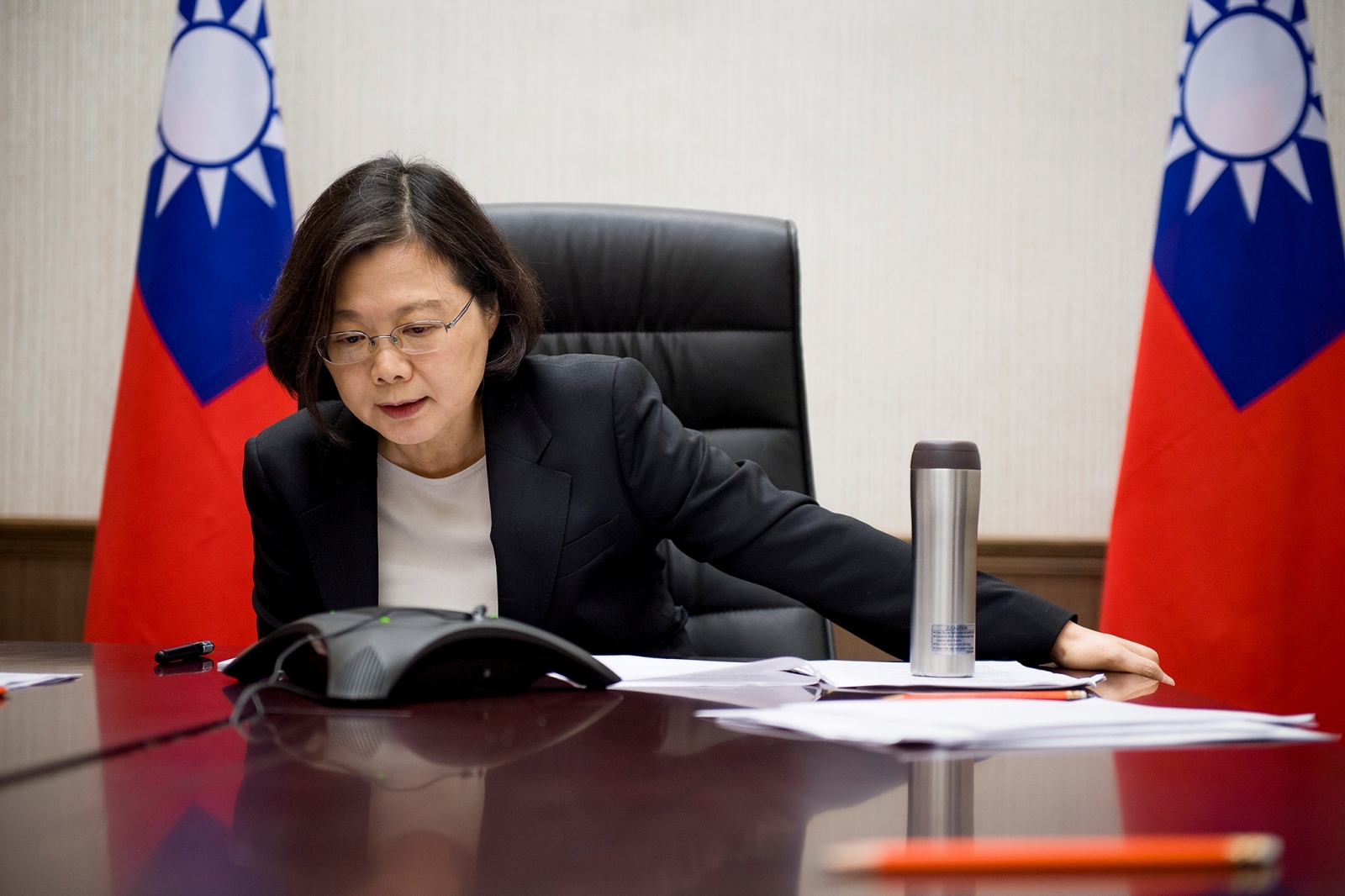
When the United States established formal ties with the People’s Republic of China in 1979, it ceased formal relations with Taiwan. 
But the United States maintains a robust informal relationship with Taiwan, and recently unveiled a $250 million complex in its capital, Taipei, that serves as a de facto embassy.
The stronger U.S. tone likely reflects the influence of John R. Bolton, a staunch Taiwan defender who became President Trump’s national security adviser in April, Mr. Feingold said.
“Bolton has a long record of support for Taiwan, including changes to the traditional approaches to the trilateral U.S.-China-Taiwan relations, so it is no surprise that we are seeing something different by way of a U.S. response to China’s actions that reduce Taiwan’s international space,” he said.
The government of El Salvador, which is led by a party of former leftist guerrillas, has also been a frequent target of Republican critics.
Senator Marco Rubio of Florida said this week that he had spoken with President Trump about ending American aid to El Salvador after it established formal ties with Beijing, and he would join with a fellow Republican, Senator Cory Gardner of Colorado, to carry that out.
Mr. Gardner told Reuters on Thursday that he would introduce legislation that would enable the State Department to use aid and other levers to encourage countries to maintain Taiwan ties.
Mr. Rubio wrote on Twitter that there “would be real consequences in our relationship with #ElSalvador if they broke with #Taiwan in favor of #China. They think we are going to react the same way we did to #Panama & #DominicanRepublic. They are very wrong.”
In January the Trump administration canceled a program that allowed 200,000 Salvadorans to temporarily live in the United States. 
That move prompted criticism that it would destabilize a country struggling with high levels of street crime.
President Trump has shown before that he is willing to shake up the traditional framework of ties between the United States, China and Taiwan. 
In December 2016, before he had assumed office, he took a congratulatory call from President Tsai, breaking with decades of precedent. 
He later said in a phone call with Chinese dictator Xi Jinping, that he would abide by the “One China policy,” under which the United States does not formally recognize the government of Taiwan.
Taiwan’s foreign minister, Joseph Wu, said Friday he was not worried that Taiwan could be used as a pawn of the United States in the current trade dispute with China.
“We understand Washington D.C.’s support of Taiwan continues to be very strong,” Mr. Wu told Bloomberg. 
“Taiwan is a positive element in the U.S. economy and I just don’t worry that Taiwan is going to become a chip to be negotiated with by the U.S.”

samedi 7 janvier 2017

Two Chinas Policy

Taiwan President Tsai Ing-Wen Heads to Americas. 
It should not surprise anyone if President Trump's advisers meet with President Tsai.
By THE ASSOCIATED PRESS

BEIJING — President Tsai Ing-wen pledged to bolster Taiwan's international profile as she set off on a trip to reinforce relations with diplomatic allies in Central America, a task that has taken on new urgency as Beijing ramps up efforts to diplomatically isolate Taipei.
Speaking to reporters before her departure, Tsai said the visits to Honduras, Nicaragua, Guatemala and El Salvador would "show the international society that Taiwan is a capable and responsible partner for cooperation."
She will transit through Houston and San Francisco.
Beijing regards the self-governing island as part of China and officials complained after President Donald Trump last month spoke by phone with the Taiwanese leader. 
Trump raised further concerns in Beijing when he questioned a U.S. policy that since 1979 has recognized Beijing as China's government and maintains only unofficial relations with Taiwan.
U.S. lawmakers often meet with Taiwanese presidents when they transit through the U.S. — most recently in June, when Tsai met in Miami with Republican Sen. Marco Rubio of Florida.
This time, it was not clear if Tsai would meet Trump, though some observers said a meeting with Trump's transition team could happen.
"It should not surprise anyone if the president's advisers who will be working on Asia policy meet with President Tsai," said Ross Feingold, a Taipei-based senior adviser at D.C. International Advisory, a consulting firm whose chief executive has been consulted by the Trump transition team.
"China might issue its usual statements of displeasure ... but it really doesn't depart from precedent," Feingold said. 
"A meeting with Trump would be the biggest precedent changer."
Regardless, Tsai is likely to keep the U.S. stops low-key to avoid further inflaming tensions with China, which has been angered by Tsai's refusal to endorse Beijing's concept that Taiwan and the mainland are part of a single China. 
In late December, in what Beijing called routine exercises, China's first and only aircraft carrier and a fleet of warships sailed past Taiwan's south, prompting Taipei to deploy fighter jets to monitor the fleet.
In Central America, Tsai will focus on strengthening ties with allies to fend off Beijing's efforts to draw governments away from Taipei and further diminish its global presence. 
Beijing and Taipei have competed for allies for much of the nearly seven decades since the end of China's civil war in 1949, when the defeated Nationalist government fled across the Taiwan Strait.
Tsai, who is leading a delegation of 120 people, will meet with most of the four countries' leaders and attend the inauguration of Nicaraguan President Daniel Ortega. 
She said she would also interact with the heads of state of other countries at the inauguration.
Beijing has intervened to prevent the island's participation in international forums and established diplomatic relations with former Taipei allies Gambia and Sao Tome and Principe. 
The moves have been seen as effectively abandoning the unspoken diplomatic truce that lasted eight years under Tsai's China-friendly predecessor. 
Just 21 countries and governments, mostly in Latin America and the Caribbean, now have official ties with Taipei.
Observers were watching to see if any of the four Central American nations might defect despite Tsai's efforts, but say stronger U.S. support under Trump's administration would help balance future diplomatic losses.
"We should expect that in the Trump administration the U.S. would be more vociferous and emphatic about Taiwan's participation in international organizations," Feingold said.
Washington remains Taiwan's main source of weapons, with $14 billion in approved arms sales since 2009, and is bound by law to consider threats to the island's security a matter of "grave concern."
If Beijing aggressively pursues existing Taipei allies, leveraging its growing economic, military and political clout, the competition could prove too expensive for Taipei and prompt Tsai to seek even deeper ties with the U.S.
"She may think now that it's America or bust," said Sean King, a Taipei-based senior vice president at consulting firm Park Strategies. 
"She's probably going to lose these peripheral countries eventually anyway, so why not go for the gusto and get as close to the U.S. while she can?"

samedi 31 décembre 2016

Beijing Pathetic Monologue: China repeats call to block President Tsai's transit in US.

Tsai Ing-wen will visit Houston and San Francisco on her way to and from Latin America
By Nandini Krishnamoorthy
Taiwan's President Tsai Ing-wen (pictured speaking to US President Donald Trump at her office in Taipei, Taiwan) might meet Trump in January during her trip to three Central American nations
Taiwan announced its President Tsai Ing-wen's itinerary for US where she will transit through Houston and San Francisco on her way to visit allies in Latin America in January, her office said on Friday (30 December). 
The announcement has prompted Beijing to repeat calls to the US to block Tsai's stopover.
Tsai will arrive in Houston on 7 January and leave the following day. 
On her way back, after visiting Honduras, Nicaragua, Guatemala and El Salvador, she will visit San Francisco on 13 January, presidential office spokesman Alex Huang told daily news briefing.
Tsai's office denied commenting on whether she would be meeting President Donald Trump's transition team while she is in the US. 
However, the US mission in the self-governing island, the American Institute in Taiwan (AIT), said her visit would be "private and unofficial".
"President Tsai's transit through the United States is based on long-standing US practice and is consistent with the unofficial nature of our relations with Taiwan," Alys Spensley, acting AIT spokeswoman, told Reuters.
The already troubled China-US ties were further strained following Tsai's phone call to Trump earlier this month that resulted in Beijing in casting doubt on the incoming president and his administration's commitment to 'one China' principle.
China's Foreign Ministry repeated calls to stop Tsai from transiting through America and warned the US to not send any "wrong signals to Taiwan independence forces".
"We think everyone is very clear on her real intentions," Reuters cited the ministry as saying, without explaining.
Speaking to the members of parliament on Friday (30 December), Xi Jinping stressed the communist country would make "unremitting efforts" at unification and development of peaceful ties across the Taiwan Strait, Xinhua news agency reported.
Meanwhile, Tsai assured on Saturday (31 December) that her country will remain "calm" when dealing with issues concerning China, however, she warned of uncertainties in 2017 that could test Taiwan's national security team.

jeudi 29 décembre 2016

President Tsai Ing-wen to stop in U.S. en route to countries in Central America

Routine trip has taken on significance after Trump call
By Adela Lin and Ting Shi

Taiwan President Tsai Ing-wen will transit through the U.S. en route to Central America next month, a routine stopover that has taken on added significance after President Donald Trump spoke with her by phone and separately questioned the One-China policy.
Tsai’s office will unveil the details of her U.S. stops at a later date, Foreign Ministry spokeswoman Eleanor Wang said in a text message. 
Her Jan. 7-15 trip announced last week to Honduras, Nicaragua, Guatemala and El Salvador will “boost cooperation and deepen friendship” with Taiwan’s Central American allies, Wang said.
While the ministry had said previously that Tsai wouldn’t transit in New York and won’t meet Trump, the stopover risks further tensions between the U.S. and China ahead of Trump’s inauguration. 
Trump has already signaled a more antagonistic approach to China as president, with the self-governing island potentially becoming one of the biggest flash points between the two global powers.
“Supporters of Taiwan and critics of China in the U.S. will obviously welcome this move as not bowing to Chinese pressure,” said Ja Ian Chong, an assistant professor with the National University of Singapore who specializes in Asia-Pacific relations. 
“This could set the tone for an even more contentious and tumultuous U.S.-China relationship.”
Ma Ying-jeou, Tsai’s predecessor, transited in Houston and Los Angeles during a March trip to Central America. 
Tsai’s trip comes at a particularly sensitive time after Trump angered Beijing in accepting the phone call from the Taiwanese president.
The 10-minute conversation on Dec. 2 was the closest a Taiwanese leader has come to getting formal recognition from Washington since the U.S. established ties with the Communist government in Beijing almost four decades ago.

jeudi 22 décembre 2016

Two Chinas Policy

Taiwan's president to visit US: Tsai Ing-wen may meet Donald Trump in person
By Simon Tisdall

President Tsai Ing-wen. Taiwan has been self-governing and de facto independent since the end of China’s civil war.

Taiwan’s president is planning to meet members of Congress next month during a stopover visit to the US that will go ahead despite strong Chinese government objections, a senior Taiwanese official has said.
China tried to block the visit by President Tsai Ing-wen in the wake of a row over pro-Taiwan comments by president Donald Trump who also held an unprecedented phone conversation with the Taiwan leader.
The visit has caused speculation in Washington and Taiwan that Tsai may meet Trump in person during a nine-day trip that begins on 7 January and includes brief state visits to Honduras, Nicaragua, Guatemala and El Salvador.
Speaking to the Taiwan legislature’s foreign and national defence committee, Javier Hou, deputy foreign minister, said Tsai’s planned stopover in the US would be made in accordance with past practice.
The foreign ministry was seeking to arrange for Tsai to meet members of the US Senate and House of Representatives, Hou said. 
The exact locations of the meetings, and the duration of the stopover, have yet to be announced. Trump’s transition HQ is in New York.
Trump infuriated China’s leadership when he spoke to Tsai on the phone and later made separate comments questioning the longstanding “one China” policy, under which the US notionally accepts Beijing’s view that Taiwan is part of China. 
The US does not officially host Taiwanese leaders.
Taiwan has been self-governing and de facto independent since the end of China’s civil war. 
Beijing regards it as a renegade province.
Alex Huang, spokesman for Taiwan’s presidential office, denied that the planning or disclosure of the transit stops were being delayed due to pressure from China. 
“There is no problem of that kind,” Huang said.
But China this week reiterated its strong objection to Tsai and her 90-strong government delegation touching down on US soil, claiming that allowing her to do so would “send wrong signals to Taiwan independence forces”.
Hua Chunying, China’s foreign ministry spokeswoman, suggested that Tsai, whose ruling Democratic Progressive party is viewed with deep suspicion in Beijing, would use the trip to rally diplomatic and political opposition to China.
“As for the question of the leader of the Taiwan region possibly transiting the United States, I think her real aim needs no explanation,” Hua said.

Any meeting between Tsai and Trump would be politically explosive, coming so close to Trump’s inauguration on 20 January. 
It would probably exacerbate tensions caused by the president’s blunt criticisms of Chinese trade policy, military activity in the South China Sea, and recent seizure of a US underwater research drone.
Tensions have also been stoked by this week’s decision by the indebted west African country, São Tomé and Príncipe, to break off ties with Taiwan and align itself with China. 
Taiwanese MPs said China was using “dollar diplomacy” to further isolate the island.
Beijing has gradually been chipping away at Taiwan’s overseas relationships. 
It consistently opposes Taiwanese membership of international forums. 
After losing São Tomé and Príncipe, Taiwan has formal diplomatic relations with 20 countries and the Holy See remaining, mostly small countries that look to it for development aid.
Tsai appealed for unity this week at a closed-doors meeting of her ruling DPP. 
“At a time of change, national solidarity across party lines is increasingly needed to fight against foreign forces,” a party spokesman, Yang Chia-liang, quoted Tsai as saying. 
“China has never stopped suppressing Taiwan’s international participation and diplomatic efforts.”