Affichage des articles dont le libellé est arbitrary detention. Afficher tous les articles

mercredi 6 mars 2019

China's Final Solution

UN religious freedom expert requests visit to East Turkestan
Reuters
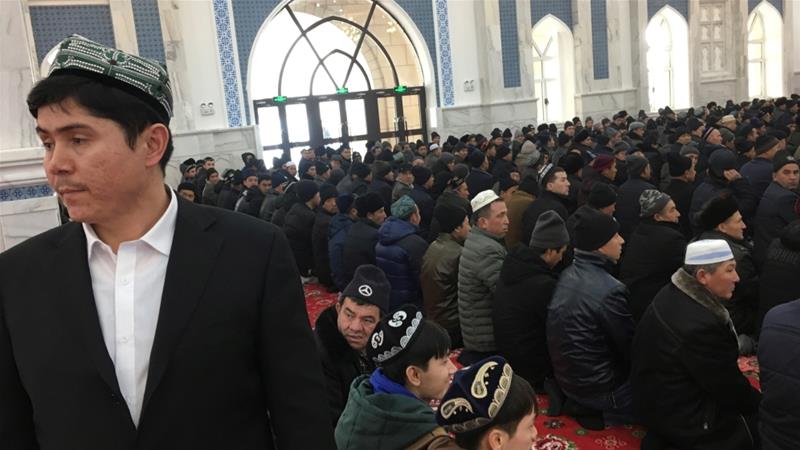
Men pray at a mosque at the East Turkestan Islamic Institute during a government organised trip in Urumqi 

The United Nations investigator for religious freedom has asked China to let him visit its East Turkestan colony where some one million ethnic Uighurs and other Muslims are being kept in concentration camps.
Facing growing international opprobrium for what it calls "re-education and training centres", China has stepped up diplomatic efforts to fend off censure.
Defending its programme in the remote western region, China told diplomats recently that "absurd preachings" from "Islamist extremists" there had turned some people into "murderous devils".
"I have requested for a visit to go there because this a priority for me in terms of looking at what is happening there. There is reason to be seriously concerned about reports coming out of the East Turkestan colony," UN special rapporteur Ahmed Shaheed told a news briefing on Tuesday.
China has not yet replied to his February request, he said.
Shaheed, a former Maldives foreign minister, disclosed he was among several UN rights experts to write to China last November voicing anxiety at its programme targeting "extremism".
The letter is also signed by UN investigators on arbitrary detention, disappearances, freedom of expression, minority issues, and protecting rights while countering "terrorism".
"I wrote to China along with a couple of other rapporteurs on the 'de-extremification' law that they are implementing which has resulted in millions being interned," Shaheed said.
"The concerns we raised were first of all that the laws were overly broadly worded and were targeting essentially protected activities of communities, in terms of their right to thought, conscience and belief. So a whole range of violations occurring in these communities," he said.

Deaths in custody
The UN letter voices concern that China's regulation "targets Turkic Muslim ethnic, linguistic and religious minorities as well as Kazakh nationals" within a context of a "crackdown on the exercise of fundamental rights in East Turkestan".
It calls on Beijing to repeal the measure.
"There have been allegations of deaths in custody, physical and psychological abuse and torture, as well as lack of access to medical care," it said.
The Chinese regulation defines extremification as the "spreading of religious fanaticism through irregular beards or name selection", the letter said.
The law's stated aim to make "religion more Chinese" was unlawful, it added.
A bipartisan group of US legislators on Monday complained to the administration of Donald Trump that its response to abuses against China's Muslim minority was inadequate months after it said it was looking into imposing sanctions.

vendredi 4 janvier 2019

Terra Non Grata

U.S. Renews Travel Advisory for China, Warning of Arbitrary Detention
By Liam Stack

Secretary of State Mike Pompeo criticized exit bans during a visit to China in October. He again mentioned detained Americans at a meeting in Washington with a Chinese foreign policy official, Yang Jiechi, left, in November.

The United States renewed a travel advisory for China on Thursday that warned American citizens could face arbitrary detention there, a move that came amid tense relations between the countries dominated by trade disputes and the recent American-requested arrest of a high-profile Chinese executive in Canada.
The rights of foreign nationals in China have received renewed focus because of public concern over the fate of an American family barred from leaving the country, Sandra Han and her two adult children, Victor and Cynthia Liu. 
The arrest in Vancouver last month of Meng Wanzhou, an executive of the Chinese tech giant Huawei, has also raised the specter of retaliatory arrests of Americans or Canadians in China.
The travel advisory issued by the State Department on Thursday was a routine renewal of a similar warning issued in January 2018. 
It urged Americans to exercise increased caution in China because of so-called “exit bans,” an illegal tool the authorities there use to bar a person from leaving the country.
People subjected to a ban typically learn of its existence only when they try to leave China, and no method exists for them to determine when the ban has been lifted, the State Department said.
The advisory warned that United States citizens under a ban have been harassed and threatened and “detained without access to U.S. consular services or information about their alleged crime.” 
They also face prolonged interrogations and extended detention for reasons related to ‘state security.’
Canada’s leading newspaper, The Globe and Mail, reported Thursday that China had detained 13 Canadians since Meng’s arrest, a higher number than the three Canadians previously reported to have been detained after her arrest on Dec. 1.
But a spokesman for Canada’s foreign ministry said it "did not have reason" to believe that the arrests were retaliatory, although the spokesman said two of the Canadians — Michael Kovrig and Michael Spavor — were arrested for unspecified reasons of national security.
The State Department said China had used exit bans to compel foreign nationals to resolve civil disputes or to cooperate with police investigations. 
Exit bans have also been used to turn foreigners into bait meant to lure other people, like fugitives, to the country.
That appears to have been the motive behind the exit ban applied since last June to Han and her children, whose father, Liu Changming, is a former executive at a state-owned bank and accused of participation in a $1.4 billion fraud case. 
The children have said their father severed ties with the family in 2012.
Some people subjected to an exit ban have been imprisoned, including Han, a naturalized American citizen who was arrested and sent to a secret prison days after the family arrived in China in June to visit a sick relative.
Others, including her children, Liu, an American-born undergraduate at Georgetown University, and Liu, a naturalized American employed by the consulting firm McKinsey & Company in New York, are allowed to move freely within China. 
But they are forbidden to leave the country.
The Liu family’s case has drawn the attention of American officials, including Secretary of State Mike Pompeo, who criticized the practice of exit bans during a visit to China in October and mentioned the family to a Chinese foreign policy official, Yang Jiechi, at a meeting in Washington in November.
In a letter sent in August to John R. Bolton, the national security adviser, Ms. Liu said she and her brother were being used as pawns in China’s investigation into her estranged father.
“The investigative officers have made abundantly clear that neither my brother nor I am under any form of investigation,” Liu wrote. 
“We are being held here as a crude form of human collateral to induce someone with whom I have no contact to return to China for reasons with which I am entirely unfamiliar.”

lundi 24 décembre 2018

Canada Presses China on Arbitrary Detention of Citizens

By Catherine Porter and Chris Buckley

Michael Kovrig, left, a former diplomat, and Michael Spavor, an entrepreneur with high-level contacts in North Korea, have been detained in China.

TORONTO — Canada tried to turn up pressure on China on Saturday over the detention of two Canadians caught up in a struggle between global superpowers, with its foreign minister calling their imprisonment “arbitrary” and “a precedent that is worrying not only for Canada but for the world.”
China seized the two Canadians, the former diplomat Michael Kovrig and the entrepreneur and writer Michael Spavor, shortly after Canada detained a Chinese telecommunications executive at the behest of the United States. 
The detentions of Mr. Kovrig and Mr. Spavor have rattled Canadians, many of whom do business and have family in China, and the government stressed that it was working feverishly for their release.
“We also believe this is not only a Canadian issue,” Foreign Minister Chrystia Freeland said in a conference call on Saturday. 
“It is an issue that concerns our allies.”
Canada is in a tricky spot, boxed in between its two largest trading partners and worried about having to choose sides. 
After feeling burned by negotiations to replace the North American Free Trade Agreement, the country is trying to strengthen trade relations with China to lessen dependence on economic ties to the United States.
Ms. Freeland said that on Friday she met with the Chinese ambassador to Canada, Lu Shaye, for a second time and that Canadian ambassadors around the world are rallying their counterparts for support. 
The United States State Department, the European Union and British Foreign Secretary Jeremy Hunt have all said they are concerned about the arrests.
Both were detained after Canada arrested Meng Wanzhou, the chief financial officer of Huawei, a powerful Chinese telecommunications equipment company. 
She was arrested on Dec. 1 while she was transferring flights in Vancouver.
On Friday, Foreign Minister Chrystia Freeland and Defense Minister Harjit Sajjan held talks in Washington with Secretary of State Mike Pompeo and Defense Secretary James Mattis, including a discussion on securing the release of the two Canadians.

Canadian authorities arrested Meng at the request of American prosecutors who want to extradite her on charges of fraudulently convincing banks to facilitate transactions that breached United States sanctions against Iran. 
Meng was granted bail after a three-day hearing, and if a Canadian court agrees to an extradition request, she can still appeal.
“Canada is a rule-of-law country and has been behaving according to the rule of law,” Ms. Freeland said. 
“Our allies understand what is at stake, and it was good to have them come out and say that publicly.”
Chinese authorities arrested Mr. Kovrig on a street in Beijing. 
Mr. Kovrig has worked since early 2017 for the International Crisis Group, an organization that tries to resolve international conflicts.
Soon after, the police in China arrested Mr. Spavor, a Canadian writer and businessman who runs an organization that promotes tours of North Korea. 
The Chinese government has accused both men of “endangering national security,” but it has not laid out more specific allegations.
A person familiar with Mr. Kovrig’s case, who requested anonymity to discuss sensitive details about it, said he has been questioned morning, afternoon and evening by Chinese investigators, and is not allowed to turn the lights off in his cell when he wants to sleep at night.
The Canadian ambassador to Beijing, John McCallum, and two Canadian consular officers visited Mr. Kovrig for about a half-hour four days after he was arrested, and he will be allowed one consular a visit a month, the person said. 
But Mr. Kovrig has not been allowed to see a lawyer, or family and loved ones. 
Nor has he been allowed to sign a letter that would allow him to retain a lawyer, the person said.
Chinese officials have not said outright that they would release Mr. Kovrig and Mr. Spavor in exchange for Meng’s return to China. 
But they have left little doubt that their arrests were in reprisal.
“Those who accuse China of detaining some person in retaliation for the arrest of Meng should first reflect on the actions of the Canadian side,” the Chinese ambassador to Ottawa, Mr. Lu, wrote last week in an op-ed article in The Globe and Mail.

China has cast Meng Wanzhou, the chief financial officer of Huawei, as the victim of human rights abuses.

Ms. Freeland said Chinese officials had not made that direct connection.
“It would, of course, be highly inappropriate for there to be any connection,” she said in the conference call. 
But she also painted a sharp contrast between Meng’s legal protections in Canada and the secretive arrests of the Canadians in China.
“Canada has been behaving scrupulously,” Ms. Freeland said. 
“Ms. Meng has been given absolute access to due process.”
Complicating the situation, Trump mused in an interview that he might intervene in Meng’s case, if it would result in trade concessions from China.
Ms. Freeland insisted politics were not involved.
"As we’ve made very clear in the case of Meng, the issue is Canada abiding by its extradition treaty commitments and following rule-of-law procedures,” she said. 
“We’ve also made clear a number of times that Canada does not believe it is appropriate to use extradition proceedings for any sort of politicized end.”
In the past week, a third Canadian was detained by the police in China, on accusations of working illegally in the country. 
Canadian officials have not considered the detention in the same light, and Ms. Freeland did not mention the case on Saturday.
A Chinese foreign ministry spokesman told reporters that the third Canadian, Sarah Donata McIver, a teacher from Alberta, was under administrative detention for working illegally in China.
That’s a kind of punishment that the police can impose in cases that fall short of criminal charges. Ms. Hua didn’t say how long that detention would last, but in the normal run of such cases it would be up to 15 days.

jeudi 6 décembre 2018

China Reneges on Its Deals. The Vatican Is Learning That the Hard Way.

The disappearance of a bishop is an object lesson in interacting with Beijing.
By BETHANY ALLEN-EBRAHIMIAN
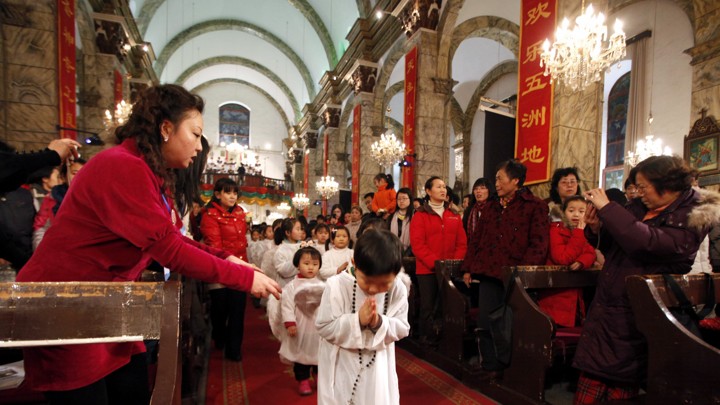
Children walk down the aisle during Christmas Mass at a Catholic church in Beijing.

As China’s economic and military power has expanded over the past decade, Beijing has shown a proclivity to renege on agreements and to make access to its markets conditional on acceding to its shifting demands. 
Countries, companies, and international organizations have found it difficult to push back.
The Vatican, as both a state and the spiritual head of a major international institution, is now grappling with this challenge. 
In September, the Holy See inked a provisional agreement with Beijing in an attempt to mend an almost 70-year-old schism. 
Vatican leaders argued that the deal would promote unity. 
They insisted that it would enable them to better minister to their Catholic flock in China. 
They dismissed concerns that it constituted “selling out” to a repressive government.
Then a Chinese bishop disappeared. 
The suspected arbitrary detention of a Vatican-appointed priest last month has reinforced worries that Beijing won’t ease its pressure on the Church but will instead use the deal to push for even more control.
The implications stretch well beyond the religious sphere—in fact, the Vatican deal is a broader object lesson in the costs of doing business with Beijing. 
If China is willing to backtrack on its agreement with the Vatican, that bodes poorly for foreign governments, international companies, and other organizations involved in dealmaking with the country.
Since the Vatican and Beijing broke diplomatic ties in 1951, the Church in China has been divided into official state-sanctioned Catholic places of worship with bishops appointed by Beijing, and underground churches whose leaders are secretly appointed by the Vatican but not officially recognized by the Chinese Communist Party. 
CCP authorities have harassed and detained underground clergy, and the dueling bishoprics have caused confusion and division among the laity. 
The pope has not been allowed to visit China or even to enter its airspace.
Vatican leadership suspects that the schism is one reason for Catholicism’s stagnant growth in China. There are about 10 million Chinese Catholics (though estimates vary), a number that has remained relatively steady in recent decades while the number of Protestant Christians has risen dramatically, reaching up to 100 million by some counts. 
That was a major motivation for the deal, which has been under discussion since 2014.
Under the terms of the agreement, which has not yet been fully made public, Francis has recognized seven party-appointed bishops, while Beijing has in turn recognized a portion of the formerly underground Vatican-appointed ones. Wenzhou
In the future, the Holy See is expected to reach a compromise with Beijing over new appointments, in an arrangement that gives the CCP control over who is selected.
But then last month, Shao Zhumin, a Vatican-appointed bishop of the eastern city of Wenzhou, who remains unrecognized by Beijing, disappeared. 
It was the latest in a string of detentions that Shao has faced in recent years. 
Some Chinese Catholics had naively hoped that such arbitrary arrests, a relatively common occurrence for underground priests, would end after the agreement was reached.
“The government has not given up its hope for control. They want the Church to be another tool of the state,” Paul Mariani, a Jesuit priest who researches Chinese religious policy at Santa Clara University, told me. 
“That’s common in China, across labor unions or NGOs—they all have to fall under the party at some level.”
Shao’s disappearance has, so far at least, seemed to vindicate the deal’s naysayers. 
Critics have accused the Vatican of giving in to an atheist, communist government with a long history of persecuting the faithful. 
Joseph Zen, the retired cardinal of Hong Kong and a fierce critic of the CCP, called the agreement “an incredible betrayal,” accusing the Holy See of “giving the flock into the mouths of the wolves.”
Sophie Richardson, the China director of Human Rights Watch, told me, “Watching a major world faith come to an agreement with an authoritarian government that’s notorious for repressing religious freedom and to effectively cede some authority to that government sets a very worrying precedent.”
The deal comes as the religious-freedom environment in China has reached its worst level in years, as the government has detained 1 million Muslim citizens in illegal detention camps, banned online Bible sales, increased control over churches and temples, and sought to incorporate party ideology directly into religious doctrine.
“The pope has effectively given Xi Jinping a stamp of approval when the latter’s hostility to religious freedom couldn’t be clearer,” Richardson said, referring to the Chinese president.
It’s not just domestic and religious groups that have felt the tightening grip of the Communist Party. International companies are forced to hand over their proprietary technology in order to do business in China. 
The Chinese government blocks the websites of businesses that do not abide by its tough online censorship laws, leading major companies such as Apple and LinkedIn to comply with official demands to remove certain content. 
In April, Beijing demanded that international air carriers change their website language regarding Taiwan to bring it in line with the Chinese government’s position that the self-governing island democracy is a Chinese province, threatening consequences for airlines that did not comply by a given deadline (to date, almost all airlines have complied).
“It’s hard to imagine China putting as much pressure on those organizations 20 years ago,” said Rush Doshi, a postdoctoral researcher specializing in China at the Brookings Institute. 
“It was afraid of the commercial and international backlash. Now there is less concern about the backlash because China is bigger and more powerful. They couldn’t afford to adopt that attitude when their economy was far smaller than that of the United States.”
In recent years, the CCP has also applied similar pressure to major international institutions such as the United Nations, seeking in some cases to change the very nature of liberal bodies to more closely resemble its own illiberal preferences. 
China has sought to erode human-rights enforcement at the United Nations by packing hearings with pro-Beijing participants, offering generous investment deals to countries in exchange for their support, and blocking activists from entering UN grounds.
“Everyone is being forced to play by Chinese government rules,” said Shanthi Kalathil, who directs the International Forum for Democratic Studies at the National Endowment for Democracy. “Increasingly, we see the Chinese government trying to impose its own definition and its own rules on international institutions and other governments. And that extends to governments such as the Vatican, it extends to arenas such as the UN, and to Chinese government bilateral relations with other countries.”
And in some cases, even when an equitable deal has been reached, the party has demonstrated a growing willingness to backtrack on commitments.
In 2015, for example, Xi reached two agreements with President Barack Obama—to reduce cyber-hacking attempts and to cease China’s militarization in the South China Sea. 
Despite these high-profile deals, however, the Chinese navy continued to build military facilities in contested waters in the South China Sea. 
And in October, the U.S. government revealed that Chinese-sponsored cyber-hacking attempts on U.S. targets had once again surged.
“If China can renege on a deal with a superpower—over hacking and over the South China Sea—then it can renege on deals with middle powers or small countries without fear of consequence,” said Doshi.
Xi has spent his six years as president strengthening the party’s grip over every aspect of Chinese society and cracking down harshly on any organization that could potentially compete for the loyalty of Chinese citizens, particularly targeting religious groups.
From that perspective, the agreement with the Vatican is the party’s attempt to finally eliminate the gray area in which underground churches have long operated, rather than a desire to cede partial control over bishop appointments to a foreign head of state thousands of miles away.
“How many times have we seen this movie?” asked Richardson.
“I’m not sure why the pope and the Vatican will succeed when many others have not.”
mardi 5 septembre 2017

Rogue Nation: China seeks to silence critics at U.N. forums

"China is systematically trying to undermine the U.N.’s ability to defend human rights, certainly in China but also globally as well." -- Kenneth Roth
By Stephanie Nebehay
Security cameras are attached to a pole in front of the giant portrait of  Chinese dictator Mao Zedong on Beijing's Tiananmen Square, near the Great Hall of the People where the 18th National Party Congress (NPC) is currently being held, November 11, 2012.

GENEVA -- Beijing is waging a campaign of harassment against Chinese activists who seek to testify at the United Nations about repression, while the world body turns a blind eye or is complicit, Human Rights Watch said.
In a report released on Tuesday, the group said China restricts travel of activists, or photographs or films them if they do come to the U.N. in Geneva to cooperate with human rights watchdogs scrutinizing its record.
“What we found is that China is systematically trying to undermine the U.N.’s ability to defend human rights, certainly in China but also globally as well,” Kenneth Roth, executive director of Human Rights Watch, told Reuters.
“This comes at a point where domestically China’s repression is the worst it has been since the Tiananmen Square democracy movement (in 1989). So there is much to hide and China clearly attaches enormous importance to muting criticism of its increasingly abysmal human rights record.”
Asked about the report at a regular briefing on Tuesday, Chinese foreign ministry spokesman Geng Shuang dismissed its accusations as “groundless”.
The U.N. system offers one of the few remaining channels for Chinese activists to express their views, the New York-based group said.
Its report, “The Costs of International Advocacy: China’s Interference in United Nations Human Rights Mechanisms,” is based on 55 interviews.

“NIP-IT-IN-THE-BUD STRATEGY”

Pro-democracy demonstrators hold up portraits of Chinese disbarred lawyer Jiang Tianyong, demanding his release, during a demonstration outside the Chinese liaison office in Hong Kong, China December 23, 2016. 

“Xi Jinping seems to have adopted a ‘nip it in the bud’ strategy with respect to activism at home, but increasingly abroad. That’s one of our messages, China’s repression isn’t stopping at its borders these days,” Roth said.
In China, activists have “decreasing space safe” from intimidation, arbitrary detention, and a legal system controlled by the Communist Party, the report said, decrying a crackdown on activists and lawyers since 2015.
Some activists who have attended U.N. reviews of China’s record have been punished on their return, it said. 
Others have their passports confiscated or are arrested before departure.
When Xi addressed the U.N. in Geneva in January, the U.N. barred non-governmental organizations (NGOs) from attending, Human Rights Watch said.

Dolkun Isa, executive chairman of the World Uyghur Congress, speaks on his phone at the organization’s Munich office July 6, 2015. 

Dolkun Isa, an ethnic Uighur rights activist originally from China, was attending a U.N. event in New York in April when U.N. security guards ejected him without explanation, despite his accreditation, it added.
Jiang Tianyong, a prominent human rights lawyer, disappeared last November, months after meeting in Beijing with U.N. special rapporteur on poverty Philip Alston who has called for his release.
Jiang, after being held incommunicado for six months, was charged with subversion. 
At his trial last month he confessed, saying that he had been inspired to overthrow China’s political system by workshops he had attended overseas.
“It illustrates the lengths to which China will go to ensure that even when it admits a U.N. investigator, the investigator only hears the government’s side of the story,” Roth said.
”When a rare activist is able to break through the ‘cordon sanitaire’, they are arrested.
“So the signal is clear -- don’t you dare present an independent perspective to a U.N. investigator.”