Affichage des articles dont le libellé est Sayragul Sauytbay. Afficher tous les articles

mercredi 4 décembre 2019

China's crimes against humanity

Chinese Propaganda: Muslim Concentration Camp Survivor Arrested for ‘Inciting Hatred,’ Had Syphilis
By Frances Martel

The Chinese state propaganda outlet Global Times published an interview with a communist official in East Turkestan, home to most of the nation’s ethnic Uyghur Muslims, on Wednesday asserting that the concentration camps there are “schools” and all escaped prisoners are lying.
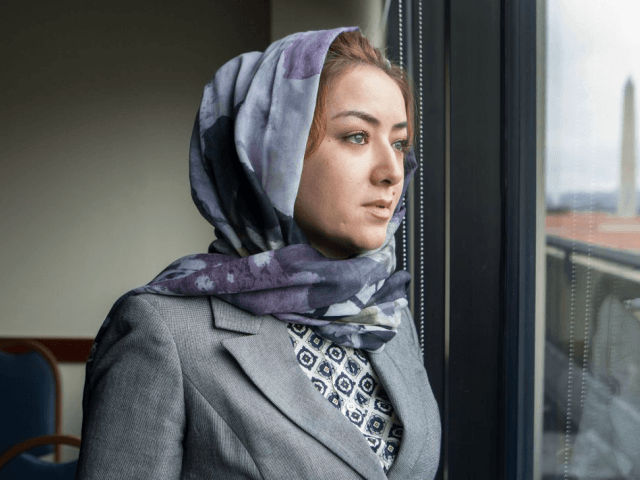
The attacks targeted two escapees in particular: Mihrigul Tursun, who fled to the United States and says Chinese government officials used electroshock torture on her, sterilized her, and killed her infant son; and Sayragul Sauytbay, who exposed the fact that China is imprisoning thousands of ethnic Kazakhs along with Uyghurs and uses rape and drugs to torture prisoners.
Tursun, the East Turkestan official claimed, was arrested for “inciting hatred” and was carrying syphilis when arrested. 
The official did not address Tursun’s allegation that concentration camp workers killed the oldest of her infant triplets, instead addressing Tursun’s claim that the Chinese government killed her brother by denying it and printing an alleged quote by him.
Sauytbay, the official claimed, was an incompetent teacher and a criminal fraud.
The Global Times did not offer evidence for any of its claims, such as a criminal or medical record for either woman.
China has for years attempted to subjugate the Uyghur, Kazakh, and Kyrgyz ethnic populations of East Turkestan, limiting the open practice of Islam and splitting children from devout families. 
In early 2018, however, reports began to surface that China had escalated its repression and begun building concentration camps to indoctrinate, torture, and enslave locals. 
Today, the United States government believes China is holding as many as 3 million people over 1,200 concentration camps across the country’s largest and westernmost state.
The Global Times repeated the Communist Party line that the camps are necessary to “train” individuals tempted to join jihadist groups and that they are a revolutionary way of eradicating "terrorism".
The official responding to the Global Times’ questions is an unnamed “spokesperson” for the East Turkestan government, a mouthpiece for the people running the concentration camps.
“I’d like to stress again that the "education and training centers" in East Turkestan are school in nature, set up according to law. They were never the so-called ‘concentration camps’ at all,” the spokesperson said. 
“Clinics are available in all the centers and professional doctors are there to provide 24-hour free medical service to trainees. Minor ailments are treated at the clinic. In the case of major and acute illnesses, trainees will be sent to hospital. The alleged nine female deaths are pure fabrications.”
In the interview, the official admits, using Orwellian Chinese communist language, that the camps serve two purposes: indoctrinating Muslims into worshipping dictator Xi Jinping and his authoritarian state, and using detainees as slaves. 
Or, in the language of a East Turkestan government spokesperson: “theoretical studies taught in classrooms and actual skills practiced in workshops.”
All those in "vocational camps", the official alleges, have some ties to "terrorism", ranging from being solicited to engage in terrorist activity to actually executing terrorist attacks.
The spokesperson claimed that no foreign citizens have ever been detained in the camp, despite Sauytbay’s testimony that as many as 2,500 ethnic Kazakhs – some, presumably, citizens of Kazakhstan – were in the camp authorities imprisoned her in. 
The government of Australia has also confirmed that some Australian citizens have landed in the camps.
The spokesperson accused Tursun of “instigating ethnic hatred and ethnic discrimination” and claimed that she did not face time in prison due to “humanitarian considerations,” because she had allegedly contracted “syphilis and other infectious diseases.” 
The spokesperson also offered a quote allegedly from brother Erkbar Tursun, who Mihrigul alleges the Chinese government murdered: “my sister is always telling lies. She not only said I died, but also lied about others’ deaths.”
The interview does not address Tursun’s infant son.
Sauytbay, the spokesperson alleged, was a schoolteacher. 
The spokesperson claimed she held a grudge against the government because she was caught “seeking performance bonuses through cheating.”
The official claimed that neither woman ever set foot in a camp, but provided no evidence of their alleged wrongdoing. 
The claims against Tursun appeared especially difficult to corroborate given that China significantly represses dissidents and defines “hate speech” as anything that jeopardizes the supremacy of the Communist Party.
Tursun began speaking out a year ago, when she arrived in Washington, DC. 
Her version of events significantly deviates from the Chinese regime’s. 
She told reporters at the National Press Club last year that authorities imprisoned her because she traveled to Egypt, her husband’s native country, once with her family. 
Once in the camps, she was subject to indoctrination, torture, and later confirmed sterilization.
“The authorities put a helmet-like thing on my head, and each time I was electrocuted, my whole body would shake violently and I would feel the pain in my veins,” Tursun described
“I begged them to kill me.”
Chinese media has previously claimed that Chinese people “laughed” when they heard her testimony.
Like Tursun, Sauytbay described the prison Chinese authorities locked her in as a concentration camp, calling it “much more horrifying than prison.” 
She saw detainees taken to a “black room” where they were raped and tortured and described the widespread use of drugs to make detainees more docile.
Their testimonies align with those of other survivors. 
Nearly all survivors are either ethnic Kazakhs who could appeal to the government of Kazakhstan for help or married to foreign citizens who appealed for their freedom.
“Any woman or man under age 35 was raped and sexually abused,” Ruqiye Perhat, a student arrested in East Turkestan in 2009 for four years, told the Washington Post in October. 
Perhat said violent forced abortions were common following the mass rape.
Other survivors have testified to enslavement, force-feeding of pork and alcohol to devout Muslims, and evidence of the harvesting of organs for sale on the black market.

jeudi 28 mars 2019

China's crimes against humanity

China Has Also Been Targeting Turkish Nationals In Its Brutal Crackdown On Muslims
Turkey is the only Muslim country to call out China’s crackdown on Uighur Muslims. Our investigation finds that several Turkish nationals have also disappeared, something that has never been publicly acknowledged by Turkey.

By Megha Rajagopalan and K. Murat Yildiz

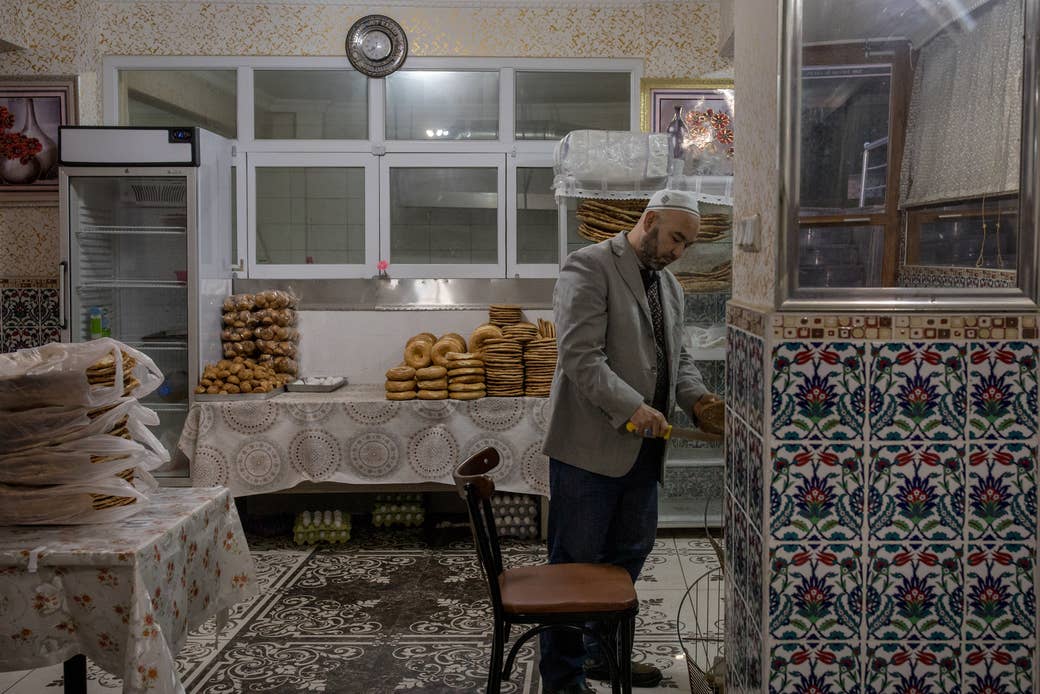
A baker prepares bread for display in a Uighur bakery in the Zeytinburnu district of Istanbul.

ISTANBUL — It was supposed to be a routine business trip, so the young Turkish man was surprised when immigration officials at the Chinese airport pulled him into a room and questioned him for hours. 
He asked to speak to diplomats from his home country, but the Chinese officials shrugged their shoulders, telling him to take it up with police.
When police brought him in handcuffs to a jail cell on the other side of the country, so damp and dark that he immediately became sick, the man asked again. 
They told him his Turkish passport, whose edges had worn out from use, was fake.
A week later, with his arms and legs shackled to a chair in an underground interrogation room in the city of Ghulja in western China, where he had lived before he became a naturalized citizen of Turkey, he asked for a third time to speak to Turkish diplomats. 
This time the answer came sharp and clear.
“You are not a Turk,” an officer told him. 
“You are from here. Don’t think you are special — we kill people like you so that others can live in peace.”
The young businessman said he had endured 38 days of interrogations, hunger, sleep deprivation, and abuse in Chinese custody before finally being released and deported back to Istanbul, without ever being told of any charges against him.
He is an ethnic Uighur — a religious and cultural minority group that the Chinese government views as a threat to the country’s security. 
The government has subjected Uighurs and other Turkic Muslims in the far-west colony of East Turkestan to a sweeping campaign of mass surveillance and incarceration that has seen more than a million people detained in concentration camps.
Despite his ordeal, the young businessman was fortunate to have been released. 
BuzzFeed News has found that six Turkish nationals — and possibly dozens more — have gone missing in China’s East Turkestan colony, including a pair of young children. 
None of their cases have been publicly acknowledged by the Turkish government, and are being reported here for the first time.
Their families believe they have been sent to prisons or concentration camps, or in the case of the children, to state-run orphanages.
The families’ claims have been corroborated by email correspondence with government officials and copies of Turkish identification documents.
Every family interviewed by BuzzFeed News said Turkish authorities had given them little information on the status of their relatives, and that they had no evidence that their loved ones had ever been allowed to speak to Turkish diplomats — a privilege guaranteed to both prisoners and detainees by the Vienna Convention on Consular Relations, to which China is a signatory
None of the six people hold dual citizenship with China, according to their families.
Three other families contacted by BuzzFeed News said they also had relatives who were Turkish nationals who had gone missing in East Turkestan, but declined to speak further or be identified because of the sensitivity of the cases. 
And three different Uighur community leaders in Istanbul said dozens more Turkish nationals have gone missing in East Turkestan, but BuzzFeed News could not independently verify all of these cases or speak to the families of those involved.
The families' stories show that Chinese authorities have been unafraid to sweep up foreign nationals in their campaign against Turkic Muslims, even people from countries that are important diplomatic partners.
The businessman who had spent more than a month in Chinese custody over the summer of 2017 became a Turkish citizen in 2011, giving up his Chinese citizenship, and was traveling in China on a tourist visa using his Turkish passport.
“At first I wasn’t that scared,” he said, neatly dressed in a black blazer and sporting a close-cropped haircut at a popular Uighur restaurant in Istanbul last month. 
“I told my cellmates I’m a Turkish citizen, and sooner or later they’d release me.”
The businessman, who asked his name not be used because he is afraid Chinese authorities will retaliate against his family there, was only released after weeks of interrogations about his contacts in Turkey and pictures he had shared on Facebook
Though he was never allowed to speak to his family or any Turkish diplomats while he was in custody, he believes he was ultimately let go because of his citizenship.
Turkey’s President Recep Tayyip Erdoğan is one of the few leaders of Muslim-majority countries to have ever criticized China’s treatment of ethnic Uighurs, describing in 2009 a crackdown by Chinese authorities following deadly riots in East Turkestan as “genocide.” 
But the Turkish government, like many others in the world, went mostly quiet on the issue, as Turkey and China established closer economic and diplomatic ties.
That changed in February this year, when Turkey issued the strongest statement in years through its foreign ministry, condemning the use of “concentration camps” by China.
In its unusual rebuke, the foreign ministry called China’s treatment of Uighurs a “shame for humanity.” 
But it said nothing about its own citizens who have been sent to internment camps without charge or who have been missing, in some cases, for more than a year.
In the cases of disappearance confirmed by BuzzFeed News for this article, families said they have contacted the Turkish foreign ministry as well as the presidency, members of parliament, and the Turkish embassy and consulates in China; been assigned case numbers; and been told the ministry is working to find out more information about their missing relatives. 
But they have become distraught. 
After months of begging the Turkish government for information, there have been few responses and no real news on the fates of their children, parents, and siblings. 
Amid constant news reports of detainees facing torture, hunger, and abuse in Chinese internment camps, the lack of information has been terrifying.
The Turkish foreign ministry was asked whether dozens of Turkish nationals had gone missing in China, and if so why it had not said anything about the issue publicly, what Turkey was doing on behalf of the individuals and their families, and to respond to comments from the families that they had heard little from the Turkish authorities. 
The ministry did not comment by the time of this article’s publication.
The Chinese embassy in Turkey also did not respond to a request for comment.

The main street in the Zeytinburnu district of Istanbul, the unofficial center of the city's Uighur diaspora.

Turkey is home to one of the world’s largest Uighur diasporas, with a population of between 20,000 and 50,000 people, according to Uighur community leaders there. 
Uighurs share close cultural, historical, and linguistic ties with Turkish people, and the public there is broadly sympathetic to Uighurs. 
Protests have broken out in Turkey as recently as 2015 over news of mistreatment of Uighurs in China and over forcible repatriation of Uighur migrants.
More recently, there was a public outcry in Turkey after reports in February of the death of Uighur folk musician Abdurehim Heyit, whose music is popular in Turkey. 
It was after this that the Turkish foreign ministry issued its strong statement calling for China to close the camps.
“This tragedy has further reinforced the reaction of the Turkish public opinion towards serious human rights violations committed in the East Turkestan colony,” the statement said.
Heyit later appeared in a video released by Chinese state media saying he was in good health, sparking a Twitter hashtag campaign by overseas Uighurs calling for displays of proof of life for their own family members.
The Uighur community in Turkey has been the heart of the exiled movement for the independence of East Turkestan — the name of the independent state some Uighurs hope to establish as their homeland — since the Communist party took power in China in 1949 and a group of Uighur leaders migrated to Turkey, said Erkin Emet, an associate professor of language at Ankara University who is himself an ethnic Uighur and has researched the history and culture of Uighurs.
“From China’s perspective, Turkey is the most dangerous place for Uighurs,” Emet said, “because of the common culture and history we share with Turks. It is also a place where, unlike in many other Muslim countries, we can easily form political parties and organizations.”
The center of this independence movement, Emet said, is still in Turkey.
Since the early days of its campaign, the Chinese government has specifically targeted Uighurs with links to Muslim countries for detention. 
That has included people who have worked or studied in Muslim countries, or even those who just have relatives living there. 
In particular, China has seized on links to Turkey.
According to the Associated Press, Uighur activists and officials from Syria and China estimate at least 5,000 Uighurs at one time traveled to Syria to fight, many doing so via Turkey. 
China has also said Uighur separatist militants were responsible for a wave of deadly knife and bomb attacks in 2013 and 2014 in East Turkestan and elsewhere in the country. 
But China has targeted millions of Turkic Muslims in its crackdown, the overwhelming majority of whom have no proven links to any extremist cause.
The total number of foreign nationals swept up in the campaign against Muslim minorities, which includes ethnic Kazakhs, is not publicly known. 
Many countries have preferred to advocate for their citizens through quiet diplomacy rather than public advocacy.
Three Australian citizens were released last year after being detained in internment camps. 
Australia is also now working to secure the release of a Uighur Australian baby boy whose father believes he’s at risk of being sent to a state-run orphanage, in a case first reported by BuzzFeed News.
Kazakhstan has remained publicly silent about the plight of ethnic Kazakhs in the region who have been swept up by China’s crackdown, although last August, a Kazakh court ruled against deporting Sayragul Sauytbay — who had worked in an internment camp as a teacher and later fled to Kazakhstan — to China.
BuzzFeed News has shown how Uighurs in countries as far flung as Sweden, Australia, Turkey, and the United States have reported facing harassment and intimidation from Chinese government agents who have contacted them through social media.
Several countries and multinational bodies, including the United States, the United Nations Human Rights Council, and the EU, have publicly condemned the Chinese government’s human rights abuses in the region, but China’s incarceration campaign has not led to any international sanctions.
China does not consider the concentration camps to be a form of criminal punishment. 
Government officials have said they are for "vocational training" and have likened them to “boarding schools,” though escapees from the camps have reported being forcibly taught Chinese language and party propaganda, and subjected to hunger, stress positions, sleep deprivation, and other abuses.
But this puts families of detainees in a difficult spot because it means there is no arrest paperwork, no sentence, and frequently no communication at all from Chinese police. 
It is as if their parents, siblings, or children have simply vanished. 
And it’s unclear whether Chinese authorities have provided Turkish officials with any more information.

Hankiz Kurban and her younger sister Nurbiye Kurban in Istanbul.

Hankiz Kurban was, like her three younger siblings, born and raised in Turkey, but has lived in China on and off for years, trying to make the family’s import and export logistics business a success.
For years the 28-year-old had lived in Urumqi, the regional capital of East Turkestan, with her mother, Amina, and her father, Yahya, to whom she had always been close. 
A quiet, methodical man, 52-year-old Yahya would draw up a to-do list each morning before breakfast. 
Because they planned to keep working in China, he was careful, Hankiz said. 
He forbade her from getting involved in political causes, even in Turkey. 
She went to a Uighur cultural event once when she was younger, and he scolded her.
Hankiz started taking Chinese lessons, hoping it would make it easier to work with business partners in China.
In 2017, she started hearing rumors of people who were disappearing. 
Friends and neighbors told her about fathers and brothers who were taken away by police in the middle of the night.
Hankiz started to worry, but her father was unfazed. 
After all, they were Turkish citizens, staying legally in China. 
They paid taxes. 
They had taken care to do everything aboveboard.
When Hankiz’s visa expired, she returned to Turkey to renew it. 
This was already unusual, she said — in the past she could have done this within China. 
While she was in Turkey, what she had feared the most happened. 
Both of her parents were detained. 
She found out through a final voice message from her mother. 
“They’re taking us away,” she said in the message. 
“Contact the embassy.”
“That was when our hell began,” Hankiz said.
Yahya and Amina Kurban were not the only family members to disappear. 
Hankiz’s uncle, Mehmet Emin Nasir, 39, disappeared in Kashgar, a city in southern East Turkestan, on September 9, 2017.
“We never thought this would last so long. We thought that as a Turkish citizen, sooner or later he’d be released,” Muyesser Temel, Nasir’s sister and Hankiz’s aunt, said as she sat in a yellow armchair at her family’s home in the immigrant-heavy neighborhood of Zeytinburnu, where much of Istanbul’s Uighur community lives in apartment blocks. 
“At the beginning I wasn’t scared, but as time passed I realized this was serious.”
Temel first heard that Nasir was taken away by police from her mother, who had gotten a phone call from relatives in East Turkestan. 
Nasir, who ran a shop that sold curtains, was living in Kashgar with his wife and four children at the time. 
He held a Turkish passport, but unlike many other Turkish Uighurs, he wanted to live in his homeland. 
His wife never sought Turkish citizenship because the family was settled in East Turkestan.
Temel said she reached out to the Turkish foreign ministry through repeated phone calls for months since she discovered her brother had been taken away. 
“They tell us they’re in touch with Chinese authorities, but we have no proof of it,” she said. 
“They just tell us on the phone they are dealing with this, but there’s no evidence.”
“We trust above everything our country, Turkey,” she said. 
“But nothing has come out of this. We have exhausted all of our options.”
Both women, and other individuals interviewed for this article, said they had received few signals from the Turkish foreign ministry about the status of their families, even when Turkish officials promised to help.
Even Turkish children have not been spared from China’s crackdown.
Pashahan Kuçar, 75, has two young grandchildren. 
Both Turkish citizens who were traveling on their mother’s Chinese passport, they have disappeared in East Turkestan along with their mother, Kuçar's daughter-in-law. 
According to their identification records, which her family provided to BuzzFeed News, Kuçar's granddaughter is 7 and her grandson has recently turned 6. 
When their mother was taken away to an internment camp, the children were left alone. 
A neighbor took them in and explained the situation to Kuçar's family by text. 
But not long after, the neighbor stopped responding to messages. 
Kuçar hasn’t heard from her grandchildren in months.
Though Kuçar can barely walk and suffers from several health conditions, she has relentlessly campaigned for the release of her family. 
In Turkey’s capital, Ankara, she has protested outside the presidential palace on a mobility scooter, draped in the light blue flag of East Turkestan. 
She has met with Turkish foreign ministry officials, but they’ve given her no clues about where her grandchildren are or whether Turkish diplomats have been able to contact them.

Pashahan Kuçar

In a way, Temel, the woman whose home is in Zeytinburnu, counts her missing brother among the lucky. 
The fact that he holds Turkish citizenship means at least she can expect Turkish authorities to help.
“You cannot find a family in this neighborhood that does not have family in the camps,” she said. “The internet is blocked over there; there’s no way to contact them — if my mother had not gotten that call we would simply not know.”
Hankiz Kurban, the 28-year-old who once dreamed of building a business in China with her father, has tried everything to find news on her missing parents. 
She reported the matter to Turkish authorities and received a case number in an automated email. 
She began calling the Turkish Embassy in Beijing every other day — so much that officials started to hang up when they heard her voice.
She lies awake at night obsessing about what might be happening to her father and mother. 
She tried taking medication for her anxiety and depression, but it just made her feel sleepy and fuzzy. What she can’t figure out is how her father, who all his life eschewed political causes so as not to get on the wrong side of the government, could have been targeted.
Two years ago in Ghulja, interrogators asked the young businessman detained at the airport in China the same questions about his politics and connections over and over again, searching for evidence of his connections to extremist groups. 
There were two interrogators, he said, one Han Chinese — China’s largest ethnic group — and the other Uighur, both fluent in the Uighur language.
One day they demanded his social media passwords — to Facebook, WhatsApp, and the Chinese messaging app QQ. 
They found a post he had shared on Facebook showing both the Turkish flag and the flag for East Turkestan. 
That day they became certain, he said, that he was a threat. 
It was like they had discovered a smoking gun.
Another day they asked him to list his contacts in Istanbul, to tell them which Uighur restaurants he frequented. 
He gave a list of made-up names, he said. 
But the pair of interrogators knew the Uighur community in Turkey well.
Unlike many Uighurs in Istanbul, the businessman didn’t live in Zeytinburnu. 
His interrogators knew the neighborhood’s shops and alleyways better than he did.
In the days before his departure, one of his interrogators mentioned he’d be traveling to Turkey in a few months. 
“If you see us in Istanbul,” he said, “will you welcome us?” ●

samedi 18 août 2018

On China's crimes against humanity

Beijing's horrific ethnic cleansing and Sinification campaign is putting at stake the internal cohesion of Asia's most powerful state.
By Richard Javad Heydarian
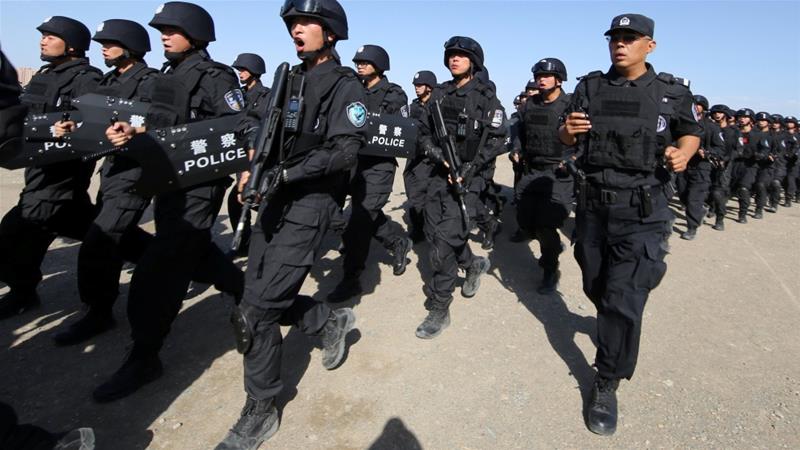
Chinese soldiers participate in an anti-terror drill in Hami, East Turkestan on July 8, 2017 

Amid Xi Jinping's consolidation of power in China, there are growing concerns over an ongoing crackdown on religious freedoms and basic rights of minority groups in the country.
China has embarked on an aggressive Sinification campaign to recast various "foreign" religions to reflect the regime's priorities and the country's unique culture.
Abrahamic faiths originating from the Middle East have been the main target of this new policy, which has provoked massive backlash among various ethnic-religious groups.
In particular, the large Muslim Chinese community has resisted coercive "re-education" efforts by the authorities, which have progressively restricted religious minorities from observing the basic articles of their faith. 
According to a report submitted to the United Nations, as many as one million Uighurs from East Turkestan have been forced into internment camps.
Rights groups are accusing China of engaging in an all campaign of ethnic cleansing
Ongoing efforts at Sinification of East Turkestan wil only intensify deep ethnic-religious faultlines in modern China. 
What's at stake is no less than the internal coherence in Asia's most powerful state.
In popular imagination, China is often synonymous with authoritarian tranquility. 
Yet, a more careful look reveals intensified socioeconomic fault lines, with religious freedom emerging as a key area of contestation in China.
Over the past decade, there has been an upsurge of resistance, sometimes even armed and violent, against Beijing's marginalisation of the Muslim minority groups. 
The large-scale migration of Han (mainstream Chinese ethnic group) population into previously Muslim-majority regions as well as government restrictions on observance of basic tenets of Islam, including wearing of veil and fasting during Ramadan, has deepened Uighur grievance against the regime.
In mid-2009, a series of violent clashes between Uighurs and Han residents of Urumqi led to the death and injury of as many as 184 individuals. 
The radicalised atmosphere has strengthened the hands of groups such as the East Turkestan Islamic Movement (ETIM), which has called for armed resistance against Beijing.
In 2013, violence hit the capital, when several Uighurs, using an SUV, ploughed through visitors at Beijing's Tiananmen Square. 
The following year saw several attacks across East Turkestan, one of which claimed the lives of close to hundred individuals as well as an Imam perceived to be China-friendly.
That year also saw a group of suspected Uighur patriots chasing and assaulting Chinese in Kunming, in the province of Yunnan, with knives, provoking fears of widespread attacks across the country.
In response, the communist regime, which derives its legitimacy from bringing about order and prosperity, adopted increasingly draconian measures, reportedly including the establishment of "reeducation camps" for religious recantation, to crash resistance among ethnic minority groups and prevent "terror" attacks across the country.
In a particularly strident editorial, The Global Times, a hard line Chinese government mouthpiece, portrayed the ongoing crackdown on and cultural marginalisation of Uighurs as a justifiable policy to ensure "East Turkestan has been salvaged from the verge of massive turmoil" and "evil influence" of extremism.
Recent weeks saw the extension of the government's religious crackdown to the historically well-integrated Hui Muslims in northern Ningxia region, reflecting a more aggressive attempt at Sinification of religion. 
A recent government decision to demolish the Weizhou Grand Mosque, supposedly for lack of proper permit but likely because of its more Middle Eastern design, sparked days of massive protests by thousands of Hui Muslims.
China's relations with Muslim-majority Central Asian neighbours have also come under strain. Recently, a Kazakh court ruled in favour of Sayragul Sauytbay, an ethnic Kazakh Chinese national, who sought refuge in the central Asian country after exposing the presence of internment "reeducation" camps for Muslim minority groups. 
China sought her extradition for supposedly violating state secrets, an accusation that can carry death penalty.
Her case sparked widespread outrage against China across Kazakhstan, forcing the Beijing-friendly government to protect the asylum-seeking activist. 
Unless the Chinese communist regime reconsiders its current policy towards religious minority groups, it will likely inspire even greater resistance among Muslim groups at home and backlash among neighbouring Muslim countries.

mardi 31 juillet 2018

Kazakh trial throws spotlight on China’s internment centres

Beijing’s crackdown in East Turkestan puts central Asian neighbours on edge 
By Emily Feng in Beijing


Sayragul Sauytbay has requested asylum in Kazakhstan. She had been forced to teach prisoners in a Chinese internment camp.
The trial of a Chinese citizen who fled to Kazakhstan has offered rare insight into China’s secretive internment centres, with Beijing’s security campaign in East Turkestan increasingly putting neighbouring countries in central Asia on edge.
 The trial, which is being held in the Kazakh town of Zharkent near the Chinese border, has featured the first public testimony describing China’s internment system in East Turkestan, alarming Chinese officials who have long obscured their existence. 
 Sayragul Sauytbay, a Kazakh with Chinese citizenship, in April fled East Turkestan where she was forced to teach Chinese history to prisoners at an internment centre.
She then requested asylum in Kazakhstan, where her husband and two children are citizens.
 On May 21, Ms Sauytbay was detained by Kazakh security officials for allegedly crossing the border into Kazakhstan illegally — a charge that could see her deported to China.
Friends and family say she is being targeted by the Chinese Communist party for possessing political secrets because of her employment at an internment centre. 
 Since 2016, China has intensified a security campaign in East Turkestan ostensibly aimed at countering Islamist and separatist "terror".
The crackdown has targeted Uighurs, a Turkic Muslim ethnic group.
Among the measures are a regional network of extra-legal internment camps that hold at least 500,000 of the region’s 11m Uighurs.
 “The people in East Turkestan definitely do not know the severe degree the centres have reached, how many have died [there] and how many have gone crazy. Those who know cannot say because once they do they will face consequences,” said Silamu Wuwali, Ms Sauytbay’s husband.
“We are very worried for her physical safety.”
 In her testimony, Ms Sauytbay said details about the operations of internment centres were classified as state secrets and their disclosure was punishable by execution. 
 Deliberations were scheduled to end last week but have been extended to begin again on Wednesday after the judge rejected Ms Sauytbay’s plea bargain to face criminal charges in Kazakhstan rather than be deported to China.
 “Ms Sauytbay is at a real risk of torture and ill-treatment and of arbitrary detention if returned to China,” her lawyers said in a statement.
Kazakhstan is a party to both the UN Convention against Torture and the International Covenant on Civil and Political Rights, which bans expelling a person to where they face a risk of torture.
As the clampdown intensifies, regional neighbours have been swept up by China’s widening security dragnet.
Particularly affected has been resource-rich Kazakhstan, one of China’s key partners in its Belt and Road Initiative.
 For decades, ethnic Kazakhs crossed relatively freely between China and Kazakhstan.
But since China’s security crackdown began in 2016, at least 10 Kazakh citizens have been detained in East Turkestan.
Ms Sauytbay testified that she taught at a East Turkestan internment camp that was built to hold almost 2,500 Chinese Kazakhs.
 Kazakh interest surrounding the trial has been such that it prompted China’s ambassador in Kazakhstan, Zhang Wei, to speak out in July.
 “This year, we have noticed different individuals zealously campaigning about the so-called problems of the ethnic Kazakhs from East Turkestan,” he said in an interview with Tengrinews, one of the largest online news outlets in Kazakhstan. 
 “They have done this on the internet and out in public, openly and secretly, inventing unfounded accusations with the evil intent of staining East Turkestan's image and grossly interfering in China’s internal affairs.”