By Kim Myong-sik
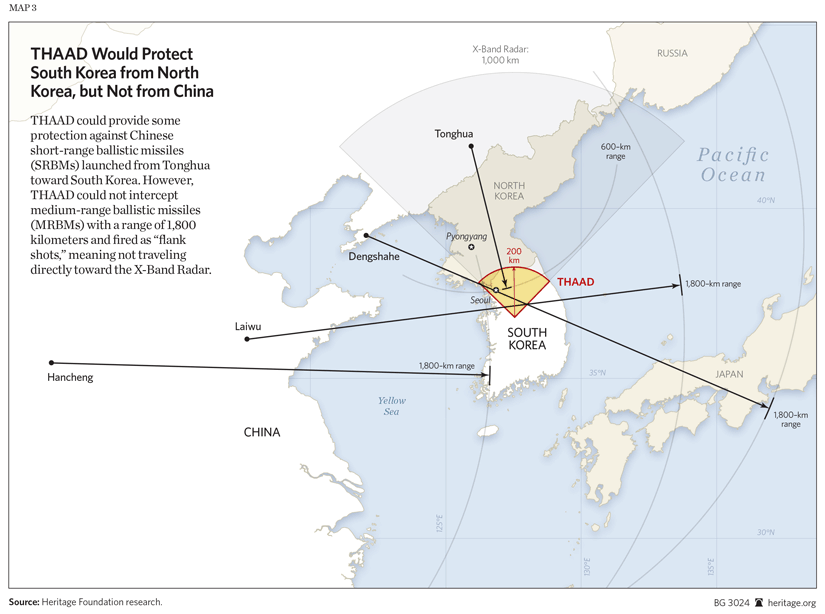
However luminous the brains of the leaders at Beijing’s Zhongnanhai may be, the current Chinese “countermeasures” on Korea’s decision to introduce the US-built Terminal High Altitude Area Defense system are unjustified and inappropriate.
Above all, they will be counterproductive.
While we were in the impeachment turmoil over the past few months, China took a variety of restrictive measures on Korean businesses and pop entertainers operating in the country.
It appeared that anti-South Korea hysteria was brewing across China, instigated by the media under control of the authorities.
The first shipment of the THAAD anti-missile system arrived here last week in full view of the Korean media.
The first shipment of the THAAD anti-missile system arrived here last week in full view of the Korean media.
When more components are delivered here to be installed on a hill in Seongju, North Gyeongsang Province, China will increase pressures on Korea to have the THAAD program canceled, possibly by the next administration.
Xi Jinping has chosen the Lotte Group as the first direct target of Chinese retaliatory measures.
Xi Jinping has chosen the Lotte Group as the first direct target of Chinese retaliatory measures.
The Korean corporation’s nearly 100 commercial outlets came under the Chinese authorities’ fire and sanitary checks which resulted in more than half of them being forced to close down.
More will face permanent or temporary closures as long as Chinese officials believe that such measures will have any effect in altering the Korean and US plans on the THAAD.
It’s sorry that Lotte has to suffer for no other reason than trading its golf course for a piece of property owned by the Korean military.
It’s sorry that Lotte has to suffer for no other reason than trading its golf course for a piece of property owned by the Korean military.
As soon as the Defense Ministry mentioned the land deal with Korea’s fifth-largest conglomerate for the THAAD deployment, China began taking punitive steps against Lotte stores.
What had initially been posed as routine inspections quickly produced arbitrary closure orders.
Korea bashing is spreading to other business areas.
Korea bashing is spreading to other business areas.
These Korean enterprises had invested in the Communist-ruled country with the capitalist economic system that needed foreign money, technology, materials and services to sustain growth.
As if regarding them as parasites of its economy rather than benefactors, China is kicking them out in reprisal for their government’s security policy.
Chinese official media are leading a wide-ranging boycott campaign, hardly imaginable in a normal state.
Their anti-South Korean narratives generally appeal to public emotion, using deception and demagogy.
Their anti-South Korean narratives generally appeal to public emotion, using deception and demagogy.
Of the many diatribes appearing in printed and internet media, one contributed by a retired rear admiral of the People’s Liberation Army naval department stood out for its radical and fanatic ideas.
Luo Yuan, introduced as a social commentator at the PLA Academy of Military Science, surprisingly suggested “surgical operations” on Seongju to eliminate the facility.
“It is important for China to let the ROK (South Korean) people know that the THAAD did not bring security to the ROK but danger,” the military theorist said in his article contributed to the China Military magazine.
“It is important for China to let the ROK (South Korean) people know that the THAAD did not bring security to the ROK but danger,” the military theorist said in his article contributed to the China Military magazine.
His 10-point countermeasures included the strengthening of China’s missile penetration capability against the US and ROK because “attack is the best defense.”
He also called for bolstering anti-missile military cooperation with Russia to achieve regional strategic balance.
The 67-year-old man said that “since the US, Japan and the ROK do not respect China’s major security concerns China does not have to be gentleman all the time.”
The 67-year-old man said that “since the US, Japan and the ROK do not respect China’s major security concerns China does not have to be gentleman all the time.”
I wonder how many in the Chinese military, civilian government or intellectual circles would share his views, which seemed to reveal a still unhealed Cold War mentality.
It is natural that he proposed “punitive retaliatory measures against Korean industrial and commercial chains” related to the THAAD deployment.
Strategic differences may be settled through strategic negotiations, not by retaliation on private businesses, which is only detrimental to the peaceful order of global commerce and trade.
Strategic differences may be settled through strategic negotiations, not by retaliation on private businesses, which is only detrimental to the peaceful order of global commerce and trade.
China would not listen to the US assertion that THAAD is neither designed for nor capable of harming China’s security interests or its assurance that its X-band radar system would be so fixed as not to scan Chinese territory.
If it is to oppose the THAAD deployment, China should do something to free the region from the North’s missile and nuclear threats.
If it is to oppose the THAAD deployment, China should do something to free the region from the North’s missile and nuclear threats.
Its arrangement of six-party talks in Beijing in the 2000s provided a stage for North Korea to cheat the international community while accelerating its programs for weapons of mass destruction.
Beijing has recently banned importing coal from North Korea as a part of UN sanctions.
Beijing has recently banned importing coal from North Korea as a part of UN sanctions.
But the world community has been hugely disappointed at China’s meager record of fulfilling its global obligations as a permanent member of the Security Council and one party of the “G-2,” with regard to implementing UN resolutions against the North.
People-to-people relations between Korea and China and bilateral economic ties have grown briskly since diplomatic normalization in 1992.
People-to-people relations between Korea and China and bilateral economic ties have grown briskly since diplomatic normalization in 1992.
Exchange visits between top government leaders have produced protocols declaring a “strategic cooperative partnership” to contribute to peace and prosperity in Northeast Asia.
Former President Park Geun-hye attended China’s WWII victory celebrations in 2015 and the two countries concluded a free trade agreement in the same year.
This framework of good neighborly ties is being shattered by the giant country’s egotistic, myopic, short-sighted actions to foil the deployment of THAAD batteries essential for our defense against lethal North Korean attacks.
This framework of good neighborly ties is being shattered by the giant country’s egotistic, myopic, short-sighted actions to foil the deployment of THAAD batteries essential for our defense against lethal North Korean attacks.
And in a scheme to achieve its ill-oriented goal, this big country is taking all-round retaliatory measures on a private business for cooperating with its government.
The Lotte Group, ironically, is seeing a considerable rise in consumer trust here, which has had a positive impact on overall local sales sufficiently offsetting losses in the Chinese market.
The Lotte Group, ironically, is seeing a considerable rise in consumer trust here, which has had a positive impact on overall local sales sufficiently offsetting losses in the Chinese market.
A Christian group I belong to canceled its tour to the Chinese ancient city of Xi'an scheduled for April, “displeased by the recent Chinese moves.”
If mutual boycotts expand in the tourism area, both sides will be inconvenienced while THAAD will be installed here anyway.
China will someday become a mature and truly leading member of global society, when editorial cartoonists here will no longer have to make anatomical renditions of the Chinese leader with a walnut-sized brain inside a big head and a small heart resembling a coffee bean.
China will someday become a mature and truly leading member of global society, when editorial cartoonists here will no longer have to make anatomical renditions of the Chinese leader with a walnut-sized brain inside a big head and a small heart resembling a coffee bean.
It will be long after the Chinese realized that Koreans cannot be bullied into concession by any kind of retaliation over a matter that involves its survival.
