Affichage des articles dont le libellé est U.S. tariffs. Afficher tous les articles

jeudi 14 mars 2019

The Art of the Deal

President Trump says he is in no rush to complete China trade deal
By Steve Holland, Jeff Mason

WASHINGTON -- U.S. President Donald Trump said on Wednesday he was in no rush to complete a trade pact with China and insisted that any deal include protection for intellectual property, a major sticking point between the two sides during months of negotiations.
Trump and Chinese dictator Xi Jinping had been expected to hold a summit at the president’s Mar-a-Lago property in Florida later this month, but no date has been set for a meeting and no in-person talks between their trade teams have been held in more than two weeks.
Bloomberg reported on Thursday that a meeting between the two was more likely to take place in April at the earliest.
A person familiar with the matter told Reuters that there “were rumblings” in Washington about a possible meeting in late April.
The president, speaking to reporters at the White House, said he thought there was a "good chance" a deal would be made, in part because China wanted one after suffering from U.S. tariffs on its goods.
But he acknowledged Xi may be wary of coming to a summit without an agreement in hand after seeing President Trump end a separate summit in Vietnam with North Korean leader Kim Jong Un without a peace deal.
“I think Xi saw that I’m somebody that believes in walking when the deal is not done, and you know there’s always a chance it could happen and he probably wouldn’t want that,” Trump said.
China has not made any public comment confirming Xi is considering going to meet Trump in Florida or elsewhere.
The president, who likes to emphasize his own deal-making abilities, said an agreement to end a months-long trade war could be finished ahead of a presidential meeting or completed in-person with his counterpart.
“We could do it either way. We could have the deal completed and come and sign, or we could get the deal almost completed and negotiate some of the final points. I would prefer that,” he said.
President Trump decided last month not to increase tariffs on Chinese goods at the beginning of March, giving a nod to the success of negotiations so far.
But hurdles remain, and intellectual property is one of them. 
Washington accuses Beijing of forcing U.S. companies to share their intellectual property and transfer their technology to local partners in order to do business in China. 
Asked on Wednesday if intellectual property had to be included in a trade deal, Trump said: “Yes it does.”
He indicated that from his perspective, a meeting with Xi was still likely.
“I think things are going along very well -- we’ll just see what the date is,” Trump told reporters at the White House.
“I’m in no rush. I want the deal to be right... I am not in a rush whatsoever. It’s got to be the right deal. It’s got to be a good deal for us and if it’s not, we’re not going to make that deal.”

‘MAINTAINING CONTACT’
China’s Foreign Ministry said on Tuesday that Xi had previously told Trump that he is willing to “maintain contacts” with the U.S. president.
China industrial output growth falls to 17-yr low, more support steps expected
Over the weekend, Vice Commerce Minister Wang Shouwen, who has been deeply involved in the trade talks with the United States, did not answer questions from reporters on whether Xi would go to Mar-a-Lago.
Two Beijing-based diplomatic sources, familiar with the situation, told Reuters that Xi would not be going to Mar-a-Lago, at least in the near term.
One said there had been no formal approach from the United States to China about such a trip, while the second said the problem was that China had realized a trade agreement was not going to be as easy to reach as they had initially thought.
“This is media hype,” said the first source, of reports Xi and Trump could meet this month in Florida.
Though Trump said he is not in a hurry, a trade deal this spring would give him a win to cite as an economic accomplishment as he advances his 2020 re-election campaign. 
The trade war has hurt the global economy and hung over stock markets, which would likely benefit from an end to the tensions.
In addition to smoothing over sticking points on content, the United States is eager to include a strong enforcement mechanism in a deal to ensure that Beijing can be held accountable if it breaks any of its terms.
U.S. Trade Representative Robert Lighthizer, who has spearheaded the talks from the American side, said on Tuesday that U.S. officials hoped they were in the final weeks of their talks with China but that major issues remained to be resolved.

lundi 29 octobre 2018

Many U.S. firms in China eyeing relocation as trade war bites

Reuters
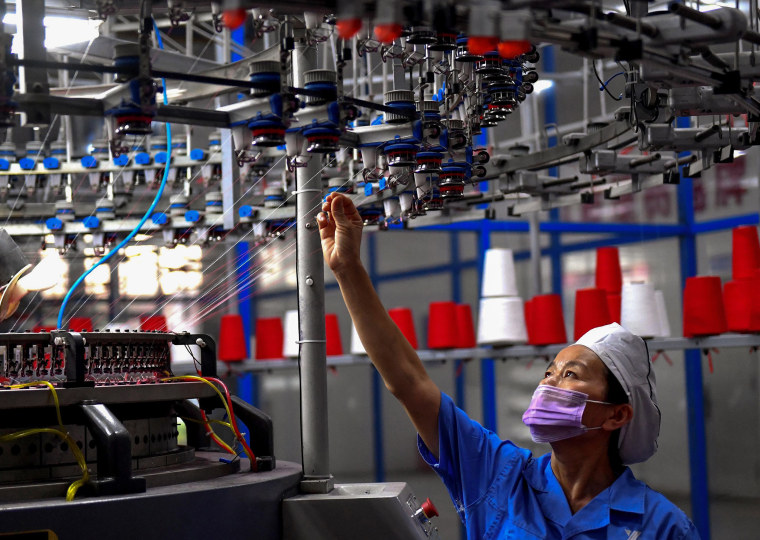
An employee monitors a circular weaving machine at a textile factory in Shangqiu, China, on Sept. 8, 2018.
More than 70 percent of U.S. firms operating in southern China are considering delaying further investment there and moving some or all of their manufacturing to other countries as the trade war bites into profits, a business survey showed on Monday.
U.S. companies operating in China believe they are suffering more from the trade dispute than firms from other countries, according to the poll by the American Chamber of Commerce in South China, which surveyed 219 companies, one-third from the manufacturing sector.
Sixty-four percent of the companies said they were considering relocating production lines to outside of China, but only 1 percent said they had any plans to establish manufacturing bases in North America.
"While more than 70 percent of the U.S. companies are considering delaying or canceling investment in China, and relocation of some or all manufacturing out of China, only half of their Chinese counterparts share the same consideration," the AmCham report said.
The trade war is shifting both supply chains and industrial clusters, mostly towards Southeast Asia, the survey found.
U.S. companies reported facing increased competition from rivals in Vietnam, Germany and Japan, while Chinese companies said they were facing growing competition from Vietnam, India, the United States and South Korea.
Customers are slowing down orders or not placing them at all, Harley Seyedin, president of AmCham South China, told Reuters.
"It could very well be that people are holding back on placing orders until times are more certain or it could very well be that they are shifting to other competitors who are willing to offer cheaper products, even sometimes at a loss, in order to get market share," he said.
"One of the most difficult things about market share is once you lose it, it is very hard to get back."
Companies in the wholesale and retail sectors have suffered the most from U.S. tariffs, while agriculture-related businesses have been most hit by Chinese measures, the survey found.
The survey was conducted between Sept. 21 and Oct. 10, shortly after the U.S. imposed tariffs on another $200 billion worth of Chinese goods. 
That prompted Beijing to retaliate with additional tariffs on $60 billion of U.S. products, escalating a tariff war between the world's two largest economies.
The U.S. duties are set to rise sharply on Jan. 1.
Both Washington and Beijing appear to be digging in for a long battle, though U.S. officials say President Donald Trump would go through with plans to meet Chinese dictator Xi Jinping at the G20 summit next month if it looked like the discussions would be positive.
Nearly 80 percent of the survey respondents said the tariffs have knocked their businesses, with U.S. tariffs having slightly more impact than the Chinese ones.
Around 85 percent of U.S. companies said they have suffered from the combined tariffs, compared with around 70 percent of their Chinese counterparts. 
Companies from other countries also reported similar impacts as their American counterparts.
The top concern of companies surveyed was the rising cost of goods sold, which resulted in reduced profits. 
Other concerns included difficulties managing procurement and reduced sales.
One-third of companies estimated the trade dispute had reduced business volumes ranging from $1 million to $50 million, while nearly one in 10 manufacturers reported high-volume business losses of $250 million or more.
Nearly half the companies surveyed also said there had been an increase in non-tariff barriers, including increased bureaucratic oversight and slower customs clearance. 
Analysts have warned of such a risk to U.S. firms as China is increasingly unable to match U.S. measures on a dollar for dollar basis.

vendredi 13 juillet 2018

New tariffs threatened by the US would be more harmful to China than the first batch

The U.S. tariffs on an additional $200 billion in Chinese goods could harm China because the targeted Chinese goods include a greater number of finished products, which can be replaced by similar ones from other sources
By Yen Nee Lee

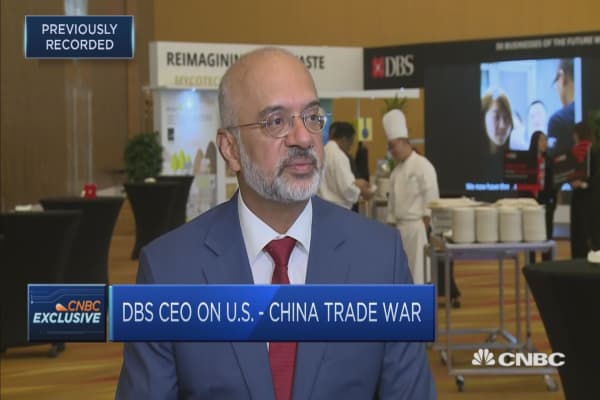
Piyush Gupta, CEO of Singapore’s DBS Bank.

The proposed U.S. tariffs on an additional $200 billion in Chinese goods would hit the world’s second-largest economy more severely than the previous custom duties did, according to the chief executive of Southeast Asia’s largest bank.
That’s because the latest list of targeted Chinese goods includes a greater number of finished products, which can be replaced by similar ones from other sources, Piyush Gupta, the CEO of Singapore’s DBS Bank, said on Friday.
The Trump administration on Tuesday said it plans to impose 10 percent tariffs on $200 billion in Chinese goods, which include refrigerators, electronics, cotton and auto parts. 
The tariffs will undergo a two-month review process, with hearings in August.
Those tariffs, if implemented, “might start biting a little bit more in terms of the volume of trade” compared to the levies on $34 billion in Chinese goods that came into effect on July 6, Gupta told CNBC’s Martin Soong at the DBS Asian Insights Conference in Singapore.
Impact from the earlier round of U.S. tariffs on the Chinese economy is limited as there aren’t many alternatives to those affected goods, he said.
“I think most of these relate to components mostly in the mobile phone and the personal computer supply chain. I think alternate sources of supply are limited,” the CEO said.
“The total impact is probably price increases of magnitude of 5 to 10 percent, my own sense is these will be passed on to the end consumer or perhaps absorbed by the supply chain. I don’t think these will reduce China’s export volume anytime soon. It’ll take at least two to three years for the supply chain to be recreated,” he added.

Trade-reliant economy already hit

Even before tensions between China and the U.S. turned into a full-blown trade war, some trade-dependent economies have experienced a slowdown in growth.
Singapore, a Southeast Asian country with one of the highest trade-to-GDP ratio in the world, said advance estimates point to its second-quarter growth missing forecasts. 
The economy is expected to expand by 3.8 percent year-over-year in the second quarter, short of the 4 percent growth estimated by Reuters.
Economists expect rising trade tensions to further threaten growth in open economies such as Singapore. 

mercredi 28 décembre 2016

Aluminum Billionaire Planning Escape From China: Lawyer

Giant aluminum stockpile in Mexico and Vietnam may represent an effort to get wealth out of China by Liu Zhongtian, chairman of China Zhongwang Holdings.
By SCOTT PATTERSON

Liu Zhongtian, chairman of aluminum giant China Zhongwang Holdings Ltd., in his office in 2009. 
A giant stockpile of aluminum that has crisscrossed the globe remains a puzzle for American executives and investigators trying to unravel the logic behind its movements.
A Dallas attorney’s correspondence suggests a surprising possibility: that the stash is a Chinese billionaire’s retirement fund.
Like all Chinese citizens, Liu Zhongtian, the 52-year-old chairman of aluminum behemoth China Zhongwang Holdings Ltd., isn’t supposed to move more than $50,000 a year out of the Communist Party-led country. 
To get around the restrictions, Chinese nationals have used Hong Kong money changers to illicitly transfer cash between bank accounts, combined their $50,000 quotas to make large-scale transfers and even carried cash across borders in suitcases.
Mr. Liu developed an industrial-scale approach involving boatloads of aluminum which he stockpiled with plans to sell the metal over time, according to the Dallas attorney’s correspondence and people who have worked for Mr. Liu whose accounts are supported by shipping and corporate records.
Mr. Liu sought to establish companies that could control his wealth outside China and set up an office in Switzerland, according to a 2012 email from attorney Herman Randow of Dallas firm Munsch Hardt Kopf & Harr.

An aerial view of the aluminum stockpile around Aluminicaste Fundición de México’s San José Iturbide plant in 2014. 

“We are at the early stages of this family office,” Mr. Randow wrote in the email reviewed by The Wall Street Journal. 
“It will not be robust until Mr. Liu retires and leaves China to live in Switzerland. That is his ultimate goal.”
A China Zhongwang spokeswoman wrote in an email that Mr. Liu “does not know this law firm, and has never had any business dealing with it.” 
She added: “We have no knowledge of the correspondence to which you refer and question its authenticity.”
A spokeswoman for Munsch Hardt Kopf & Harr said the firm doesn’t currently represent Mr. Liu “nor have we represented Mr. Liu or his interests for quite some time.” 
She said Texas ethics laws prevented her from commenting further. 
Mr. Randow, who still works for the firm, didn’t respond to requests for comment.
The law firm email is a tantalizing clue that could help explain why several large aluminum stockpiles have mysteriously popped up around the world. 
Metal caches in Mexico and Vietnam have been the subjects of Wall Street Journal articles that have traced the metals’ connections to Mr. Liu and businesses tied to him and his family.
Mr. Liu has denied any connection to the aluminum or to the companies moving it around the world. “As we have repeatedly stated, neither China Zhongwang nor Mr. Liu has connections to the ‘stockpile’ in Mexico, or the metal in Vietnam,” his company’s spokeswoman wrote.
Most of the Mexican aluminum stockpile was moved to Vietnam, according to trade records and people familiar with the matter. 
All told, about 1.7 million tons of aluminum has been stored in Vietnam since 2015 by a company co-owned by one of Mr. Liu’s business associates, according to trade and corporate records and people familiar with Mr. Liu’s business operations. 
Data provided by Global Trade Information Services, which tracks world-wide trade, values the aluminum at about $5 billion
The metal has been extruded, or turned into various shapes, for sale as products.
The stockpiles are so big that metals-industry officials have been worried they are depressing global aluminum-extrusion prices. 
The market for aluminum, like other commodities such as steel, has been plagued by a glut driven by supercharged Chinese production.

A plant owned by China Zhongwang Holdings in Liaoyang, China. 

American executives have accused Mr. Liu of routing inexpensive, government-subsidized aluminum into the U.S. through Mexico and Vietnam to avoid U.S. tariffs. 
China Zhongwang’s products have faced tariffs as high as 374% because a 2010 Commerce Department probe found the company received illegal Chinese subsidies and was “dumping”—selling aluminum products below market prices.
The Department of Homeland Security is investigating whether U.S. companies linked to Mr. Liu illegally avoided punitive import tariffs on Chinese aluminum, according to people familiar with the probe. 
In a separate investigation, the Commerce Department ruled this year that China Zhongwang had sidestepped U.S. trade sanctions by disguising its metal in a form not specifically covered by the 2010 trade restrictions.
China Zhongwang said it was no longer selling the type of aluminum targeted by Commerce.
The Dallas attorney’s email raises another possibility for the metal: Aluminum, which is commonly traded in dollars, provided a way of moving currency out of China.
In his email, the Dallas attorney, Mr. Randow, emphasized the secret nature of Mr. Liu’s plans to set up businesses outside of China and live in Switzerland.
“I want to reinforce that all this information and these relationships absolutely are confidential, and I am not typically authorized to freely disseminate this information to third parties outside of the family office,” Mr. Randow wrote.
Mr. Randow’s email was related to two Swiss companies that he said were owned by Mr. Liu: Eighty Eight Investments AG and Grand Provenance Holdings AG.
Grand Provenance is the parent of GT88 Capital, a Singapore aluminum-trading firm that shipped more than $1 billion worth of aluminum from 2010 to 2013 to a Mexican facility once owned by Mr. Liu’s son called Aluminicaste Fundición de México, according to shipping and corporate records. The GT88 shipments formed part of the Mexican stockpile under investigation by the Commerce Department, people familiar with the matter say.

Liu Zhongtian toasts the listing of the shares of China Zhongwang Holding at the Hong Kong Stock Exchange in 2009. 

Mr. Randow wrote that Grand Provenance and Eighty Eight “are simply the confidential holding companies for the family office for Mr. Liu Zhongtian.”
The companies “simply direct all his investments out of the People’s Republic of China,” Mr. Randow wrote.
The email was sent to a business associate of Mr. Liu’s in response to questions from Banque Heritage, a Swiss bank conducting due diligence on the companies as they tried to open an account.
If the bank had more questions about Mr. Liu, Mr. Randow suggested: “Google him.”
Banque Heritage declined to comment.
Mr. Liu, through a spokeswoman, denied any involvement with Grand Provenance and Eighty Eight. Mr. Liu’s main company, Liaoyang-based China Zhongwang, says it sells most of its aluminum to Chinese companies.
A U.S. attorney who has represented Mr. Liu, Charles Pok, says Mr. Liu’s name was fraudulently connected to the two Swiss companies by a former U.S. business associate named Eric Shen
“Eric Shen and Herman Randow definitely know that Mr. Liu never instructed them to establish these companies,” Mr. Pok wrote in an email.
Munsch Hardt said the firm and Mr. Randow denied Mr. Pok’s allegations. 
Mr. Shen also denied them.
American executives who have investigated the shifting stockpiles of metal say they suspected Mr. Liu may have been motivated in part by a desire to move wealth offshore. 
Even though he ultimately failed to sell large amounts of metal into the U.S., they point out that it still serves as a store of value.
Mike Rapport, who owns an aluminum business in Southern California, said an Aluminicaste salesman told him Mr. Liu planned to use the Mexican metal to fund his retirement.
Mr. Liu has made moves that indicate he may be preparing to leave China.
Last year, he paid €650,000 to become a Maltese citizen, taking advantage of a new policy introduced by Malta’s government in 2014, according to government records there. 
With Maltese citizenship, Mr. Liu can live and work in any country in the European Union. 
Chinese law forbids the country’s citizens from holding dual citizenship.
Mr. Liu also has a Social Security number in the U.S., where his family owns several homes, according to a records search.
The China Zhongwang spokeswoman said the company doesn’t comment on personal matters.
In August, Zhongwang USA LLC, controlled by Mr. Liu and affiliated with China Zhongwang, agreed to acquire Cleveland-based aluminum producer Aleris Corp. for $1.1 billion, which would mark the highest price ever paid by a Chinese firm for a U.S. metals producer.