Affichage des articles dont le libellé est New York Times. Afficher tous les articles

mercredi 28 août 2019

American Quisling: LinkedIn is helping China recruit spies overseas

  • Chinese spies is using LinkedIn to seek out potential new foreign recruits.
  • LinkedIn is ideal for espionage recruitment because it’s a platform where millions of Americans are looking for jobs.
By Yen Nee Lee


Social networking application LinkedIn.

Chinese spies have been using LinkedIn — the only major American social media platform not blocked in China — to seek out potential new foreign recruits, The New York Times reported on Tuesday.
LinkedIn is ideal for espionage recruitment because it’s a platform where millions of people are looking for jobs, the report said. 
Typical targets are academics and people outside China who have just left their government jobs, according to the Times, which interviewed former diplomats and intelligence experts.
One way Chinese agents use LinkedIn is by pretending to be corporate headhunters, the Times reported. 
Under that guise, they reach out to potential recruits and offer to pay for a trip to China for speaking or consulting opportunities, adding that relationships are developed from there.
A LinkedIn spokeswoman told CNBC the company declined to comment.
The Times is not the first media organization to report on Chinese agents using LinkedIn for espionage recruitment. 
Reuters last year reported U.S. intelligence and law enforcement officials warning about China’s “super aggressive” activities on the platform.

mercredi 23 mai 2018

Cultural Genocide

Tibet activist jailed in China over language campaign
BBC News
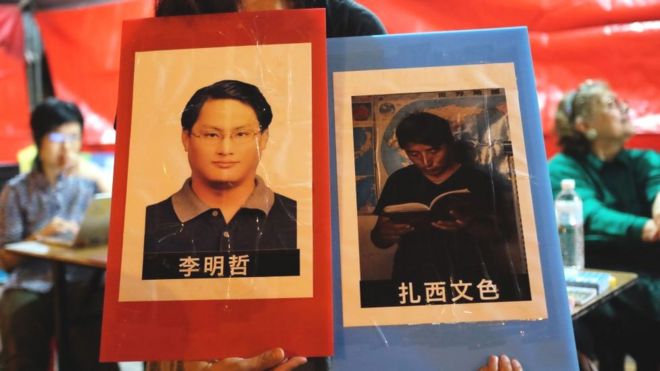
A volunteer holds placards of detained Taiwanese activist Lee Ming-cheh (L) and Tibetan education advocate Tashi Wangchuk (R)

A Tibetan activist has been jailed for five years in China for "inciting separatism," after he spoke to the New York Times about efforts to preserve his native language.
Tashi Wangchuk was arrested in 2016, after featuring in a video by the newspaper.
In the interview, he spoke of his fear that Tibetan culture was being destroyed in China.
Amnesty International denounced the verdict as "beyond absurd".
Tashi, who pleaded not guilty to the charges, will be due for release in 2021.
His lawyer told the AFP news agency that he planned to appeal the decision.
"I believe he committed no crime and we do not accept the verdict," Liang Xiojun told AFP.
Tashi appeared in a New York Times documentary in late 2015, where he voiced concerns that Tibetan culture was being destroyed in China.
He attempted to file a lawsuit in Beijing against local officials in his hometown, Yushu, saying they were sidelining the Tibetan language in favour of Mandarin in schools.
Mr Liang told reporters at Tashi's trial earlier this year that the video was used as a key piece of evidence by the prosecution.
"He doesn't believe he's incited separatism," Mr Liang said. 
"He only wants to strengthen Tibetan language education."
Joshua Rosenzweig, East Asia research director at Amnesty International called the verdict a "gross injustice".
"He is being cruelly punished... To brand peaceful activism for [the] Tibetan language as 'inciting separatism' is beyond absurd," he said in a statement.
Tibet, a remote and mainly Buddhist territory known as the "roof of the world", is governed as an "autonomous" region of China.
Rights groups say China continues to violate human rights, accusing Beijing of political and religious repression.

mercredi 10 janvier 2018

Cultural Genocide

How China Used a Times Documentary as Evidence Against Its Subject
By JONAH M. KESSEL

Last week, Tibetan activist Tashi Wangchuk was tried in Yushu Tibetan Autonomous Prefecture, Qinghai on charges of “inciting separatism” after he appeared in a New York Times video about his fight to preserve the Tibetan language, which faces extinction due both to government efforts to enforce Mandarin learning and to economic pressures to learn the national tongue. No verdict has yet been announced, but the charges against him could bring a sentence of up to 15 years. CDT cartoonist Badiucao pays tribute to Tashi by depicting a snow lion, the traditional emblem of Tibet, with a muzzle over its mouth

During the eight years I lived in China, people would often say they felt as if they had no voice under Communist Party rule. 
This was especially true for minorities.
So when Tashi Wangchuk, a Tibetan herder turned shopkeeper, showed up at my apartment in Beijing in the spring of 2015, I of course wanted to listen to his story.
He told me the Chinese authorities on the Tibetan Plateau had been slowly eradicating the Tibetan language from schools and the business world. 
Mr. Tashi believed prohibiting the study of the Tibetan language went against China’s constitution.
The New York Times was not Mr. Tashi’s first stop in his attempt to raise this issue, I learned. 
Chinese state-controlled media had refused to listen to him. 
And years earlier, the Chinese authorities had briefly jailed him for expressing his opinions on social media. 
Foreign media were his last resort to be heard.
Last week, more than two years after our first meeting, Mr. Tashi was tried in court for “inciting separatism,” a criminal charge that largely amounts to seeking independence from the Chinese state. No verdict has come down yet, but the sentence could hold a punishment of 15 years in prison. (For those hoping for an acquittal, it’s important to note that China’s courts have a 99 percent conviction rate.)
But the root of his crime was talking to me.
In 2015, after I met Mr. Tashi, I made a nine-minute film for The Times about his efforts to raise the issue of Tibetan education to the central government and Chinese state media. 
Last week, that documentary was shown in court as the main evidence that Mr. Tashi was inciting separatism.
The use of my film as evidence against Mr. Tashi gets at the heart of one of the thorniest issues that can plague foreign journalists: How do we justify instances when our work — aimed at giving voice to the voiceless and holding the powerful to account — ends up putting its subjects at risk or in danger?

Protesters gathered outside the Chinese Embassy in London on the first anniversary of Mr. Tashi’s detention.

Before I made this documentary, Edward Wong — then The Times’s Beijing bureau chief — and I talked at length with Mr. Tashi about the risks he assumed in speaking with us and appearing on video.
Mr. Tashi thought that people wouldn’t believe his story if they couldn’t see him. 
I agreed that it wouldn’t hold the same power. 
He believed he was acting within the guidelines of the law. 
I believed in giving him the agency the Chinese government and state media had refused him. 
He believed his voice must be heard at all costs.
But for Mr. Tashi, speaking out has come at a price.
In early 2016, Mr. Tashi — who specifically told me that he was not advocating Tibetan independence — was kidnapped and held in secret detention, without contact with lawyers and family members for months on end. 
He was subjected to constant interrogation
For two years, he has waited in jail, silenced.
But along with his struggles came renewed hope in a story long plagued by news fatigue: The international community began speaking up for Mr. Tashi and his cause.
United Nations officials, Human Rights Watch, Amnesty International, PEN America and the United States Embassy in Beijing have all publicly criticized the Chinese government over the case. 
Last March, the European Union and Germany voiced concerns at the United Nations Human Rights Council over Mr. Tashi’s arrest. 
His case has been covered by countless publications around the world, and his arrest has transformed him from an ordinary shopkeeper with a fifth-grade education into a cultural icon of both justice and oppression.

Protesters gathered in support of Mr. Tashi outside the Chinese consulate in New York on Monday.

One of Mr. Tashi’s lawyers told us that community members in Yushu, his hometown, had said that Mr. Tashi had “made a big impact on local Tibetans” and that “people admire him.”
The International Tibet Network awarded him the Tenzin Delek Rinpoche Medal of Courage, recognizing his “courage and dedication to promoting Tibetan human rights and justice for the Tibetan people.”
Meanwhile, some have asked me if I regret making my film. 
I’ve fielded a variety of queries on the topic — from Tibetan advocacy groups, journalists, students, press freedom groups and social media. 
Some have been critical, saying I shouldn’t have made the documentary. 
A former State Department official raised the question of whether I am “complicit in exposing a person vulnerable for his ethnicity.”
I’ve struggled with some of these issues on my own. 
I’ve wondered: Is our discussion of Tibetan rights worth more than a decade of one man’s freedom? Has Mr. Tashi’s arrest ultimately furthered his cause?

Protesters from @SFTHQ demanding the release of #TashiWangchuk are outside of the Chinese consulate in New York City

These are important and difficult questions. 
And while I don’t have definite answers, I do know this: Mr. Tashi and his concerns are now being acknowledged throughout the world. 
On Monday, protesters gathered outside the Chinese consulate in New York City to demand language rights for all Chinese — as well as the release of Mr. Tashi. 
Similar gatherings have happened in London. 
A political cartoonist in Australia has turned his message into pop art
His voice, at last, is resonating on an international stage.
I know, too, that Mr. Tashi has asked these kinds of questions himself and that he came to his own conclusions: that language rights are human rights, that they are protected by both China’s constitution and international human rights law, and that it was his duty to help protect his culture, no matter the cost.

mardi 10 janvier 2017

Apple aids and abets Big Brother in China

Lack of transparency in pulling New York Times app adds to Orwellian nature of move 
By Tom Mitchell in Beijing

Most people old enough to have watched the 1984 Super Bowl will not remember the two American football teams that played in it.
They will probably remember “The Commercial”.
In the annals of the NFL playoffs, it is almost as famous as “The Catch” — an improbable end zone grab by the San Francisco 49ers’ Dwight Clark in the 1982 NFC Championship game.
During a break in the third quarter of Super Bowl XVIII, as the Los Angeles Raiders were running up the score on the Washington Redskins, CBS broadcast an Apple advertisement for its new Macintosh computer.
Directed by Ridley Scott, the 60-second spot featured an athlete hurling a sledgehammer into a giant screen on which Big Brother was hypnotising the masses.
The screen explodes, symbolising Apple’s assault on what it regarded as the bland conformity of the emerging personal computer industry. 
Titled “1984” in honour of George Orwell’s novel of the same name, it is today regarded as one of the best television commercials of all time.
It is also sadly ironic in light of recent events in China, where Apple has decided to aid and abet Big Brother. 
Last week, Apple confirmed it had pulled the New York Times app from its online store in China, where the newspaper’s website has been blocked by censors since 2012.
The app was the only way China-based readers could access New York Times content, including articles translated into Mandarin, without having to use special software that is expensive for the average Chinese internet user and often unreliable.
At first glance, Apple had no choice but to comply with the Chinese government’s directive.
China’s smartphone market, the world’s largest, accounted for 20 per cent of its sales — or $8.8bn — in the third quarter of last year.
The California company’s supply chain is also deeply rooted in China.
When running at full tilt, an iPhone manufacturing facility operated by Foxconn in Zhengzhou, Henan province, can produce 1m handsets every two days.
The Chinese government’s leverage over Apple is enormous.
But so is Apple’s leverage over the Chinese government, should it be brave — and wise — enough to use it. 
At a time when Beijing is simultaneously attempting to spur slowing economic growth and halt capital outflows, it badly needs foreign investment and the jobs it creates. 
The iPhone manufacturing facility in Zhengzhou is a high-tech jewel in a relatively poor, inland province, otherwise blighted by twilight heavy industries and chronic pollution.
Foxconn also recently announced it would spend $8.8bn on a flat-panel display factory in the southern city of Guangzhou.
It may well be that Apple quietly fought the good fight before yielding to the authorities’ demand to pull an app that was allegedly “in violation of local regulations”.
But in confirming the decision, Apple could have at least specified what regulations the New York Times app had supposedly violated.
It did not and the lack of transparency surrounding the affair has only added to the Orwellian nature of Apple’s surrender. 
It is a disappointing outcome for a company whose remarkable run, from 1980s iconoclastic outsider to the world’s most valuable company 30 years later, began with such a bold statement.

samedi 7 janvier 2017

Apple is the world leader in globalizing Chinese and Foxconn censorship

Apple blocks New York Times in China after paper probes Chinese subsidies given to iPhone maker’s partner Foxconn
By MATTHEW SHEFFIELD


Apple has officially blocked the New York Times from the Chinese edition of its mobile application market.
This move followed a Chinese government ruling that appears to have been sparked by the newspaper’s reporting on massive subsidies provided to Apple’s top manufacturing partner by the People’s Republic.
The ban went into effect on Dec. 23, when Apple formally removed the Times’ English- and Chinese-language programs from its app store for users in mainland China. 
It was not announced by the newspaper until this week, presumably because the Times sought to reverse the decision.
In a statement released to the Times, Apple spokesman Fred Sainz said that the paper had been banned from the app store because it had somehow run afoul of unspecified Chinese laws.
“For some time now the New York Times app has not been permitted to display content to most users in China and we have been informed that the app is in violation of local regulations,” Sainz said in the statement.
“As a result, the app must be taken down off the China App Store. When this situation changes, the App Store will once again offer the New York Times app for download in China.”
The newspaper’s website has been blocked by China’s infamous “Great Firewall” censorship regime since 2012, when it published several reports about the vast wealth of the family of Wen Jiabao, who was at the time the ostensibly Communist nation’s country’s prime minister.
Tom Grundy, editor-in-chief of the Hong Kong Free Press, condemned the move on Twitter, describing it as “Apple eagerly assisting Beijing’s blatant censorship.”
But Apple, the world’s most valuable company by market capitalization, is far from the only major technology firm willing to comply with Beijing’s demands in order to do business in China.
According to former Al Jazeera journalist Melissa Chan, “every single US tech company in China makes compromises in order to enter the market.”
She gave several examples in an essay for the Guardian, including social network LinkedIn, note-taking service Evernote and Microsoft. 
Google is one of the few American tech firms unwilling to comply, opting instead not to do business in China. 
It completely exited the country in 2010.
“But if anybody had hoped Google’s defection would launch an exodus, it never happened,” Chan wrote.
“Since then, Chinese censorship and attempts to control foreign companies have only become more odious, with no indication it will let up.”
According to Wikipedia, about 3,000 major websites are currently banned within China.
The Times apps were blocked by Beijing due to a story that reporter David Barboza was working on about the massive subsidies and other inducements that the Chinese government provides to Foxconn, a Taiwanese firm which is Apple’s manufacturing partner and the largest private employer in China.
According to the Times, Barboza contacted Apple on Dec. 23 for comment about his report. 
Within hours, the newspaper’s management was informed by the iPhone maker that its apps had been blocked for users with billing addresses within mainland China.

The Dirty Four

Apple is not the only tech company kowtowing to China’s despots.
There is rightly outrage at Apple removing the New York Times app from its Chinese store. 
Now let’s take a look at LinkedIn, Evernote and Microsoft.
By Melissa Chan

‘One online advocacy organization labelled Apple the “world leader in globalizing Chinese censorship”.’

News of Apple pulling the New York Times app from its store in China has been met with the expected outrage on social media.
One online advocacy organisation labelled Apple the “world leader in globalising Chinese censorship”. 
Tom Grundy of Hong Kong Free Press, an independent online news outlet, tweeted that Apple was now “eagerly assisting” in censorship
And the New York Times’s own correspondent, Chris Buckley, asked on Twitter whether Apple owed an explanation to the paper’s Chinese readers.
I have experience with Chinese censorship, as both target and witness of it.
As a reporter there for five years, I – along with the rest of the foreign press corps – often faced attempts at both the local and national level to interfere with and stop our coverage.
And as someone who happened to be in China when social media and cloud-based technology started taking off, I also wrote many stories on China’s moves to block Facebook, Twitter and Google. Here’s a list of major websites blocked in the country.
As much as I have spoken up against Chinese censorship, and as often as I berate Mark Zuckerberg’s blatant kowtowing in order to get Facebook back into China, I actually think we should hold some of our fire, or at least stop short of singling Apple out as the worst offender.
I say this as someone who has also covered Silicon Valley as a Bay Area-based correspondent.
In the United States, Apple has a strong track record as an industry leader against government attempts to access users’ data.
It has butted heads directly with the Obama administration over issues of privacy and security, calling it a fight for civil liberties.
It has taken unpopular positions, including refusing to cooperate with the FBI to help agents read the encrypted data from domestic terrorist Syed Farook’s iPhone.
This is a technology company that has appeared to have at least tried, at times, to do the right thing.
Of course, Apple has not manufactured iPhones in China without scandal.
From stories of factory workers being made ill by the chemicals used to make iPhone touch screens, to a spate of suicides at a manufacturer’s campuses, Apple’s record is checkered.
Apple only shoulders responsibility when it also happens to improve the company’s bottom line, or when it’s easy. 
In the United States, Apple has recourse to a functioning legal system to launch its battles.
In China, where the rule of law is weak, it means a much tougher environment and far fewer options when the company disagrees with government decisions.
The situation is complicated by the tremendous leverage the Chinese government has over Apple. 
Not only is the iPhone manufactured there, but sales of Apple products in China account for a quarter of its global revenue.
Apple has not explained its latest decision and which law the New York Times fallen foul to.
The newspaper has a Chinese-language edition of its paper.
In 2012, Beijing blocked both the Chinese and English-language websites, but readers could continue reading articles if they downloaded the apps to their iPhones.
Now, Apple has removed both English and Chinese-language apps from its store, making it impossible to read the New York Times unless users know how to employ circumvention tools.
Maybe the larger the company, the more scrutiny it should receive.
In that spirit, Apple’s decision to pull the apps deserves full moral fury.
But keep in mind that every single US tech company in China makes compromises in order to enter the market.
LinkedIn restricts its content
Evernote, like Apple, stores Chinese account holders’ data on Chinese servers so that authorities may access the information. 
Microsoft censors
None of this is right.

Tom Grundy of Hong Kong Free Press, an independent online news outlet, tweeted that Apple was now “eagerly assisting” in censorship.
Few foreign companies have taken the moral stand that Google did by exiting China. 
I remember when the company made that decision.
Supporters of a more open China dropped off flowers outside its Beijing offices, excited that it had made such a bold move.
But if anybody had hoped Google’s defection would launch an exodus, it never happened.
Since then, Chinese censorship and attempts to control foreign companies have only become more odious, with no indication it will let up. 
Apple’s problem today, is another foreign company’s conundrum tomorrow.
Its dependance on China serves as a case study for how the story will repeatedly, dismally play out. All this stops only when the financial incentives to do business in China, and with China, disappear.

jeudi 5 janvier 2017

Kowtowing to China’s despots

Apple pulls New York Times app from its China store — acting on Beijing’s orders
By Simon Denyer 

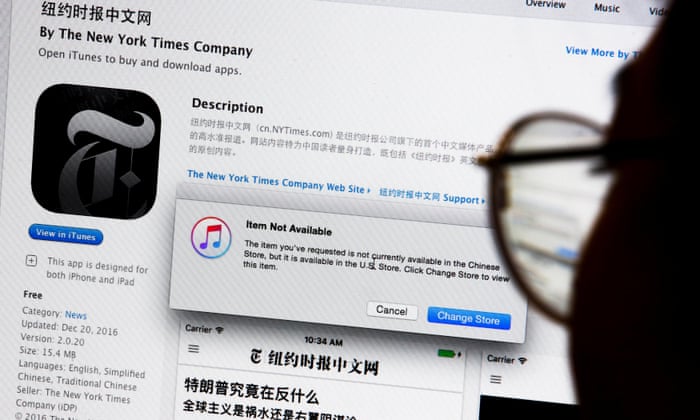
An illustration shows a person looking at a computer screen in Beijing showing an Apple iTunes store message saying that the New York Times app is not available. 


Apple has removed the New York Times app from its digital store in China, acting on what it says were orders from the Chinese government.
The news underlines how American information technology companies are being forced to play by China’s rules if they want to do business here — even at some cost to their reputation in the West. 
It is also another example of how the noose is gradually tightening under the world’s largest system of censorship known as the Great Firewall of China.
But it also comes as China redoubles its own efforts to spread the Communist Party’s message far and wide across the world, including in the United States.
The New York Times, which offers content in both English and Chinese, is one of a growing number of foreign news organizations whose content is blocked in China.
Readers can only access content by using special software to bypass the Great Firewall. 
The latest move throws up another barrier for Chinese readers, especially new customers. 
The app is available in Apple stores in Hong Kong and Taiwan, for example, but users need a credit card billing address outside mainland China to download it, the Times reported.
“For some time now the New York Times app has not been permitted to display content to most users in China and we have been informed that the app is in violation of local regulations,” Apple spokesman Fred Sainz told the Times. 
“As a result, the app must be taken down off the China App Store. When this situation changes, the App Store will once again offer the New York Times app for download in China.”
The Times said the app had been removed from Apple stores on Dec. 23, and appears to have been made under regulations issued last June preventing mobile apps from engaging in activities that endanger national security or disrupt social order.
The Washington Post’s website is not blocked in China, and its English-language app is available on the Apple store, but many other news organizations are blocked. 
Here’s a graphic tracking the blocking of 18 major news websites in China over time produced by ProPublica.
The Times said it had asked Apple to reconsider its decision. 
Criticism also rained down online.
As my colleagues Emily Rauhala and Elizabeth Dwoskin reported last month, California’s Internet companies may have once dreamed of liberating China through technology, but these days they seem more willing than ever to play the Communist Party’s game; case in point, news that Facebook is developing a censorship tool that many interpreted as an attempt to get its service unblocked here.
The news of the Times’ app being blocked was not reported by Chinese media, but filtered through to a few Netizens.
“We are closing our doors to the outside world,” lamented one user of weibo, China’s equivalent of Twitter.
“This is a restoration of the Cultural Revolution or another historical retrogression,” said another.
The news also comes as China Central Television (CCTV), a propaganda arm of the Communist Party and the country’s largest TV network, launched a new global platform on New Year's Day to try to improve China’s image overseas.
In a congratulatory letter, Xi Jinping urged the newly launched China Global Television Network to “tell China's story well, spread China's voice well, let the world know a three-dimensional, colorful China, and showcase China's role as a builder of world peace.”
The Washington Post is one of many Western newspapers that carries a regular paid supplement by China Daily, another Communist Party mouthpiece.