Affichage des articles dont le libellé est Vatican. Afficher tous les articles

vendredi 28 décembre 2018

The world must stand against China’s war on religion

By Chris Smith

Muslim protesters outside China's embassy in Jakarta, Indonesia, on Dec. 21. 

Mihrigul Tursun said she pleaded with God to end her life as her Chinese jailers increased the electrical currents coursing through her body. 
Tursun, a Muslim Uighur whose escape led her to the United States in September, broke down weeping at a Nov. 28 congressional hearing as she recounted her experience in one of China’s infamous political “ re-education centers. ”
It is an appalling story but one that is all too familiar as existential threats to religious freedom rise in Xi Jinping’s China. 
The world can’t ignore what’s happening there. 
We must all stand up and oppose these human rights violations.
The ruling Chinese Communist Party has undertaken the most comprehensive attempt to manipulate and control — or destroy — religious communities since Mao Zedong made the eradication of religion a goal of his disastrous Cultural Revolution half a century ago. 
Now Xi, apparently fearing the power of independent religious belief as a challenge the Communist Party’s legitimacy, is trying to radically transform religion into the party’s servant, employing a draconian policy known as sinicization.
Under sinicization, all religions and believers must comport with and aggressively promote communist ideology — or else.
To drive home the point, religious believers of every persuasion are harassed, arrested, jailed or tortured
Only the compliant are left relatively unscathed.
Bibles are burned, churches destroyed, crosses set ablaze atop church steeples and now, under Xi, religious leaders are required to install facial-recognition cameras in their places of worship. 
New regulations expand restrictions on religious expression online and prohibit those under age 18 from attending services.
Government officials are also rewriting religious texts — including the Bible — that remove content unwanted by the atheist Communist Party, and have launched a five-year sinicization plan for Chinese Protestant Christians.
These efforts have taken a staggering human toll. 
In recent months, more than 1 million Uighurs and other Muslims in the East Turkestan colony have been detained, tortured and forced to renounce their faith. 
The U.S. government is investigating recent reports that ethnic minorities in internment camps are being forced to produce goods bound for the United States.
Yet, despite this anti-religion campaign, the Vatican has shown a disturbing lack of alarm concerning these threats and, instead, appears to be seeking a form of accommodation. 
In September, Vatican officials signed a “provisional agreement” that essentially ceded to the Chinese government the power to choose — subject to papal review — every candidate for bishop in China, which has an estimated 10 million to 12 million Catholics.
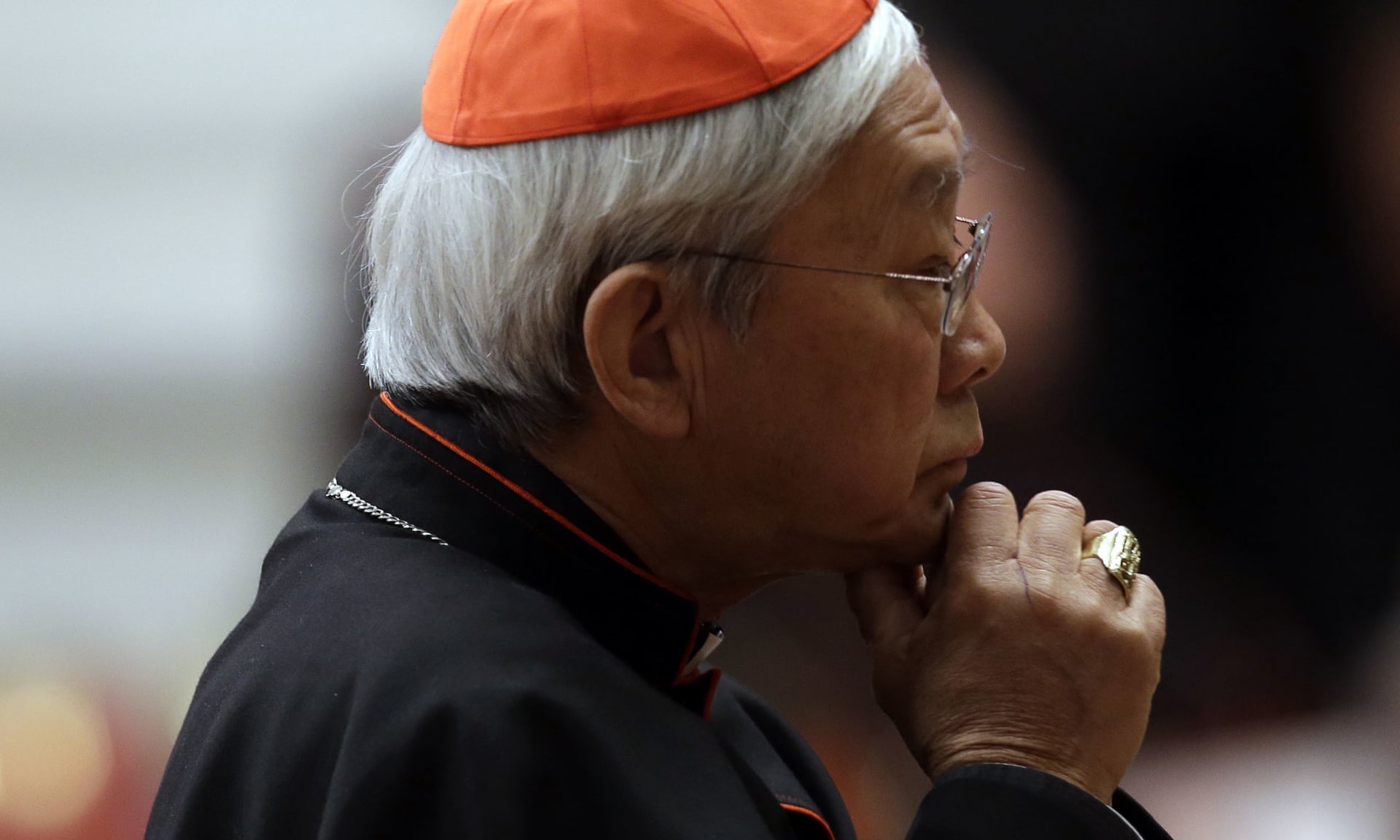
Cardinal Joseph Zen Ze-kiun, a retired bishop of Hong Kong, in September called the deal “a complete surrender” by the Vatican and an “incredible betrayal” of the faith.
At a congressional hearing I chaired in September, Tom Farr, president of the Religious Freedom Institute, testified that the government-controlled body charged with carrying out the policy, the Catholic Patriotic Association, had drafted an implementation document containing the following passage: “The Church will regard promotion and education on core values of socialism as a basic requirement for adhering to the Sinicization of Catholicism. It will guide clerics and Catholics to foster and maintain correct views on history and the nation.”
One can hope that Beijing has made concessions to the church that have yet to be revealed. 
Since the agreement was reached, underground priests have been detained, Marian shrines destroyed, pilgrimage sites closed, youth programs shuttered, and priests required to attend reeducation sessions in at least one province.
The Vatican should reconsider its arrangement with the Chinese government. 
But what can be done more generally in response to Xi’s war on religion? 
The United States and several European countries have condemned it, but any nation that values freedom of religion should unite in denouncing China’s treatment of Muslim Uighurs, Christians, Tibetan Buddhists and Falun Gong practitioners. 
In particular, Muslim-majority countries, strangely muted regarding the persecution of Muslim Uighurs, must protest these abuses even at the risk of endangering the benefits from China’s “Belt and Road”infrastructure projects.
Sen. Marco Rubio (R-Fla.) and I have urged the Trump administration to use Global Magnitsky Act sanctions to target Chinese officials responsible for egregious human rights abuses. 
We have sought expanded export controls for police surveillance products and sanctions against businesses profiting from the forced labor or detention of Uighurs. 
We have also introduced the bipartisan Uyghur Human Rights Policy Act of 2018 to provide the administration with new tools to comprehensively address the abuse.
The United States must lead the way in letting the Chinese Communist Party know that taking a hammer and sickle to the cross and enslaving more than 1 million Uighurs in an effort to erase their religion and culture are destructive, shameful acts that will not be tolerated by the community of nations.

jeudi 6 décembre 2018

China Reneges on Its Deals. The Vatican Is Learning That the Hard Way.

The disappearance of a bishop is an object lesson in interacting with Beijing.
By BETHANY ALLEN-EBRAHIMIAN
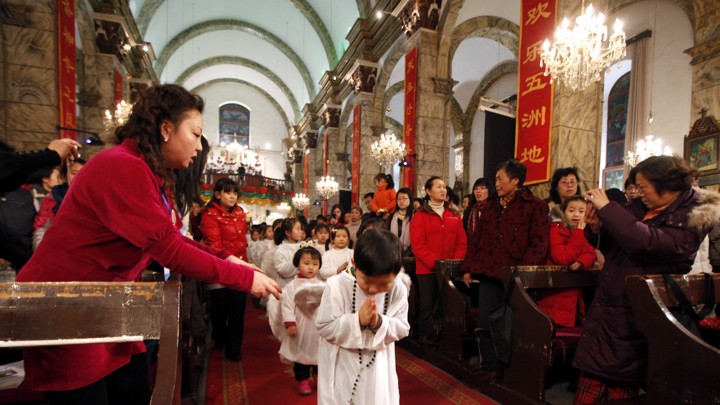
Children walk down the aisle during Christmas Mass at a Catholic church in Beijing.
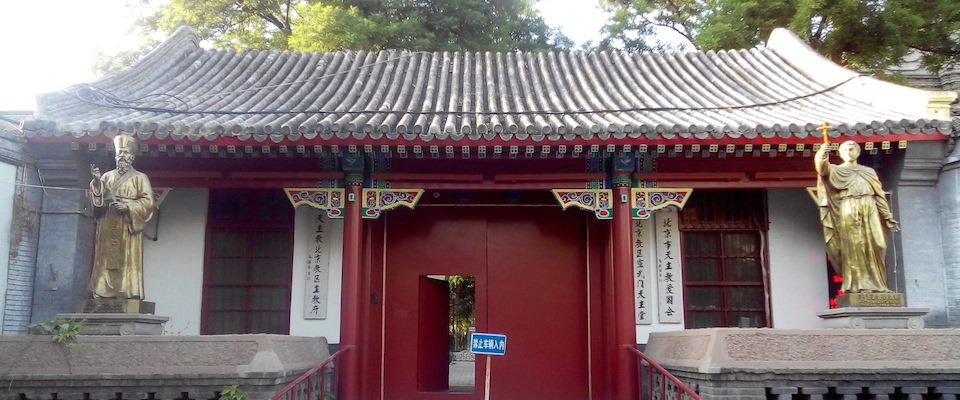
As China’s economic and military power has expanded over the past decade, Beijing has shown a proclivity to renege on agreements and to make access to its markets conditional on acceding to its shifting demands. 
Countries, companies, and international organizations have found it difficult to push back.
The Vatican, as both a state and the spiritual head of a major international institution, is now grappling with this challenge. 
In September, the Holy See inked a provisional agreement with Beijing in an attempt to mend an almost 70-year-old schism. 
Vatican leaders argued that the deal would promote unity. 
They insisted that it would enable them to better minister to their Catholic flock in China. 
They dismissed concerns that it constituted “selling out” to a repressive government.
Then a Chinese bishop disappeared
The suspected arbitrary detention of a Vatican-appointed priest last month has reinforced worries that Beijing won’t ease its pressure on the Church but will instead use the deal to push for even more control.
The implications stretch well beyond the religious sphere—in fact, the Vatican deal is a broader object lesson in the costs of doing business with Beijing. 
If China is willing to backtrack on its agreement with the Vatican, that bodes poorly for foreign governments, international companies, and other organizations involved in dealmaking with the country.
Since the Vatican and Beijing broke diplomatic ties in 1951, the Church in China has been divided into official state-sanctioned Catholic places of worship with bishops appointed by Beijing, and underground churches whose leaders are secretly appointed by the Vatican but not officially recognized by the Chinese Communist Party. 
CCP authorities have harassed and detained underground clergy, and the dueling bishoprics have caused confusion and division among the laity. 
The pope has not been allowed to visit China or even to enter its airspace.
Vatican leadership suspects that the schism is one reason for Catholicism’s stagnant growth in China. There are about 10 million Chinese Catholics (though estimates vary), a number that has remained relatively steady in recent decades while the number of Protestant Christians has risen dramatically, reaching up to 100 million by some counts
That was a major motivation for the deal, which has been under discussion since 2014.
Under the terms of the agreement, which has not yet been fully made public, Francis has recognized seven party-appointed bishops, while Beijing has in turn recognized a portion of the formerly underground Vatican-appointed ones. Wenzhou
In the future, the Holy See is expected to reach a compromise with Beijing over new appointments, in an arrangement that gives the CCP control over who is selected.
But then last month, Shao Zhumin, a Vatican-appointed bishop of the eastern city of Wenzhou, who remains unrecognized by Beijing, disappeared
It was the latest in a string of detentions that Shao has faced in recent years. 
Some Chinese Catholics had naively hoped that such arbitrary arrests, a relatively common occurrence for underground priests, would end after the agreement was reached.
“The government has not given up its hope for control. They want the Church to be another tool of the state,” Paul Mariani, a Jesuit priest who researches Chinese religious policy at Santa Clara University, told me. 
“That’s common in China, across labor unions or NGOs—they all have to fall under the party at some level.”
Shao’s disappearance has, so far at least, seemed to vindicate the deal’s naysayers. 
Critics have accused the Vatican of giving in to an atheist, communist government with a long history of persecuting the faithful. 
Joseph Zen, the retired cardinal of Hong Kong and a fierce critic of the CCP, called the agreement “an incredible betrayal,” accusing the Holy See of “giving the flock into the mouths of the wolves.”
Sophie Richardson, the China director of Human Rights Watch, told me, “Watching a major world faith come to an agreement with an authoritarian government that’s notorious for repressing religious freedom and to effectively cede some authority to that government sets a very worrying precedent.”
The deal comes as the religious-freedom environment in China has reached its worst level in years, as the government has detained 1 million Muslim citizens in illegal detention camps, banned online Bible sales, increased control over churches and temples, and sought to incorporate party ideology directly into religious doctrine.
“The pope has effectively given Xi Jinping a stamp of approval when the latter’s hostility to religious freedom couldn’t be clearer,” Richardson said, referring to the Chinese president.
It’s not just domestic and religious groups that have felt the tightening grip of the Communist Party. International companies are forced to hand over their proprietary technology in order to do business in China. 
The Chinese government blocks the websites of businesses that do not abide by its tough online censorship laws, leading major companies such as Apple and LinkedIn to comply with official demands to remove certain content. 
In April, Beijing demanded that international air carriers change their website language regarding Taiwan to bring it in line with the Chinese government’s position that the self-governing island democracy is a Chinese province, threatening consequences for airlines that did not comply by a given deadline (to date, almost all airlines have complied).
“It’s hard to imagine China putting as much pressure on those organizations 20 years ago,” said Rush Doshi, a postdoctoral researcher specializing in China at the Brookings Institute. 
“It was afraid of the commercial and international backlash. Now there is less concern about the backlash because China is bigger and more powerful. They couldn’t afford to adopt that attitude when their economy was far smaller than that of the United States.”
In recent years, the CCP has also applied similar pressure to major international institutions such as the United Nations, seeking in some cases to change the very nature of liberal bodies to more closely resemble its own illiberal preferences. 
China has sought to erode human-rights enforcement at the United Nations by packing hearings with pro-Beijing participants, offering generous investment deals to countries in exchange for their support, and blocking activists from entering UN grounds.
“Everyone is being forced to play by Chinese government rules,” said Shanthi Kalathil, who directs the International Forum for Democratic Studies at the National Endowment for Democracy. “Increasingly, we see the Chinese government trying to impose its own definition and its own rules on international institutions and other governments. And that extends to governments such as the Vatican, it extends to arenas such as the UN, and to Chinese government bilateral relations with other countries.”
And in some cases, even when an equitable deal has been reached, the party has demonstrated a growing willingness to backtrack on commitments.
In 2015, for example, Xi reached two agreements with President Barack Obama—to reduce cyber-hacking attempts and to cease China’s militarization in the South China Sea. 
Despite these high-profile deals, however, the Chinese navy continued to build military facilities in contested waters in the South China Sea. 
And in October, the U.S. government revealed that Chinese-sponsored cyber-hacking attempts on U.S. targets had once again surged.
“If China can renege on a deal with a superpower—over hacking and over the South China Sea—then it can renege on deals with middle powers or small countries without fear of consequence,” said Doshi.
Xi has spent his six years as president strengthening the party’s grip over every aspect of Chinese society and cracking down harshly on any organization that could potentially compete for the loyalty of Chinese citizens, particularly targeting religious groups.
From that perspective, the agreement with the Vatican is the party’s attempt to finally eliminate the gray area in which underground churches have long operated, rather than a desire to cede partial control over bishop appointments to a foreign head of state thousands of miles away.
“How many times have we seen this movie?” asked Richardson.
“I’m not sure why the pope and the Vatican will succeed when many others have not.”

lundi 24 septembre 2018

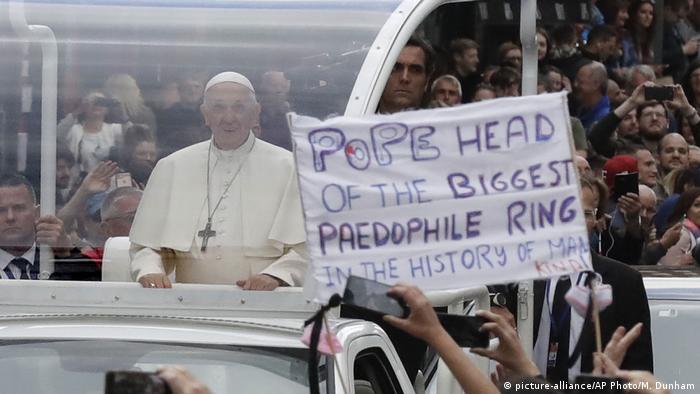
Xi Jinping's Pope

Another Vatican Diplomatic Blunder on the 85th Anniversary of the Reichskonkordat
By GEORGE WEIGEL


The malfeasant Francis

Eighty-five years ago, on July 20, 1933, a concordat defining the legal position of the Catholic Church in the Third Reich was signed by Vatican secretary of state Cardinal Eugenio Pacelli (later Pope Pius XII) and German vice chancellor Franz von Papen.
The Reischskonkordat was then ratified by the Nazi-dominated German parliament some six weeks later, on September 10. 
Pope Pius XI, under whose authority Cardinal Pacelli had negotiated this treaty, was under no illusions about German National Socialism.
And unlike some Vatican diplomats who seem to have imagined that the Third Reich would be a short-run thing, the pope likely thought that Hitler and his gangsters would be in power for some time. 
So he wanted to negotiate legal protections for the Church so that it could operate pastorally under a totalitarian regime that, with the passage of the notorious “Enabling Act” of March 23, had assumed virtually dictatorial powers. 
That one condition for the Reichskonkordat was the de facto destruction of the Catholic-based Center Party was evidently a price Pius XI thought worth paying if the result were the protection of Catholic institutions and pastoral life.
This legal-diplomatic strategy — which seems to have been based on the belief that even a totalitarian regime would honor a treaty commitment — didn’t work. 
The Third Reich began violating the Reichskonkordat shortly after the ink dried on the treaty. 
Then after some two dozen stiff diplomatic notes to Berlin (drafted by Pacelli) had not produced results, an irate Pius XI issued the encyclical Mit brennender Sorge [With Burning Concern] in 1937, had it clandestinely printed in Germany, and ordered that it be read from all German pulpits. 
In the encyclical, Pius denounced an “idolatrous cult” that replaced belief in God with a “national religion” and a “myth of race and blood,” and his stress on the perennial value of the Old Testament made it quite clear what he thought of the Nazi swastika and what it represented.
It is beyond ironic, and it borders on the scandalous, that the lesson of this debacle — paper promises mean nothing to totalitarians — has not been learned in the Vatican, which now appears to be on the verge of repeating its mistake by completing a deal with the government of the People’s Republic of China, on the 85th anniversary of the Reichskonkordat.
Vatican sources are calling the deal “a historic breakthrough,” but the only thing “historic” about it is the inability of Vatican diplomacy to learn from history. 
To make matters worse, others in the Vatican are conceding that the deal is “not a good agreement” but then go on to suggest that it might pave the way for something better in the future. 
Really? 
Haven’t we been down that road before? 
Isn’t the failed Reichskonkordat a cautionary tale? 
Is history taught at the Pontifical Ecclesiastical Academy, the Church’s graduate school for papal diplomats?
According to the deal as described in various media sources, candidates for bishop in China will be chosen by the priests and laity of a diocese, from a list of potential bishops presented by Chinese authorities. 
The result of these “elections” will be sent to Beijing, which will then submit a candidate to the Vatican. 
Rome will then have time to check out the nominee, which it can accept or decline. 
If it’s the latter, a “dialogue” will ensue, presumably to get Beijing to submit another name. 
But that other name will have been produced by the same rigged system, for it is impossible to imagine that any candidate proposed by the Chinese authorities at the local level will not have been thoroughly vetted for reliability as a Communist puppet.
As described in press reports, this deal is a clear violation of current Church law. 
Canon 377.5 in the Code of Canon Law states flatly that “no rights or privileges of election, appointment, presentation, or designation of bishops are conceded to civil authorities” — an unambiguous stipulation that gives legal form to the teaching of the Second Vatican Council in its Decree on the Pastoral Office of Bishops in the Church. 
Even worse, responsibility for Church affairs in the PRC has now been taken from the Chinese state and given to a bureau of the Chinese Communist Party — which means that the Vatican is proposing to give a right of “presentation of bishops” to Communist bureaucrats, whose interests, it may be safely assumed, are not those of the Church and its mission of evangelization.
Worse still, in terms of the eroding moral authority of a Vatican fumbling its response to clerical sexual abuse and malfeasant bishops, this deal comes at a time when the Chinese government is ramping up the persecution of religious groups throughout China, demolishing Catholic churches, stripping others of religious statues, consigning leaders of Protestant house churches to slave-labor camps, and conducting a campaign of genocide against the Uighur Muslims. 
China intensifies religious persecution and the Vatican signs an agreement with the PRC?
Please.

As for the notion that this deal will help bridge the gap between a largely underground Catholic Church loyal to the bishop of Rome and the regime-sponsored Patriotic Catholic Association (PCA), there is no known voice from the persecuted Church in China that supports the proposed agreement. Why? 
Because the persecuted Church knows that the PCA is, functionally, a regime tool, even if some of its clergy are, in their hearts, loyal to Rome. 
It doesn’t take rocket science to figure out that a deal whereby Communist-party authorities “nominate” bishops through faux elections conducted by PCA-approved bodies from candidate lists prepared by other Communist authorities is a deal that further empowers the PCA while disempowering the persecuted Church.
So why is this happening? 
Two explanations occur.
The first is that this misbegotten deal represents the continuing influence in Vatican diplomacy of the Casaroli Gang — the disciples of the late Cardinal Agostini Casaroli, architect of the 1970s Vatican Ostpolitik, which was supposed to make life better for persecuted Catholics behind the Iron Curtain through deal-making with Warsaw Pact regimes. 
The Ostpolitik did nothing of the sort. 
It turned the Hungarian Church into a wholly owned subsidiary of the Hungarian Communist party; it did serious damage to the Church in what was then Czechoslovakia; and it facilitated the deep penetration of the Vatican itself by East Bloc intelligence agencies. 
This massive policy failure has been quite well documented with materials from former Warsaw Pact secret-police archives. 
I have written about it extensively, in books readily available in Italian. 
Yet not a murmur of dissent from the legend of Casaroli the Great is permitted in important Roman circles. 
And it is second- and third-generation Casaroli acolytes who are the drivers of the reported China deal. 
They are, it seems, uneducable. .
Then there is Francis
John Paul II gave the Catholic Church real moral leverage in world politics. 
Benedict XVI offered the post–Cold War incisive commentaries on the political challenges of the 21st century. 
That legacy has been squandered through one ill-advised move after another over the five and a half years of this pontificate: 
  • a Syrian initiative that gave Obama an excuse not to enforce his putative “red line” and thus strengthened the murderous Assad regime; 
  • disastrous and counterproductive kowtowing to the Maduro regime in Venezuela and the Communist dictatorship in Cuba that has demoralized the opposition in both countries; 
  • a refusal to use the words “invasion” in reference to Crimea and “war” in reference to what Russia is doing in eastern Ukraine; 
  • an approach to Russian Orthodoxy that refuses to concede that the Church’s principal interlocutors in that “dialogue” are agents of Russian state power first, and churchmen somewhere down the line; 
  • an absolutist approach to the migrant crisis in Europe that has shrunk the space in which a reasonable political compromise could take shape; 
  • a lot of papal moral capital expended on ephemera like the threat posed by plastic bottles and straws in the oceans. 
Mistake after mistake, now seemingly on the verge of being compounded by the betrayal of persecuted Catholics in China through a deal that empowers the Chinese Communist party in its efforts to make the Church an instrument of the state.
The pope could still call a halt to this, and he should. 
A bad deal in these circumstances is far worse than no deal, for a bad deal further compromises the moral authority of the Church, which is then further weakened in its evangelical mission. 
That is the lesson that should have been learned from the Reichskonkordat of 1933. 
Eighty-five years later, it is long past time for Vatican diplomacy to get on a learning curve.

jeudi 17 mai 2018

THE HOLY SEE, CHINA, AND EVANGELIZATION

By George Weigel

In a recent interview, Cardinal Pietro Parolin, Secretary of State of the Holy See, suggested that certain critics of a deal between the Vatican and the People’s Republic of China were misconstruing the Holy See’s motivations: “There are those who’ve accused us of only wanting diplomatic relations as a sign of some sort of success. But the Holy See, as the pope has said many times, is not interested in diplomatic successes.”
It’s just possible that, among other things, His Eminence had in mind an online article I published at Foreign Policy.com this past February. 
There, I argued that the decades-long passion of some Vatican diplomats for securing diplomatic relations with the PRC reflected an outmoded view of the Holy See’s role in world affairs, in which the Vatican is imagined to be a third-tier power trying to punch above its weight (as the cardinal secretary of state of Pius VII, Ercole Consalvi, did at the Congress of Vienna in 1815). 
That is no longer the case, I suggested, for the only real power the Holy See can deploy in twenty-first-century world politics is the power of moral witness and argument. 
That moral authority is compromised, and the life of the Church under totalitarian or authoritarian regimes is weakened, when deals are made by the Vatican that concede far too much authority in Church affairs to communist regimes. 
Which is what happened under the so-called Ostpolitik of Pope Paul VI and Archbishop Agostino Casaroli: a policy of accommodation that led to grave problems for the Church in Hungary and Czechoslovakia and caused unnecessary headaches for the Church in Poland in the 1960s and 1970s, before the Ostpolitik was effectively jettisoned by the most geopolitically consequential pope in centuries, John Paul II.
So the issue here is not an untoward eagerness for diplomatic success; the issue is one of confusing diplomatic accomplishment with evangelical achievement. 
And that gets me to the oft-repeated nub of my critique of the putative deal between the Vatican and the People’s Republic of China: Any arrangement by which the Chinese communist authorities are conceded a significant role in the appointment of Catholic bishops will weaken the Church’s evangelical possibilities—today, and especially in the China of the future. 
Kowtowing to communists is bad for achieving a full reconciliation among the currently divided factions in the Catholic Church in China. 
But first and foremost, it is bad for mission and evangelization, now and in the future.
I am skeptical of the claim, often heard in Vatican circles, that China will inevitably become the lead power in the world. 
Yes, China has made enormous strides economically since Deng Xiaoping abandoned Maoist economic madness and unleashed the creativity of the Chinese people. 
Yes, the Chinese model of efficient authoritarianism is now a serious competitor to democracy. 
And yes, the communist regime’s claim to have restored the Middle Kingdom’s dignity after a century of quasi-colonial degradation has significant appeal among Han Chinese (if not among Tibetans and the Uighurs of Xinjiang). 
But the one-child policy that China brutally enforced for decades has created serious demographic and social problems; there’s little by way of a social safety net for an increasingly elderly Chinese population; and it seems unlikely that today’s restraints on free expression in China will be tolerated indefinitely by a rapidly growing middle class.
The communist regime in China is inherently unstable, despite what appears on the surface to be a successful, alternative model of development. 
Chinese communism will not rule China forever. 
And when a post-communist China finally opens itself fully to the world, China will become the greatest field of Christian mission since the Europeans came to the western hemisphere in the sixteenth century.
A Catholicism that has become identified with a discarded communist regime, because the Vatican once conceded the communists a significant role in the Church’s internal life, will be at a grave evangelical disadvantage in the post-communist China of the future, where evangelical Protestants and Mormons will be very, very active. 
And that evangelical concern, I would respectfully remind Cardinal Parolin, has long been the core of my argument against granting the Chinese communist regime a significant role in the choice of bishops.
Or to quote Pope Francis, any such deal would be an impediment to living out the Holy Father’s vision of “a Church permanently in mission.”

vendredi 16 février 2018

The Vatican's Quisling: Francis Is Playacting Realpolitik

The Vatican’s diplomacy with authoritarian China is based on a century-old fantasy of its worldly power.
BY GEORGE WEIGEL
Xi Jinping's Pope or Vatican's Quisling?

In recent weeks, many observers have been deeply disturbed by what appears to be an impending deal between the Vatican and the People’s Republic of China. 
The agreement would concede a significant role to the Chinese Communist regime in the appointment of Roman Catholic bishops in China, as a step on the path to full diplomatic relations between Beijing and the Holy See. 
More than a few questions have been raised about such an arrangement.
Why would the Vatican trust any agreement cosigned by a totalitarian power, given its previous unhappy experiences with Mussolini’s Italy and Hitler’s Third Reich, both of which systematically violated concordats they concluded with the Holy See?
Why have the Vatican’s diplomats (and Francis himself) dismissed warnings from within China, and from the retired bishop of Hong Kong, Cardinal Joseph Zen, about the negative impact of such a deal on those Chinese Catholics who have remained loyal to Rome rather than to the regime-sponsored Patriotic Catholic Association?
Why would the Church violate its own canon law (according to which “no rights or privileges of election, appointment, presentation, or designation of bishops are conceded to civil authorities”) as a step toward full diplomatic exchange with a regime that routinely violates human rights with great cruelty?
What has motivated the dogged pursuit by Vatican diplomats of diplomatic relations between the Holy See and China over the past four decades?
Answering these questions requires three steps back: first to 1870, then to 1929, and finally to 1962.
In 1870, when the forces of the Italian Risorgimento captured Rome and made it the capital of a unified Italy, the last vestiges of the old Papal States (which once encompassed all of central Italy) disappeared, and Pope Pius IX retired behind the Leonine Wall, styling himself the “Prisoner of the Vatican.” 
The Holy See, which international law and customary diplomatic practice have long recognized as the juridical embodiment of the pope’s role as universal pastor of the Catholic Church, continued to send and receive ambassadors even as it lacked any territory over which it exercised internationally recognized sovereignty. 
But Pius’s four successors tried nonetheless to reach an agreement with the new Italian state that would guarantee the pope’s independence from all earthly powers.
That goal was finally achieved by Pius XI in the 1929 Lateran Accords, which created the independent Vatican City State on a 108-acre tract surrounding St. Peter’s Basilica.
But while the Lateran Accords assured the pope’s freedom to conduct his global ministry without interference from another sovereign, the reduction of the pope’s sovereign territory to the Vatican City microstate underscored that, in the future, Holy See diplomacy would have to reply on the exercise of papal moral authority, not the usual tangible instruments of state power.
The largely Italian Vatican diplomatic service never quite grasped this implication of the Lateran Accords, though. 
Rather, it seems these foreign-policy professionals continued to think that the new Holy See/Vatican City was something like the old Holy See/Papal States: a third-tier European power. 
And as Italy itself became a less serious actor in world politics, it was natural for Italian papal diplomats to seek some significant role for “Rome” on the global stage, working the system as other third-tier powers did.
Then came October 1962. 
It has been insufficiently remarked that the opening of the Second Vatican Council — the four-year meeting of all the world’s Catholic bishops that became the most important event in Catholic history since the Reformation and set the foundations for Catholicism’s current role as a major institutional promoter and defender of human rights — coincided precisely with the Cuban missile crisis. 
Pope John XXIII and the Vatican diplomatic corps were sufficiently shaken by the possibility of a nuclear war that might have ended Vatican II before it got underway that they devised a profound redirection of Vatican diplomacy toward the European communist world. 
This became known as Vatican Ostpolitik, and its principal agent was the career Vatican diplomat Archbishop Agostino Casaroli.
Casaroli’s Ostpolitik, which unfolded during the pontificate of Pope Paul VI (1963-1978), aimed at finding a modus non moriendi, a “way of not dying” (as Casaroli frequently put it), for the Catholic Church behind the Iron Curtain. 
In order to appoint bishops, who could ordain priests and thus maintain the Church’s sacramental or spiritual life under atheist regimes, the Vatican ended the anti-communist rhetoric that had characterized its public diplomacy in the 1950s, removed senior churchmen who refused to concede anything to communist governments (like Hungary’s Cardinal Jozsef Mindszenty and Czechoslovakia’s Cardinal Joseph Beran), discouraged any public role for exiled Catholic leaders like Ukrainian Cardinal Josyf Slipyj, urged underground Catholic clergy and laity to cease their resistance to their local communist regimes, and diligently sought various forms of agreements with communist governments. 
One premise informing this remarkable volte-face was that the Vatican’s once-harsh anti-communist rhetoric had been at least partially to blame for communist regimes’ persecution of the Church; the theory was that if the Vatican showed itself more accommodating (the buzzword was “dialogue”), such mellowness would be reciprocated.
It wasn’t. 
And by any objective measure, Casaroli’s Ostpolitik was a failure — and in some instances a disaster.
In Rome, it led to the deep penetration of the Vatican by East bloc intelligence services, a counterintelligence debacle (now fully documented from original sources) that put the Church’s diplomats in an even weaker position in negotiations with their communist counterparts, who frequently knew the Vatican game plan thanks to the work of well-placed moles and informers inside the Roman Curia.
In the countries that were to be the putative beneficiaries of the Ostpolitik, there were no improvements of consequence as a result of Casaroli’s shuttle diplomacy, and in fact more damage was done. 
The Hungarian Catholic hierarchy became what amounted to a wholly owned subsidiary of the Hungarian state, which of course meant the Hungarian communist party. 
Repression increased in what was then Czechoslovakia, with regime-friendly faux-Catholic organizations achieving public prominence while underground bishops and priests worked as janitors, window-washers, and elevator repairmen, conducting clandestine ministries at night. 
The Ostpolitik did nothing to improve the situation of Catholics in the Soviet Union: The Ukrainian Greek Catholic Church remained the world’s largest illegal religious community, and Lithuanian Catholic resistance leaders found themselves doing hard time in gulag labor camps.
The Ostpolitik had no serious effect in Poland, however, where the wily primate Cardinal Stefan Wyszynski and the charismatic archbishop of Krakow, Cardinal Karol Wojtyla, nodded politely to visiting Vatican diplomats but continued to confront the Polish communist authorities with vigorous public protests when they thought that necessary to preserve the Church’s tenaciously held free space in a communist state. 
That strategy, in turn, strengthened the most vigorous national Catholic community in the Soviet sphere, even as the Vatican Ostpolitik was weakening local Churches in other Warsaw Pact countries.
When Wojtyla was elected pope in 1978, taking the name John Paul II, the Casaroli Ostpolitik was quietly buried — although the shrewd John Paul appointed Casaroli his secretary of state, thus creating something of a good cop-bad cop strategy. 
Casaroli would continue his shuttle diplomacy in east-central Europe. 
But that, John Paul understood, would provide him useful cover as he, using the megaphone of the papacy, boldly challenged communist human rights violations in his pilgrimages all over the world, most notably on his first papal visit to Poland in June 1979, and then in October of that year from the rostrum of the General Assembly of the United Nations. 
That two-track strategy was instrumental in igniting the revolution of conscience that shaped the Revolutions of 1989 and the self-liberation of east-central Europe from communism.
Yet the lessons that ought to have been learned from all this — that the Ostpolitik was a failure because the appeasement of communist and other authoritarian regimes never works, and that the only real authority the Holy See and the pope have in world politics today is moral authority — were not learned by the heirs of Agostino Casaroli, many of whom are influential figures in Vatican diplomacy today. 
At Rome’s Pontifical Ecclesiastical Academy, the Ostpolitik is still presented to future Vatican diplomats as a model of success, and at no level of the Vatican Secretariat of State has there been an intellectual reckoning with the evidence demonstrating the failures of Casaroli’s diplomacy.
The election of Cardinal Jorge Mario Bergoglio of Buenos Aires as Francis in March 2013 has not changed the “Casarolian” cast of mind dominating Vatican diplomacy; quite the opposite, in fact. Bergoglio brought to the papacy a record of resistance to the authoritarian Kirchner regime in his native Argentina, with which he had tangled on several issues. 
But he had no experience of world politics, and from the outset of his pontificate, Francis made it clear that he believed that “dialogue,” perhaps his favorite word when speaking of international affairs, is possible with the likes of Vladimir Putin, Bashar al-Assad, Nicolás Maduro, and Raúl Castro.
Thus under Francis, the accommodating Casaroli approach to Vatican diplomacy has made a great comeback, while the world-changing achievements of John Paul II, the result of charismatic moral leadership, seem to be virtually ignored by the Church’s senior diplomats. 
And one result of that comeback is the new démarche with China, which the senior Italians among the Vatican’s diplomats regard as a rising world power with whom they must be a “player.”
John Paul and his successor, Benedict XVI, could have had the deal now being proposed by Beijing, or something very similar to it. 
Both declined, because they knew it was not a step toward greater freedom for the Catholic Church in China but a step toward greater Catholic subservience to the Chinese Communist regime, a betrayal of persecuted Catholics throughout the People’s Republic of China, and an impediment to future evangelism in China. 
Both may also have weighed the fact that any formal Vatican diplomatic exchange with Beijing would necessitate ending diplomatic relations with Taiwan, the first Chinese democracy in history — and that would be a bad signal to the rest of the world about the Vatican’s commitment to Catholicism’s own social doctrine.
Vatican diplomacy today rests on shaky and insecure foundations — and on Italianate fantasies that the 21st-century Holy See can act internationally as if this were 1815, when Cardinal Ercole Consalvi, Pope Pius VII’s chief diplomat, was a significant actor at the Congress of Vienna. 
Those shaky foundations and that fantasy are not a prescription for diplomatic success. 
They are, rather, a prescription for both diplomatic and ecclesiastical failure, which is the likely result of the deal now being bruited between the Vatican and China.

Vatican's Crypto-Communism: Francis Kowtows to China

In capitulating on the issue of bishop appointments, the Vatican loses a 1,000-year struggle.
BY WILL INBODEN

Henry IV, king of the Germans, surrenders his crown to Pope Gregory VII, who sits enthroned. (Woodcut by John Foxe/Rare Books and Manuscripts Library/Ohio State University Libraries/Wikimedia Commons)

While the Winter Olympics in South Korea are dominating the headlines from Asia this week, surreptitious negotiations now taking place in Beijing may prove more consequential for the eventual course of the 21st century. 
According to news reports, the Vatican might be nearing an agreement with the Chinese government that would lead to mutual diplomatic recognition between Beijing and Rome. 
However, the agreement would be entirely on Beijing’s terms, with the Holy See ceding authority to the Chinese Communist Party for the appointment of bishops and granting the party effective control of the Catholic Church in China. 
If true, that would amount to a stunning unilateral concession by Francis rather than a negotiated compromise.
The geopolitical stakes are enormous, embroiling the world’s largest nation of 1.4 billion and the world’s largest religious group of 1.2 billion. 
The population overlap between the two is small — there are only 10 million or so Catholics in China, split between the underground church and the one church controlled by Beijing — numbers that pale in comparison to the estimated 70 million or more (perhaps many more) Chinese Protestants.
Yet the resolution of this dispute will do much to shape whether China continues to be ruled by an officially atheistic and increasingly aggressive government, or begins to evolve in a more pacific and liberal direction.
For readers unfamiliar with Catholic theology and church governance, this is not a mere administrative trifle but an issue central to Catholicism’s beliefs, identity, and history going back millennia. 
One of medieval Europe’s most cataclysmic events came with the investiture controversy of the 11th century over whether emperors or popes had the authority to appoint bishops and priests.
The dispute climaxed in 1076 and 1077, when Emperor Henry IV, the German monarch, failed in his challenge to Pope Gregory VII, and the humiliated emperor found himself instead a supplicant standing in the snow outside the pope’s palace at Canossa, groveling for forgiveness and conceding the church’s authority over religious offices.
The issue lies at the core distinctions between church and state.
Churches and other religious organizations have the authority to choose their own clergy, determine their theology, and govern themselves in spiritual matters, while respecting and deferring to the authority of the state in political matters.
In the case of bishops and priests, Catholic teaching holds them to be Christ’s representatives here on earth, the successors of the original Apostles, whose highest loyalties are to the Pope and ultimately to Christ in heaven.
As a Protestant in the reformed tradition who holds to the priesthood of all believers, I myself do not have any ecclesial stake in the current negotiations between Beijing and the Vatican.
But as an American who believes in religious liberty, human rights, and not capitulating to the pretensions of an aggressive atheistic government that seeks to squelch any independent civil society, I find the Vatican’s reported concessions of serious concern.
So do many Catholics.
The estimable George Weigel, a leading Catholic intellectual and a biographer of Pope John Paul II, wrote in a piece for Foreign Policy:
John Paul and his successor, Benedict XVI, could have had the deal now being proposed by Beijing, or something very similar to it. 
Both declined, because they knew it was not a step toward greater freedom for the Catholic Church in China but a step toward greater Catholic subservience to the Chinese Communist regime, a betrayal of persecuted Catholics throughout the People’s Republic of China, and an impediment to future evangelism in China. 
Both may also have weighed the fact that any formal Vatican diplomatic exchange with Beijing would necessitate ending diplomatic relations with Taiwan, the first Chinese democracy in history — and that would be a bad signal to the rest of the world about the Vatican’s commitment to Catholicism’s own social doctrine.
Weigel’s points highlight the especially sensitive issue of the seven Chinese bishops who had previously been appointed by the government over the fierce objections of previous popes who actually excommunicated at least some of those faux-bishops.
The provisional agreement between the Holy See and Beijing would reverse those excommunications and affirm those bishops as legitimate appointments. 
This is why so many Catholics who have stayed faithful to the Vatican through supporting China’s persecuted underground Catholic Church are remonstrating against the proposed deal.
Witness this open letter to Francis, for example.
One of those faithful Chinese Catholics who has maintained his loyalty to Rome and been a courageous voice for democracy and human rights is Cardinal Joseph Zen of Hong Kong.
Based on decades of firsthand experience trying to shepherd his flock and protect it from Beijing’s encroachments, the wily cardinal has spoken out against the Vatican’s concessions, and even reportedly traveled to Rome the other week to appeal to Francis.
I was privileged to meet Zen in 2007 when as a National Security Council staff member I helped set up a visit between him and President George W. Bush in the White House residence.
Their meeting sparked the ire of Beijing, which then as now regarded the cardinal as an irksome troublemaker, but it also helped demonstrate to China that the United States stood with those around the world advocating for democracy and human rights in their own countries.
Previous American presidents such as Ronald Reagan and George H.W. Bush enjoyed close relations with their papal counterparts, especially when John Paul occupied the papacy.
Unfortunately Francis does not inherit his predecessor’s steadfast opposition to tyranny, nor has President Donald Trump yet taken up the mantle of America’s historic support for freedom abroad.
The distaste the two hold for each other also limits the White House’s ability to quietly sway Rome away from its embrace of Beijing.
The newly confirmed ambassador-at-large for international religious freedom, Sam Brownback, is a devout Catholic with strong Vatican ties, so hopefully he is already engaging in some vigorous quiet diplomacy with the Holy See to forestall this looming capitulation to China.
Meanwhile, perhaps Trump could also invite Zen back for a return visit to the White House.

jeudi 15 février 2018

Xi Jinping's Pope: Francis is abandoning China's Christians to Beijing's brutal regime

The Vatican is cozying up to Communist officials despite the fact at least 1,000 church leaders have been arrested and churches ransacked, blown up
By Terry Glavin
Chinese Christians pray during a service at an underground independent Protestant church on Oct. 12, 2014, in Beijing.

Owing to Ash Wednesday falling this week, and because the day’s observances mark the commencement of Lent, there is no more suitable moment in the liturgical calendar for this country’s Roman Catholics to start paying attention to an unconscionable betrayal that Francis appears determined to visit upon the clandestine Catholic faithful in the People’s Republic of China.
This is not to be clever or gratuitously offensive. 
Lent sets aside 40 days to a righteous discipline of sacrifice and devotion, abstinence and repentance. It’s supposed to be a time to reflect upon the obligations of resistance to worldliness and the necessarily personal battles Catholics are duty bound to wage with evil. 
In that vein, then, in that struggle, in China, Francis himself is giving every appearance of offering up abject surrender.
Even worse, says Hong Kong’s Cardinal Joseph Zen, the Pope is counselling China’s long-persecuted Catholics to follow his example and capitulate to the deepening tyranny of Xi Jinping’s ruling Communist Party. 
It is as though Francis is telling faithful Chinese Catholics “You are stupid for being loyal for so many years. Now surrender,” Cardinal Zen told reporters the other day.Hong Kong Cardinal Joseph Zen hands a letter to Francis at the end of his weekly general audience at the Vatican on Jan. 10, 2018. 

Born Jorge Mario Bergoglio in Buenos Aires in 1936, Francis succeeded the dour, unpopular and private Pope Benedict XVI in 2013. 
Ever since, he has cultivated a glamorous reputation for championing social justice causes and the plight of the put-upon and marginalized. 
He routinely weighs in with uplifting and earnest homilies about refugees, climate change, violence against women, poverty, fake news and nuclear weapons. 
This is all very delightful.
But in China, Francis has lately sided with an establishment faction in the Vatican’s diplomatic corps that is intent upon rapprochement with Beijing. 
Talks are closing in on a kind of merger between the Communist-controlled “Chinese Patriotic Catholic Association,” established by Mao Zedong in 1957, and China’s underground Catholic parishes.
The Communist-controlled church appoints its own bishops in defiance of Rome and disavows communion with Catholics who have kept faith with the Holy See. 
About half of China’s 10 million Catholics persist in the pre-Mao parishes, risking imprisonment by attending mass. 
Catholics are already a small minority among the 80-100 million Christians in China — estimates vary wildly owing to the tradition of worshipping in secret, the complexity of denominations, and overlaps between officially tolerated churches and clandestine “house” churches.Tu Shouzhe stands on his Protestant church’s roof on July 29, 2015, hours after Chinese government workers cut down the building’s cross, at right, in Muyang Village, in Zhejiang Province.

Beijing’s persecution of China’s Catholics is similar to the approach the Communist Party has taken with Tibetan Buddhists. 
Those whose loyalties remain with the exiled Dalai Lama are considered followers of a dangerous separatist and a traitor. 
The Communist Party has appointed its own puppet to serve as Panchen Lama, the second-highest authority in the religion. 
The 28-year-old Gyaltsen Norbu is being groomed as the frail, 83-year-old Dalai Lama’s successor. Over the past 10 years, China’s Uyghur Muslims, meanwhile, have been subjected to an unprecedented regime of persecution. 
Their home province of Xinjiang is now the most heavily policed region in the world, a dystopia of security checkpoints, re-education camps, artificial-intelligence surveillance systems and anti-religious propaganda.
While Pope Benedict went so far as to excommunicate the Communist-appointed bishops of China’s “patriotic” Catholic church, the Vatican and Beijing have struck agreements on the assignment of bishops to various dioceses as far back as the 1980s. 
But in 2016, Francis approved the ordination of three Communist bishops, and last December the Vatican asked two bishops in Shantou and Mindong to step down to make way for Communist-appointed replacements. 
And last month, the Vatican recognized the authority of seven Communist-appointed bishops.This image taken on April 30, 2014, shows a Christian church in the town of Oubei, outside the city of Wenzhou, that Chinese authorities had begun demolishing on April 28, according to internet postings, after a weeks-long stand-off between worshippers and the local government.
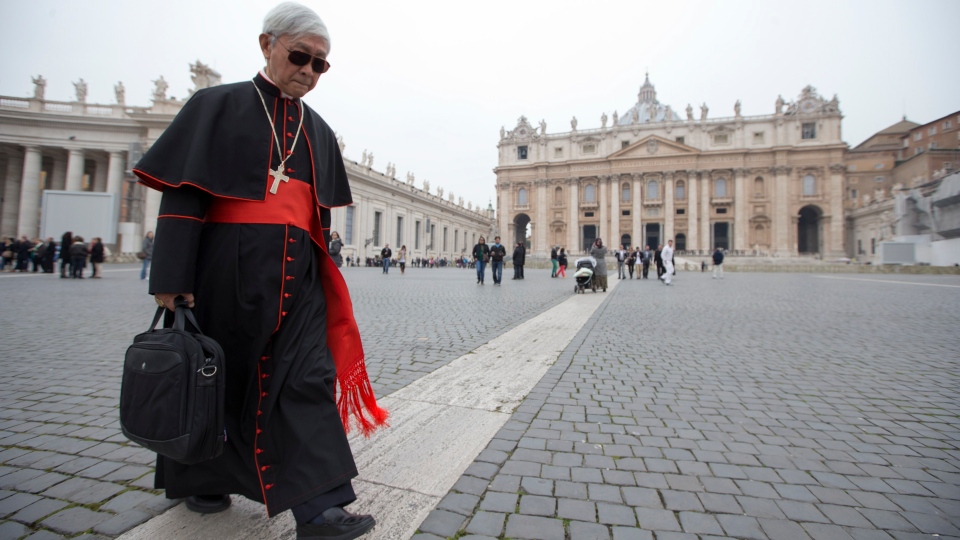
On Feb. 1, new regulations came into force governing all religious institutions in China. 
The new rules shed some light on the sort of church Francis appears willing to reassemble from the catacomb Christianity of his flock under Beijing’s rule. 
The new laws give Communist Party officials the authority to bar children from religious services, decide the content of religious instruction, and approve or disapprove of the time and place of religious services. 
The clampdown comes as part of a renewed effort by Xi Jinping to obliterate any ideological deviation from approved modes of thinking.
The Christian rights group China Aid reckons that at least 1,000 church leaders have been arrested for conducting unauthorized services over the past three years. 
Police have ransacked churches. 
Informal chapels have had their crosses pulled down. 
Christians have been instructed to replace pictures of Jesus Christ with portraits of Xi Jinping. 
Last month, in Shanxi, a church that served roughly 50,000 Christians was demolished by dynamite.
“Unfortunately,” Cardinal Zen wrote in a recent dispatch to China’s Catholics, “as of February 2018, we can expect a much stricter control by the Government on the activities of our brothers and sisters, also because the Government knows that it now has the Holy See’s consent.”
The Vatican’s accommodation of totalitarianism under Francis is not, of course, without precedent, and to appreciate the folly of it you only have to go back to the Vatican’s intimacies with the Spanish fascists of the 1930s, or recall Pius XI’s Reichskonkordat with Nazi Germany. 
During the 1960s, Cardinal Agostino Casaroli, with the blessing of Paul VI, pursued an accommodationist policy of “Ostpolitik” with several Warsaw Pact dictatorships. 
Among the Catholics of Eastern Europe, the policy ended up leaving the Vatican’s reputation in tatters.
The current Pope’s entreaties to Xi Jinping will only end up feeling like “a slap in the face” to China’s Catholics, according to Duke Divinity School professor Xi Lian
“The Vatican risks losing its spiritual authority and dampening the spirit of the Catholics.”
That’s putting it mildly. 
It’s just one consideration Catholics might reflect upon in the coming days of Lent.

lundi 12 février 2018

The Manchurian Pope

Catholics warn of church schism if Vatican makes a deal with China
By Simon Denyer 

Chinese Catholics pray at morning Mass in the Cathedral of the Immaculate Conception in Beijing on Jan. 30. 

BEIJING — A group of influential Catholics published an open letter Monday to express their shock and disappointment about a report that the Vatican could soon reach a deal with the Chinese government, warning that it could create a schism in the church in China.
The Holy See has been in negotiations for several years with the Chinese Communist Party and is now believed to be close to an agreement over the appointment of bishops in China.
That agreement, under which responsibility for the appointment of bishops would probably be shared between the Vatican and the government, could pave the way for the eventual reestablishment of diplomatic relations between China and the Vatican, cut in 1951. 
The deal is also expected to confer Vatican recognition on seven state-appointed bishops, who had been excommunicated by previous popes.
But 15 leading Catholics, many of them from Hong Kong, have written to bishops all over the world arguing that the Chinese government should play no role in the selection of bishops. 
The group argued that the moral integrity of the seven “illicit” bishops was questionable.
“They do not have the trust of the faithful, and have never repented publicly,” they wrote. 
“If they were to be recognized as legitimate, the faithful in Greater China would be plunged into confusion and pain, and schism would be created in the Church in China.”
The 15 Catholics include university professors, lecturers, researchers, human rights activists and lawyers. 
They warned that a deal with the Chinese government could do irreparable harm and that recent regulations put into effect this month allow for even greater government scrutiny over religion in China.
The Communist Party in China, under the leadership of Xi Jinping, has repeatedly destroyed crosses and churches, while the state-backed China Patriotic Catholic Association maintains its heavy-handed control over the church.
In his keynote speech to a major Communist Party Congress in October, Xi underlined that the religion in China must also be “Chinese in orientation” and guided by the Communist Party to adapt to socialist society.
The Catholics complained that religious persecution has never stopped in China and warned that they could not see any possibility that it would, even if a deal were reached.
“We are worried that the agreement would not only fail to guarantee the limited freedom desired by the Church, but also damage the Church’s holiness, catholicity, and apostolicity, and deal a blow to the Church’s moral power,” they wrote.
“We earnestly ask you, with the love on the people of God, appeal to the Holy See: Please rethink the current agreement, and stop making an irreversible and regrettable mistake.”
Senior Vatican officials argue that any deal would help Catholics in China practice and evangelize their faith. 
There are about 10 million Catholics in China, but their numbers are dwarfed by the fast-growing number of Protestants, and some officials hope a deal could help Catholicism keep pace.
But retired Hong Kong cardinal Joseph Zen has been at the forefront of those arguing that a deal with a “totalitarian” regime would be immoral and a sellout.

In praise of China’s outspoken cardinal

Cardinal Zen has history on his side, and he knows China better than any in the Vatican diplomatic corps
By Fr Raymond de Souza

Joseph Cardinal Zen, the emeritus bishop of Hong Kong, will not go away quietly. 
Which makes it difficult for the Vatican diplomats to go quietly and cut a deal with Chinese regime. What is playing out now, as the Holy See reportedly nears a deal with China on normalising relations, revisits a centuries-long debate about how the Church should deal with hostile, persecuting powers.
More specifically, the very public denunciation of Vatican diplomacy by Cardinal Zen revisits the Ostpolitik practised by the Holy See during the 1960s and 70s. 
The “eastern politics” of Vatican diplomacy sought to achieve breathing room for the Church under communism by ratcheting down the anti-communist rhetoric and reining in the underground Churches faithful to Rome. 
The Ostpolitik was the attempt by Paul VI to try a different path than that of Pius XII, who shut down all official contacts with the Soviet empire and its satellites.
In practice, Ostpolitik was bitterly opposed by the much of Catholic leadership who had suffered persecution behind the Iron Curtain. 
To do a deal with the Devil was to betray the witness of the martyrs. 
Or, as Cardinal Zen puts it with characteristic frankness, it is like St Joseph negotiating with King Herod after the massacre of the innocents.
Paul VI’s Ostpolitik was a cause of suffering for him; while he believed it was right, he took no pleasure in either dealing with the Devil or opposing the heroic pastors who daily bore the brunt of the battle. 
It was not, he conceded, a “policy of glory”. 
It was employed on the grounds that it was, according to the Vatican’s diplomatic corps, the best way to salvare il salvabile – to save what could be saved.
The policy did not save much. 
It did not strengthen the Church behind the Iron Curtain, though it did secure the release from prison – at the cost of permanent exile – of several bishops. 
The one local Church that remained steadfast and strong under communism was in Poland, and there the primate, Cardinal Stefan Wyszyński, insisted that he, and he alone, would deal with the Polish communists. 
Such was his towering stature that he kept Vatican diplomats at bay for some 30 years, blocking the ne plus ultra of Vatican diplomacy, a full-status nunciature and exchange of ambassadors. 
He judged the price of that to be too high.
Cardinal Zen has rather the same view. 
The difference today is that we are able to hear the disagreements openly.
“In the Church there is a full right to disagree and to tell one’s own criticisms, and that the Holy See has a moral duty to listen to them and to evaluate them carefully,” Cardinal Pietro Parolin, the Vatican secretary of state, said in defending his China policy. 
“It is legitimate to have different views over the most appropriate responses to the problems of the past and present. That is entirely reasonable.”
Cardinal Parolin may well think that a “far eastern politics” will succeed where Ostpolitik failed. 
But he acknowledges that his view is not the only one, and that those who have suffered most are in disagreement with him. 
Whereas under the original Ostpolitik the Vatican’s diplomats could do their work in secret, and the underground Church had little recourse, today Cardinal Zen ensures that the betrayal of the Church in China – as he sees it – will have to be accomplished in the open.
After Cardinal Parolin’s defence of the Holy See’s China policy, a senior official – perhaps the cardinal himself, but certainly someone authorised by him – gave a lengthy interview to America magazine in which he laid out the path ahead with the Chinese regime.
“It is a suffered accord; it is not a good one, it is not the one we would like, but it is the best that we can get at this moment,” anonymous source said. 
The best that we can get. 
Salvare il salvabile.
Cardinal Zen argues that no accord is better than a bad accord. 
Don’t save what the communists will let you save, he argues. That is an illusion offered by fraudsters. 
The better way is to save your integrity and the fidelity of Catholic witness.
I am inclined to side with Cardinal Zen. 
He has history on his side, and he knows China better than any in the Vatican diplomatic corps. 
But I also am inclined take his side because he is man who speaks clearly and has evident courage.
In 2013 I hosted Cardinal Zen in Kingston for our annual dinner in support of our mission on campus, the St John Fisher Dinner. 
I invited him – without having any relationship with him – because I admired him greatly. 
Yet I was shocked when he accepted. 
For a retired octogenarian, the trip from Hong Kong was long and tiring. 
Why did he accept?
He explained at the dinner that it was foolish for him to travel so far at his age; and, after all, he had to re-arrange the classes he was now teaching to seminarians. 
But he “had to come” when he saw the invitation. 
Anything to honour St John Fisher, he said, meant that he had to accept. 
Cardinal Zen came to Kingston in 2013 because the Church needs more men like St John Fisher in the face of persecuting regimes. 
And that’s why he went to Rome last month to press his case again.

jeudi 8 février 2018

The Vatican's crypto-communist

Why the Pope Is Genuflecting to China
By Yi-Zheng Lian 

Catholics praying in Beijing on Jan. 30, two days before new repressive regulations of religion went into force in China. 

On Feb. 1, the same day that new repressive regulations of religion went into force in China, the Vatican took a deep bow before Beijing. 
After long resisting, it finally agreed to recognize several hack bishops designated by the Chinese Communist Party (C.C.P.), even sidelining two of its own long-serving appointees for the occasion.
Cardinal Joseph Zen Ze-kiun, the outspoken, blogging, 86-year-old retired archbishop of Hong Kong, had recently flown to Vatican City to personally plead the case of the two bishops to the pope himself. 
How nettlesome. 
He was shoved off, and has since been called an “obstacle” to a deal between the Vatican and Beijing.
The reasons the Holy See is caving to the atheist Communist government are not entirely transparent, but it appears to be hoping for a historic thaw. 
Diplomatic ties were severed in 1951, not long after the Communists came to power in China, and relations have since been testy at best.
Catholics in China are thought to number between 9 million and 12 million today, with about half of them adhering to underground congregations loyal to the pope in Rome and refusing to recognize a state-sanctioned version of the Church called the Chinese Catholic Patriotic Association or, more informally, the “patriotic church.”
One major conflict between the two governments has been the method for appointing bishops: Traditionally a prerogative of the papacy, Beijing has steadily tried to usurp it in China
The deal that the Vatican currently seems to be seeking would likely formalize some joint vetting procedure.
The Vatican justifies its conciliatory stance toward Beijing as an attempt to overcome the schism that has divided the Catholic community in China for nearly seven decades — as “a balm of mercy,” it has said, for the pain caused by the barriers that have prevented Chinese Catholics “from living in communion with each other and with the Pope.”
Rapprochement could also give the pope, nominally at least, ultimate authority over all the Catholics in China — a standing, however symbolic, that may well matter to a Vatican that is losing ground to other Christian denominations among Chinese converts.
The total population of Christians in China has grown considerably, from about 4 million in 1949 to perhaps as many as 100 million today. 
In relative terms, however, Catholics are falling behind. 
By some estimates, whereas Catholics in China outnumbered Protestants by 3 to 1 in 1949, today Protestants outnumber Catholics by 5 to 1.
A major explanation for the increasing differential is that the Roman Catholic Church wields not only religious and moral authority, but also political and diplomatic power.
The Catholic Church has a relatively unified command structure, a well-defined ideology and a disciplined organizational backbone. 
It has global reach and mass appeal, commands great loyalty and has long demonstrated the ability to survive and expand, all on the merits of peaceful soft power. 
In each of these ways, it rivals, perhaps even bests, the C.C.P.
And so, naturally, the C.C.P. sees Chinese Catholics’ allegiance to the pope as a direct challenge to their allegiance to the party. 
Vatican City is also, still, among the 20 states, all small, that recognize Taiwan diplomatically.
Many Protestant churches, although deemed suspect as well, are on better terms with the C.C.P. 
After a visit to Beijing in 1983, the archbishop of Canterbury gushed about liberalization in China and reportedly praised the emergence of “a church with Chinese characteristics.”
Like his predecessor, the current Anglican archbishop overseeing Hong Kong and Macau is a member of the Chinese People’s Political Consultative Conference, a body including luminaries that supposedly advises the C.C.P. but often promotes the party’s interests informally or clandestinely. Both men have tended to support Beijing’s restrictive reading of democratic freedoms in Hong Kong and opposed the pro-democracy Umbrella Movement of 2014.
Representatives of other faiths have gone further. 
A vice president of the Buddhist Association of China called Xi Jinping’s speech to the Chinese Communist Party’s 19th Congress last fall, “the Buddhist sutra of the current age.” 
Buddhists in China — who are variously said to number between more than 100 million to more than 240 million — have been treated with a relatively light hand by the party, at least if they are not of the Tibetan kind.
Yet even if brown-nosing seems to pay off, the Vatican’s appeasement of the Chinese government would have great downsides, for itself and for the rest of the world.
By recognizing China’s so-called "patriotic" church, the Vatican could harm the wholesomeness of Catholic teachings in the country. 
Sermons given in government-sanctioned churches have been known to exclude passages of the Bible deemed politically subversive (like the story of Daniel) or to include Communist Party propaganda.
Millions of faithful Catholics in China might also soon feel abandoned, perhaps even betrayed, after having suffered decades of oppression. 
Worse, the government, emboldened by the deal, could well come down even harder on them. 
In fact, the religious regulations that recently came into effect include much stiffer fines on underground churches and penalties for public-school teachers who give Sunday-school lessons on their own time.
And then, rapprochement might augur the Vatican’s readiness to eventually stop recognizing Taipei and instead recognize Beijing as truly representing China. 
Such a shift would alter the delicate balance of power across the Taiwan Strait, as well as harm Taiwan’s vibrant democracy. 
It would also confer legitimacy — and with the pope’s imprimatur! — on authoritarian regimes throughout the world that crack down on churches and sects.
The Catholic Church already has a checkered record dealing with fascist or totalitarian states. 
Pope Pius XII was criticized for betraying the Jews of Europe during World War II: Hewing to what he described as a position of neutrality between the Nazis and the Allies, he never denounced Hitler’s Final Solution. 
After Soviet forces violently repressed the Hungarian uprising in 1956, the Vatican sidelined the outspoken anticommunist Archbishop József Mindszenty in favor of a deal with the new puppet regime.
The Vatican’s eagerness to play catch-up in China today may do it no favors either.
Beijing doesn’t have much of a reputation for honoring commitments. 
Just look at its application of the “one country, two systems” arrangement it promised Hong Kong, which was supposed to guarantee the city a large degree of autonomy until 2047.
Even under the deal the Vatican seems to want, the Chinese government could eventually come to control the Catholic Church in China — by, say, simply delaying nominating anyone for bishop or repeatedly rejecting candidates presented by the Vatican until all the bishops previously ordained by the pope have retired or died out. 
Bishops ordain priests and so without bishops, in time there could be no priests, or very few, and Catholicism in China would have died a silent death.
Four decades ago, when a destitute China was emerging from deep Maoism, Western companies got tipsy at the mere notion of selling deodorant to two billion Chinese armpits. 
Now that average Chinese have much more disposable income, major international corporations are willing to hand over proprietary technology, stoically endure violent xenophobic outbursts and take on members of the Chinese Communist Party as senior managers rather than risk losing out on the business prospects.
No one, it seems, can resist the lure of the great market of China, for deodorants, cars — or congregants. 
Not even the Vatican.

mardi 30 janvier 2018

The Manchurian Pope

Vatican is selling out Catholic Church to China: Holy See ordered two bishops to make way for Beijing’s choices 
By Lucy Hornby in Beijing


 Cardinal Joseph Zen: 'Do I think that the Vatican is selling out the Catholic Church in China? Yes'

One of Asia’s most senior Catholic leaders has accused the Vatican of selling out the Church by pursuing a rapprochement with Beijing while the Chinese government cracks down on religious freedom.
Cardinal Joseph Zen, the outspoken 86-year-old former bishop of Hong Kong, hand-delivered protests from two Chinese bishops to Pope Francis earlier this month after a Vatican delegation ordered them to make way for replacements picked by Beijing.
 The issue of bishop appointments has been a stumbling block in talks between Beijing and the Vatican to try to establish diplomatic relations.
The Vatican is one of 20 remaining states that maintain diplomatic ties with self-governing Taiwan, which Beijing insists is part of China.
 “Do I think that the Vatican is selling out the Catholic Church in China? Yes, definitely, if they go in the direction which is obvious from all what they are doing in recent years and months,” Cardinal Zen wrote in a blog post.
 The Vatican did not immediately respond to a request for comment.
 Chinese Catholics went underground during the bloody decades of Maoist rule and the Cultural Revolution, before religious practice was tolerated again in the early 1980s.
 In many parts of China, the “underground” congregations and those led by bishops appointed by Beijing have been reconciled since a 2007 letter from Pope Benedict to Beijing, with bishop appointment agreed upon by the Vatican and Beijing’s “patriotic association”.
In some areas the rift still persists.
 There are 19 active “underground” bishops and 58 official bishops, not counting those who have retired, according to the Holy Spirit Study Center, which is part of the Catholic diocese of Hong Kong.
The protest from Cardinal Zen comes amid a general crackdown on religious practice in China outside the churches or mosques that are governed under the patriotic associations, which report to the Communist party’s United Front Work Department.
 Crosses have been removed from many Protestant churches that were constructed without permission and “house churches” ordered to disband.
The crackdown has included the foreign Catholic community in Beijing, which has lost one of the venues where Catholics previously met for English-language mass.

Xi Jinping's Pope: The Secret History of Francis


Francis courts China with plan to install communist bishops
Associated Press

Cardinal Joseph Zen, pictured here in 2013, said he was revealing confidential information because Chinese Christians should know the truth. 

The retired cardinal of Hong Kong has revealed the Vatican’s efforts to improve relations with China included a request for a bishop to retire in favour of an excommunicated one recognised by Beijing.
Cardinal Joseph Zen, the most vocal opponent of Pope Francis’s overtures to China, bitterly criticised the proposed change in Shantou diocese, Guangdong, and revealed in a Facebook post Monday that he had travelled to the Vatican this month to personally raise it with the pope.
Zen confirmed reports by the AsiaNews missionary news agency that the Vatican had asked Shantou bishop Peter Zhuang Jianjian, 88, to step aside for Bishop Joseph Huang Bingzhang
Huang was excommunicated by the Vatican in 2011 after he was consecrated without papal approval.

Pope's deal with China would betray Christ, says Hong Kong cardinal.

Zen said he was exposing the “confidential” information – including the contents of his audience with Pope Francis on 14 January – so China’s Christians “may know the truth to which they are entitled”.
“My conscience tells me that in this case, the right to truth should override any such duty of confidentiality,” he wrote.
The issue of bishop nominations is the key stumbling block in Vatican-Chinese relations, which were officially severed when Beijing ordered Chinese Catholics to cut ties with the Holy See soon after the foundation of the Communist state in 1949.
The Vatican insists only the pope can nominate successors to Christ’s apostles. 
China views the Vatican’s insistence as interference in its sovereignty.
Popes from John Paul II onward have expressed hope for restoring diplomatic ties, with Pope Benedict XVI taking the boldest step in 2007 by urging the millions of Chinese Catholics worshipping in both the state-controlled churches above ground and the oft-persecuted clandestine underground churches to unite under his jurisdiction.
Francis is taking that overture further to try to reach a deal with the state-backed Chinese Patriotic Catholic Association.
“Do I think that the Vatican is selling out the Catholic Church in China?” Zen asked in his post. 
Yes, definitely, if they go in the direction which is obvious from all what they are doing in recent years and months.”
Vatican spokesman Greg Burke declined to comment, or to confirm or deny the AsiaNews report.
The news agency, which follows the Catholic Church closely in China, reported this month that a Vatican delegation was in Beijing in December to negotiate Zhuang’s retirement and Huang’s nomination in Shantou.
The Vatican asked the legitimate bishop of Mindong, Monsignor Joseph Guo Xijin, to accept a demotion to become an auxiliary bishop to Bishop Vincent Zhan Silu, who isn’t recognised by the Vatican, the agency reported.
But Zen wrote that when he raised the cases with Francis during a private audience, the pope said he had told his aides “not to create another Mindszenty case”.
The reference was to the Hungarian cardinal Jósef Mindszenty, who was imprisoned by Hungary’s Communist rulers and, during a brief spell of freedom during the revolution of 1956, took refuge in the US embassy in Budapest. 
Pope Paul VI eventually stripped him of his titles under pressure from the Hungarian government.
Zen said he felt encouraged by the pope’s refusal to allow a similar fate to befall China’s underground churchmen. 
“His words should be rightly understood as of consolation and encouragement more for them than for me,” he said.
Calls to the ethnic and religious authorities in the two dioceses went unanswered. 
There was also no answer at the China Patriotic Catholic Association.