Affichage des articles dont le libellé est war on law. Afficher tous les articles

jeudi 9 novembre 2017

Harassment and house arrest in China as Trump has 'beyond terrific' time

Human rights defenders and their families placed under heavy surveillance by Xi Jinping’s agents as US president is feted
By Tom Phillips in Beijing
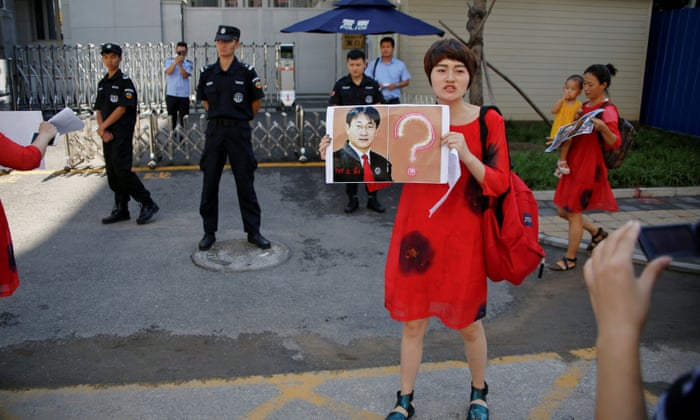
Li Wenzu, wife of lawyer Wang Quanzhang, during a protest in Beijing against the detention of human rights defenders. 

On day one of Donald Trump’s “state visit-plus” to China he was treated to a tour of the Forbidden City, a night at the opera and an intimate dinner with Xi Jinping. 
“Beyond terrific,” he boasted.
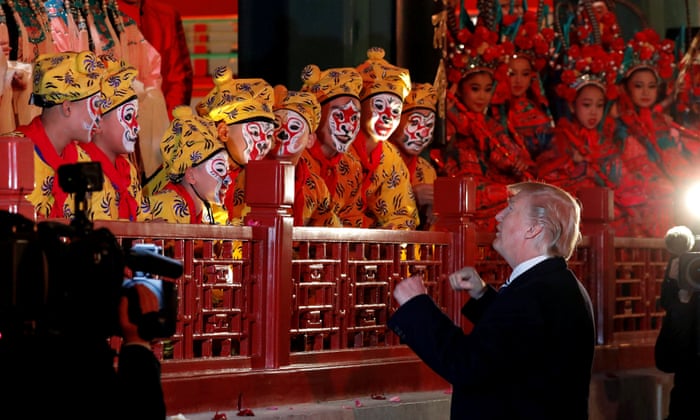
Trump's freak show

Li Wenzu got a loud knock at the door from a man claiming to represent the domestic security agency tasked with suppressing political dissent. 
“The US president is in town,” the 32-year-old mother-of-one says she was informed by the agent. “Do not go anywhere … you must cooperate with our work.”
Li is the wife of Wang Quanzhang, a crusading human rights lawyer whom she has not seen since the summer of 2015 when he was spirited into secret detention during a roundup of attorneys and activists known as Xi’s “war on law”.
With China’s leader out to impress his American guest, Li and dissidents like her say they have been placed under house arrest or heavy surveillance in a bid to stop them spoiling the show.
“[The authorities] are afraid of us meeting with foreign leaders, of our stories being heard by people all over the world, and of the truth being uncovered,” she said by phone on Thursday morning as Xi rolled out the red carpet for Trump in Tiananmen Square.
After the knock on her door at about 7am on Wednesday, Li said about a dozen plainclothes agents had camped outside her flat in west Beijing.
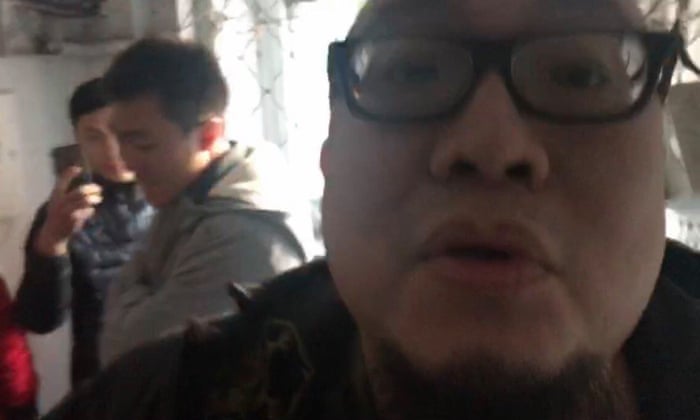
A photograph taken by Li Wenzu after plainclothes Chinese security agents were posted outside her flat.

When she tried to go out with her young son, she claimed one of the group “pushed me with his body and prevented us from going”.
“Shame on him!” Li said. 
“Just think about it, I don’t have the right to go anywhere in the country. It is ridiculous. I felt so powerless.”
Beijing-based activist He Depu told Radio Free Asia, a US-backed news website, other activists were also feeling the pinch because of Trump’s arrival: “All political dissidents are under surveillance right now.”
Peter Dahlin, a Swedish human rights activist who was expelled from China last year after 23 days in secret detention, said authorities saw Li – who has campaigned relentlessly on behalf of her imprisoned husband -- as a “constant thorn in their side”. 
He called her treatment “unusual even for China” and symptomatic of a wider breakdown in the rule of law under Xi.
Dahlin, a friend of Li’s husband, said Wang had spent so long in secret detention that “at one point people were seriously wondering if he was even alive any more”. 
He is now thought to be behind bars in the northern city of Tianjin.
Trump has enraged human rights activists by courting China’s authoritarian leader despite what they call the government’s worst crackdown in decades. 
Trump has called Xi a friend and recently praised his “extraordinary elevation” and “great political victory” after he was anointed China’s most powerful leader since Mao.
On Wednesday, Republican senator Marco Rubio rejected that description: “Xi’s further consolidation of power, in a one-party communist state, was not a political victory. It was a tragedy for human rights advocates, reformers and thousands of political prisoners,” he tweeted.
Li Wenzu, who has not seen her husband since he was seized, said: “I hope [Trump] can show concern for human rights issues in China … He should think carefully about dealing with a country that does not care about human rights, and violates the law.
“It’s just like when we are making friends, we must first look at character of the person [we are befriending].” 

vendredi 17 février 2017

China eliminating civil society by targeting human rights activists

Report details use of torture by Chinese security agencies – including beatings, stress positions and sleep deprivation – to force activists to confess ‘crimes’
By Benjamin Haas In Hong Kong
Since coming to power in 2012, Xi Jinping has overseen a sweeping crackdown on civil society. 

China’s human rights situation further deteriorated last year as police systematically tortured activists and forcibly disappeared government critics while state TV continued to broadcast forced confessions, a new report shows.
A creeping security state also attempted to codify much of its existing behaviour on paper, giving the police legal authority to criminalise a host of NGOs deemed politically sensitive by the authorities, according to the report by the Network of Chinese Human Rights Defenders (CHRD).
“The Chinese government seems intent on eliminating civil society through a combination of new legislation restricting the funding and operations of NGOs, and the criminalisation of human rights activities as a so-called threat to national security,” Frances Eve, a researcher at CHRD, told the Guardian.
“What stands out is the institutionalised use of torture to force defenders to confess that their legitimate and peaceful human rights work is somehow a ‘crime’.”
Since coming to power in 2012, Xi Jinping has overseen a sweeping crackdown on civil society. 
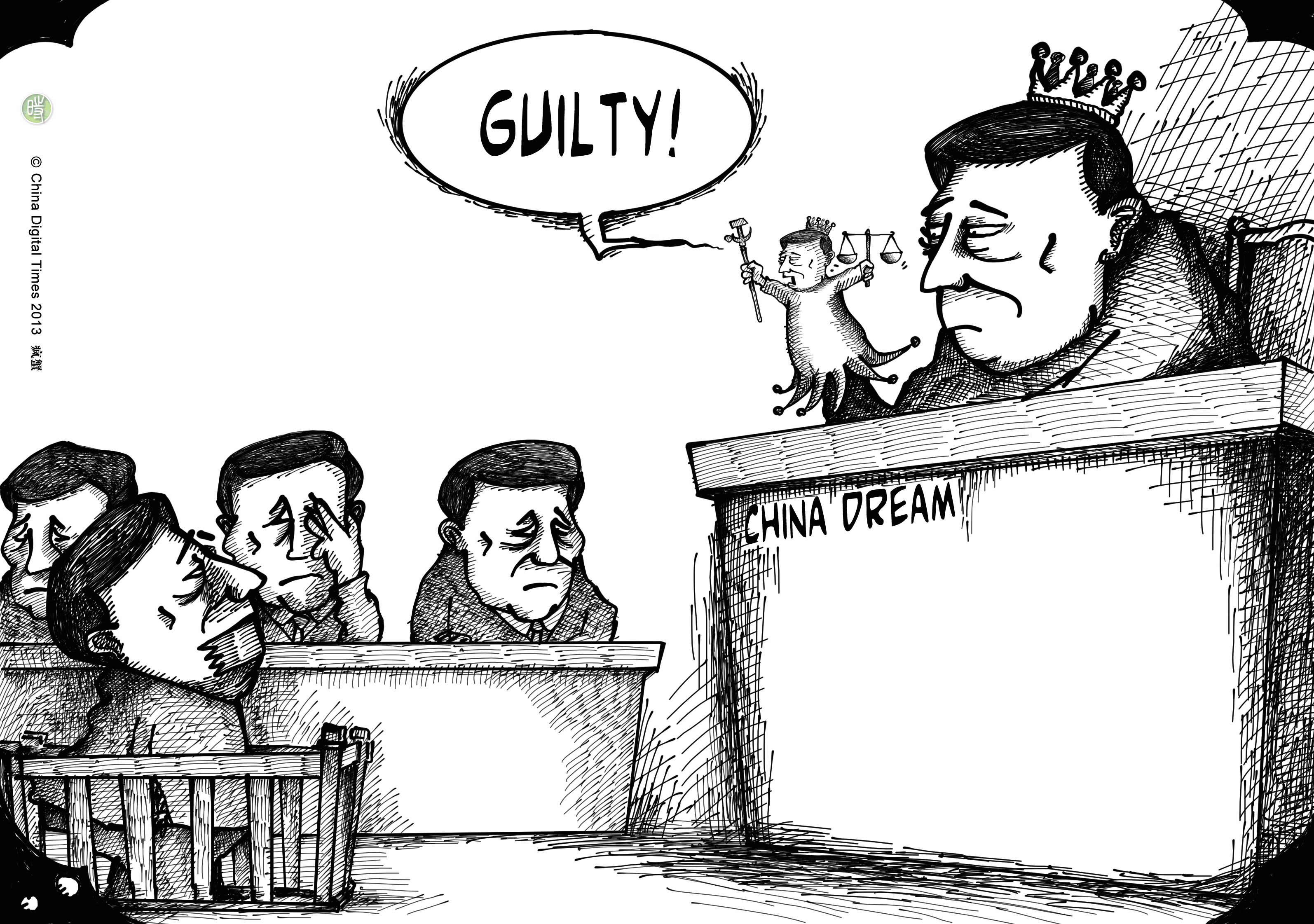
In 2015, police targeted almost 250 rights lawyers and activists in a “war on law”, and the effects of that campaign continued to be felt throughout last year.
Reports of torture while in detention in 2016 were rampant, with methods including beatings, attacks by fellow inmates on the orders of prison guards, stress positions, deprivation of food, water and sleep, inhumane conditions and deprivation of medical treatment.
In some cases, human rights activists were prevented from receiving medical care even once they were released.
Huang Yan, who was detained in November 2015, was suffering from ovarian cancer and diabetes. Police confiscated her diabetes medication, and despite an exam done at a detention facility in April 2016 showing the cancer had spread, she was not treated and was denied medical bail.
When she was finally released, Huang was scheduled to undergo surgery last November to treat her cancer, but the authorities pressured the hospital and the team of surgeons declined to treat her.

Torture also took more overt forms. 
Last year reports also emerged that rights lawyer Xie Yang was subject to beatings and stress positions in detention, with interrogators warning him: “We’ll torture you to death just like an ant”.
In November 2016, Jiang Tianyong, a respected Christian attorney, disappeared while about to board a train and police waited weeks to confirm he had been detained. 
Jiang’s whereabouts are still a mystery nearly three months later.
In a rare strongly-worded statement, the European Union called for his immediate release along with several other lawyers.
China also continued the practice of airing confessions on state television, a move that is reminiscent of internal Communist party political purges.
In one of the most prominent cases, Swedish NGO worker Peter Dahlin was paraded on the national broadcaster after three weeks in detention, declaring: “I have violated Chinese law through my activities here. I have caused harm to the Chinese government. I have hurt the feelings of the Chinese people.”
The confessions air before detainees ever see the inside of a courtroom, and in Dahlin’s case he was promptly deported.
For those activists that do go to trial, in at least 15 cases last year police attempted to pressure activists into accepting government-appointed lawyers. 
In cases where state-appointed lawyers represented human rights activists, little defence was mounted and the accused pleaded guilty and promised not to appeal their cases.
The report also outlined two laws passed in 2016 that are likely to curb civil society: legislation regulating charitable giving and a law on foreign NGOs. 
The charity law, while not explicitly requiring all NGOs to register with the government, makes it difficult for unregistered organisations to raise funds domestically.
The foreign NGO regulations require overseas groups that give money to Chinese organisations to be registered with the police.
“Together, these laws will hamper the development of Chinese civil society by restricting their funding,” the CHRD report said.
“There are no more ‘grey areas’,” an unnamed human rights activist said in the report. 
“To advocate for human rights in China today, you must be willing to accept the reality that the government views your work as ‘illegal’.”

samedi 10 décembre 2016

Human Rights Day: US and EU call on China to release political prisoners

‘I remain extremely concerned about the ongoing detention of Chinese lawyers,’ the US ambassador to China says
By Benjamin Haas in Hong Kong

More than half a dozen political prisoners in China should freed, the United States and European Union have said, citing a deteriorating human rights situation that has seen hundreds lawyers and activists detained in the past year.
Since coming to power in 2012, Xi Jinping has presided over a wide-ranging crackdown on freedom of expression, rights lawyers, feminists, activists and religion. 
About 250 lawyers and activists were detained by police starting in July last year in what some have called a “war on law”.
“I remain extremely concerned about the ongoing detention of Chinese lawyers,” Max Baucus, the US ambassador to China, said in a statement. 
“China’s treatment of these lawyers and advocates calls into question its commitment to the rule of law.”
Crusading attorneys Li Heping, Wang Quanzhang, Xie Yang and Xie Yanyi all remain remain behind bars, and Baucus singled out their cases and called for their release. 
The EU echoed many of the same sentiments and highlighted the same jailed lawyers.
“We urge China to immediately release any individual who has been detained … for seeking to exercise, protect or promote their own rights or the rights of others,” the EU statement said.
The US and EU made the calls to mark Human Rights Day, a United Nations holiday commemorating the adoption of the Universal Declaration of Human Rights, which China signed.
“During the past year, we have been extremely troubled about the deterioration of the situation with respect to freedom of expression and association,” the EU statement said.
“We are equally concerned about all human rights defenders and their family members who have been harassed and punished because of their work in promoting rights which are protected in China’s Constitution and international law.”
Both the US and EU called for Nobel Peace prize laureate and democracy activist Liu Xiaobo, who has been in prison since 2008, to be freed.
Tashi Wangchuk, a jailed Tibetan language advocate, was also mentioned by both governments. 
His case is emblematic of the hardline stance China has taken towards ethnic minorities who do not toe the Communist party line. 
Another victim of those policies is Ilham Tohti, a Muslim Uighur academic sentenced to life in prison, who the EU said should be released.
“I can tell you that China’s approach to human rights directly impacts our overall bilateral relationship,” Baucus said. 
“While other countries celebrate when their citizens win the Nobel Peace prize, Chinese Peace prize winner Liu Xiaobo remains jailed.”
The strongly-worded statement on human rights from the US may be its last for a while, Chinese activists worry. 
They fear president-elect Donald Trump will pull back from defending right around the world.
Curiously absent from the EU statement was Gui Minhai, a Swedish national and publisher of books critical of China’s leaders, who was abducted from Thailand a year ago. 
He later appeared in China, giving a televised “confession”.
More than 120 authors also took the opportunity of Human Rights Day to call on Xi to his end his government’s fierce crackdown on writers and dissidents, with the authors saying they “cannot stand by as more and more of our friends and colleagues are silenced”.