Affichage des articles dont le libellé est lawmakers. Afficher tous les articles

vendredi 12 octobre 2018

China's theft of US intellectual property

Lawmakers press for answers about China's supply chain hack
By Derek Hawkins

Sen. Marco Rubio (R-Fla.) on Capitol Hill in Washington on Aug. 2. 

Lawmakers are prying into a controversial report that Chinese spies installed surveillance microchips in servers used by Apple, Amazon and other American companies.
On Wednesday, Sens. Marco Rubio (R-Fla.) and Richard Blumenthal (D-Conn.) wrote to Supermicro, the firm that manufactured the compromised hardware, asking whether it had detected any such tampering in its products. 
The senators said “the nature of the claims raised alarms that must be comprehensively addressed.”
“We are alarmed by the dangers posed by back doors, and take any claimed threat to the nation’s networks and supply chain seriously,” they said. 
“These new allegations require thorough and urgent investigation for customers, law enforcement and Congress.”
Other lawmakers on the Hill have fired off similar missives. 
Sen. John Thune (R-S.D.) wrote to Apple, Amazon and Supermicro requesting staff briefings about the Bloomberg article by Friday. 
And House Oversight Committee Chairman Trey Gowdy (R-S.C.) and Intelligence Committee Chairman Devin Nunes (R-Calif.) called on the heads of the FBI, Department of Homeland Security and the Office of the Director of National Intelligence to provide a classified briefing on the matter by Oct. 22. (Amazon.com founder and chief executive Jeffrey P. Bezos owns The Washington Post.)
The flurry of requests underscores long-standing concerns in Congress about the potential for China to conduct cyber espionage by infiltrating the supply chain. 
So lawmakers aren’t taking any chances with the allegations raised in it.
“If this news report is accurate, the potential infiltration of Chinese back doors could provide a foothold for adversaries and competitors to engage in commercial espionage and launch destructive cyber attacks,” Rubio and Blumenthal wrote.
The explosive Bloomberg report said that operatives from a unit of the People’s Liberation Army secretly installed the surveillance chips in Supermicro motherboards during the assembly process in China, creating a “stealth doorway” into networks that used the machines. 
Citing unnamed government and corporate officials, the report described it as the “most significant supply chain attack known to have been carried out against American companies.”
Sen. Ron Johnson (R-Wis.), chairman of the Homeland Security Committee, said in a hearing Wednesday morning that he found the story credible. 
He asked FBI Director Christopher A. Wray and Homeland Security Secretary Kirstjen Nielsen, who testified in the hearing, whether they were aware of “implantation of chips in the supply chain.”
Wray deflected. 
“Be careful what you read in this context,” he said, adding that he was barred from commenting on whether the FBI was investigating the matter. 
Nielsen said that supply chain hacks are "a very real and emerging threat that we are very concerned about." 
Indeed, the article seemed to channel some of Washington’s worst anxieties about supply chain security.
Lawmakers and federal officials have long fretted over whether a foreign adversary could carry out such an infiltration, and over the past year they’ve taken steps to try to prevent it. 
Last fall, DHS directed federal agencies to stop using software made by the Russian cybersecurity contractor Kaspersky over concerns that Moscow’s intelligence services could use the company to conduct cyber espionage. 
Shortly after, Congress banned federal agencies from using Kaspersky’s products as part of the defense spending bill. 
Lawmakers and military officials have raised similar fears that Chinese telecom giants ZTE and Huawei could be used as conduits for Beijing to spy on U.S. citizens, companies and government offices. 
This year, lawmakers abandoned an effort to prohibit federal agencies and contractors from doing business with ZTE at the request of the White House.
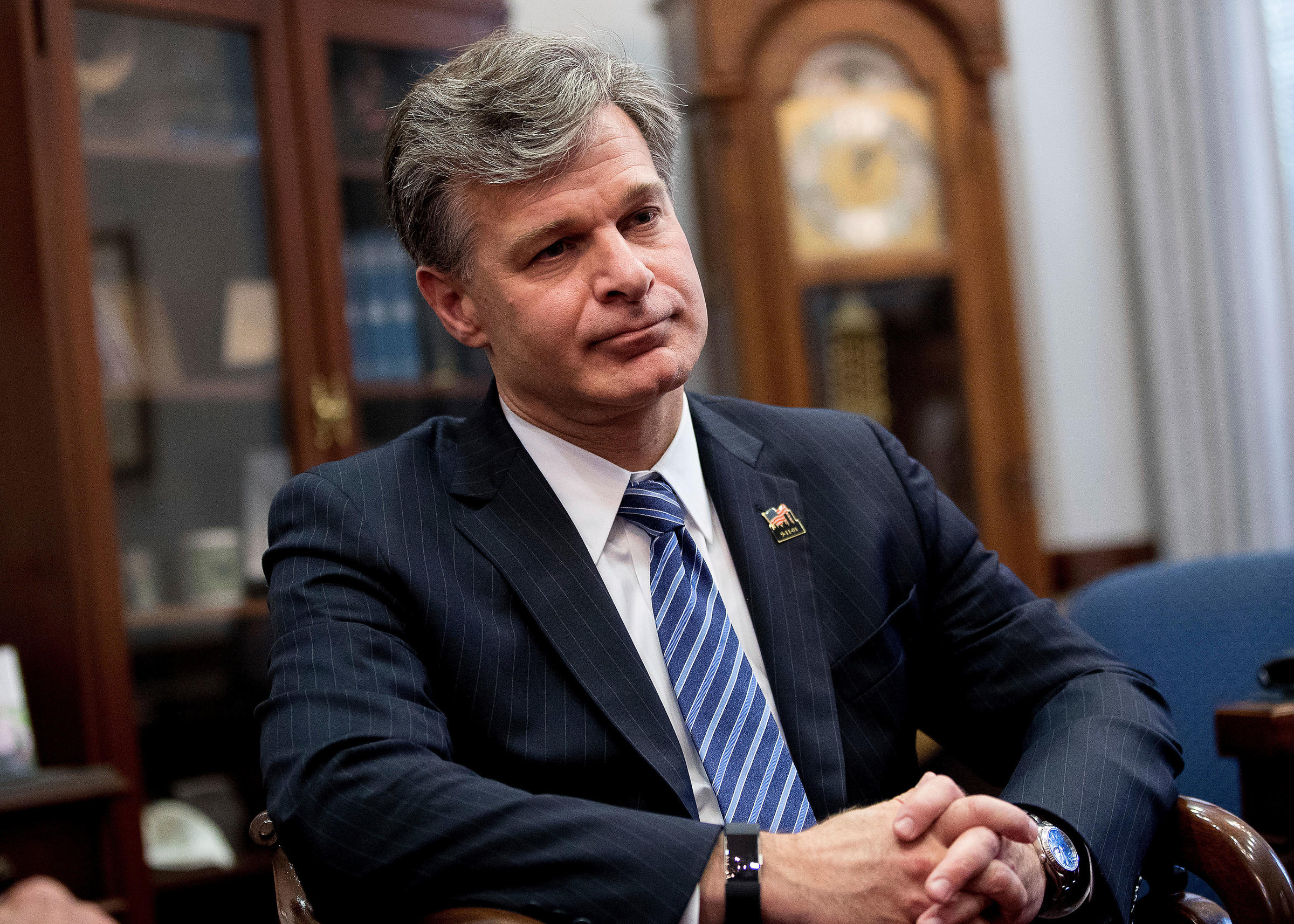
China a bigger security threat than Russia, says FBI Director Wray

Nielsen also warned senators that China “absolutely” is “exerting unprecedented effort to influence American opinion" in her appearance before the Senate Homeland Security and Governmental Affairs Committee on Wednesday. 
Nielsen testified alongside Wray and Russell Travers, the acting director of the National Counterterrorism Center at the Office of the Director of National Intelligence.
Asked by Sen. Jon Kyl (R-Ariz.) to assess the risk that Beijing's cyber activities and disinformation efforts represent in comparison to Russia, Wray replied that he was “reluctant to try to rank threats” but added that “China in many ways represents the broadest, most complicated, most long-term counterintelligence threat we face.” 
Wray told Kyl that China will remain a threat to the United States in the long run. 
“Russia is in many ways fighting to stay relevant after the fall of the Soviet Union. They're fighting today's fight,” Wray said. 
“China is fighting tomorrow's fight, and the day after tomorrow, and the day after that. And it affects every sector of our economy, every state in the country and just about every aspect of what we hold dear.”

dimanche 27 mai 2018

Corrupted Clown President

More than 60 lawmakers demand ethics investigation into Trump's relationship with China
BY MARY TYLER 

More than 60 Democratic representatives are demanding an ethics investigation into Trump's ties to China, following his recent push to rescue Chinese telecommunications firm ZTE.
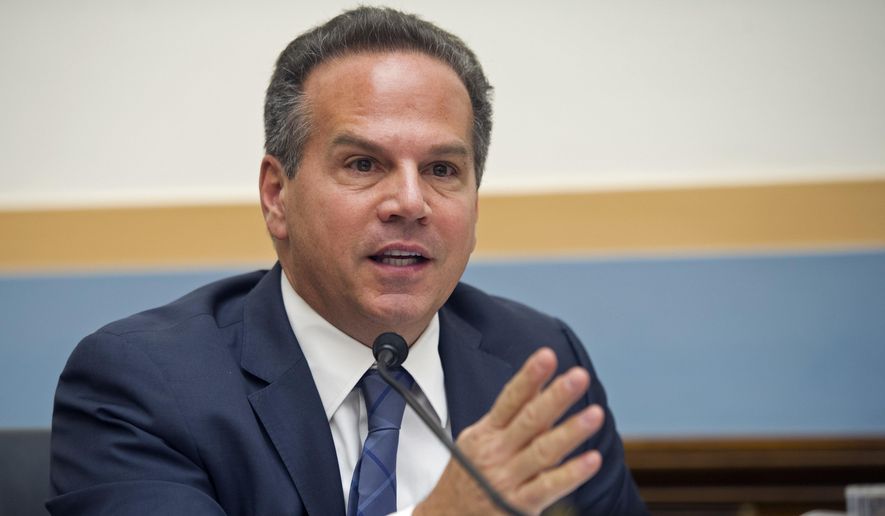
Rep. David Cicilline (D-R.I.) posted a letter to David Apol, acting head of the federal government's ethics office, to Twitter on Sunday, stating that the request was prompted by Trump "advocating" for ZTE just days after the Chinese government gave one of the president's business endeavors a $500 million loan.
In the letter, lawmakers say the business dealing between the Trump Organization and China may have violated U.S. laws forbidding public officials from accepting payments or gifts from foreign entities without Congress's approval.
"The Chinese government's loan provides a clear financial benefit to Trump," the letter reads. "Despite the nearly unanimous recommendation by legal experts that he divest from his business interests before assuming the presidency, he failed to do so, instead placing his adult children in charge of day-to-day operations."

NEW: Will be sending this letter with more than 60 colleagues to demand an ethics investigation into @realDonaldTrump advocating for a Chinese company just days after China’s government gave his company a $500 million loan. pic.twitter.com/EC2fbjz4gr— David Cicilline (@davidcicilline) May 27, 2018
Rep. David Cicilline

Because Trump still holds interests in his businesses via a revocable trust — an arrangement that allows him to draw funds at his discretion — the president will be able to oversee the project and "earn a profit if it succeeds," according to the letter.
The project, an Indonesian theme park and development that will house Trump-branded hotels and golf courses, snagged a $500 million loan from China earlier this month.
Three days after the loan was reported, Trump announced that he ordered his administration to buoy ZTE, saving it from financial collapse. 
Trump sought to revive ZTE earlier this month, roiling lawmakers on both sides of the aisle who have sought to fortify restrictions on the company's ties to the U.S.
Despite a wave of bipartisan pushback, Trump on Friday appeared to confirm that his administration had reached a deal to put ZTE back in business.
"I closed it down then let it reopen with high level security guarantees, change of management and board, must purchase U.S. parts and pay a $1.3 Billion fine," he tweeted late Friday. 
"Dems do nothing but complain and obstruct."
Cicilline and the letter's co-signatories raised alarm over the short time frame between the loan's announcement and Trump's hinting at a renewed deal with ZTE.
"We believe that these events raise several potential constitutional and ethical violations," the letter continues. 
"… [T]he extremely short time period between the Chinese's [sic] government's loan and Trump's order to roll back penalties on ZTE warrants a review of any applicable federal ethics regulations."
Lawmakers went on to ask the ethics office to investigate whether the administration improperly secured the $500 million loan from China, whether Trump sought and obtained congressional approval before accepting the loan, and whether Trump or a member of his administration violated federal statute regarding conflicts of interest or ethics in the decision to ease sanctions on ZTE.
"The Trump administration has yet to give a satisfactory answer about the reason behind and the appropriateness of making concessions to ZTE, a Chinese company that illegally sold U.S. technology to hostile regimes," they wrote. 
"The Trump administration has also completely failed to address the suspicious timing between this policy reversal and the Chinese government's loan to a Trump-linked project."
"As you know, the issue of U.S. policy being manipulated by a foreign entity or the personal business interests of a public official is of grave concern to the American people. We ask that you promptly conduct a review of this matter and keep us apprised periodically about the progress of your investigation," the letter concludes.
Lawmakers have expressed previous concerns about ZTE potentially threatening national security. 
A 2012 House Intelligence Committee report warned congressional leaders to be wary of doing business with ZTE and Chinese competitor Huawei.
ZTE was banned by the Commerce Department from buying tech components after it violated U.S. sanctions by selling equipment to North Korea and Iran.

mardi 8 novembre 2016

This is the beginning of the end of Hong Kong

The ‘one country, two systems’ principle and the Sino-British Joint Declaration are now completely shattered and irrelevant
By Claudia Mo

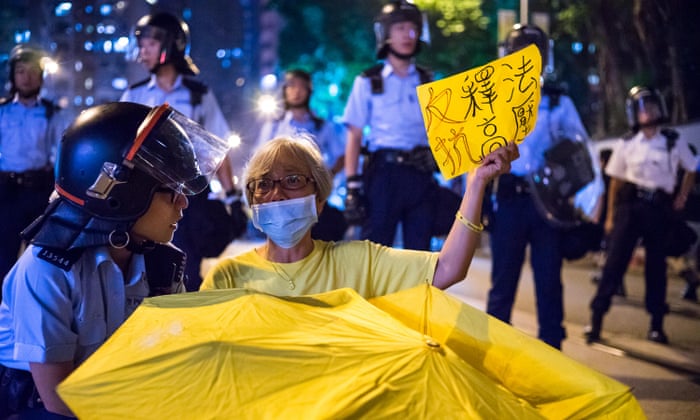
Protesters clash with police at China Liaison Office, where they occupied the road and were pepper sprayed. 

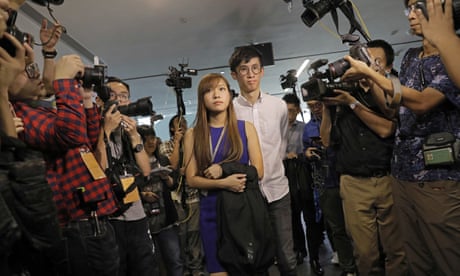
The Chinese government’s decision to bar two elected lawmakers from taking up their seats marks the beginning of the end of Hong Kong.
Samuel Johnson once said, “Patriotism is the last refuge of the scoundrel”. 
And today China has said that in Hong Kong, patriotism is so vital that it trumps freedom of speech, freedom of expression and freedom of thought, which are all now completely irrelevant.
By preventing the two pro-independence politicians from taking office, the Chinese government has opened the door to disqualify anyone from Hong Kong’s government if they are determined to not be loyal to Beijing.
This sets a very, very dangerous precedent because China has now started to form a habit of ruling Hong Kong by decree. 
Rule of law has become nonexistent in Hong Kong and there is no telling how that’s going to affect the confidence of foreign investors. 
We have to plug the dyke, but there’s nothing Hong Kong people can do and that explains all the fear, anger, resentment and frustration you now see in the city.

Of course, according to the Basic Law, Hong Kong’s mini-constitution, the power of interpretation is vested in Beijing, but that sort of power should not be used lightly. 
Every policeman has the power to stop you in the street and haul you off to the station if you’re acting suspiciously, but no one expects every policemen to do that lightly. 
Beijing is abusing its power.
Beijing loyalists in Hong Kong’s legislature will say, ‘We need to protect the integrity of the motherland, you’re not allowed to say things like ‘Hong Kong is not China.’’ 
They worry these sentiments will spread to places like Tibet and Xinjiang, western Chinese provinces with large populations of ethnic minorities and a history of chafing under Beijing’s yoke.
The Chinese government never promised “one country, two systems” to Tibet or Xinjiang, but that promise was made to Hong Kong. 
However, that and the Sino-British Joint Declaration, which sought to safeguard freedoms in the former colony, is now completely shattered and has become irrelevant. 
China’s mandarins now behave exactly like the Big Brother in George Orwell’s 1984. 
Whatever and whenever they find something politically incorrect, they will just change it and make it bend to their will.
The oath-taking saga is merely an excuse to make sure Hong Kong will be reined in. 
Chinese officials needed an issue and pounced at the first opportunity, because in Beijing’s eyes Hong Kong has become uncontrollable and disobedient, especially after the umbrella movement.
This is a very frightening trend that shows Beijing will interpret Hong Kong laws any time it wants. Anytime they feel parts of the Basic Law are not up to their current standards of political correctness, they will change it and tell Hong Kong courts to obey.
This move is not only a blow to our legislature, but also local courts as well. 
What are our judges for if Beijing steps in whenever it wants?
Today Beijing talks about anti-independence, tomorrow it talks about anti-self-determination and the day after it can talk about anti-democracy altogether.
While I have met some young people who have foreign passports who want to stay and fight for Hong Kong, they have a safety net and can leave whenever they want. 
I’m very worried about the young who can’t afford to leave and have no choice but to fight on against extremely difficult odds.
But we still need to fight, because if we don’t, we will definitely never get what we want.