Affichage des articles dont le libellé est Hu Yaobang. Afficher tous les articles

lundi 3 juin 2019

30th Anniversary

Tiananmen Square massacre: How Beijing turned on its own people
By Ben Westcott

Hong Kong -- As the sun rose on the morning of June 4, 1989, the Chinese people woke to a country which had changed overnight.
For seven weeks it had seemed like China was on the brink of a massive social change, but in just one night the dreams of hundreds of thousands of protesting students and workers were brutally crushed.
For about a decade, China's economy had been steadily opening up and allowing small amounts of free enterprise in the Communist country, after years of strict state control under Mao Zedong.
Directing the change was then-Paramount Leader Deng Xiaoping, who wanted to see China grow prosperous by embracing some pro-market liberalization.
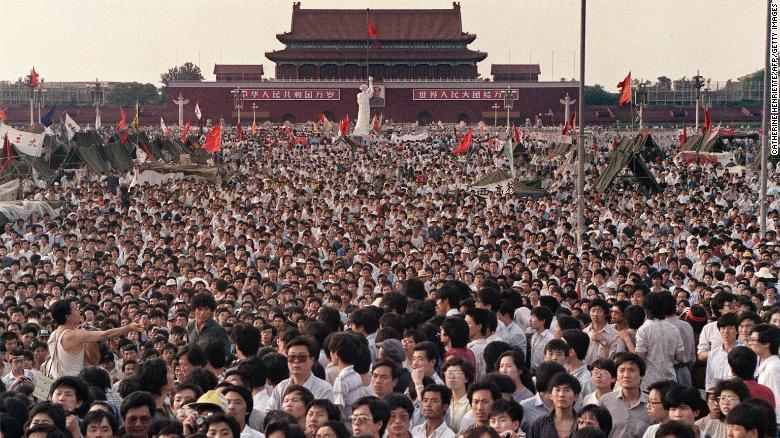
Hundreds of thousands of Chinese gather on June 2, 1989 in Tiananmen Square demanding democracy despite martial law in Beijing.

But when large-scale protests in Beijing called for greater social freedoms, such as freedom of speech and even democracy, Deng would prove far less enthusiastic.
The protests first began in April, triggered by the death of former Chinese Communist Party leader Hu Yaobang at the age of 73. 
Seen by the public as a champion for liberalization, Hu had been deposed two years earlier and his death on April 15 was widely mourned.
Three days later, thousands of grieving students marched through Beijing, calling for a more democratic government in Hu's honor.
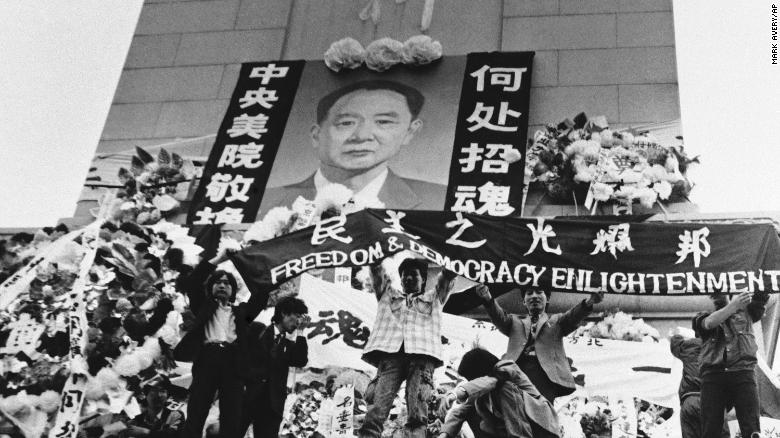
Chinese students hold aloft a banner calling for freedom, democracy and enlightenment on the Martyrs Monument in Beijing's Tiananmen Square, festooned with a giant portrait of Hu Yaobang, April 19, 1989.

The protesters occupied Tiananmen Square, the massive public space in the center of Beijing which faces onto the Forbidden City, former home of the Chinese emperors, and the Great Hall of the People.
Over the coming month and a half, the numbers of protesting students and workers steadily grew. 
A rally on May 19 in the square drew an estimated 1.2 million people, leading then-Communist Party leader Zhao Ziyang to meet with them to plead for an end to the protests.
He began his now-famous speech by saying: "Students, we came too late. We are sorry."
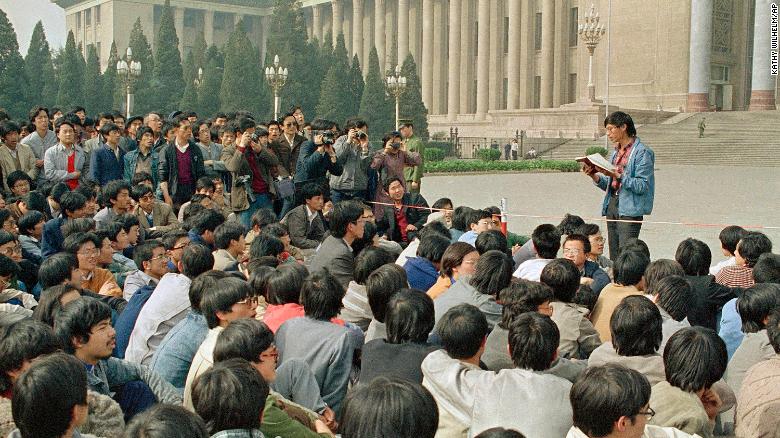
A Chinese student leader reads a list of demands to students staging a sit-in in front of Beijing's Great Hall of the People on April 18.

But he was ignored and hardline Premier Li Peng imposed marital law on the city the same day. Trucks of soldiers began to arrive in Beijing, but still the protests didn't stop.
On May 30, in the center of the square, protesters built a 10-meter high statue called the Goddess of Democracy, to boost morale among the huge crowd.
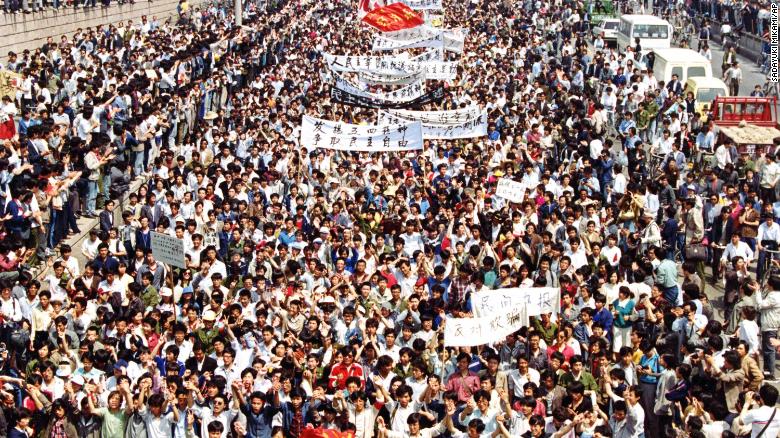
More than seven thousand students from local colleges and universities march to Tiananmen Square, Beijing, May 4, to demonstrate for government reform.

In the end, the government moved swiftly. 
After a tense two weeks, on the night of June 3, convoys of armed troops entered Beijing with an aim to clear the square by whatever means necessary.
Blocked by civilians in the streets who were attempting to protect the students, the troops opened fire. Students, workers and other ordinary citizens fought back, setting fire to some military vehicles, but they were overwhelmed.
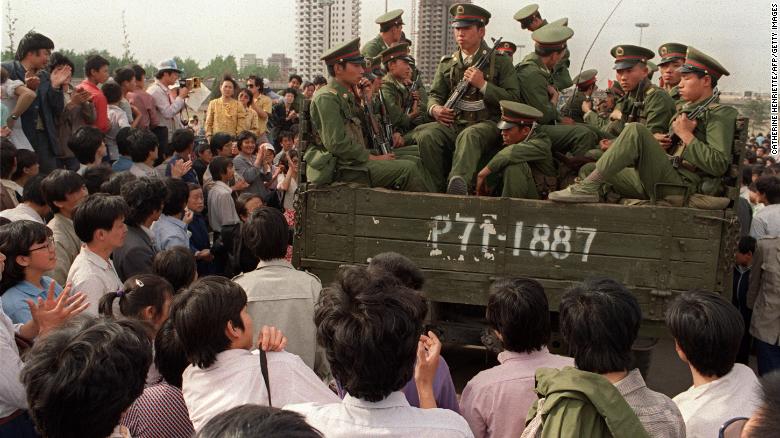
Pro-democracy demonstrators surround a truck filled of People's Liberation Army (PLO) soldiers on 20 May 1989 in Beijing on their way to Tiananmen Square.

Witnesses told horrific stories of tanks driving over unarmed protesters and soldiers shooting indiscriminately into crowds.
No official death toll was ever released by the Chinese government, but human rights groups estimate it was the hundreds, if not thousands.
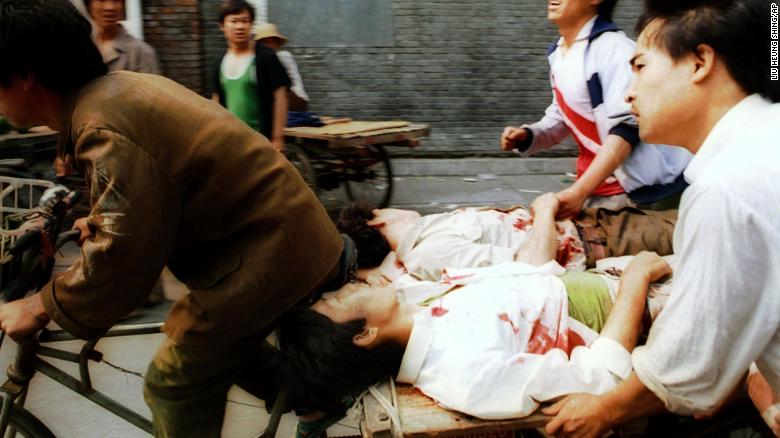
On June 4, a rickshaw driver pedals wounded people, with the help of bystanders, to a nearby hospital in Beijing after they were injured during clashes with Chinese soldiers in Tiananmen Square.

Many of the protest leaders were imprisoned, some of whom wouldn't be released for more than a decade, and the government has worked hard to remove all mention of the massacre from Chinese history and media, seeing it as a threat to the legitimacy of its continued one-party rule.
So far, at least, it appears to have worked. 
On the 30th anniversary in 2019, no public memorials or events marking the day are expected in mainland China.

vendredi 31 mai 2019

30th Anniversary

New Documents Show Power Games Behind China’s Tiananmen Crackdown
By Chris Buckley
Zhao Ziyang, the Communist Party general secretary, urging students to call off their hunger strike on May 19, 1989, in Beijing’s Tiananmen Square.

BEIJING — One by one, China’s shaken leaders spoke up, denouncing the student protesters who had occupied Tiananmen Square until the army rolled in. 
They heaped scorn on Zhao Ziyang, the Communist Party leader purged for being soft on the demonstrators, and blamed the upheaval on subversives backed by the United States.
This scene was played out among Chinese Communist Party leaders soon after troops and tanks crushed pro-democracy protests on June 3-4, 1989, according to a collection of previously secret party speeches and statements published Friday in Hong Kong.
“Kill those who should be killed, sentence those who should be sentenced,” Wang Zhen, a veteran Communist with a famously fiery temper, said of the party’s opponents, according to the collection, “The Last Secret: The Final Documents From the June Fourth Crackdown.”
The newly published documents lay bare how after the massacre, party leaders quickly set about reinforcing a worldview that casts the party and China as menaced by malign and secretive forces. 
It is an outlook that continues to shape Chinese politics under Xi Jinping, the party leader facing off with President Trump in a trade war.
“This view that the Chinese Communist Party is surrounded by enemies has been dominant since 1989,” said Jean-Pierre Cabestan, a professor of political science at Hong Kong Baptist University and author of “China Tomorrow: Democracy or Dictatorship?”
Student hunger strikers atop buses parked at Tiananmen Square on May 19, 1989.

The upheavals of 1989 are barely mentioned these days in China; censorship and security controls silence efforts at public commemoration. 
But that time left a deep mark on politics.
Students occupied Tiananmen Square after the April 1989 death of Hu Yaobang, a reformist party leader who had been sidelined, and their protests evolved into a passionate movement for cleaner government and more democratic rights.
Mr. Zhao and his supporters favored defusing the protests through negotiations. 
But hard-liners prevailed, and pushed Mr. Zhao from power. 
Overnight on June 3, 1989, soldiers fatally shot thousands of protesters and bystanders in Beijing, and bloody confrontations erupted in other Chinese cities.
The 209 pages of documents emerged from meetings called in June 1989 to consolidate support for the armed suppression. 
Each official stepped in line behind Deng Xiaoping, the elderly leader who ordered the crackdown, and each denounced Mr. Zhao, the Communist Party general secretary ousted for favoring compromise to end the months of protests.
“Dictatorship has its own tools; it’s not just lip service or something propped up there to admire — it’s there to be used,” said Bo Yibo, another powerful veteran official, in the collection issued by New Century Press, a small publisher that has defied China’s efforts to censor books about that time.

People Liberation Army soldiers leap over a barrier at Tiananmen Square in June 1989.

The comments suggest how close the leaders felt the Communist Party came to losing control.
“At that time the party had simply become an underground party, and our government also went underground,” Chen Xitong, the mayor of Beijing who defended the armed crackdown, told the other officials. 
“We were hemmed in everywhere.”
That deep-seated fear explains why the party moves quickly to crush any semblance of social unrest, most recently by quashing a small group of students who turned to militant Marxism as a solution to China’s yawning inequalities.
Even officials such as Hu Qili and Yan Mingfu who had backed Mr. Zhao’s more moderate policies turned on him, criticizing him for poor leadership, said Warren Sun, an expert on Chinese Communist Party history at Monash University in Australia.
Bao Pu, the publisher of New Centry Press whose father is a former top aide to Mr. Zhao, said “the ultimate secret found in these documents is how the party has this mechanism so that officials disregard their own beliefs and morals, and obey the No. 1 leader.”
“When Deng Xiaoping shows his cards, everyone falls into line,” he said.
Since coming to power in 2012, Xi Jinping has redoubled demands for obedience to himself as the top leader, and entrenched his power in 2018 by abolishing a term limit on the presidency, meaning that he can hold power indefinitely.

Bao Pu, founder of New Century Press, in Hong Kong on Thursday.

The new collection of documents joins a succession of books smuggled out of China that have shed light on the upheavals of 1989, a subject that the Communist Party subjects to ruthless censorship.
In 2001, scholars published “The Tiananmen Papers,” a collection of reports and documents that drew controversy, especially because some researchers challenged the authenticity of its accounts of high-level meetings. 
Mr. Bao, the publisher in Hong Kong, also helped issue the memoirs of Mr. Zhao, the fallen party leader, and a diary-like account by Li Peng, the Chinese premier who energetically supported the crackdown on the protests.
The new collection showed how Chinese officials asserted the view that China was threatened by subversive forces from abroad, particularly the United States. 
The public security minister singled out George Soros — still a target of conspiracy theories — as a supporter of liberal party officials.
“In demonizing domestic critics and exaggerating the role of foreign forces, the victorious conservatives revealed their blindness to the real problems affecting the regime,” Andrew J. Nathan, a professor of Chinese politics, writes in an introduction to the documents. 
While the hard-line officials acknowledged public ire about inflation and corruption, they treated political demands for more open government as nothing more than a tool of Western subversion.
For all the vitriol directed at Western influence in the newly published speeches, Deng, the party patriarch, wanted China to plow ahead with opening up to foreign investment. 
The officials were quick to voice their support.
“As for this fear that foreigners will stop investing, I’m not afraid,” Mr. Wang, the elderly party leader, said. 
“Foreign capitalists are out to make money, and they’ll never abandon a big market for the world like China.”

mardi 16 avril 2019

30th Anniversary

The Tiananmen Massacre Is One of China's Most Censored Topics. Here's a Look at What Gets Banned
BY AMY GUNIA / HONG KONG

More than 1,000 posts related to the Tiananmen Square Massacre that were removed from the Internet by Chinese censors were made public on Monday.
The database contains images of 1,056 posts that were deleted from Sina Weibo, a popular micro-blogging site with more than 400 million users, between 2012 and 2018. 
Researchers at the University of Hong Kong collected the posts as part of a project called Weiboscope, which tracks censorship on several Chinese social media networks.
“Over the years we found Chinese netizens consistently continued to post about the Tiananmen Square crackdown in early June,” Dr. King-wa Fu, an associate professor at the University of Hong Kong, who leads the project, told TIME.
Nearly thirty years after the crackdown on student-led pro-democracy protesters in Beijing’s Tiananmen Square, it remains one of the most censored topics on the Chinese Internet. 
China’s censorship apparatus, dubbed the Great Firewall, and a army of censors thought to be in the millions, block all mentions of the event. 
Related words and topics are also banned, and authorities have even blocked references to the date — June 4, 1989 — that Chinese tanks rolled into Beijing’s Tiananmen Squares and left what is believed to be thousands of protesters dead.
But Hong Kong, a semi-autonomous Chinese enclave, lies outside the Firewall, and researchers here were able to archive many posts before they were deleted.
Here’s a look at the photos the Chinese government does not want its people to see or share.

Re-enactments of the iconic ‘tank man’ photo
A photo of an anonymous man facing off to a row of tanks entering Tiananmen Square is one of the most well-known photos of event. 
Authorities block any posts that look similar to that photo — even of a swan facing a semi-truck.


Hu Yaobang tributes
Protests in Tiananmen Square started in April 1989 when students gathered to mourn the death of Hu Yaobang — a former Communist Party General Secretary, who was popular with students for his ideas about political and economic reform but was forced to resign by the government. 

Mentions of commemoration ceremonies
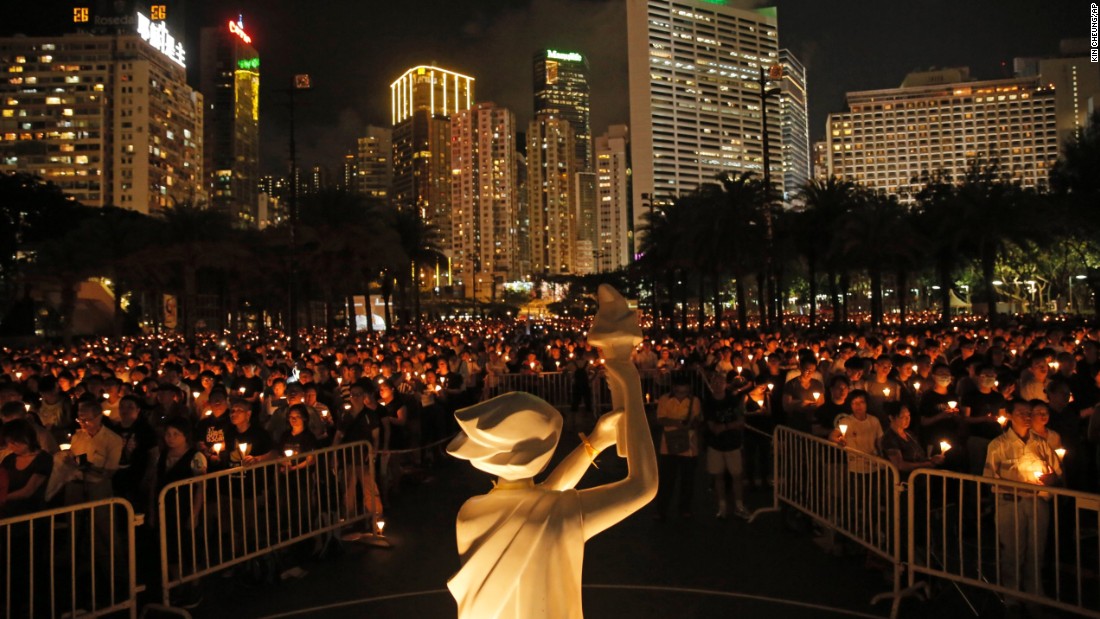
Each year in Hong Kong, tens of thousands of people gather to hold a candlelight vigil in remembrance of the event. 
Photos of the ceremony have been widely censored, and even simple photos of candles posted around the date of the event are removed.


Any references to the date on which the massacre occurred
An image of a set of playing cards displaying what could be seen as the year, month and date of the event, and a screenshot of a calendar, attracted the attention of censors.

Other images can be seen on the project’s Instagram account, Pinterest and website. 
“I want the public to understand the extent [to which] people are trying to post, about what kind of message they want to send out,” said Fu.


samedi 11 février 2017

The Fate of China’s Democracy Goddess

She was constructed as a rallying symbol for protesting students in Tiananmen Square. And when the tanks came rolling in, the Goddess of Democracy crashed to the ground.
By Allison Mcnearney

She was the symbol of a movement.
On May 30, 1989, 10 art students unveiled the Goddess of Democracy in the middle of Tiananmen Square in Beijing. 
She stood 30-feet tall, her arms raised to hold her torch high, her eyes staring unwaveringly into those of Mao Zedong, whose portrait hung on the opposite building. 
The statue rallied the flagging protestors, helping them to reinvigorate their pro-democracy movement in the face of exhaustion and government opposition.
And then, five days later, she watched as hundreds of tanks and thousands of soldiers invaded the camp, shooting down students and ultimately bringing down the goddess herself.
The protests had started two months earlier, in mid-April, after the death of Hu Yaobang, a Chinese politician who had been forced to resign from his position two years earlier over criticism that he was too sympathetic toward students and intellectuals.
While the movement would eventually end with a bloody roar in Beijing, protests were launched in several cities throughout the country.
For nearly two months, students, intellectuals, journalists, and others who sympathized with the activists’ call for greater rights and government transparency staged protests and boycotts.
In Beijing, these activities centered around Tiananmen Square, the site of many of the country’s most important historical events, from Mao’s creation of the People’s Republic in 1949 to earlier student protests dating back to 1919.
The 1989 protests had launched with the force of the students’ passionate convictions, but, by the end of May, they were starting to wind down.
The students and their supporters were tired. 
They had put themselves on the line, their lives on hold, for months, and their initial energy and zeal was starting to leech away as more and more people left the square. 
There were murmurings that it all might be coming to an end.
But not everyone was ready to give up the fight. 
In a piece written on May 30, 1989, The Wall Street Journal reported that a core group of students had hoped they could keep the protests going through June 20, when the standing committee of the National People’s Congress was scheduled to meet. 
But in order to do that, they needed a rallying cry to unite and reinvigorate the movement. 
They needed a piece of art—a symbol—that would represent what they were fighting for.
Over four days and nights, 10 students from Beijing’s Central Academy of Fine Arts got to work building a statue that would do just that.
The result was a towering white statue of a woman, her one-shoulder dress artfully draped down her body. 
Her left arm reached across her chest to grasp the bottom of the torch held high in her right—a two-handed grip on the flame of democracy.
Her hair billowed out to one side and her face—which was detailed with Western features—gazed determinedly over the crowd.
The artists made the choice to construct the statue out of plaster and Styrofoam, a decision that may be attributed partly to speed, but one that also had another benefit—the massive structure would be harder to dismantle.
“The students regard the statue as a public relations coup: either it will remain and symbolize the democracy movement and official weakness; or the authorities will be in the embarrassing position of sending the police to attack the Goddess of Democracy and Freedom with sledgehammers,” Nicholas Kristoff wrote in The New York Times on May 30, 1989.
On the night of May 30, the remaining protestors in Tiananmen Square became curious when they noticed a wooden scaffolding being built in the middle of the square. 
Soon after, a crew of tricycle carts came riding into the courtyard, ferrying sections of the goddess from the art school to her new home. It took all night, but piece-by-piece, the Goddess of Democracy took shape.
Reporter Steve Futterman was on the scene that night covering the events of the protest. 
In a 2009 article on The Huffington Post, he recounted watching this momentous event unfold. 
“It was a slow, arduous process, yet virtually no one left the square, so enraptured were they by the power of this papier-mâché Goddess. The crowd cheered each time a new section was put in place.”
The reaction was immediate. 
Futterman remembers that “tens of thousands of ordinary Beijing citizens, people who had played no active role in the protests,” quickly flocked to the square to see the statue.
“She signifies hope for China,” 22-year-old Y. H. Yang told The New York Times. 
“But she’s behind schedule in reaching the square, and she’s coming by tricycle. That is symbolic of the slowness and backwardness of the democratization process in China.”
This new symbol injected a fresh wave of hope and energy into the movement. 
Tiananmen Square filled back up and the protest enjoyed a new sense of resolve, one bolstered by the tall white beacon of democracy standing vigil in their center.
The Chinese government, predictably, was not so moved. 
They called the artistic expression an “abomination” and reiterated that “this is China, not America,” a fact that surely did not need to be reiterated to those who had given the previous couple of months to the fight for democracy.
But less than four days later, the government decided to intervene and end the stand-off. 
Premier Li Peng ordered tanks and thousands of soldiers to break up the protestors’ Tiananmen Square camp on the night of June 3 and into the next day.
There were reports that locals rushed into the streets to try to slow down the soldiers and provide a barricade for the students. 
But they were no match for the military force, which began firing into the crowds.
To this day, the exact number who lost their lives in the Tiananmen Square Massacre is unknown. Estimates range from the hundreds to the thousands, with thousands more injured and arrested.
Among the death toll that night was the Goddess of Democracy. 
Her end was televised as a tank rammed into her base and the statue toppled over, face forward.
While the government ultimately prevailed that day, the Goddess of Democracy remains a symbol of the freedom that the Chinese students were fighting for during those protests over two decades ago.
In the following years, cities and countries around the world, from Hong Kong to Canada to San Francisco, constructed replicas of the statue in their own public spaces.
But the Goddess of Democracy remains banished from China—at least for now.
The 10 artists knew their plaster and Styrofoam creation wouldn’t last forever. 
In a statement they issued when the statue was unveiled, they revealed their hopes that a more permanent replacement would eventually be created.
“On the day when real democracy and freedom come to China, we must erect another Goddess of Democracy here in the Square, monumental, towering, and permanent. We have strong faith that that day will come at last,” they wrote. 
In the meantime, they implored, “Chinese people, arise! Erect the statue of the Goddess of Democracy in your millions of hearts!”
Résultat de recherche d'images pour "hong kong goddess of democracy"
Hong Kong Democracy Goddess