Affichage des articles dont le libellé est trade war. Afficher tous les articles

vendredi 20 décembre 2019

Like rats deserting a sinking ship

Money has been leaving China at a record rate. Beijing is battling to stem the tide
By Laura He

Hong Kong -- Beijing is stepping up the battle to stop money flowing out of China as the country contends with economic woes and trade war tensions that have eased but show no sign of ending altogether.
Money was leaving the country at a record clip earlier this year through unauthorized channels, according to analysts.
That's bad news for China, which needs to keep financial reserves high to maintain confidence in its markets.
Now Chinese officials are trying harder than ever to avoid a repeat of the financial scare four years ago that sapped its money reserves by hundreds of billions of dollars.
The State Administration of Foreign Exchange, a key government regulator, said Sunday that its most important job next year is to prevent major financial risks, avoid "abnormal" capital flows across its borders and crack down on illegal trading activities.
"We need to fight a critical battle" to defuse financial risks and maintain market stability, SAFE said in an statement.
The pledge was an unusually strong one for the agency, which deployed the kind of military language more often used by top leaders in China.

Cracking down
The agency has already started cracking down on capital flight.
In November, it fined Chinabank Payments $4.2 million — one of the largest-ever fines SAFE has imposed — for moving money overseas.
The regulator didn't say how much had been transferred, but it could have been tens of millions of yuan because China calculates fines based on the amount of money in question.
The online payments firm, a subsidiary of billionaire Richard Liu's JD.com, told CNN Business that the transfers were made by "external merchants" who had taken advantage of loopholes.
But it said it felt "deeply sorry" and would reflect on its management.
Major corporations aren't the only ones linked to the flight of money out of China.
Earlier this month, a Bank of China customer took out $50,000 in cash from his bank account over the course of a week.
SAFE fined the bank nearly $6,000 for breaking a government rule limiting how much foreign currency people can take out of their accounts within a short period of time.
While the amount was small, it still symbolizes how far the government is willing to go to crack down on such withdrawals.
"Controls on outflows are increasingly tight," said Alicia Garcia Herrero, chief economist for Asia Pacific at Natixis Bank.

Fleeing money
The threat of fleeing capital stems from concerns about the country's economy, which has been hurt by cooling domestic demand and a prolonged trade war with the United States.
The People's Bank of China also allowed the yuan to weaken, a way to help the country to counter the impact of higher US tariffs on its exports.
Since the trade war began last year, the currency has depreciated by around 12% against the US dollar.
A weaker currency, though, raises the risk that people will try to move money out of the country, which in turn threatens to drive the yuan's value even lower.
The Chinese government has been able to stop some money from leaving.
About $74 billion left China through regulated channels in the first half of this year — the smallest amount in a decade, wrote Gene Ma, head of China research for the Institute of International Finance, in an October report.
Even so, a record amount of funds have left China through "unrecorded transactions" during that time, he said.
The Washington-based trade group estimates that $131 billion left China in the first six months of 2019 — the most recent data available — through "hidden capital outflows." (People can move money through such means, for example, by asking friends and family to pool the annual limit on foreign currency they are allowed to withdraw from Chinese banks, or by claiming to make investments overseas that don't really exist.)
Ma wrote that the surge was triggered by "intensifying trade tensions."
China has also been trying to help its economy by cutting benchmark interest rates, which will likely increase the amount of money leaving China, said Herrero, the Natixis Bank economist.
And while China and the United States recently agreed to a "phase one" trade agreement that could cool tensions between the two countries, Herrero said that deal isn't likely to alleviate the pressure on China entirely.
She said the yuan's respite might be "temporary," adding that China's central bank will likely let the currency depreciate again if the deal is not signed, or is eventually watered down.

Lessons learned
China has good reason to keep its money in the country.
The last time China experienced this kind of capital flight was in 2015 and 2016, when the economy faltered and the People's Bank of China suddenly devalued the yuan, roiling global financial markets.
On average, the amount of money leaving China was equivalent to 6% of the country's GDP in each of those two years, according to an estimate by the Chinese Academy of Social Sciences, a government think tank.
In total, China lost $1.28 trillion, and it was forced to tap into its foreign exchange reserves to prevent its currency from rapidly depreciating even further.
China's foreign reserves shrank by more than $800 billion in those two years before recovering some losses in 2017.
Since then, Beijing has significantly tightened control of capital and made it more difficult for people to exchange money for foreign currency or transfer funds abroad.
"Chinese regulators have learned their lessons during the frightening period of 2015-16," analysts from Bank of America wrote in November.
Analysts at UBS also pointed out that China has taken steps to offset capital flight.
They noted earlier this month that the country recently opened up its financial markets further to attract foreign investors and companies.
Those kind of measures can boost interest from foreign investors in the Chinese market and attract more money within the country's borders.

mardi 29 octobre 2019

As China’s Troubles Simmer, Xi Reinforces His Political Firewall

With China mired in a trade war, economic slowdown and Hong Kong unrest, Xi Jinping will use an elite meeting to focus more on increasing his control over the Communist Party.
By Chris Buckley

BEIJING — Slowing economic growth
A rancorous trade war
Recalcitrant protesters in Hong Kong
A mass die-off of pigs and surging food prices
The frustrations are piling up for Chinese dictator Xi Jinping.
But a gathering of the Communist Party elite this week will grapple with lurking risks that worry him more: dysfunction, divisions and disloyalty in the party.
Communist Party rule could eventually crumble if the party fails to constantly reinforce its grip on China, Xi said in a recently published speech, citing ancient emperors whose dynasties rotted from corruption, lax discipline and infighting. 
The Central Committee, a party conclave of about 370 senior officials, began meeting in Beijing for four days on Monday to approve policies intended to ward off such dangers.
“From ancient times to the present, whenever great powers have collapsed or decayed, a common cause has been the loss of central authority,” Xi said in the speech, which was given early last year but not issued till this month in a leading party journal, Qiushi.
“As I see it, we can be defeated only by ourselves,” he said. 
“Prevent strife starting from inside the family home.”
Xi has warned this year that China must prepare for “struggle,” an ominous term for domestic and external challenges, and has described his goal as building an authoritarian fortress against any shocks. 
The meeting this week, also called the plenum, will push efforts to sharpen China’s political defenses, likely including greater use of advanced technology to monitor and manage officials and citizens.
Xi laid out his proposals on the first day, according to Xinhua, China’s official news agency, but no details were released.
“He’s looking at this from the viewpoint of the next 30 years,” said Tian Feilong, a professor of law at Beihang University in Beijing. 
“The system still isn’t strong enough for this struggle against all kinds of external forces, because it still has many holes.”
To critics, Xi’s drive to centralize power is not a cure for China’s policy missteps, but rather one of their chief causes. 
The intense pressure on lower officials to conform with the top leader has robbed them of room to debate, spot missteps, and alter course, they say.
Some have pointed to Xi’s misreading earlier in the year of how far he could push the Trump administration in trade talks, and China’s impasse in Hong Kong, where demonstrators have taken to the streets for 21 weeks.
“The principal problem stems from the nature of the political system which increasingly permeates all sectors of activity,” said Jonathan Fenby, China chairman of TS Lombard, a firm that advises investors. 
“The political constraints sap initiative.”

The Yangshan Deep Water Port in Shanghai. Chinese and American negotiators agreed to a provisional pause in their trade dispute this month.

‘Rumors of Displeasure’
For Xi, there is no issue more vital to his political survival than command of the party, and he appears anxious to stop setbacks from festering into wider doubts about his and the party’s capacity to rule.
Since 2012, he has repeatedly introduced offensives intended to rid officialdom of graft, factionalism and bureaucratic fragmentation, failings that he suggested weakened his predecessors. 
Last year, he swept away a term limit on the presidency, opening the way to an indefinite stay as president, Communist Party general secretary and chairman of China’s military.
“The plenum will be the latest step in this campaign,” Mr. Fenby from TS Lombard said. 
“It may bring institutional changes aimed at streamlining the transmission of orders and achieving further centralization of authority. But the main element is likely to be an intensification of Xi’s personal leadership.”
Two retired officials in Beijing and a businessman who talks to senior officials, speaking on condition of anonymity, described jitters in the party elite about Xi’s policies. 
Even so, that sentiment was far from coalescing into concerted opposition to him, they said.
“Rumors of displeasure — even animosity — toward Xi’s rule are rampant, but his hold on power appears firm,” said Jude Blanchette, the Freeman Chair in China Studies at the Center for Strategic and International Studies in Washington.
A deeper worry for Xi and other top leaders is improving the effectiveness and morale of hundreds of thousands of junior officials who enforce their policies.
Many midranking officials resent Xi’s anticorruption drive, which has shrunk their income and influence, Ke Huaqing, a professor at the China University of Political Science and Law in Beijing who studies the rules and workings of the party, said in an interview.
Cadres have also been punished for complaining about government policies, defying orders to move to other posts, or spreading rumors about leaders. 
When the party recently announced the punishment of Liu Shiyu, the former chairman of the China Securities Regulatory Commission, it said his misdeeds included a “wavering” political stance and failure to rigorously enforce central leaders’ decisions.
“The Chinese Communist Party could get away without cleaning itself up,” Ke said, “but after a period of time it might collapse.”

A construction site in Beijing. The country has seen slowing economic growth.

‘Modernizing the System’
While the committee usually meets once a year at the walled Jingxi Hotel in western Beijing, this session has been unusually delayed — it has been 20 months since the last meeting.
That has led some to speculate that Xi feared rifts upsetting proceedings. 
Others have questioned why he has devoted the meeting to party organization issues when China faces many pressing problems.
“He would seek to delay a full gathering of the Central Committee until such time that he felt he had built a consensus,” said Mr. Blanchette from the Center for Strategic and International Studies, who wrote an assessment of the speculation
“Xi can stand before his peers with some credible ‘wins.’”
He has had several of late. 
On Oct. 1, Xi presided over a military parade celebrating 70 years of Communist rule, basking in adulatory shouts of loyalty from 15,000 troops. 
Later in the month, Chinese and American negotiators agreed to a provisional pause in their trade dispute.
The group could discuss economic and foreign policy at the gathering. 
But often at this point in the leadership’s 5-year cycle of meetings, the Central Committee focuses on the party’s organizational and legal issues.
Some in Beijing have speculated that Xi could also use the meeting to elevate protégés as he lays the groundwork for a third term as party leader in 2022. 
Xi, though, was unlikely to signal a possible successor so soon, the three political insiders in Beijing said.
“Xi draws much of his strength from his careful cultivation of an air of implacable unassailability,” said Christopher K. Johnson, a former China analyst at the C.I.A. 
“Injecting that kind of uncertainty makes no political sense, particularly as his bid for a third term presumably is about to gear up.”

Soldiers during a parade in Beijing on Oct. 1 to celebrate the 70th anniversary of the founding of communist China.

The official announcements at the end of the meeting on Thursday will most likely to focus on the official theme of “modernizing the system of governance.”
According to experts, the steps announced could include:
  • Fleshing out the powers of the new party policy commissions that Xi has created to steer policy.
  • Honing a shake-up of government begun last year that Xi said in July remains incomplete, creating gaps and poor coordination.
  • Expanding the presence of party committees in businesses, organizations and neighborhoods to enforce policy and monitor potential discontent.
  • Using high-tech monitoring to detect and extinguish sources of public ire, such as official misconduct, pollution or land disputes, before they ignite protests. China already leads the way in using collection of personal data, surveillance technology and online monitoring to stifle social threats, most notably in East Turkestan, the ethnically divided colony in western China.

lundi 7 octobre 2019

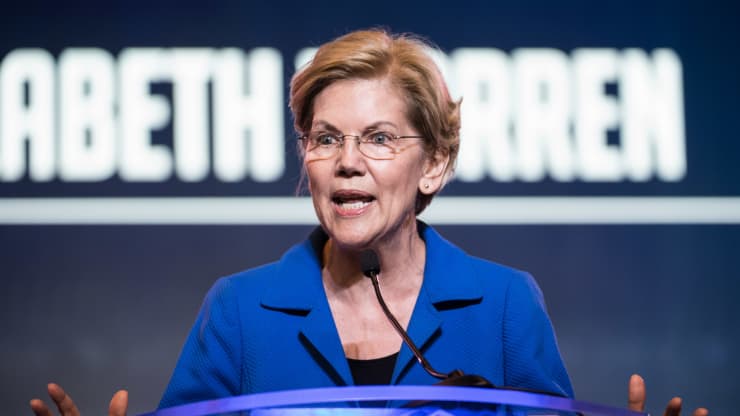
Sen. Elizabeth Warren as president would be far tougher on China than Trump

  • An Elizabeth Warren presidency would be really bad news for China, CNBC’s Jim Cramer predicts.
  • Trump is willing to negotiate with Beijing, but Cramer doesn’t believe Sen. Warren would do so.
  • “She is, I would say, far more extreme than Trump on what it would take to be able to have a trade deal,” Cramer says.
By Jessica Bursztynsky

Sen. Warren is far tougher on China than Trump

An Elizabeth Warren presidency would be really bad news for China, CNBC’s Jim Cramer said Monday.
“She is, I would say, far more extreme than Trump on what it would take to be able to have a trade deal,” Cramer said, discussing the Massachusetts senator’s 2020 Democratic nomination bid. 
“I don’t understand why the Chinese government doesn’t realize that if Sen. Elizabeth Warren comes in, there will be no talks whatsoever.”
Donald Trump’s administration is heading into another round of trade talks with Beijing, starting Thursday. 
However, Chinese officials are growing hesitant to pursue a broad trade deal that would include key commitments.
With Trump, Cramer said, Chinese officials have room to negotiate, so long as a deal is made. 
As part of his strategy, Trump has put tariffs on billions of dollars worth of Chinese goods in hopes of forcing Beijing to acquiesce to U.S. trade demands.
However, that would be a different story for Sen. Warren, said Cramer, adding she wouldn’t agree to talks with China because they “don’t believe in” religious freedom or global warming.
“She’s a much harder line than Trump,” Cramer said on “Squawk Box,” adding she likely won’t rollback the billions of dollars of tariffs introduced.
The “Mad Money” host recently said that China is likely safer with a Trump reelection. 
After Sen. Warren released her China approach, he said, “The Chinese better wake up to Sen. Warren. ‘President Warren’ would be tougher on China than Trump.”
Warren, in late July, released what she called an “economic patriotism” agenda, which outlined her approach on China. 
“We’ve let China get away with the suppression of pay and labor rights, poor environmental protections, and years of currency manipulation,” Warren wrote in a blog post.
On Thursday, Cramer said that if Sen. Bernie Sanders were to exit the 2020 presidential race, Sen. Warren would be free to loosen up her hard-line stance against Wall Street. 
Last month, Cramer first reported that he’s hearing the financial community saying about Warren that “she’s got to be stopped.” 
On Tuesday, Cramer said, “I’m not as fearful of Elizabeth Warren as Wall Street is.” 
He believes those fears are “getting overblown.”

vendredi 20 septembre 2019

Chinese Fifth Column

Trump’s China policy is working, but you’d never know that from media reports
By GREG AUTRY

Pr. Peter Navarro has been a key adviser to the president on China trade policy.

On the morning after the 2016 presidential election, CNBC interviewed Peter Navarro, who had been an economic adviser to the Trump campaign and would soon join the administration to advise the president on trade and manufacturing policy. 
Navarro outlined President Trump’s economic plans: cutting taxes, reducing regulation, cutting energy costs and reforming trade. 
He predicted strong growth and a Dow moving past 25,000 based on these pro-growth policies.
The Trump administration has delivered on every one of those things, but you’d never know that from the mainstream media. 
Today, it’s hard to turn on the financial news, open a business paper or browse an investment website without seeing some doomsayer predicting the impending collapse of the U.S. economy and equity markets because of the latest tariff or presidential tweet. 
When the markets invariably resume their upward trends the next day, it’s crickets.
With each drop, tariffs are blamed, and sometimes, the blame is more specifically laid at the feet of Navarro, who has been a chief architect of the president’s trade policies. 
As the economy hummed along, with historically low unemployment, the Wall Street Journal recently suggested we might see a “Navarro recession.”
We’ve also heard the constant refrain that the tariff burden is borne by American consumers. 
In fact, while economists differ on the effects of the tariffs, there is considerable evidence that they are having the desired effect. 
Modeling by European economists Benedikt Zoller-Rydzek and Gabriel Felbermayr concluded that, although U.S. consumer prices for affected Chinese products will rise by about 4.5%, Chinese firms will pay approximately 75% of the tariff burden. 
And as of the end of August, the treasury had collected more than $25 billion in tariffs from China.
Another benefit of the tariffs has been that many U.S. manufacturers are diversifying their supply chains, moving production out of China. 
While this is not cost-free for companies, they are making a worthy investment that will ultimately make the global economy far more competitive and resilient. 
The promising speed at which this is happening must terrify the Politburo in Beijing.
Most economists and business scholars in the 1990s bought into the promise of globalism. 
But by the mid-2000s, a few of us were skeptical of the way things were playing out, realizing that China had no intention of enacting the structural reforms required for WTO compliance. 
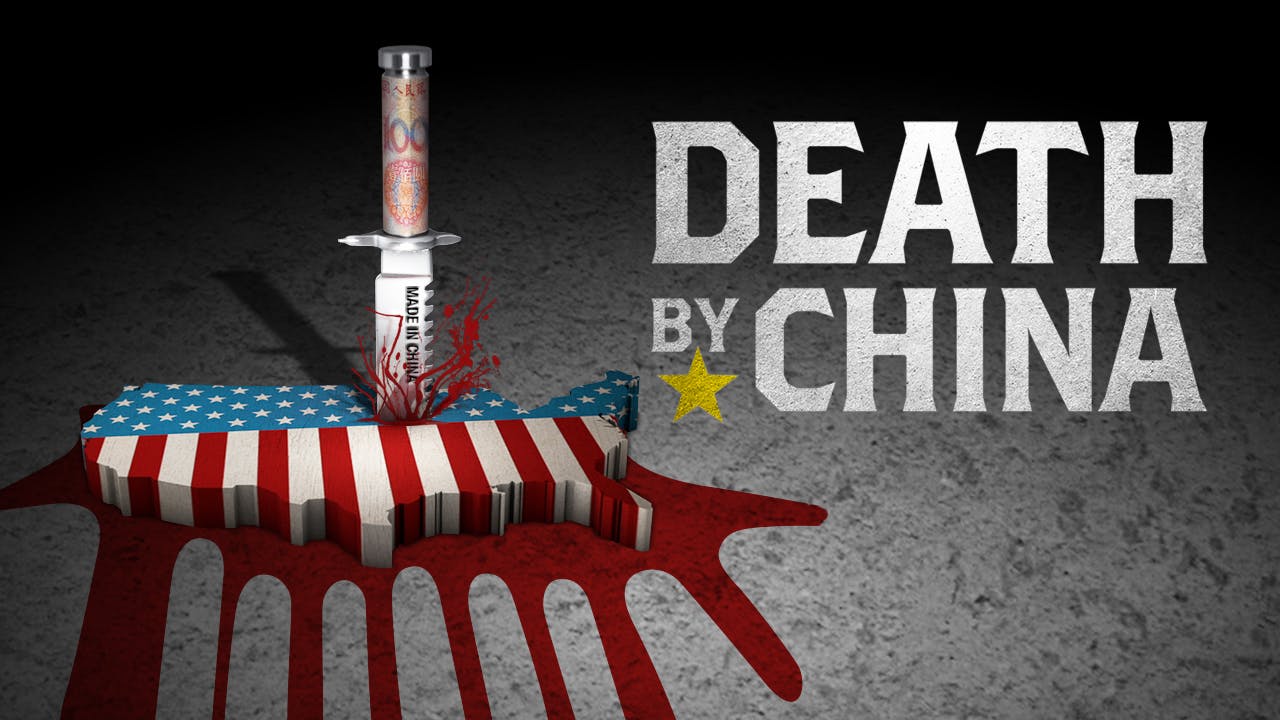
In 2011, Navarro and I wrote Death by China,” to expose the predatory process underlying the offshoring of global manufacturing to China. 
The book laid out how China was obtaining the foreign expertise and capital it required by forcing technology transfer, stealing intellectual property, debasing the country’s environment, exploiting labor, and eroding the purchasing power of Chinese consumers.
While China’s actions enhanced the profits of large, multinational corporations, American workers and small U.S. firms took it on the chin. 
Meanwhile, millions of rural Chinese were pushed into a Dickensian nightmare of 16-hour workdays in some of the world’s most polluted cities for the benefit of China’s privileged elite. 
Worse, economic engagement was failing to liberalize China’s Communist Party; they were using their newfound wealth to fortify a repressive police state and build an increasingly aggressive military.
Seeing this unfolding chess game, a small coalition of economists and business leaders worked to build political support for trade reform. 
Our efforts were rewarded with growing bipartisan awareness of the China problem in Congress and finally the election of Trump, whose refreshing honesty on China ripped away the emperor’s imaginary clothing.
The administration is the first to fully recognize that globalization hasn’t delivered for Americans and that China is an existential threat. 
Moving from awareness to action is now a global challenge. 
American firms are on notice that the U.S. government once again sees American workers and national security as top priorities in its dealings with China. 
And the administration has drawn a clear line in the sand for China, requiring it to embrace global norms and structural reforms that would lead to mutually beneficial trade.
Whenever the next recession invariably arrives — and it looks years away — it won’t have been the administration’s trade policies that caused it.


The Trump Syndrome

Wall Street is starting ‘to get religion’ on China trade like President Trump
  • Steve Bannon says China’s attempts to forge a two-tier deal to end the yearlong trade war with the U.S. is “wishful thinking.”
  • “Wall Street is starting to get religion like Trump.” Bannon refers to the tough talk earlier this week from Blackstone co-founder Stephen Schwarzman, who has extensive ties to China.
By Matthew J. Belvedere

Steve Bannon on the US-China trade war: ‘We have all the cards’

Wall Street is coming around to President Donald Trump’s view on how China has been unfairly protecting its economy to the detriment of the rest of the world, former White House chief strategist Steve Bannon told CNBC on Thursday.
“Wall Street is starting to get religion like Trump,” said Mr. Bannon, a longtime critic of China. “Schwarzman now has religion on CNBC.”
Mr. Bannon was referring to comments earlier this week by Stephen Schwarzman, the billionaire co-founder and chief of private equity powerhouse Blackstone who has extensive ties to China.
In an interview on “Squawk Box on Tuesday, Schwartzman said that Beijing knows it must change its trade and business practices. 
But he added that China is reluctant to do so because it would slow the robust growth it’s been able to achieve over decades by putting up economic barriers.
“The upper Midwest, this is why Donald Trump is president,” Mr. Bannon said said on “Squawk Box.” 
“People know that the factories and the jobs all went to China and the fentanyl an opioids came in, into this despair of not having jobs.”
Mr. Bannon also said China’s attempt to forge a two-tier deal to end the yearlong trade war with the U.S. is “wishful thinking.” 
Last week, Trump signaled he would consider an interim trade deal with China, even though he would prefer a full agreement.
“What they’re trying to do to a large extent is trying to game the system,” Mr. Bannon said.
“They are trying to box in Donald Trump. And I think Trump has been the force of stability here,” he added. 
“This is about shifting the supply chain back to the U.S.”
As U.S. and Chinese deputy trade negotiators get ready to resume face-to-face talks in Washington on Thursday, there’s a thought that Chinese officials want to address the trade disputes first, leaving tougher national security issues for later.
Mr. Bannon said a key focus in the 2020 presidential election will be China. 
Candidates who pressure Beijing and show they can navigate a trade deal will do better, he said.
In goodwill gestures ahead of higher-level trade talks next month, the U.S. delayed by two weeks tariff rate hikes that had been set to go into effect Oct. 1 and China exempted some U.S. products from additional levies. 
Both sides have imposed billions of dollars import tariffs on each other’s goods.

lundi 26 août 2019

President Trump's trade war with China is worth the fight

By James D. Schultz 


For years, and through multiple presidential administrations — Clinton, Bush and Obama — the United States has naively looked the other way while China cheated its way to an unfair advantage in the international trade market. 
It took a long time to get to this point, and it's not going to turn around overnight. 
But with President Donald Trump's long-term approach to trade policy, the United States is in a good position to make up for the misguided policies of the past, which resulted in millions of lost jobs and thousands of shuttered factories.
A bad day or a bad week on Wall Street is not an indication that Trump's policy is failing. 
Market volatility is neither a surprise nor a reason to head for the lifeboats. 
The markets are going to react and fluctuate as the United States and China go back and forth in trade negotiations.
As the US Treasury Department reported in May, there has been, and is, an "exceptionally large and widening" bilateral trade imbalance between China and the United States."
It's not as though China hasn't had a chance to change its ways. 
It simply chose not to by, among other things, willfully ignoring its G20 commitment to fair trade, dumping products below cost into US markets and stealing intellectual property.
China has also recently been labeled a currency manipulator by the Treasury Department. 
The Chinese government, not the free market, sets its currency's value against the dollar. 
When China allows its currency to fall in an attempt to boost its own exporters, American companies and workers pay the price.
Only by applying pressure will China be motivated to change its destructive trade habits. 
The United States will apply an additional tariff of 15% on approximately $300 billion of Chinese goods — some effective September 1 and some effective December 15. 
This puts the squeeze right where it needs to be — on China. 
The delay in tariffs on some Chinese goods from September to December, is strategic and not a retreat on tariffs. 
It was done to avoid impacting the holiday season because tariffs will not apply to goods that have been ordered. 
Thus, American retailers and consumers will likely not get stuck with the extra cost for those goods tariffed in December.
Something had to be done to end China's unfair practices, and rather than capitulate to the predictions of recession and calamity, we need to stay the course and continue to add tariffs to Chinese goods. We as a nation simply cannot allow China to continue to have its way with our economy.
Of course, trade wars don't come without risk or impact, and American farmers are bearing the brunt of the fallout. 
In what was clearly a retaliatory move, China placed stifling tariffs on American agricultural products. 
President Trump stepped in to assist with $14.5 billion in subsidies that go directly to farmers to make up for the loss of income, the US Department of Agriculture announced in May.
The good news is that the USDA predicts a 10% increase in farm profit in 2019 to $69.4 billion after a 16% dip in 2018, according to the USDA Economic Research Service.
It's important to view the current trade war within the context of the Trump administration's broader trade policy.
For example, if we focus only on farming, the president negotiated the US-Mexico-Canada Trade Agreement which, if Congress does its job, will provide farmers a fairer market to export their goods.
Perhaps this is one of the reasons why President Trump 's support among farmers remains strong, despite the trade war's impact on their bottom line. 
According to a recent survey by the Purdue Center for Commercial Agriculture, 78% of farmers said they believe the trade war will ultimately benefit US agriculture.
China appears ready for a long fight, but there are indications it is already feeling the strain. 
Tech companies — at least 50 to date — are in the process of moving significant portions of their manufacturing operations out of China and back to other countries in an effort to get out from under US tariffs.
It seems that our choice is clear: We stay in this for the long haul to ensure that American businesses can compete on a fair playing field, or we panic and continue to allow China to play with a corked bat.
The former is sound trade policy. 
The latter is bad for US business, prosperity and security.

The Necessary War

Sen. Lindsey Graham: "Accept the pain that comes with trade between US and China"
By Andrew O'Reilly 


Sen. Lindsey Graham, R-S.C., said on Sunday that Democrats should not criticize President Trump for taking on China over trade as they have complained for years about Beijing’s policies but done nothing.
Every Democrat and every Republican of note has said China cheats,” Graham said on CBS News’ “Face the Nation.” 
“The Democrats for years have been claiming that China should be stood up to, now President Trump is and we’ve just got to accept the pain that comes with standing up to China.”
Graham added: “To my Democratic colleagues: he’s doing the things you’ve been calling for all these years.”
Graham’s comments come as President Trump faced a tense reception from his counterparts on the world stage as they gathered in a French beach resort for the Group of Seven summit.
President Trump suggested during a breakfast meeting with United Kingdom Prime Minister Boris Johnson that he harbored qualms about the spiraling conflict. 
"Yeah. For sure," he told reporters when asked if he had any second thoughts about ramping up tariffs on China after Beijing imposed new tariffs to retaliate against earlier tariff moves by the U.S.
Then hours later, however, White House Press Secretary Stephanie Grisham issued a statement saying the news media had "greatly misinterpreted" President Trump's response. 
Grisham said the president only responded "in the affirmative -- because he regrets not raising the tariffs higher."
President Trump had been trying to use the summit to rally the other leaders to do more to stimulate their economies, as fears rise of a potential slowdown in the U.S. before he stands for reelection in November 2020.

The meetings come days after President Trump responded to China's announcement Friday that it would slap new tariffs on $75 billion in American goods with more tariffs of his own. 
President Trump also issued an extraordinary threat to declare a national emergency in an attempt to force U.S. businesses to cut ties with China.
Graham on Sunday did admit that the trade war would hurt some of his constituents – saying “consumer prices on commodities are going to go up” – but called it a necessary evil to take on Beijing.
“Until [the Chinese] feel the pain they’re not going to stop,” he said. 
“They never will until they feel a heavier price.”

samedi 24 août 2019

"Try looking at Emergency Economic Powers Act of 1977..."

President Trump maintains he can order renegade U.S. businesses out of China with the National Emergencies Act
By Ray Kelly

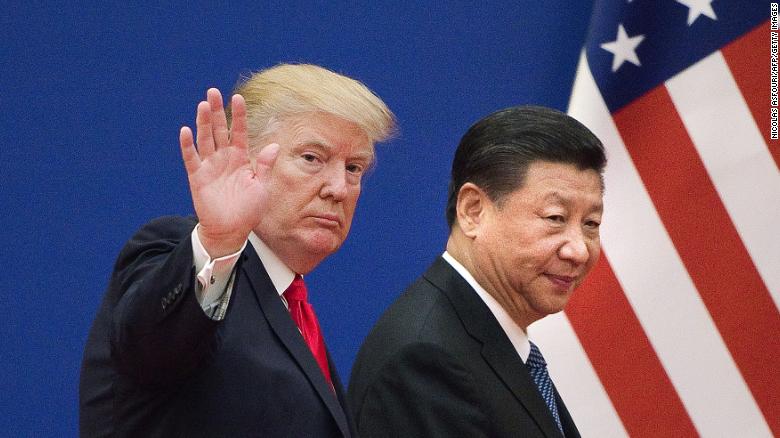
President Donald Trump, left, meets with Xi Jinping during a meeting on the sidelines of the G-20 summit in Osaka, Japan on June 29, 2019.

President Donald Trump doubled down Friday night on his threat to order U.S. businesses out of China as part of an escalating trade war.
The president had tweeted on Friday morning, “We don’t need China and, frankly, would be far. ... better off without them. The vast amounts of money made and stolen by China from the United States, year after year, for decades, will and must STOP. Our great American companies are hereby ordered to immediately start looking for an alternative to China, including bringing... your companies HOME and making your products in the USA..”
After some reporters questioned whether President Trump has the power to order private businesses to relocate, President Trump lashed out at the news media.
“For all of the Fake News Reporters that don’t have a clue as to what the law is relative to Presidential powers, China, etc., try looking at the Emergency Economic Powers Act of 1977. Case closed!," he tweeted Friday night.
Jennifer Hillman, a Georgetown University law professor and trade expert at the Council on Foreign Relations, told The Washington Post that President Trump does have the authority under the International Emergency Economic Powers Act to prevent future transfers of funds to Beijing.
The International Emergency Economic Powers Act of 1977, approved by President Jimmy Carter, is part of the National Emergencies Act
It permits the president to block transactions and freeze assets in the events of an “unusual and extraordinary threat... to the national security, foreign policy, or economy of the United States.”
It was invoked by Carter during the Iran hostage crisis in 1977 and again by President George W. Bush following the 9/11 attacks in 2001 to freeze assets of terrorist organizations. 
It has also been used in response to events in such countries as Lebanon, Libya, Yemen and Venezuela.
Earlier this year, the White House said President Trump might cite the act to impose tariffs on Mexican exports in response to illegal immigration into the U.S.
U.S. companies invested a total of $256 billion in China between 1990 and 2017, compared with $140 billion Chinese companies have invested in the U.S, according to the Rhodium Group research institute.

vendredi 23 août 2019

Dies iræ

Trade war explodes as President Trump clashes with US firms over order to abandon China, block fentanyl shipments
By Alex Pappas


President Trump's trade war with China boiled over Friday as Beijing slapped retaliatory tariffs on America and the president declared he's ordering U.S. companies to prepare to leave the country and relocate back home.
"Our great American companies are hereby ordered to immediately start looking for an alternative to China, including bringing ... your companies HOME and making your products in the USA," Trump tweeted in a blistering set of statements Friday morning. 
The president went on to call on companies to “search for & refuse” shipments of the opioid painkiller fentanyl from China.


Donald J. Trump
✔@realDonaldTrump
· 5h
Our Country has lost, stupidly, Trillions of Dollars with China over many years. They have stolen our Intellectual Property at a rate of Hundreds of Billions of Dollars a year, & they want to continue. I won’t let that happen! We don’t need China and, frankly, would be far....


Donald J. Trump
✔@realDonaldTrump

.... better off without them. The vast amounts of money made and stolen by China from the United States, year after year, for decades, will and must STOP. Our great American companies are hereby ordered to immediately start looking for an alternative to China, including bringing..
32.2K
4:59 PM - Aug 23, 2019
Twitter Ads info and privacy
21K people are talking about this

The U.S. has said it plans to impose 10 percent tariffs on $300 billion of Chinese goods in two steps, on Sept. 1 and Dec. 15. 
China responded Friday with new tariffs on $75 billion of U.S. products in retaliation, deepening a conflict over trade and technology.
But as Trump rejects such warnings while keeping his foot on the gas in the clash with China, American businesses responded to his latest guidance by urging continued trade talks.
The U.S. Chamber of Commerce issued a statement saying it wants to see continued "constructive engagement" with China.
President Trump, meanwhile, pressured major shipping companies to block fentanyl from China.
"I am ordering all carriers, including Fed Ex, Amazon, UPS and the Post Office, to SEARCH FOR & REFUSE all deliveries of Fentanyl from China (or anywhere else!)," Trump tweeted Friday.


Donald J. Trump
✔@realDonaldTrump

· 5h
Replying to @realDonaldTrump
.... your companies HOME and making your products in the USA. I will be responding to China’s Tariffs this afternoon. This is a GREAT opportunity for the United States. Also, I am ordering all carriers, including Fed Ex, Amazon, UPS and the Post Office, to SEARCH FOR & REFUSE,....


Donald J. Trump
✔@realDonaldTrump

.... all deliveries of Fentanyl from China (or anywhere else!). Fentanyl kills 100,000 Americans a year. President Xi said this would stop -- it didn’t. Our Economy, because of our gains in the last 2 1/2 years, is MUCH larger than that of China. We will keep it that way!
57.3K
4:59 PM - Aug 23, 2019
Twitter Ads info and privacy
25.2K people are talking about this

China added fentanyl products to the country's list of narcotics subject to state control after Xi Jinping met with President Trump in December 2018, but the White House says it has not seen substantial action on blocking major shipments.
But the shipping companies suggested they're already doing what they can.
FedEx and UPS both said in statements they already work to identify and remove illegal shipments.
“FedEx already has extensive security measures in place to prevent the use of our networks for illegal purposes. We follow the laws and regulations everywhere we do business and have a long history of close cooperation with authorities,” the company said.
“UPS takes a multi-layered approach to security and compliance to identify and prevent delivery of illegal Fentanyl and other illicit substances as well as any other attempts of noncompliant shipments,” the shipping business said.
Stocks fell sharply on Wall Street after Trump’s comments. The Dow Jones Industrial Average sank more than 600 points Friday.
The stocks of all three companies the president mentioned also dropped as traders tried to understand what the implications for them were.
Meanwhile, President Trump also lashed out at the Federal Reserve after its chairman, Jerome Powell, stopped short of saying the U.S. central bank is prepared to cut interest rates for a second time this year.
In a tweet, President Trump compared Powell -- whom he’s repeatedly criticized, despite hand-picking him almost two years ago -- to Chinese dictator Xi Jinping.
“As usual, the Fed did NOTHING!” Trump tweeted, initially misspelling Powell’s last name before changing it. 
“My only question is, who is our bigger enemy, Jay Powel or Chairman Xi?”


Donald J. Trump
✔@realDonaldTrump
· 5h
As usual, the Fed did NOTHING! It is incredible that they can “speak” without knowing or asking what I am doing, which will be announced shortly. We have a very strong dollar and a very weak Fed. I will work “brilliantly” with both, and the U.S. will do great...


Donald J. Trump
✔@realDonaldTrump

... My only question is, who is our bigger enemy, Jay Powell or Chairman Xi?
36.2K
4:57 PM - Aug 23, 2019
Twitter Ads info and privacy
26.2K people are talking about this

His tweet came shortly after Powell gave a speech at the Jackson Hole Economic Symposium in Wyoming in which he promised policymakers will “act as appropriate” to sustain the record economic expansion. 
The economic outlook, Powell said, remains strong, despite uncertainties resulting from the U.S.-China trade war, slowing global growth and muted inflation.
Stocks had been wavering between gains and losses earlier after China said it would retaliate against the latest round of tariffs imposed by Washington with duties on $75 billion of U.S. products.
China said Friday that it will also increase import duties on U.S.-made autos and auto parts. 
The retaliation pulled global markets into negative territory.

vendredi 28 juin 2019

China’s Rare Earths, Locked And Loaded

By Steve Hanke 

President Trump has picked a fight with China on trade. 
This has run the gamut of badgering to the imposition of tariffs on Chinese exports to the United States. 
And, if that is not enough, the President threatens to lay on more tariffs if China fails to comply with a host of U.S. demands. 
China will not stand idly by and be beaten with a stick, but will they pull the trigger?
One weapon that China has in its arsenal is rare earths. 
As the Global Times, a state-owned Chinese newspaper, put it: rare earths are “an ace in China’s hand.” 
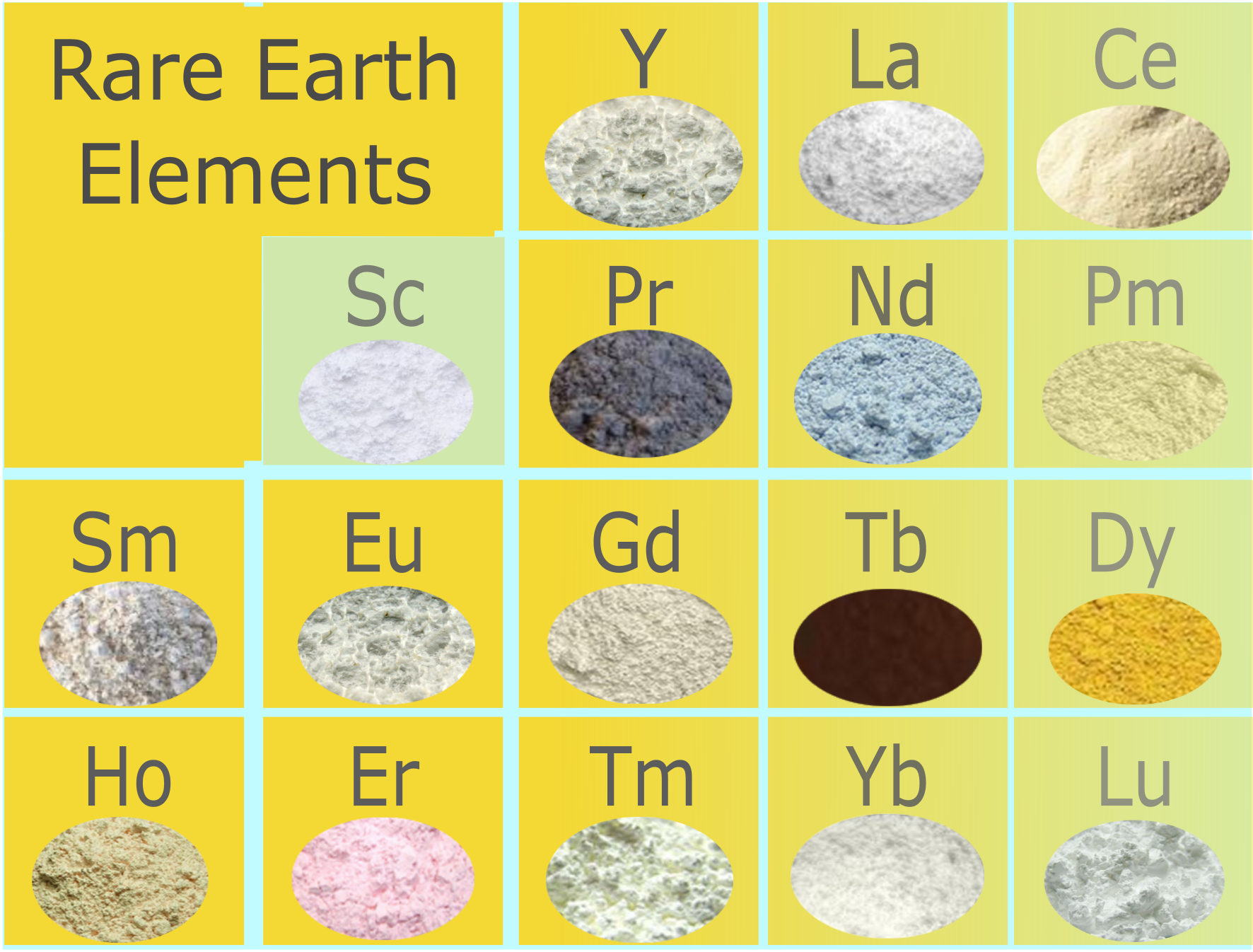
Rare earths cover 17 important elements on the periodic table. 
And, they are elements in which China occupies a dominant position. 
Furthermore, the Chinese leadership is well aware of the strategic importance of rare earths. 
As far back as 1992, Deng Xiaoping stressed that “the Middle East has oil; China has rare earths.”
And that is not all. 
China knows that rare earths can be used to counterpunch. 
Last month, China’s Natural Development and Reform Commission, a body that oversees Chinese policy shifts, pointedly brought up rare earths in a question-and-answer bulletin on the threat of a rare earths export ban. 
The notice read: “Will rare earths become China’s counter-weapon against the US’s unwarranted suppression? What I can tell you is that if anyone wants to use products made from rare earth to curb the development of China, then the people of the revolutionary soviet base and the whole Chinese people will not be happy.”
So, the threat of a Chinese export ban on rare earths is not idle. 
Indeed, China has used export bans before. 
In 2010, China cut its exports of rare earths after a Chinese trawler collided with two Japanese Coast Guard ships in the East China Sea. 
Subsequently, the World Trade Organization ruled against these Chinese restrictions.
To punctuate the importance and potential potency of the rare earths weapon, Xi Jinping recently visited a rare earths mining site. 
He also visited a plant that produces precision magnets which rely on rare earths.
Just what are rare earths used for and why are they important? 
Rare earths are found in a wide range of consumer products from iPhones to DVD players and rechargeable batteries. 
They are also critical for many “green” products, like LED lights. 
Prominent products also contain specialized magnets that require rare earths, and China produces 90% of those magnets. 
Motors in electric cars and the generators in wind turbines all use loads of precision magnets. Magnets that use rare earths are also employed in missile guidance systems
Other military equipment, like night vision devices and jet engines use rare earths.
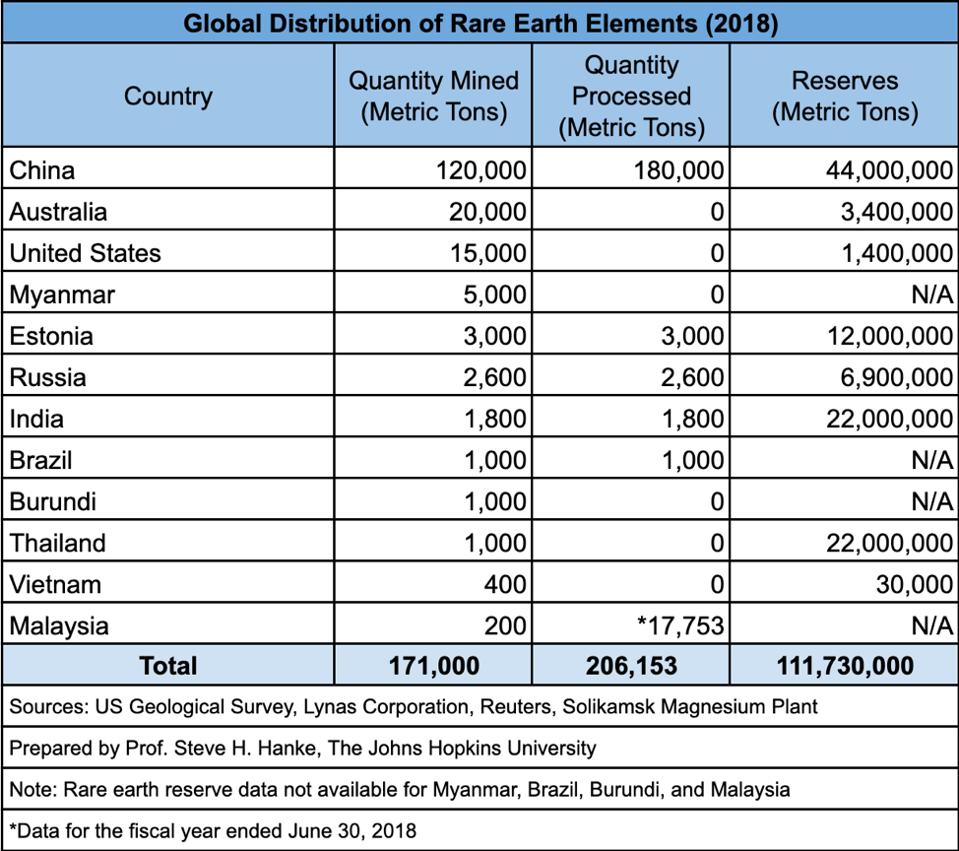
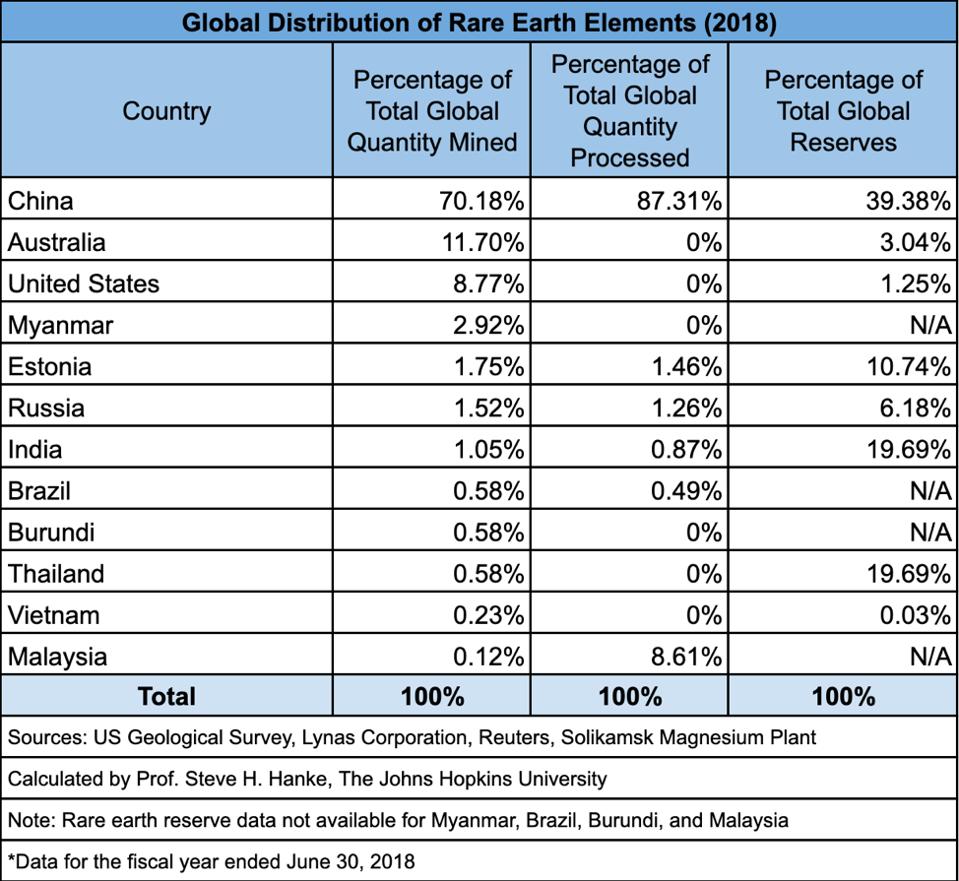
As the following two tables indicate, the reserves of rare earths are scattered around, with China holding down the top spot with slightly over 39% of the world’s reserves. 
When it comes to mining and the physical removal of rare earths, China’s lead becomes dominant. Indeed, over 70% of rare earths are mined in China. 
Further downstream is processing. 
At that stage, China is even more dominant, with 87% of the world’s rare earths being processed in China.


How did China gain such a dominance across the board in rare earths? 
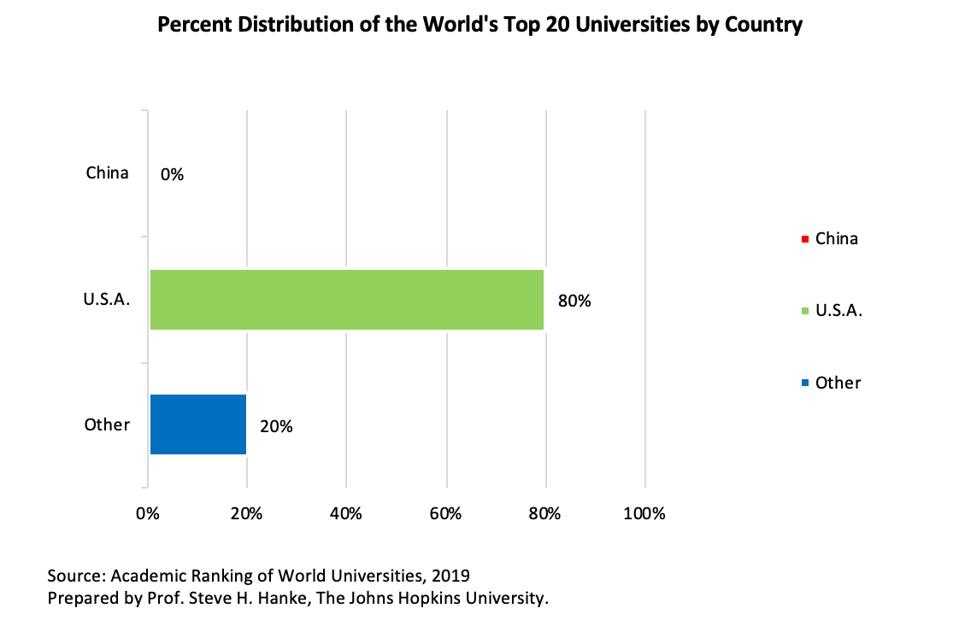
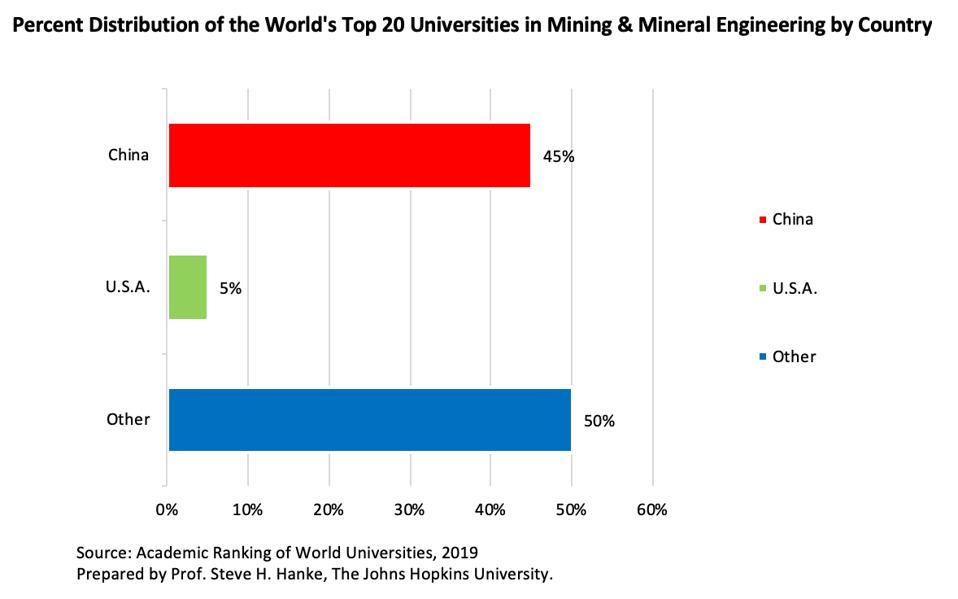
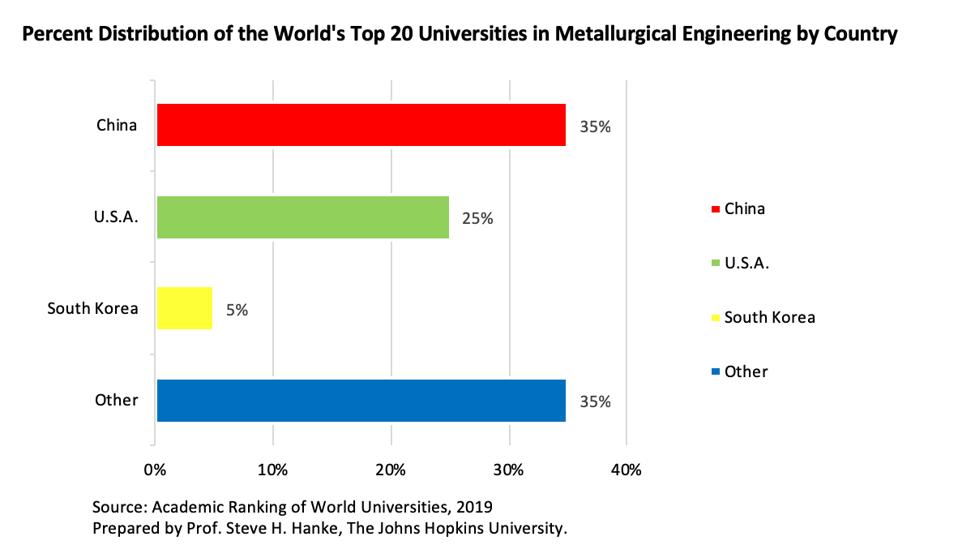
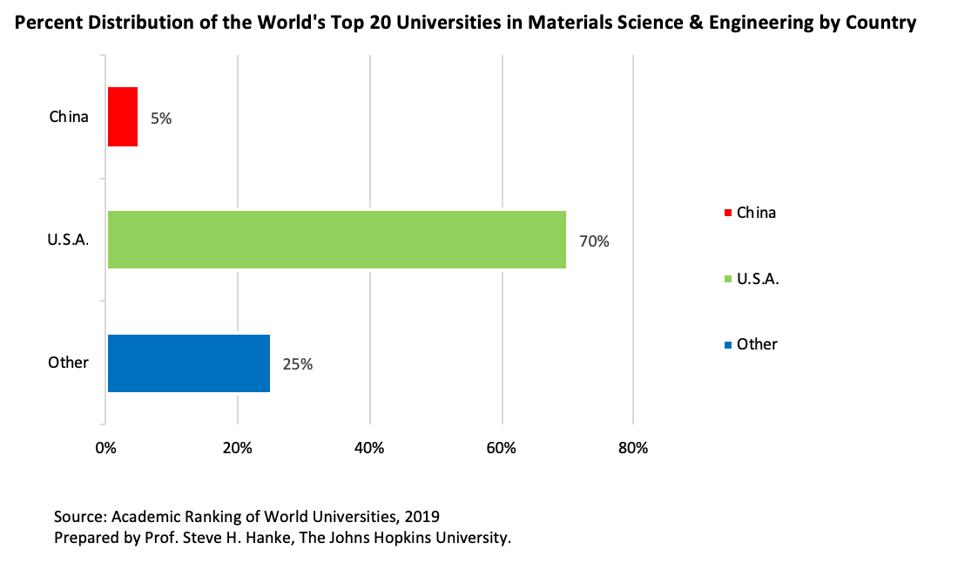
As someone who landed his first faculty position and cut his eye teeth on mineral economics in the late 1960s at the Colorado School of Mines (the top-ranked University in the World in Mineral Engineering), I suspected that China must have invested heavily in the 3Ms: Mining and Mineral Engineering, Metallurgical Engineering, and Materials Science and Engineering.
So, let’s take a look. 
The chart below shows that, when it comes to the world’s top-flight universities, China is nowhere to be found in the Top-20.

But, when we move into the 3Ms, things change dramatically. 
China dominates in Mining and Mineral Engineering, with nearly half of the world’s Top-20 programs in those fields.


When we move to Metallurgical Engineering, China holds down 35% of the Top-20 programs in the world.

In Materials Science and Engineering, China slips, but still holds down 5% of the world’s first-class programs.

Just how has China reached the commanding heights in the 3Ms educational fields? 
The answer to this question is hard to nail down with precision. 
We have Deng Xiaoping’s quip about rare earths in 1992. 
So, we know that the Chinese leadership was aware of the importance of the 3Ms. 
But, it wasn’t until 2001 that I was able to turn up specific evidence of the Chinese government pouring money into education and development of the 3Ms.
In 2001, China launched its 10th Five-Year Plan for National Economic and Social Development. 
It was signed by none other than Zhu Rongji
According to the plan, China aims to make good use of its abundant mineral resources and enhance traditional industries (such as energy, metallurgy, chemical, machinery, automobile, building materials, construction, textile and light industries) with high, new, and advanced technologies. 
The measures include improving product variety and quality as well as speeding up development of universal, key, and accessory technologies. 
These objectives are to be supported by university investments in the relevant fields.
So, Mining and Mineral Engineering, Metallurgical Engineering, and Materials Science and Engineering are supported by the Five-Year Plan. 
The Communist Party has spoken, and in the sphere of the 3Ms, the Party has delivered.
When it comes to rare earths, China is loaded for bear—locked and loaded. 
But, will China fire? 
It is not as likely as it might seem at first sight. 
After all, the last time Beijing attempted to restrict supply, it didn’t work out too well. 
Indeed, the World Trade Organization slapped China down. 
And, given today’s trade wars, China does not want to cross swords with the WTO. China needs the WTO to protect it from Trump’s tariff onslaught. 
Also, if a Chinese export ban was imposed, prices of rare earths would soar, and investment would pour into the development of non-Chinese mines and processing facilities. 
These investments would create new sources of rare earths supply. 
On the demand side, work arounds and rare earths substitutes are available, and they would be used if prices of rare earths become higher and more variable. 
So, China might not pull the trigger on rare earths, but rather just stay locked and loaded.

mercredi 26 juin 2019

Made in Vietnam: US-China tensions spark a manufacturing shift but not without growing pains

  • Companies are starting to question whether it’s time to shift production out of China due to the ongoing trade war between Washington and Beijing.
  • Many firms are already making the move to other countries, with Vietnam as a major beneficiary of tensions between the world’s two largest economies.
By Jessica Bursztynsky


Multinational companies are starting to question whether it’s time to shift production out of China due to the ongoing trade war between Washington and Beijing.
Many firms are already making the move to other countries, with Vietnam as one of the major beneficiaries of tensions between the world’s two largest economies.
President Donald Trump is set to meet with Chinese dictator Xi Jinping at the G-20 summit in Japan later this week, where the two leaders are expected to restart stalled trade talks.
However, if talks were to prove unsuccessful the White House has threatened to place 25% tariffs on an additional $300 billion worth of Chinese goods, essentially all remaining imports into the U.S. from China.
Some companies, such as Brooks Running — which is part of Warren Buffett’s Berkshire Hathaway — are not waiting to see if the additional China tariffs will go into effect. 
CEO Jim Weber said back in May that Brooks would be “predominantly in Vietnam by the end of the year.” 
He also said about 8,000 jobs will move there from China.
Such relocation plans raise the question of whether Vietnam can become the new China. 
CNBC’s Carl Quintanilla reports from Hanoi, ahead of the Trump-Xi meeting, with a look at Vietnam’s manufacturing boom and whether it can be sustained.
Vietnamese firms are starting to grow to try to accommodate the influx of companies, mostly apparel and shoe makers.
Textile firm TNG Investment & Trading told Quintanilla that it’s never seen an expansion like this before. 
Last year, the firm hired 3,000 employees, bringing its total to 15,000.
TNG’s Linh Nguyen said it had to build an apartment complex just to accommodate the additional employees. 
“In order to grow the business, it’s more important for us to build a home for the people than actually building a factory.”
The demand for technical skills is growing in Vietnam, and the Vietnamese government has a goal of training 2 million people in vocational schools.
More than 90% of students trained in technical skills, such as welding or making electronics, can get hired, said professor Nguyen Quang Huy
He told CNBC that it’s “very easy to get a job, and a lot of companies need more people.”
However, Vietnam still lacks much of the infrastructure that has enabled China to become a manufacturing epicenter.
Ramping up the ability to transfer goods from Vietnamese factories to ports will be key. 
Across the country, railroad lines are sparse compared with China’s, highways are smaller, and it’s still an agrarian economy largely focused on rice.
Vietnam is building a deep-water port that can make transfers easier, but that won’t open for another three years.

American Quislings

U.S. Tech Companies Sidestep a Trump Ban, to Keep Selling to Huawei
By Paul Mozur and Cecilia Kang
A Huawei billboard in Shanghai. The deals with United States companies will help Huawei continue to sell its smartphones and other products.

SHANGHAI — United States chip makers are still selling millions of dollars of products to Huawei despite a Trump administration ban on the sale of American technology to the Chinese telecommunications giant.
Industry leaders including Intel and Micron have found ways to avoid labeling goods as American-made, said the people, who spoke on the condition they not be named because they were not authorized to disclose the sales.
Goods produced by American companies overseas are not always considered American-made. 
The components began to flow to Huawei about three weeks ago, the people said.
The sales will help Huawei continue to sell products such as smartphones and servers, and underscore how difficult it is for the Trump administration to clamp down on companies that it considers a national security threat, like Huawei. 
They also hint at the possible unintended consequences from altering the web of trade relationships that ties together the world’s electronics industry and global commerce.
The Commerce Department’s move to block sales to Huawei, by putting it on a so-called entity list, set off confusion within the Chinese company and its many American suppliers, the people said. Many executives lacked deep experience with American trade controls, leading to initial suspensions in shipments to Huawei until lawyers could puzzle out which products could be sent. 
Decisions about what can and cannot be shipped were also often run by the Commerce Department.

American companies like Intel sell technology supporting current Huawei products until mid-August.

American companies may sell technology supporting current Huawei products until mid-August. 
But a ban on components for future Huawei products is already in place. 
It’s not clear what percentage of the current sales were for future products. 
The sales have most likely already totaled hundreds of millions of dollars, the people estimated.
While the Trump administration has been aware of the sales, officials are split about how to respond, the people said. 
Some officials feel that the sales violate the spirit of the law and undermine government efforts to pressure Huawei, while others are more supportive because it lightens the blow of the ban for American corporations. 
Huawei has said it buys around $11 billion in technology from United States companies each year.
Intel and Micron declined to comment.
“As we have discussed with the U.S. government, it is now clear some items may be supplied to Huawei consistent with the entity list and applicable regulations,” John Neuffer, the president of the Semiconductor Industry Association, wrote in a statement on Friday.
“Each company is impacted differently based on their specific products and supply chains, and each company must evaluate how best to conduct its business and remain in compliance.”
In an earnings call Tuesday afternoon, Micron’s chief executive, Sanjay Mehrotra, said the company stopped shipments to Huawei after the Commerce Department’s action last month. 
But it resumed sales about two weeks ago after Micron reviewed the entity list rules and “determined that we could lawfully resume” shipping a subset of products, Mr. Mehrotra said. 
“However, there is considerable ongoing uncertainty around the Huawei situation,” he added.
A spokesman for the Commerce Department, in response to questions about the sales to Huawei, referred to a section of the official notice about the company being added to the entity list, including that the purpose was to “prevent activities contrary to the national security or foreign policy interests of the United States.”
The Idaho-based Micron competes with South Korean companies like Samsung to supply memory chips that go into Huawei’s smartphones.

A senior administration official said that after the Commerce Department put Huawei on the entity list, the Semiconductor Industry Association sent a letter to the White House asking for waivers for some companies to allow them to continue selling components to Huawei. 
But the administration did not grant the waivers, he said, and the companies then found what they assert is a legal basis for continuing their sales.
Administration officials would like to address this issue, he said, but they do not plan to do so before the G-20 summit in Japan at the end of this week. 
Mr. Trump’s top priority is to discuss the general trade dispute with Xi Jinping and get the two sides to resume trade talks that have dragged on since early 2018, the official said.
The fate of Huawei, a crown jewel of Chinese innovation and technological prowess, has become a symbol of the economic and security standoff between the United States and China. 
Chinese companies like Huawei, which makes telecom networking equipment, could intercept and secretly divert information to China. 
Xi Jinping and President Trump are expected to have an “extended” talk this week during the Group of 20 meetings in Japan, a sign that the two countries are again seeking a compromise after trade discussions broke down in May. 
After the talks stalled, the Trump administration announced new restrictions on Chinese technology companies.
Along with Huawei, the administration blocked a Chinese supercomputer maker from buying American tech, and it is considering adding the surveillance technology company Hikvision to the list.
Kevin Wolf, a former Commerce Department official and partner at the law firm Akin Gump, has advised several American technology companies that supply Huawei. 
He said he told executives that Huawei’s addition to the list did not prevent American suppliers from continuing sales, as long as the goods and services weren’t made in the United States.

The SK Hynix plant in Icheon, South Korea. American companies are worried about losing market share to foreign rivals.

A chip, for example, can still be supplied to Huawei if it is manufactured outside the United States and doesn’t contain technology that can pose national security risks. 
But there are limits on sales from American companies. 
If the chip maker provides services from the United States for troubleshooting or instruction on how to use the product, for example, the company would not be able to sell to Huawei even if the physical chip were made overseas, Wolf said.
“This is not a loophole or an interpretation because there is no ambiguity,” he said. 
“It’s just esoteric.”
After this article was published online on Tuesday, Garrett Marquis, the White House National Security Council spokesman, criticized the companies’ workarounds. 
He said, “If true, it’s disturbing that a former Senate-confirmed Commerce Department official, who was previously responsible for enforcement of U.S. export control laws including through entity list restrictions, may be assisting listed entities to circumvent those very enforcement mechanisms.”
Wolf said he does not represent Chinese companies or firms on the entity list, and he added that Commerce Department officials had provided him with identical information on the scope of the list in recent weeks.
In some cases, American companies aren’t the only source of important technology, but they want to avoid losing Huawei’s valuable business to a foreign rival. 
For instance, the Idaho-based Micron competes with South Korean companies like Samsung and SK Hynix to supply memory chips that go into Huawei’s smartphones. 
If Micron is unable to sell to Huawei, orders could easily be shifted to those rivals.
Beijing has also pressured American companies. 
This month, the Chinese government said it would create an “unreliable entities list” to punish companies and individuals it perceived as damaging Chinese interests. 
The following week, China’s chief economic planning agency summoned foreign executives, including representatives from Microsoft, Dell and Apple. 
It warned them that cutting off sales to Chinese companies could lead to punishment and hinted that the companies should lobby the United States government to stop the bans. 
The stakes are high for some of the American companies, like Apple, which relies on China for many sales and for much of its production.

A FedEx warehouse in Kernersville, N.C. “FedEx is a transportation company, not a law enforcement agency,” the company said in a complaint against the government.

Wolf said several companies had scrambled to figure out how to continue sales to Huawei, with some businesses considering a total shift of manufacturing and services of some products overseas. 
The escalating trade battle between the United States and China is “causing companies to fundamentally rethink their supply chains,” he added.
That could mean that American companies shift their know-how, on top of production, outside the United States, where it would be less easy for the government to control, said Martin Chorzempa, a research fellow at the Peterson Institute for International Economics.
“American companies can move some things out of China if that’s problematic for their supply chain, but they can also move the tech development out of the U.S. if that becomes problematic,” he said. 
“And China remains a large market.”
“Some of the big winners might be other countries,” Mr. Chorzempa said.
Some American companies have complained that complying with the tight restrictions is difficult or impossible, and will take a toll on their business.
On Monday, FedEx filed a lawsuit against the federal government, claiming that the Commerce Department’s rules placed an “impossible burden” on a company like FedEx to know the origin and technological makeup of all the shipments it handles.
FedEx’s complaint didn’t name Huawei specifically. 
But it said that the agency’s rules that have prohibited exporting American technology to Chinese companies placed “an unreasonable burden on FedEx to police the millions of shipments that transit our network every day.”
“FedEx is a transportation company, not a law enforcement agency,” the company said.
A Commerce Department spokesman said it had not yet reviewed FedEx’s complaint but would defend the agency’s role in protecting national security.

vendredi 14 juin 2019

China Is Bluffing in the Trade War

Chinese say they can effectively retaliate against Trump’s tariffs. They’re wrong.
BY SALVATORE BABONES

A Chinese worker looks on as a cargo ship is loaded at a port in Qingdao, China, on July 13, 2017.

U.S. President Donald Trump’s trade war with China is about to get real. 
Until this point, not much has happened, because the 25 percent tariffs on Chinese goods that the Trump administration announced in May did not apply to goods already in transit. 
That created a four- to six-week window of opportunity for U.S. and Chinese negotiators to come to an agreement and avoid the implementation of the duties.
That window is now closing, and with no deal in sight, speculation has turned to how China might respond. 
With Chinese official media vowing no compromise in negotiations with the United States, the country seems to be settling in for a protracted siege.
Considering that China ran a trade surplus of $420 billion with the United States last year, it is obvious that it can’t come close to matching the United States in terms of tit-for-tat tariffs. 
But it does have other arrows in its quiver. 
Expert commentary and internet speculation have focused on three: an embargo on imports of soybeans from the United States, an embargo on exports of rare earth metals to the United States, and the diversification of China’s currency reserves away from the dollar.
Fortunately for the United States—and for the health of the global trading system—each of these would be an empty threat.
In 2018, as rhetoric about the trade war took off in earnest, China slapped a punitive tariff of 25 percent on American soybeans. 
Soybeans are the United States’ biggest farm export, and they are important crops in the Midwestern states that swung to elect Trump in 2016. 
The 25 percent duty has been widely cited as the root cause of low prices that have led to a wave of farm foreclosures across the U.S. heartland.
The United States’ largest competitor in the global soybean market is Brazil, so one might expect Brazilian farmers to be jumping with joy as they see more demand for their produce. 
But Brazilian soybean prices have fallen almost 20 percent since April 2018, almost exactly matching the slightly over 20 percent fall in U.S. soybean prices for that period.
The reason is simple: Soybeans are fungible. 
When China buys Brazilian soybeans instead of American ones, Europeans have to turn to soybeans from the United States to replace their usual Brazilian supplies. 
There is one, single, undifferentiated global market for soybeans. 
Squeeze it in one place, and it just pops out in another.
Indeed, the decline in soybean prices is global, and it has nothing to do with the U.S.-China trade war. It’s all about the Chinese swine fever. 
The majority of the world’s soybeans feed pigs and other animals, not people, and China’s pork producers have been hit with a nationwide fever epidemic.
As a result, Chinese purchases of U.S. soybeans have now stopped completely
That may look like a total soybean embargo. 
But the reality is that China just doesn’t need as many soybeans, because it doesn’t have as many pigs to feed. 
As the swine fever continues to rage, look for U.S. exports of pork products to boom.
China is by far the world’s largest producer of rare earth metals: elements such as neodymium, europium, terbium, and dysprosium that are crucial to the production of some advanced materials and electronics. 
Despite their name, rare earths really aren’t so rare, and, in fact, the United States was the world’s major producer until cheap Chinese sources undercut the market in the 1980s.
The United States still has plenty of rare earth metals, but the environmental costs of extracting them from the underlying ores are too high to make production economic. 
Refining the minerals is only cheap in China because of the country’s lax environmental standards. 
If China does place a global embargo on the export of rare earths, prices will go up to reflect the metals’ true economic costs, which would actually be a good thing (from an environmental perspective).
Anything less than a total global embargo, however, would be useless, since, even more so than soybeans, rare earths are entirely fungible. 
China found that out in 2010, when it slapped an embargo on rare earth exports to Japan. 
Analyses a few years later found that the export ban had virtually no ill effect. 
If China sells them to anyone, U.S. companies can just buy them secondhand or switch to alternative inputs to their industrial processes.
China holds an estimated $1.1 trillion of U.S. government bonds, out of a total foreign currency reserve of around $3 trillion. 
That sounds like a lot of money, but in comparison to the size of its economy and levels of international trade, China’s reserves are roughly in line with those of other developing countries. 
It’s also not a particularly large proportion of the roughly $22 trillion total U.S. government debt to the world outstanding.
Alarmists warn that a Chinese dollar dump could send U.S. interest rates soaring and the U.S. economy crashing down. 
Just about everyone else understands that the huge market for U.S. Treasury securities, with an average daily trading volume of $500 billion in the spot market—and many times that in swaps, options, and futures—could easily absorb China’s entire reserves.
Ironically, the biggest victim of any Chinese liquidation of U.S. dollar holdings could be the European Union. 
Any reduction in China’s dollar reserves holdings would have to be matched by a corresponding rise in its holdings of other currencies, and the euro is the most likely alternative. 
But eurozone government bond trading is much thinner and more fragmented than the U.S. Treasurys market. 
A massive Chinese shift into euros could see that currency skyrocketing, placing a massive drag on Europe’s big industrial exporters.
The truth is that China has very little leverage in a trade war with the United States. 
Given Beijing’s bluster, it can be easy to forget that China is still a relatively poor country with a GDP per capita less than one-sixth the U.S. level. 
Compared to the America’s, China’s economy is relatively inefficient and undifferentiated, and its markets are poorly developed.
The simple fact is that China needs the United States more than the United States needs China. 
In itself, that’s no reason to start a trade war. 
But if the trade war really does heat up, there’s little doubt who will win.

mercredi 12 juin 2019

How China Could Shut Down America’s Defenses

Advanced U.S. weapons are almost entirely reliant on rare-earth materials only made in China
BY KEITH JOHNSON, LARA SELIGMAN
The Virginia-class fast-attack submarine USS Hawaii prepared to moor at the historic submarine piers at Joint Base Pearl Harbor-Hickam on June 6. Each Virginia-class submarine uses nearly five tons of rare-earth materials. 

President Donald Trump has often argued that China has much more to lose than the United States in a trade war, but critics say his administration has failed to address a major U.S. vulnerability: Beijing maintains powerful leverage over the warmaking capability of its main strategic rival through its control of critical materials.
Every advanced weapon in the U.S. arsenal—from Tomahawk missiles to the F-35 fighter jet to Aegis-equipped destroyers and cruisers and everything in between—is absolutely reliant on components made using rare-earth elements, including critical items such as permanent magnets and specialized alloys that are almost exclusively made in China. 
More worrisome is that the long-term U.S. supply of smart bombs and guided munitions that would have to be replenished in a hurry in the event of U.S. conflict in Syria, Iran, or elsewhere are essentially reliant on China’s acquiescence in their continued production.
Chinese threats to cut off U.S. supplies of rare earths, first floated by Beijing in late May, haven’t abated. 
Over the weekend, Chinese state media suggested that high-end, finished products using rare earths that the U.S. defense industry requires could be included in China’s technology-export restrictions, themselves a response to U.S. pressure on the telecoms giant Huawei. 
“China is capable of impacting the US supply chain through certain technical controls,” said an editorial in China’s Global Times that pointedly referred to processed rare earths.
“China has effectively altered the way we manage war, and potentially the outcome,” said James Kennedy, the founder of ThREE Consulting, a rare-earths consultancy focused on security implications.
For all the hints of a new cold war with China, Kennedy said, U.S. warfighting capabilities are in the hands of the one country that has come to be seen by U.S. national security officials as a peer competitor and a strategic rival.
“Rare earths are actually a hegemonic trigger. If the United States gets into a conflict, China is supplying the majority of the upscale weapons,” he said. 
“China can determine the outcome of the conflict, and that could result in a hegemonic shift.”
If rare-earth elements have become the key ingredient in all sorts of advanced civilian technology such as cell phones, electric cars, and renewable energy equipment, they’re doubly important for defense. 
Each Virginia-class attack submarine needs 9,200 pounds of rare-earth materials, while each F-35 needs 920 pounds, according to a 2013 Congressional Research Service report.
The defense industry, unlike most other sectors, doesn’t need low-end rare-earth materials that—contrary to their name—are actually commonly found in many places around the world. 
Rather, what the defense industry most needs are highly processed rare-earth products, especially permanent magnets, that are essentially made only in Japan and China. 
And while Japan, itself stung by a Chinese rare-earth embargo in 2010 and 2011, has made some progress emancipating itself from reliance on Chinese suppliers, its rare-earth value chain is still deeply enmeshed with China, leaving it with little ability to ramp up production volumes to bail out U.S. consumers while still meeting its own domestic needs.
The highest-end products are high-powered magnets, which are what make the guidance systems on smart bombs and cruise missiles work and what runs Aegis missile-tracking and secure communications.
But there are a host of other rare-earth products that the defense industry relies on, Kennedy said. Those include temperature-resistant coatings and alloys for jet engines and stealth coatings for fuselages, all advanced targeting systems, advanced radar and sonar, and even night-vision goggles.
The Pentagon has been grappling with the importance—and vulnerability—of rare earths in the defense industrial base for years. 
Successive administrations have sought to either revitalize the once-booming U.S. rare-earths industry, stockpile critical materials, or line up alternative suppliers—but with little success so far.
China often subsidizes its rare-earth firms and sells at or below cost, which makes it very difficult for private firms to make a go in the business. 
Alternative supplies of rare-earth ore abound, but China has a dominant position in the processed rare-earth products that the defense industry needs. 
The Department of Defense has no clear definition of just what critical materials are needed, and defense stockpiles of critical materials often are not in usable form.
“DOD has no comprehensive, department-wide approach to determine which rare earths are critical to national security, and how to deal with potential supply disruptions to ensure continued, reliable access,” concluded the Government Accountability Office in 2016.
The Pentagon most clearly outlined its concerns in a 2018 review ordered by the White House, which accused China of deliberately leveraging its monopoly on these minerals to squeeze the U.S. defense industrial base. 
The report specifically warned that China is the sole source or primary supplier for a number of critical materials used in munitions and missiles. 
For example, the United States used to make neodymium ion boron permanent magnets, the gizmo that helps guide guided missiles to their targets; today, they are almost all made in China, and none are manufactured in the United States.
In many cases there is no alternative for this material, and in others the time and cost to test and qualify alternatives would be “prohibitive,” the report found.
“China represents a significant and growing risk to the supply of materials and technologies deemed strategic and critical to U.S. national security,” the report concluded. 
And it underscored the potential national security vulnerabilities as Washington’s trade war with Beijing heated up.
“China’s trade dominance and its willingness to use trade as a weapon of soft power increases the risks America’s manufacturing and defense industrial base faces in relying on a strategic competitor for critical goods, services, and commodities,” the report said.
Former defense officials stress that despite years of attention to the potential vulnerability, it’s not clear that the United States yet has a solution.
“Rare-earth elements are critical for defense applications, and there are no easy alternatives for their functionalities, so we absolutely need them,” said Andrew Hunter, the director of the Defense-Industrial Initiatives Group at the Center for Strategic and International Studies and a former senior Pentagon official. 
“It would be a major blow to the defense industrial base if we were cut off from rare earths.”
Having weathered one Chinese embargo on rare-earth exports nearly a decade ago, which led to price spikes but only temporary disruptions, many Pentagon officials put their faith in market solutions, Hunter said. 
“I sense that still holds, but I’m not sanguine that it will remain that way without more government intervention,” he said.
Still, it is far from clear that Beijing will make good on implicit threats to cut off U.S. access to certain critical minerals. 
Hu Xijin, the editor of the Global Times tabloid, which is owned by the Chinese Communist Party, said in late May that the government was considering the idea but cautioned that it may not act right away. 
Such a curtailment would be seen in Beijing and Washington as an extremely provocative step—especially after China has spent the last decade trying to rebuild its reputation as a reliable supplier of critical rare earths.
“I think Chinese government won’t do this immediately,” Hu wrote on Twitter, “but it’s seriously evaluating the need to do so.”
China has had a laser focus on rare earths and their importance to advanced technologies since the Deng Xiaoping years—the former Chinese leader reportedly likened the leverage it gave Beijing to the Middle East’s control of oil supplies.
And that industrial dominance has come to complement China’s breakneck race to match the U.S. military’s technological dominance, put on explosive display during the Gulf War, when smart bombs revolutionized modern warfare. 
That development convinced Chinese leaders they would have to catch up technologically to pose a credible threat to U.S. military might, and Beijing has spent the last 30 years doing just that, noted former U.S. Deputy Defense Secretary Robert Work and his former Pentagon colleague Greg Grant in a new study for the Center for a New American Security on China’s own “military-technical offset.”
It didn’t used to be this way. 
From the 1960s into the 1980s, the United States dominated both the mining and processing of rare earths. 
But that started to change, partly because of challenging economics in what is still a niche industry, and partly because China’s lax environmental standards give it an advantage in the dirty business of extracting the stuff, which is often mixed with radioactive material.
One important blow to the U.S. industry was a 1980 regulatory change regarding the handling of thorium, a radioactive element, that drove conventional miners of iron, zinc, and other raw materials—once the source of most rare-earth production—to dispose of rare-earth ores rather than use them. 
Combined with China’s state subsidies, lax standards, and desire to corner the market, it amounted to a wholesale shift in who controlled what would become one of the key building blocks of the modern economy—and modern militaries.
The shift of rare-earth dominance to China happened to coincide with a revolution in military affairs, where high-tech weapons using ever more difficult-to-acquire materials became the go-to arrows in the U.S. quiver. 
Tomahawk missiles, for example, are about the most ubiquitous and most used weapon in the U.S. arsenal, but they can’t read terrain and find their targets without the critical materials now controlled by China.
Next-generation weapons will likely be even more reliant on highly processed rare-earth materials, Kennedy said, including hypersonic missiles, directed-energy weapons, and even quantum computing.
The Pentagon does maintain a stockpile of lots of different critical materials and rare earths—but mostly in raw or intermediate form, not in the highly processed finished form that defense platforms actually require. 
Rare-earth oxides, for example, still must be further processed or refined into metals, alloys, and eventually the permanent magnets that run guidance systems for missiles or navigation systems for American Abrams battle tanks. 
The United States has very little rare-earth processing ability, and it would take years to rebuild it.
“The critical materials stockpile is a joke,” Kennedy said.
The Trump administration and many lawmakers are redoubling efforts to restart domestic rare-earth mining, and the Department of Commerce this month released a report calling for the United States to address its reliance on imported critical minerals.
The Defense Department recently asked Congress for federal funds to bolster domestic production of these minerals. 
The Mountain Pass mine in California is currently the only operating U.S. rare-earths facility. Notably, China’s Shenghe Resources Holding Co. is a minority investor, and MP Materials, the owner of Mountain Pass, ships the roughly 50,000 tons of concentrate it extracts from California each year to China to be processed, according to Reuters.
At least three U.S.-based companies are planning to open rare-earth processing plants, including one at Mountain Pass mine set to open next year that will reportedly produce about 5,000 tons of rare earths a year, Reuters reported.
But more mines and intermediate processing facilities likely won’t blunt China’s control of the whole production chain—from mine to magnet. 
Even highly touted announcements, such as Lynas Corp.’s decision to build a rare-earth separation plant in Texas, don’t solve the Pentagon’s problem, because the oxides must still be shipped overseas to be turned into alloys or permanent magnets.
One possible solution that has been rattling around Washington for years, which Kennedy advocates, is to allow technology firms to create a cooperative. 
That would be a way to provide soup-to-nuts rare-earth services: mining the stuff, separating it, processing it, and finally turning it into advanced metals, magnets, and more, without risking the serial bankruptcies that have plagued the sector for decades.
Some House Republicans have been urging the administration to take such a step, and the White House could issue an executive order essentially dictating the same measures.
But for now, the United States is still left without an answer to its rare-earth dilemma.