Affichage des articles dont le libellé est kidnapping. Afficher tous les articles

mercredi 24 janvier 2018

Chinese State Hooliganism

EU, Sweden call for China to release detained publisher
AP

In this June 18, 2016, file photo, freed Hong Kong bookseller Lam Wing-kee stands next to a placard with picture of missing bookseller Gui Minhai, in front of his book store in Hong Kong as the protesters are marching to the Chinese central government's liaison office. Gui, who was secretly detained in China has been taken away by Chinese authorities again after being released into house arrest last October, his daughter said Monday, Jan. 22, 2018. 

BEIJING— The European Union on Wednesday joined Sweden in calling on China to immediately release a Swedish book publisher who was taken off a train in front of his country's diplomats by Chinese police four days ago.
The Chinese foreign ministry on Wednesday indicated Gui Minhai, the Hong Kong-based book publisher, and the Swedish diplomats who were with him may have been breaking Chinese law.
Gui was first abducted in 2015, one of five Hong Kong booksellers whose disappearances became a symbol of the extent to which China was willing to reinforce its hard line on squelching political dissent and a free press — despite international criticism.
The office of EU foreign policy chief Federica Mogherini said it "fully supports the public statement and efforts of the Swedish government" on Gui's behalf.
"We expect the Chinese authorities to immediately release Mr. Gui from detention, allow him to reunite with his family and to receive consular and medical support in line with his rights," it said in a statement.
On Tuesday, Swedish Minister for Foreign Affairs Margot Wallstrom said in a news release that China has given no clear explanation for Gui's detention. 
Sweden has already summoned China's ambassador in the Scandinavian country over the 53-year-old's case.
"We take a very serious view of the detention on Saturday of Swedish citizen Gui Minhai, with no specific reason being given for the detention, which took place during an ongoing consular support mission," Wallstrom said in her statement.
"We expect the immediate release of our fellow citizen, and that he be given the opportunity to meet Swedish diplomatic and medical staff," she said.
Wallstrom said the Swedish diplomats accompanying Gui had been "providing consular assistance to a Swedish citizen in need of medical care.
"This was perfectly in line with basic international rules giving us the right to provide our citizens with consular support," she said.
Gui had been running a Hong Kong publishing company specializing in tales about high-level Chinese politics when he disappeared from his Thai holiday home about two years ago. 
He had been spirited away by Chinese security agents to mainland China, where he later turned up in police custody. 
In a videotaped confession that was coerced, Gui stated that he'd turned himself in to mainland authorities over a hit-and-run accident.
He was released into house arrest in October in the eastern city of Ningbo, living in what his daughter Angela called a police-managed apartment.
His daughter told Radio Sweden, the English-language service of national broadcaster Sveriges Radio, that her father was on a train with two Swedish diplomats on Saturday when a group of police officers seized him.
She said her father was traveling to Beijing to see a Swedish doctor after he was diagnosed with amyotrophic lateral sclerosis, a neurological disease that he developed while in custody.
Gui's 2015 abduction reinforced rising fears that Beijing was chipping away at the rule of law in Hong Kong, a semiautonomous Chinese city that is promised civil liberties such as freedom of speech until 2047.
The books Gui and his colleagues sold at their Causeway Bay Bookshop were popular with visitors from mainland China, where such titles are banned.
Chinese authorities have a history of continuing to persecute political prisoners even after their release from prison and other legal strictures.
Noted human rights lawyer Gao Zhisheng recently disappeared back into custody after five years of prison and three more years confined by guards at home. 
Liu Xia, the wife of the late Nobel Peace Prize laureate Liu Xiaobo, has been held a virtual prisoner for years despite never being charged.
Since her husband's death in July while serving a prison sentence, Liu has had virtually no contact with friends or family and the authorities will not say where she is currently being held.

mercredi 17 janvier 2018

State Terrorism

Chinese-American journalist's wife kidnapped by China
AP

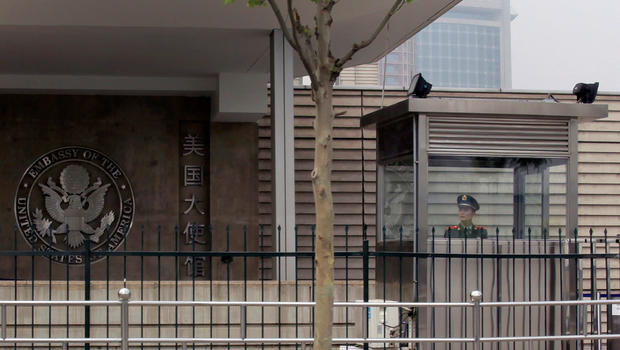
Paramilitary police officer guards entrance to U.S. embassy in Beijing on April 30, 2012.

BEIJING -- A Chinese-American journalist who extensively interviewed an exiled businessman says his wife has been kidnapped and held for months by Chinese security forces, adding a subplot to the high-stakes drama that has transfixed followers of Chinese politics.
Chen Xiaoping, a New York-based editor at Chinese-language Mirror Media Group, told The Associated Press that a new video that surfaced this week of his wife denouncing his work was filmed under duress and proves that she is being held by the government in an effort to pressure him.
Over the past year, Chen has been at the centre of a political firestorm surrounding Guo Wengui, a fugitive real estate billionaire who repeatedly appeared on his live-streamed broadcast to air allegations of corruption within the upper echelons of China's ruling Communist Party.
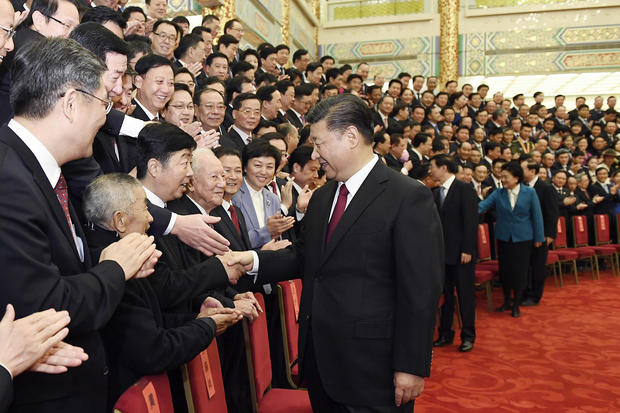
In this photo released by Xinhua News Agency, Xi Jinping, front right, meets representatives attending the award ceremony on ethical role models and pioneers in Beijing, China on Nov. 17, 2017.

In September, shortly before one of Chen's broadcasts, his wife Li Huaiping, who remained in China, sent him a terse message saying she was "in trouble," Chen said.
Li was not heard from until Sunday, when an anonymous YouTube account believed to be linked to Chinese security agencies uploaded a video in which she explained she had cut all contact with Chen due to "emotional issues" -- as well as his "overseas work." 
The video is the first sign of Li since she disappeared from her home in Guangdong province, and it was uploaded a day after Chen published an open letter on Twitter to Xi Jinping pleading for his wife's freedom.
"I didn't think a video would be released so quickly after I wrote my letter," Chen said from Long Island, New York. 
"It's clear that my wife's kidnapping and my work have been totally related."
Li, who appears to be reading from a prepared text in the video, also asked Chen to stop searching for her and speaking out publicly on her behalf.
"They forced her to make this video," Chen said.
Chen has spoken to State Department and congressional officials about the disappearance of his wife, who is a U.S. permanent resident, he said. 
Chen became a naturalized U.S. citizen in 2012 and married Li that same year.
Spokesmen for the Ministry of Public Security in Beijing referred inquiries to police headquarters in the southern province of Guangdong, where calls rang unanswered Wednesday.
Li's disappearance carries echoes of 2015, when several Hong Kong publishers who sold politically sensitive books vanished in quick succession -- believed to be abducted by Chinese agents -- in cases that sent chills through Chinese-language political media around the world.
But until the recent disappearance of Chen's wife, Mirror Media Group, under the direction of its publisher Ho Pin, managed to avoid the pitfalls of the business while cultivating its reputation as one of the top clearinghouses for Chinese political gossip.
The outlet's following and profile skyrocketed in 2017 when Chen conducted half-dozen interviews with Guo, who is seeking asylum in the U.S. 
Chinese authorities have accused Guo, who lives in Manhattan, of a long litany of "crimes", including bribery, extortion, kidnapping, genocide and rape.

jeudi 12 octobre 2017

China grabbed American as spy wars flare

A focus on Russia overshadows Beijing's aggressive tactics, including the kidnapping of a suspected American operative.
By ALI WATKINS


Both Chinese and U.S. officials kept quiet about the previously unreported incident, described to POLITICO and confirmed by multiple U.S. officials.

The sun was setting over Chengdu when they grabbed the American.
It was January 2016.
The U.S. official had been working out of the American consulate in the central Chinese metropolis of more than 10 million.
He may not have seen the plainclothes Chinese security services coming before they jumped him.
In seconds he was grabbed off the Chengdu street and thrown into a waiting van.
The Chinese officials drove their captive — whom they believed to be a CIA officer — to a security facility where he was interrogated for hours, and, according to one U.S. official, filmed confessing to unspecified acts of treachery on behalf of the U.S. government.
It wasn’t until the early morning hours of the following day that other U.S. officials — who were not immediately informed by their Chinese counterparts of the consular official’s capture — arrived to rescue him.
He was eventually released back to their custody and soon evacuated from the country.
Both Chinese and U.S. officials kept quiet about the previously unreported incident, described to POLITICO and confirmed by multiple U.S. officials.
But it threatened to spill into an international incident in the early days of the 2016 presidential campaign.
U.S. officials strongly protested the abduction to their Chinese counterparts and, according to one official, issued a veiled threat to kick out suspected Chinese agents within the U.S.
U.S. officials consider the abduction an unusually bold act in a long-simmering spy game between Washington and Beijing, one recently overshadowed by a newly aggressive Russia.
But U.S. officials and China experts say the two countries are engaged in an espionage battle that may be just as fierce, if far less publicized.
“The Chinese have not gone away,” one counterintelligence official who recently left government said.
“The things going on with Russia right now really have distracted from China.”
POLITICO spoke with more than half a dozen current and former national security officials for this story.
Almost all requested anonymity to more freely discuss sensitive intelligence matters.
China’s ongoing espionage within the U.S. was clear at a July pre-trial hearing at a Washington courthouse for former CIA officer Kevin Mallory, charged in June with passing at least three top secret U.S. government documents to a Chinese intelligence operative in exchange for $25,000 in cash.
“Your object is to gain information, and my object is to be paid for it,” prosecutors said the 60-year-old Mallory, then a government contractor, wrote in a message to a Chinese agent.
During the packed hearing, Mallory, who sat quietly in a dark jumpsuit, showed little emotion as prosecutors played a recording of a phone call he made to his family in which he frantically directed his children to find a device on which he stored information, including CIA material, for his Chinese contacts.
On the recording, Mallory can be heard worriedly shushing his son as the boy begins to describe the device—perhaps out of well-grounded fear that federal investigators might be listening.
Government witnesses testified that data Mallory allegedly stored on the device was sensitive enough to compromise critical U.S. intelligence gathering inside China—and specific enough to reveal and gravely endanger U.S. sources there.
The CIA and State Department declined to comment.
Some officials and China experts said Beijing uses a softer touch in its espionage.
Where Moscow stomps, Beijing tiptoes — focusing heavily on the theft of economic secrets and making no known effort to influence U.S. electoral politics.
China is an uneasy partner for the U.S. — particularly as Donald Trump seeks Beijing’s help in taming North Korea’s nuclear program.
And American corporations that care little about Russia’s stunted economy want good relations with China’s potential market of more than 1 billion consumers.
“It’s a much more sophisticated effort than Russia’s,” Daniel Blumenthal, a China expert at the American Enterprise Institute and a former commissioner of the U.S.-China Economic and Security Review Commission, said of Chinese spying.
“They’re stronger, they’re more ambitious, they’re more powerful. And there are more U.S. stakeholders who want a positive relationship with China.”
Mallory is just one of two U.S. government employees charged this year with passing U.S. state secrets to China.
The other, 60-year-old Candace Marie Claiborne, was a State Department veteran whose postings included Beijing and Shanghai.
A March federal indictment charged her with accepting tens of thousands of dollars in cash and gifts from Chinese officials, including a laptop computer and international vacations, in return for U.S. government documents on U.S.-China economic relations.
U.S. officials interviewed by POLITICO said that, while visiting China, their colleagues are often “pitched,” or approached by Chinese intelligence operatives trying to recruit them.
Chinese efforts to recruit spies expand far beyond U.S. government employees. 
In a 2014 counter-recruitment video, titled “Game of Pawns,” the FBI tells the story of Glen Duffie Shriver, who as a U.S. student in Shanghai struck up a relationship with a woman he eventually discovered was a Chinese government operative.
Shriver took $70,000 from the woman as he sought a U.S. government job that would give him access to secret information he could pass to his handlers. 
He was sentenced to four years in prison.
“We live in a very sheltered society," Shriver says in the video.
"And when you go out among the wolves, the wolves are out there."
One former U.S. official said the cases show the way Chinese intelligence services, which long sought to appeal mainly to Chinese-Americans, are now recruiting from a far broader pool.
The way the Chinese have gotten more aggressive is, they’ve looked at recruiting more than just ethnic Chinese,” one Obama-era National Security Council official said.
Officials and experts are especially concerned about China’s 2015 hack of the Office of Personnel Management, which saw the theft of personal data from millions of U.S. federal workers.
That information went well beyond Social Security numbers or birthdays—officials confirmed that China-linked hackers accessed troves of “SF-86” forms.
That extensively detailed document—required for government employees seeking a security clearance—includes everything from relationships to the month-by-month minutia of a personal history.
The scope and detail of the files may serve as a kind of recruitment road map for years, Michelle Van Cleave, former director of the Office of the National Counterintelligence Executive, said at a U.S.-China Economic and Security Review Commission hearing this summer.
“The threat will grow as a result of their successes against us, because of the integration of those cyber successes and their human espionage capabilities,” Van Cleave said.
“I'm looking at what was lost through the OPM breach ... and I'm saying this is, this is staggering. This is staggering.”
The snatching in Chengdu is an extreme illustration of current and former officials' description of intense surveillance of Americans by Chinese security authorities in China.
The officials described how their rooms or belongings were “tossed” — searched by Chinese operatives — while they were staying in the country.
“They were as fundamentally aggressive in their activity [as the Russians],” one former U.S. diplomatic official told POLITICO.
Calling China’s approach more “subtle” than Russia’s, he added: “They always knew what we were doing and where we were.”

mardi 18 octobre 2016

Who will remember my father, Gui Minhai?

By Angela Gui

The author with her father, Gui Minhai, in Gothenburg, Sweden, in 1994.

It’s a strange thing to mourn someone who has disappeared.
You talk about the person and catch yourself saying that he was, instead of he is. 
You find a book on sale that you know he would like, but you do not buy it because you don’t know whether you will see each other again. 
You send email upon email just to say hi but never receive a response. 
After 365 days, it seems increasingly unlikely.
But really, mourning is neither enough, nor allowed, when the Chinese state decides to have a person disappear. 
Today marks a year since my father, Gui Minhai, was abducted while on vacation in Thailand, for publishing and selling politically “sensitive” books.
His tiny Hong Kong apartment is empty, the books and the porcelain teapots collecting dust. 
The once rapidly growing industry specializing in books about mainland politics, in which my father’s was one of the leading bookstores, has gone unusually quiet. 
People whisper of self-censorship; some titles are deemed too risky to write, to publish, to print — to read. 
By kidnapping five booksellers, two of whom are European citizens, China has shown that it is possible to successfully diminish perhaps one of the most effective spaces for critical thinking and democratic political participation.
In China, the abduction of my father has been presented as a voluntary surrender to the infallible Chinese law enforcement. 
Not once acknowledging their failure to produce proof that my father ever left Thailand legally, the Chinese government has pieced together a story of him — as an immoral criminal — choosing to return to China out of guilt from causing a traffic accident in 2004. 
In a video aired on state-owned TV (where his T-shirt keeps changing color), my father performs a robotic, yet occasionally overly emotional, “confession.” 
When the Chinese foreign ministry held a question and answer event during the Lianghui, or “Two Sessions,” earlier this year, questions about the Gui Minhai case were dismissed with reference to his family “stirring up trouble.”
A year on, I still can’t contact my father. 
It still isn’t clear where he is being held.
Quartz reported in January that even Chinese citizens were expressing skepticism in social media about the official explanation to my father’s disappearance. 
But how long before that doubt has been erased by China’s panoptic censorship apparatus? 
In articles on the Tiananmen massacre — blocked in China, of course — the majority of Chinese students today is estimated to know hardly anything about the events on June 4 27 years ago. Members of the group Tiananmen Mothers, a support group founded by mothers of the massacre victims, have been detained and placed under strict surveillance for having the audacity to mourn their children.
Who will remember my father and Causeway Bay bookstore in 27 years? 
The Chinese most likely will not. 
With a history that is so easily manipulated, and an international community that is ready to swallow that manipulated history whole — using economic interests and a skewed image of “Chinese culture” as a nervously presented excuse — we must remember. 
We must remember because keeping memory alive, through writing and publishing, is so radical it has become a political act.
So who will remember Gui Minhai? 
Perhaps those countries that are usually so quick to assert their democratic values will take responsibility toward their citizens and demand concrete actions of China, instead of repeating empty condemnations. 
Or perhaps the world will stand by as more foreign citizens will disappear — because they don’t fit into China’s increasingly narrow political agenda.