Affichage des articles dont le libellé est Wang Qishan. Afficher tous les articles

mardi 15 octobre 2019

A Tale of Two Nazisms

Inside a Brazen Scheme to Woo China: Gifts, Golf and a $4,254 Wine
By Michael Forsythe, David Enrich and Alexandra Stevenson

The towering International Commerce Center houses Deutsche Bank’s offices in Hong Kong. Confidential documents detail how the company’s hiring practices in China curried favor with the state.

It was a brazen campaign to win business in China by charming and enriching the country’s political elite.
The bank gave a Chinese president -- Jiang Zemin -- a crystal tiger and a Bang & Olufsen sound system, together worth $18,000.
A premier -- Wen Jiabao -- received a $15,000 crystal horse, his Chinese zodiac animal, and his son got $10,000 in golf outings and a trip to Las Vegas.
A top state banking official, a son of one of China’s founding fathers, accepted a $4,254 bottle of French wine — Château Lafite Rothschild, vintage 1945, the year he was born.
Millions of dollars were paid out to Chinese consultants, including a business partner of the premier’s family and a firm that secured a meeting for the bank’s chief executive with the president.
And more than 100 relatives of the Communist Party’s ruling elite were hired for jobs at the bank, even though it had deemed many unqualified.
This was all part of Deutsche Bank’s strategy to become a major player in China, beginning nearly two decades ago when it had virtually no presence there.
And it worked.
By 2011, the German company would be ranked by Bloomberg as the top bank for managing initial public offerings in China and elsewhere in Asia, outside Japan.
The bank’s rule-bending rise to the top was chronicled in confidential documents, prepared by the company and its outside lawyers, that were obtained by the German newspaper Süddeutsche Zeitung. The previously undisclosed documents, shared with The New York Times, cover a 15-year period and include spreadsheets, emails, internal investigative reports and transcripts of interviews with senior executives.
The documents show that Deutsche Bank’s troubling behavior in China was far more extensive than the authorities in the United States have publicly alleged. 
And they show that the bank’s top leadership was warned about the activity but did not stop it.
Josef Ackermann, the bank’s chief executive until 2012, said in an interview with The Times and separately in answers to written questions that he was not familiar with many of the details contained in the documents.
But he defended the bank’s broader practices.
“This was part of doing business in this country,” Mr. Ackermann said.
“At the time, this was the way things were done.”

Josef Ackermann, the bank’s chief executive until 2012, said in an interview that China was “a relationship country,” and that “of course we cultivated these people.”

For years, Deutsche Bank has been a poster child for misconduct in the finance industry. 
Regulators and prosecutors around the world have imposed billions of dollars in penalties against the bank for its role in a wide range of scandals. 
Most recently, the bank has been under investigation for the facilitation of money laundering in Russia and elsewhere.
Deutsche Bank — which for two decades was the primary lender to Trump — also has been under scrutiny by two congressional committees and by state prosecutors in New York who are investigating Trump’s finances.
In August, the bank agreed to pay $16 million in a settlement with the United States Securities and Exchange Commission related to allegations that it had used corrupt means to win business in both China and Russia, violating anti-bribery laws, though it did not admit wrongdoing.
That penalty, the documents show, amounted to a small fraction of the revenues gained in China from business stemming in part from the activities. 
The bank’s outside lawyers had warned executives in 2017 that they could face a penalty of more than $250 million from the S.E.C. related to China. 
There is no evidence that German regulators investigated the bank’s activities in China, though they were alerted to some of it, according to the documents.
Reasons for concern appear throughout the documents, which include internal investigations conducted by two law firms, Gibson, Dunn & Crutcher and Allen & Overy, at the time of the S.E.C.’s action.
Deutsche Bank, the documents show, dispensed hundreds of thousands of dollars to secure meetings for top executives with China’s leadership.
An obscure company received $100,000 to arrange a 2002 meeting between Ackermann and Jiang Zemin, then the country’s president.
In all, the documents show, the bank paid seven consultants more than $14 million, including for help buying a stake in a Chinese bank and winning coveted assignments from state-owned companies. Some of the payments were flagged internally as problematic but allowed to go through.
On multiple occasions, according to the documents, Deutsche Bank tried to win business by collaborating with family members of Wen Jiabao, China’s premier from 2003 to 2013.
The Wens’ enormous accumulation of wealth was the focus of a 2012 investigation by The Times that found family members had controlled assets worth at least $2.7 billion.

Winning Over the Wens
Among its many ties to China’s political elite, Deutsche Bank cultivated a deep relationship with the family of Wen Jiabao during his term as premier of China.
Wen himself received gifts from the bank valued at more than $15,000.
But it was a family affair, involving his son, daughter and their spouses, as well as a close business associate of the family.

Wen Jiabao
Zhang Beili
Premier
2003-13
Diamond expert
WIFE
Wen family
EMPLOYED
SON-IN-LAW
DAUGHTER
DAUGHTER-IN-LAW
SON
Liu
Chunhang
Wen
Ruchun
Yang
Xiaomeng
Winston
Wen
GOLF
PARTNER
Co-founder of the
New Horizon Capital
private equity firm
RECOMMENDED
ACQUAINTANCE
RECOMMENDED
Huang
Xuhuai
Liu
Lina
Jane
Jin
Jean
Kang
FRIEND
GIFTS
HIRED
INVESTED
HIRED
Josef Ackermann provided Mr. Wen with a crystal horse sculpture valued at more than $15,000.
Deutsche Bank hired several job candidates referred to them by members of the Wen family.
Deutsche Bank invested in Winston Wen’s private equity firm, as well as paying for golfing vacations for him.
Lee Zhang hired Mr. Huang as a consultant in 2005 and again in 2006, paying him more than $5 million.
Deutsche Bank
Josef Ackermann
Lee Zhang
Chief executive
2002-12
Head of corporate
finance in Asia
2004-10
Source: Documents compiled in internal Deutsche Bank investigation.
The bank, at least in part through its hiring of people with political connections, won hundreds of millions of dollars in Chinese deals. 
Such hires can be illegal if they are done in exchange for business. 
The bank’s outside lawyers calculated that just 19 of its so-called relationship hires helped bring in $189 million in revenue, including a plum assignment in 2006 managing a state bank’s market debut, then the biggest initial public offering in history.
Most of the Chinese government officials entangled in the bank’s activities have since retired, among them Jiang and Wen. 
But two parents of people the bank employed are now members of the Politburo Standing Committee, the country’s pinnacle of power. 
And the country’s vice president, Wang Qishan, accepted gifts from the bank when he held previous positions, such as mayor of Beijing.
Efforts by The Times and Süddeutsche Zeitung to reach Jiang, Wang and Wen — as well as other Chinese officials, executives and relatives mentioned in the documents — either were unsuccessful or received no response. 
Several current and former Deutsche Bank employees declined to comment.
Tim-Oliver Ambrosius, a spokesman for the bank, did not respond to specific questions about the documents. 
In a written statement, he said that the company had “thoroughly investigated and reported to authorities certain past conduct,” adding that the bank had “enhanced our policies and controls, and action has been taken where issues have been identified.”
“These events date back as far as 2002 and have been dealt with,” the statement said.
Ackermann said that he had cautioned the bank’s staff that “no business is worth risking the bank’s reputation.” 
Though he pushed employees to increase revenue and profits, he said, “feeling pressure cannot excuse violating compliance rules and regulations or the law of the land.”

Playing Catch-Up
When Ackermann was picked in 2000 as the next chief executive, his ambition was for Deutsche Bank to be universally recognized as a global leader. 
And he wanted it done fast.
China was critical. 
It was the most populous country in the world and on its way to becoming the second-largest economy. 
Yet Deutsche Bank was far behind its rivals there.
Goldman Sachs and Morgan Stanley had been at the forefront of helping China modernize its moribund financial system and network of state-owned businesses. 
In 1995, Morgan Stanley helped set up the country’s first investment bank, China International Capital Corporation. 
Goldman won the rights in 1997 to bring China Telecom, the country’s phone monopoly, to the international market through an initial public offering in Hong Kong.
Ackermann had to play catch-up.
A first step for the bank was poaching Lee Zhang, the head of Goldman Sachs’s Beijing office. 
Zhang was fluent in the ways of both China and Western business. 
Born and raised in China, he had studied in Canada and later moved to California, where he worked for Hewlett-Packard and studied business administration. 
He then went to Hong Kong, eventually landing at Goldman.
Zhang’s mandate was to transform Deutsche Bank into a player in China. 
That required winning over the Communist Party.
Zhang began hiring aggressively. 
Many of his recruits — dozens and dozens of them, according to spreadsheets compiled by the bank’s lawyers — were young, inexperienced and well connected. 
They came to know him as Uncle Zhang.
Ma Weiji, whose parents were senior executives at state-owned companies, interviewed for a job in 2007. 
It did not go well. 
A senior Deutsche Bank executive emailed Zhang that Ma “was probably one of the worst candidates.”
He got the job nevertheless. 
Soon, Ma was using his family connections to secure meetings for the bank with his parents’ companies, according to a memo by Allen & Overy.
Another job candidate was a son of Liu Yunshan, then China’s propaganda minister. 
He “cannot meet our standard,” a Deutsche Bank employee wrote in an email about the company’s equity capital markets group. 
He was offered a job anyway.
The younger daughter of Li Zhanshu — now a top member of the Politburo Standing Committee — was judged unqualified for the bank’s corporate communications team. 
She got an offer, too.
Even for qualified candidates, political connections were taken into account.
Wang Xisha, whose father was the top official in Guangdong Province when she applied in 2010, was a veteran of the rival bank UBS and had also interned at Goldman Sachs. 
During her recruitment process, one banker noted that she would “have access” to a state-owned automaker, according to Allen & Overy. 
Her father, Wang Yang, is now a member of the Politburo Standing Committee.
In 2006, Deutsche Bank began to engage in what it called referral hiring. 
The goal was to drum up business for the bank by doling out personal favors to current and prospective clients, the S.E.C. found. 
Premier Wen Jiabao’s son-in-law, who was a senior official at China’s banking regulator, referred one candidate. 
Wen’s daughter-in-law referred another. 
Both were hired.
A state railway executive in China referred the son of a judge on the Supreme People’s Court. 
The assistant president of the oil refiner Sinopec referred a candidate, too. 
So did the general manager of the state-owned Industrial and Commercial Bank of China.
Zhang, reached by phone, declined to be interviewed for this article. 
He also did not respond to written questions sent through a business associate.
“It’s a relationship country,” Ackermann said in the interview. 
“Of course we cultivated these people.”

Cashmere Overcoats
The roster was set. 
The first nine foursomes to tee off at Deutsche Bank’s Beijing golf invitational in October 2003 were a predictable mix of German and Chinese executives.
The 10th group was different. 
It included Winston Wen, son of the newly appointed premier, as well as Huang Xuhuai, a close business associate of the Wen family. 
They were joined by a top official from PetroChina, a state-owned oil company.
The fourth player was Zhang. 
The following month, he, Huang and Wen would be off to Thailand for more golf, and later to Germany, according to documents compiled for the bank’s internal investigation.
The relationships that Zhang built with the golfers were microcosms of how the bank made a name for itself in China beyond its strategic hiring. 
They were showered with gifts. 
They were enlisted to introduce Deutsche Bank executives to Chinese decision makers. 
And they were hired as consultants to help win the bank work.
Among dozens of gifts to political leaders and heads of state-run companies, the oil executive received golf clubs and a bag valued at more than $2,500.
Executives at China Life Insurance, which picked Deutsche Bank to help manage its I.P.O. in 2003, were treated to Louis Vuitton luggage, cashmere overcoats, golf clubs, even a sofa, totaling more than $22,000, according to a memo by Gibson, Dunn & Crutcher.
The bank prohibited gifts to public officials unless the legal and compliance departments signed off, and Gibson Dunn found that Zhang, who generated many of the expenses, had violated that policy.
The law firm’s research showed that from 2002 to 2008, bank officials gave more than $200,000 in gifts to Chinese officials, their relatives and executives of state-owned companies. 
More than a fourth went to people on the Politburo or their relatives, including Jiang Zemin, the president; and Wen Jiabao, the premier.
Some of the gifts, like the crystal tiger for Jiang Zemin, who was born in 1926, the year of the tiger, were “provided” by Ackermann, according to the internal investigation.
Ackermann said that while he didn’t recall personally giving the items, he was aware that the bank’s staff thought it a good idea. 
He has not been accused of wrongdoing in China.
“They said that’s what Goldman and JPMorgan are doing, so we should do it,” Ackermann said in the interview. 
“I don’t think Wen Jiabao would be somehow influenced by a gift of a few thousand.”
In 2016, JPMorgan was fined $264.4 million by the Justice Department for its Chinese hiring. 
Other banks were also known to engage in similar practices. 
The Swiss bank Credit Suisse paid $77 million last year in criminal penalties and other fines. Goldman Sachs has not been accused of wrongdoing in its China business.

‘Red Flags’
The plan to increase Deutsche Bank’s clout in China also included buying a big stake in a midsize Beijing bank, Huaxia.
The acquisition plan, code-named Project Rooster, involved hiring Huang, one of Zhang’s golf partners. 
Huang had no experience in banking but had worked in a diamond company run by the wife of the premier, according to a background check that was done for the bank at the time. 
He was paid the equivalent of more than $2 million.
The bank’s compliance department didn’t stand in the way of the consulting role, but some senior executives were uneasy.
“Based on the information from the search firm, if this person is not known to the market and industry, why are we paying for the service and what are we paying for?” Polly Lee, the bank’s head of compliance in Hong Kong, wrote in an email to Till Staffeldt, a regional executive who was pushing for Huang’s hiring. 
“My concern is this individual is fronting for someone else.”
Staffeldt is now Deutsche Bank’s global chief operating officer for regulation, compliance and preventing financial crime.
Deutsche Bank’s bid for Huaxia was successful. 
In late 2005, the bank secured a 9.9 percent stake, which later increased to almost 20 percent. 
It was unclear what Huang did to help the deal go through, but Gibson Dunn later found that the circumstances around his hiring raised “red flags” that might have violated the Foreign Corrupt Practices Act, in part because of Huang’s ties to the family of the premier, Wen.
In 2006, Deutsche Bank again brought Huang on as a consultant. 
This time, his task was to “study in-depth the financial safety of China’s banking industry.” 
He received $3 million.
Inside the bank, concerns had been mounting about Zhang’s use of consultants to win business. 
Frank Nash, who ran the bank’s Asian corporate finance division until 2004, warned a top executive, Michael Cohrs, about the problematic use of politically connected consultants.
Cohrs shared those concerns with the bank’s lawyers, including Richard Walker, a general counsel. 
They concluded that Zhang was operating inside the law, three people familiar with those discussions told The Times.
Zhang kept going. 
In 2006 he turned to another consultant named Huang to help the bank secure a role in the I.P.O. of Industrial and Commercial Bank of China. 
The stock offering was set to be the world’s largest ever. 
The banks handling the transaction reaped not only huge fees but also coveted bragging rights.
That man, Huang Xianghui, was lacking in banking experience, and a background check found that the Beijing company he claimed to work for did not appear to exist at the address on his business card. 
But what he did have, according to the bank’s documents, was a previous affiliation with PetroChina, the state oil company. 
Zhang hired him.
Huang’s original contract said he would receive $3 million for services that were “solely focused on the energy industry.” 
In a draft, someone crossed out “the energy industry” and wrote “ICBC,” a reference to the giant state-owned bank. 
Deutsche Bank went on to win a high-profile role in the I.P.O.
The success ingratiated Zhang with his superiors, especially Ackermann. 
Zhang would escort him to meetings with top Chinese leaders, including the president and premier, as well as to gatherings with cultural and academic experts, Ackermann said. 
While at Deutsche Bank, Zhang was appointed to a top government advisory body, signaling his insider status.
“He introduced me to all sorts of people,” Ackermann said in the interview. 
But Cohrs, who was the head of investment banking, warned the company’s lawyers that he was “scared of how Lee Zhang was doing business and whether there was money being passed around in envelopes,” the documents show.
There was reason to be concerned.

A Settlement, No Wrongdoing
In 2010, the head of I.C.B.C. approached Ackermann and said he wanted to hire Zhang, citing his excellent work at Deutsche Bank, according to Ackermann. 
He became senior executive vice president at the giant Chinese bank.
Two years later, Ackermann stepped down as chief executive. 
A top executive warned his successor, Anshu Jain, that the bank had grown overly reliant on winning business from state-owned companies, an area rife with corruption risks, according to a person with direct knowledge of the warning.
In 2013, when the United States began investigating JPMorgan’s hiring practices in China, Deutsche Bank initiated an internal review. 
It found a troubling pattern of politically connected hiring, and reported the findings to the S.E.C. and the Justice Department.
The S.E.C. subpoenaed the bank in April 2014. 
Months later, Deutsche Bank sued Zhang, accusing him of profiting from one of the consulting companies he had hired because it was owned by a relative. 
Zhang denied wrongdoing in the suit.
The Times and Süddeutsche Zeitung found two other consulting companies used by Deutsche Bank that appeared to be owned by Zhang’s wife.

Deutsche Bank agreed to pay $16 million this year in a settlement with the Securities and Exchange Commission, in part because of its activity in China.

Amazing Channel Holdings and Speedy Link Holdings, both registered in the British Virgin Islands, list Ji Zhengrong as the owner, according to documents found in the Panama Papers. 
Zhang’s wife has the same name, and her birth date, listed in Hong Kong court records, matches the birth date in the offshore company records.
Speedy Link was paid $3.65 million by Deutsche Bank to assist in its successful bid to help manage the I.P.O. of China Life Insurance Company in 2003, according to the bank’s documents. 
Amazing Channel Holdings was paid $100,000.
At the time, Deutsche Bank’s top lawyer was Walker, who had been warned of executives’ concerns about politically connected consultants in China.
Before joining Deutsche Bank, Walker had been the head of the S.E.C.’s enforcement division. 
Now, as the agency’s investigation unfolded, bank officials were feeling optimistic.
Lawyers for Deutsche Bank traveled to the S.E.C.’s office in Salt Lake City to give a presentation on the company’s internal investigation. 
They argued that its hiring of Chinese princelings was far less extensive and systematic than at other banks, according to a person briefed on the meeting.
The lawyers told Walker afterward that the S.E.C. seemed to share the bank’s perspective, the person said. 
The agency’s investigators had concluded that when the bank hired politically connected employees, they were generally well qualified — something the bank’s internal reviews had cast doubt on.
This August, the S.E.C. announced that it was closing its investigation and had settled with the bank without requiring an admission of wrongdoing. 
Asked about the previously undisclosed Deutsche Bank documents, Chandler Costello, an S.E.C. spokeswoman, said, “The S.E.C. does not comment on details of any investigation, but, as always, the S.E.C. is committed to pursuing violations of federal securities law, wherever or by whomever they may occur.”
Earlier this year, the bank disclosed that it remained under investigation by the Justice Department for its hiring practices and use of consultants in foreign countries.

vendredi 17 novembre 2017

The Manchurian Broadcaster

Voice of America fires three staff over explosive Guo Wengui interview
By Choi Chi-yuk

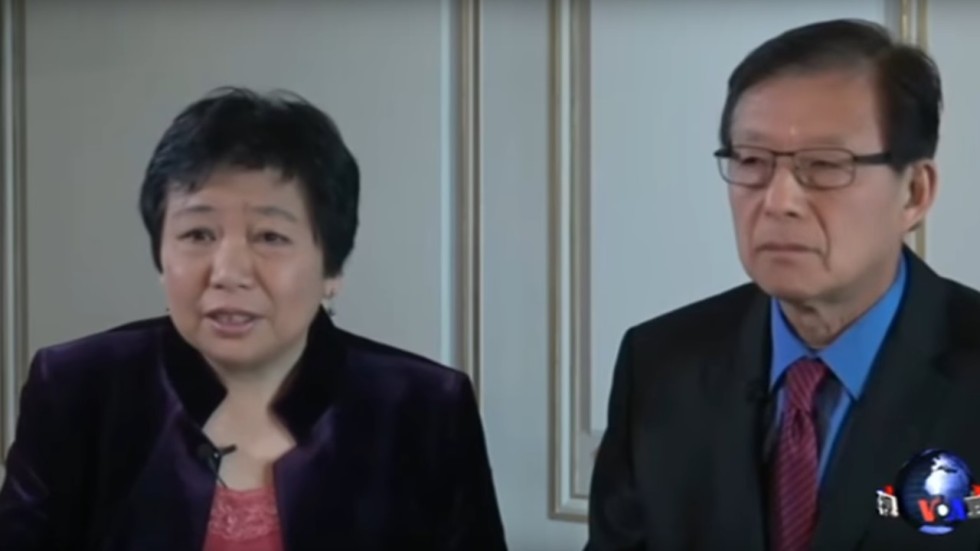
Voice of America’s Sasha Gong Xiaoxia (left) and Dong Fang are shown during the interview with Guo Wengui. 

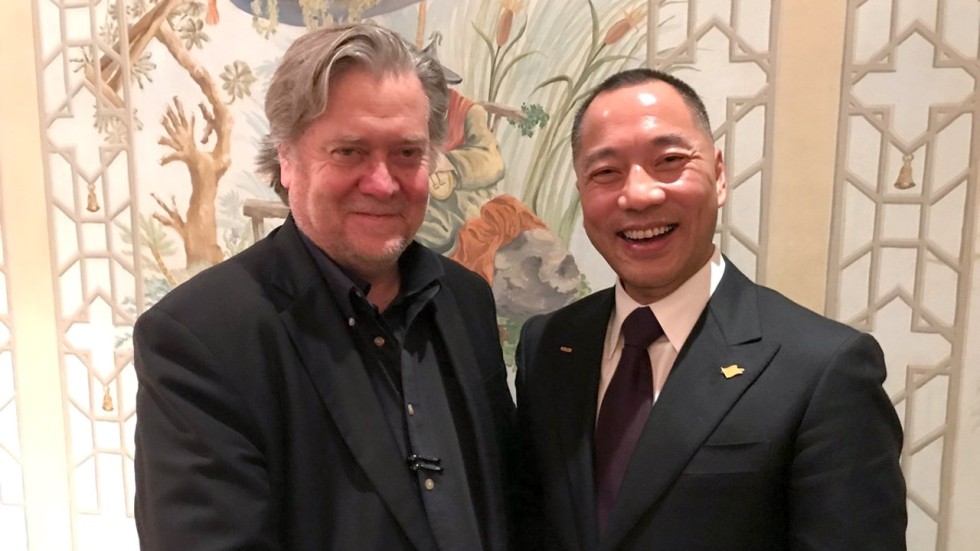
Chinese fugitive Guo Wengui with Steve Bannon

Voice of America, a US government-funded broadcaster, has sacked three suspended staff members over their involvement in a live streaming interview with self-exiled Chinese tycoon Guo Wengui half a year ago, according to the International Federation of Journalists.
The IFJ, a global federation of journalistic trade unions, has called on the international news source to explain the terminations.
Washington-based journalists Sasha Gong Xiaoxia and Dong Fang interviewed Beijing-wanted billionaire Guo, who is also known as Miles Kwok, at a location that was not disclosed for Guo’s protection on April 19.
During the live stream, Guo accused numerous top Chinese officials or their relatives, including former top graft buster, Wang Qishan, of taking huge bribes.
The interview, originally expected to last three hours, was abruptly halted. 
Five Voice of America staff members, including Gong and Dong Fang as well as Yang Chen, Bao Shen and Li Su, were ordered to take administrative leave with pay amid an investigation.
The IFJ said in a statement issued on Sunday that both Yang and Bao had resumed their work while the employment of Gong, Dong Fang and Li Su, a technician, had been terminated. 
The three staff members had "allegedly" violated certain regulations, including disobeying management’s orders and "failing to follow journalistic practices", according to the IFJ.
Gong denied the allegations and said she would fight her termination, according to the IFJ.
“They (Voice of America) could not tell me which order I had disobeyed,” Gong was quoted. 
“I don’t understand how I had not followed the journalistic practice.”

jeudi 2 novembre 2017

U.S. Tech Quisling

Facebook blocked dissident Guo Wengui after the Chinese government complained
By Heather Timmons
Facebook, Twitter, and Google were grilled this morning about their efforts to combat propaganda in the run up the 2016 US election by the Senate’s intelligence committee. 
Most of the questions focused, naturally, on Russia’s influence, because the Kremlin was specifically identified by US intelligence as trying to sway the vote.
Florida senator Marco Rubio, who takes a particular interest in Beijing’s attempts to curtail Chinese citizens’ free speech, focused for a moment on dissident Guo Wengui. 
Facebook said Oct. 1 it had taken down a page associated with Guo and stopped him from posting to his own account after he had posted someone else’s “personal identifier information.”
Did Facebook do so at the behest of Beijing, Rubio asked the company’s attorney Colin Stretch. Kind of, Stretch admitted.
“We did receive a report from a representative of the Chinese government about that account,” Stretch said. 
“We analyzed that report as we would any other, and took action based on our policies,” he said.
Guo Wengui

The Chinese government has been trying to silence Guo, and to bring him back from the US to China, because he has been using social media to disseminate claims that elite government officials are corrupt. 
The wealthy businessman lives in a Manhattan penthouse surround by bodyguards.
Guo’s account was blocked because he published information about Wang Qishan, a member of the elite Politburo in charge of Beijing’s anti-corruption push, and Fan Bingbing, a movie star on his Facebook page, people briefed on his case say. 
He has alleged that Wang’s family amassed a fortune from dealings with Chinese conglomerate HNA, and that Fan was his mistress.
The company’s Community Standards only specify it will take action for “credible threats to public figures and hate speech directed at them.” 
A Facebook spokesman said when his account was blocked that “we don’t allow people to publish the personal information of others without their consent” and the company had no update today after the hearing.
Although Facebook is officially blocked in China, the Chinese government has a robust presence on the platform, mostly through state-owned media accounts, which claim to have tens of millions of Facebook fans. 
The Chinese government employs a veritable army of paid social media users to spread its message on Chinese networks that are jokingly called the “50 Cent party”.
The 50 Cent party is also colonizing foreign social media. 
Searching for Guo’s name on Twitter turns up a string of poorly-worded tweets disparaging him.

mercredi 25 octobre 2017

Charting China's great purge under Xi

BBC News
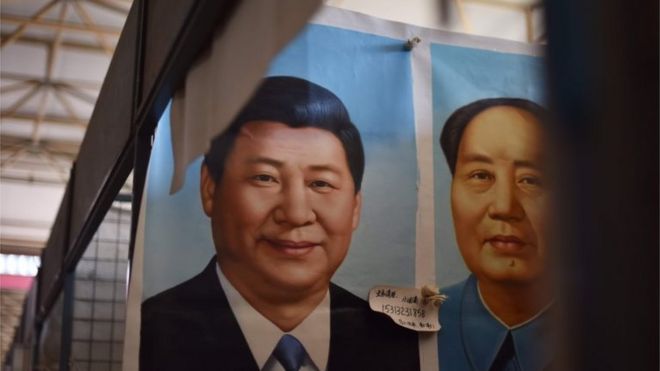
Not since the days of Mao Zedong (right) has a campaign on the scale of Xi's been seen

Since becoming China's leader in 2012, Xi Jinping has overseen a vast and ruthless anti-corruption drive in which more than a million officials have been disciplined.
A BBC study has found that more than 170 ministers and deputy minister-level officials have been sacked and many jailed under Xi, accused of charges such as corruption, misconduct and violation of party discipline.
It has been described by some as a massive internal purge of opponents, on a scale not seen since the days of Mao Zedong, in whose Cultural Revolution many top officials were purged.

How extensive is the campaign?

The most noticeable departure from tradition has been the breaking with many unwritten party conventions since Mao's time. 
The prosecution of so many national-level officials has been notable -- in recent decades prominent figures would usually have been quietly retired.
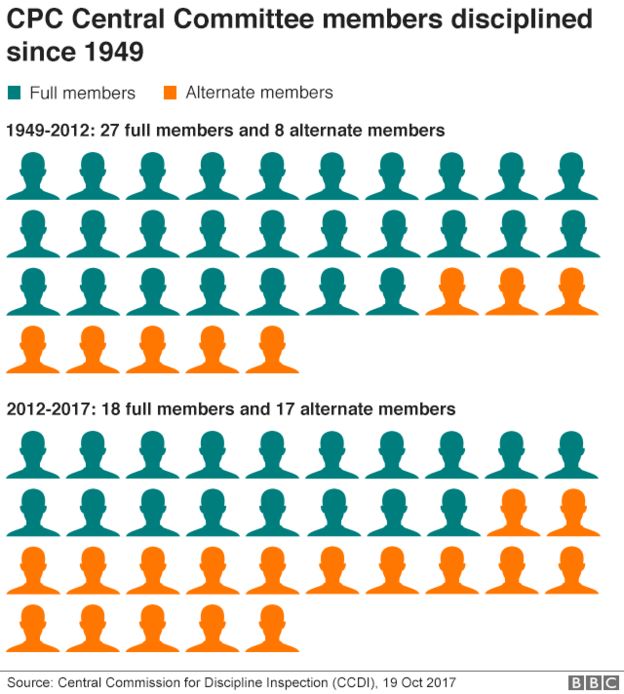
But in the last five years, 35 members (full and alternate) of the Chinese Communist Party's powerful Central Committee have been disciplined. 
That is as many as in all the years between 1949 and 2012.


Who has been targeted?
Based on official data, a staggering 1.34 million officials at high and low levels -- the so-called "tigers and flies" -- have been brought down by corruption and disciplinary charges during Xi's first five years in office.
No walk of life has been spared -- those felled range from village chiefs and factory managers to government ministers and generals.
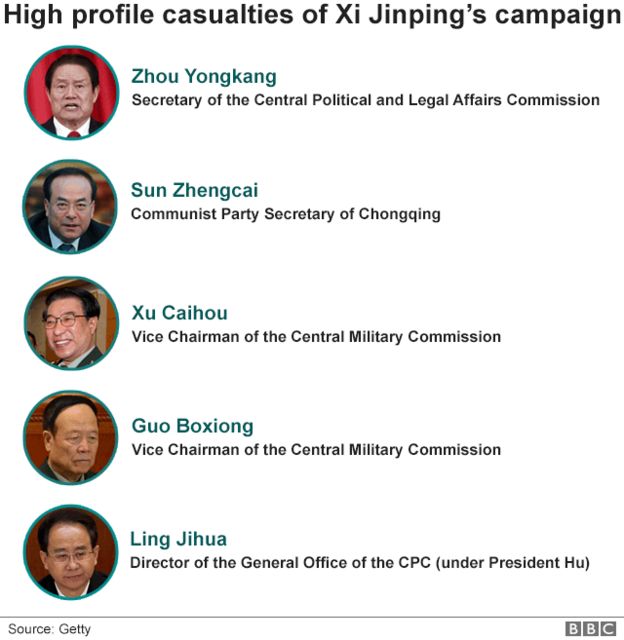
The great purge goes right to the very top of government -- the biggest scalp so far was once the third most senior leader in China, Zhou Yongkang. 
He had been in charge of the vast internal security apparatus until he retired.
Sun Zhengcai, who was sacked as Chongqing party secretary, was only the fourth sitting politburo member ever to be expelled from the Communist Party. 
Promoted before Xi Jinping took office, Sun, 54, was the politburo's youngest member and had been tipped for the very top.


Zhou Yongkang is the most senior official felled so far. 
Until he retired in 2012 he was the third most powerful politician in China. 
In 2015 he was jailed for life for bribery, abuse of power and disclosing state secrets.
Abruptly removed from his post in July, Sun Zhengcai is the most senior serving official to be caught by Xi's purge. 
Only the fourth sitting politburo member to ever be expelled from the Party.
Xu Caihou was among highest-ranking military until he retired in 2013. 
He was investigated as part of a "cash for ranks" probe and ultimately expelled from the party and prosecuted. 
He died of cancer in 2015.
Guo Boxiong served alongside Xu. 
In July 2016 he became the highest-ranking military official prosecuted since the end of the revolution in 1949. 
He was sentenced to life in prison for bribery.
Ling Jihua was a trusted adviser of Hu Jintao but was swiftly demoted under Xi. 
After a scandal that began when his son died "in a state of undress" in a Ferrari crash, he was jailed for life for bribery in 2016.
Nearly 70% of the party's ruling Central Committee members will be replaced with new faces at the current congress although in the majority of cases alleged corruption or other transgressions will not be the reason -- age will be.
An unwritten party rule currently sets the retirement age at 65 for Central Committee members.

Has the army been spared?

No area has been more radically restructured under Xi than the military, which he swiftly set about comprehensively reorganising and modernising.
More than 60 generals have been investigated and sacked in the drive to introduce a Western-style joint command and promote young officers to top positions.
Even as the delegates started to gather in Beijing for the current party congress, the pace of the campaign showed no signs of slowing down. 
Two top generals, Fang Fenghui and Zhang Yang, disappeared from public view as recently as last month, and a series of new high-level investigations have been announced.

What is Xi's goal?
The five-yearly congress in Beijing is expected to see Xi remain as party chief and bring in a new leadership team, helping to entrench his already considerable power.
If things go to plan for Xi, he should be able to get many of his loyalists into key positions. 
Since he took office a number of his allies have been promoted. 
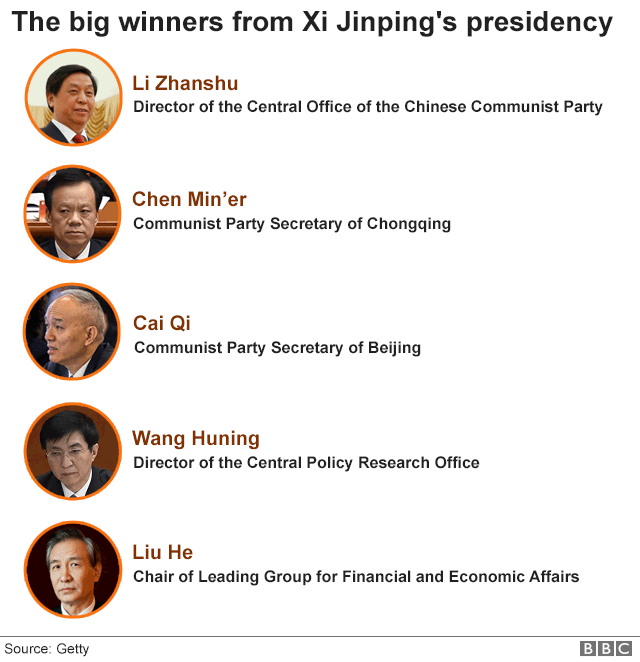
Here are some of the biggest gainers.
Li Zhanshu was party chief in a county neighbouring Xi's early in their careers. 
In 2015 he visited Moscow as Xi's "special representative". 
Has played a leading role in maintaining strong relations with Russia.
Chen Min'er is one of the "New Zhijiang Army", the group of now senior CPC figures who worked under Xi when he was party secretary in Zhejiang. 
Chen replaced the disgraced Sun Zhengcai in Chongqing.
Another of the so-called "New Zhijiang Army" is Cai Qi. 
Before being summoned to the capital his popular blog had more than 10m social media followers.
Said to be Xi's top foreign policy aide, Wang Huning has been labelled "China's Kissinger" by a leading South Korean newspaper. 
He also advised former presidents Hu and Jiang.
Xi described his key economic adviser Liu He as "very important to me" when introducing him to President Obama's National Security Adviser in 2013. 
Liu has an MA in public administration from Harvard.
Who ends up in the party's Politburo Standing Committee, China's top decision-making body which currently has seven seats, will show exactly how powerful he has become. 
Its members -- and those of the 25-seat Politburo -- will be revealed on 25 October once the congress ends.
But analysts say Xi, along with anti-corruption chief Wang Qishan, a key ally, has used the clean-up campaign to help shape who China's new leaders will be.
The country's Communist Party has for decades ruled by consensus, but analysts say Xi is rewriting party rules and concentrating power in his own hands.
Critics accuse him of encouraging a cult of personality. 
They point to the fact that most of the top officials who have been disciplined have been supporters of his opponents, or former presidents Jiang Zemin or Hu Jintao.
Xi's supporters say the anti-corruption drive is needed to restore the ruling party's credibility as the president pursues his dream of a more prosperous and powerful China which will soon overtake the US as the world's largest economy.

vendredi 6 octobre 2017

Exiled Chinese billionaire blasts kleptocracy running China, warns of spy infiltration in US

  • China is being controlled by a small clique of crooked high-level officials.
  • Chinese security officials earlier this year authorized an escalation of espionage efforts in the United States.
  • Guo's earlier scheduled appearance at a Washington think tank was postponed due to heavy pressure by China.
By Dan Mangan

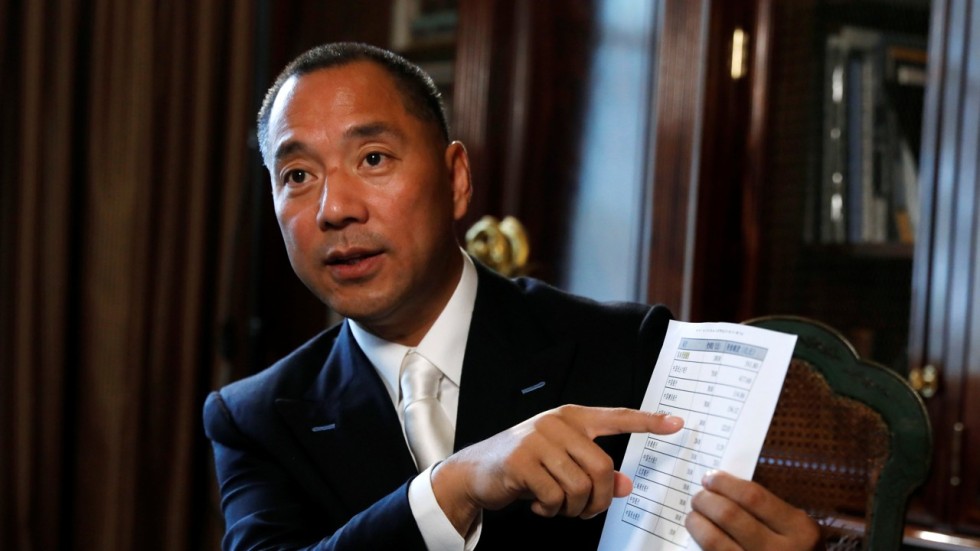
Billionaire businessman Guo Wengui speaks during an interview in New York City, April 30, 2017.
A Chinese billionaire in self-imposed exile blasted on Thursday a small clique of corrupt "kleptocrats" running China — as he also warned of a wave of Chinese spies being dispatched to the United States in recent months.
"What they're doing is against humanity," said Guo Wengui, during an appearance at the National Press Club in Washington, two days after a previously scheduled appearance at a think tank in the same city was postponed due to heavy pressure from the Chinese government.
"What the U.S. ought to do is take action, instead of just talking to the Chinese kleptocracy," Guo said through a translator.
"They are just a tiny group of Mafia, pure and simple," said Guo, a real-estate magnate also known as Miles Kwok, who lives in a $68 million apartment in New York City.
"I would like all the members of the Chinese Communist Party to wake up and say no to this ruling clique."
Guo said he was aware of multiple initiatives by that clique in China to increase the number of spies in the U.S. and "to weaken the United States, to bring about turmoil in the United States and to ... decimate the United States."
"These plans pose great threats to the American people and their property," Guo said.
Those efforts are "100 times, or even 1,000 times" as potentially damaging as the Sept. 11, 2001, terror attacks.
Guo's appearance in Washington was just the latest in a recent flurry of controversies surrounding the real estate magnate, who fled to the United States in 2015 after learning a security official he had ties with was being targeted by an anticorruption campaign.
Guo has unloaded a barrage of allegations of corruption by people in the highest levels of China's ruling Communist Party, which include claims that the party's own head of anticorruption activities, Wang Qishan, has unclean hands. 
Wang's family secretly controls one of the largest conglomerates in China, the New York Times has reported.
In September, Guo applied for political asylum in the U.S. 
But he has kept on making scathing and salacious attacks on social media against his targets.
Last Saturday, Facebook reportedly blocked a profile with Guo's name and removed another page linked to him. 
Facebook said it took that action after confirming the pages included another person's identifiable personal information, in violation of the platform's terms of service.
Guo's targets haven't taken his claims lying down.
In April, the Voice of America, which is operated by the U.S. government, abruptly cut short an interview with Guo, and later put five of its own journalists on administrative leave in connection with the interview. 
The chief of VOA's Mandarin service told CNBC that Chinese authorities met with VOA's Beijing correspondent and asked that the interview with Guo be canceled.
Earlier this year, the Chinese government asked Interpol to issue an international arrest warrant for Guo.

The Associated Press has reported that Chinese prosecutors are investigating Guo "for at least 19 major criminal cases," which included allegedly bribing intelligence officials, kidnapping, fraud and money laundering. 
In August, AP revealed that Chinese authorities have asked for another Interpol warrant for Guo, on a claim that he "raped" a 28-year-old former personal assistant.
This week representatives of a pro-China corporate investigative firm provided CNBC with a 12-page dossier on Guo detailing his use of social media to make "allegations against women and his perceived enemies," and the fact that he "has been subject to accusations of questionable business dealings and the defrauding of business partners."
The dossier from the firm, which has been retained by a number of clients around the world that have been targets of Guo, also noted "a series of defamation suits" filed in New York City against the billionaire since April.
The suits were filed by Caixin Media; Soho China, a real estate company; an affiliate of the major Chinese conglomerate HNA Group, and China's vice minister of housing and urban rural development.
Guo told The Wall Street Journal for a story published Tuesday that he has set up a $150 million legal war chest to fight the lawsuits.
"Nothing can stop me," Guo told the Journal.
But Guo was stopped hours later Tuesday by the Hudson Institute think tank in Washington.
The Hudson Institute told Guo around noon that day that it was postponing his planned appearance there on Wednesday, the Journal reported. 
Guo told the paper that the think tank told him his appearance was "poorly timed." 
CNBC has reached out for comment from the Hudson Institute.
So instead, Guo spoke to reporters Thursday at the National Press Club.
"You have caused quite a stir, not only in the United States but also in China," said Bill Gertz, senior editor of the Washington Free Beacon, who moderated the event.
Guo told reporters that he was jailed in China for 22 months after the government's 1989 crackdown on pro-democracy students in Tiananmen Square, whose efforts he supported with donations.
At around the same time, Guo said, "due to some kind of a trade dispute" that his brother became involved with, police shot and killed his younger brother, as his brother tried to shield Guo's wife from their bullets.
"The crime they gave me was so-called anti-revolutionary, and then they change it to obstruction of justice and fraud. They said I engaged in fraud and stole somebody's money," Guo said.
Years before, during the Cultural Revolution, Guo said his father was beaten badly after being sent into internal exile, "my brothers were injured physically ... and my mother had a nervous breakdown."
After his own release from jail, Guo returned to business, and began building luxury hotels, he said.
"From then on, I set myself a goal, which I had in my heart, that was to engage in revenge, not only for myself but for the whole of the Chinese people," Guo said. 
"For the injustices and the injuries and the deaths they have rendered to my younger brother, to my family members, to my brothers, and to my cousins, and to promote and bring about justice and equality to the whole country by overthrowing the existing system."
He said that after making $17 billion, his goal was "to engage in some kind of revolutionary activities."
That $17 billion, he said, is now "all frozen by the Chinese government."
"Since I came abroad, I have also made a lot of money," Guo said. 
"I have the best house, private aircraft, yacht, so as far as my personal welfare and personal needs are concerned, I have no other needs that I really desire."
"My only single goal is to change China," he said.

jeudi 7 septembre 2017

Billionaire Who Accused Top Chinese Officials of Corruption Asks U.S. for Asylum

By MICHAEL FORSYTHE

Guo Wengui, a billionaire property developer, is seeking asylum in the United States because his public charges against Chinese officials have made him “a political opponent of the Chinese regime,” his lawyer said. 

A billionaire property developer who has accused some of China’s most powerful officials of corruption has applied for political asylum in the United States, his lawyer said.
The billionaire, Guo Wengui, who is in the United States on a tourist visa that expires later this year, is seeking asylum status because his public charges against Chinese officials have made him “a political opponent of the Chinese regime,” Thomas Ragland, a Washington-based lawyer representing him, said in a telephone interview late Wednesday.
Asylum – even a pending asylum application — would give Mr. Guo more protection because he could stay in the United States while the application was being considered, a process that can take years, Mr. Ragland said.
“Asylum offers a level of protection that is different from having a visa status,” Mr. Ragland said. “Visas can be canceled or revoked.”
From his $68 million apartment overlooking Central Park in Manhattan, Mr. Guo, also known as Miles Kwok, has used Twitter and YouTube to publicize his claims that Wang Qishan, a member of the elite Politburo Standing Committee who oversees the ruling Communist Party’s own anticorruption efforts, and his family members secretly control one of China’s largest conglomerates.
His accusations made against the family of Wang’s immediate predecessor can be corroborated.

Wang Qishan, a member of China’s elite Politburo Standing Committee whose retirement status will be decided at a Communist Party meeting next month. Wang and his family secretly control one of China’s largest conglomerates.

Mr. Guo’s actions have earned the ire of the Chinese government. 
In April Beijing asked Interpol, the global police organization, to issue a global warrant for his arrest. He is also being sued for libel in United States courts by several Chinese individuals and companies.
The asylum application could present a diplomatic quandary for the Trump administration, which is seeking China’s help in isolating North Korea after it conducted a series of missile tests and underground nuclear tests. 
Mr. Guo is arguably China’s most-wanted man, and giving him asylum would almost certainly antagonize Beijing, which may interpret the move as tacit approval of Mr. Guo’s tactics to undermine China’s leadership.
Articles in China’s closely controlled news media have accused Mr. Guo of crimes including fraud, money laundering and rape. 
In April one of his associates, a former vice minister of state security, appeared in a televised confession in which he said Mr. Guo had bribed him.
Mr. Guo’s asylum application may be complicated by his claims that he has passports from many countries, including the United Arab Emirates, and is no longer a citizen of China. 
It is unclear why Mr. Guo could not go to another country where he has citizenship when his United States visa expires, though Mr. Ragland said that the United States might be the only country where Mr. Guo feels safe from the long arm of the Chinese state.
Mr. Guo’s asylum application, which Mr. Ragland said was received Wednesday by a government processing center in Vermont, comes ahead of an important Communist Party meeting next month that will determine whether Wang, who is past the customary retirement age, will be able to remain on the Politburo Standing Committee.
Mr. Guo’s accusations were seen by some analysts as weakening Wang’s position. 
But on Wednesday, Beijing sent a signal that Wang still enjoyed strong backing from his peers. 
Three of his fellow members of the seven-man Politburo Standing Committee, plus the top aide to Xi Jinping, attended a ceremony in Beijing with Wang to mark the 100th anniversary of the birth of his father-in-law, a senior leader who died in 1994.

samedi 12 août 2017

Animal Farm

China's Xitocracy: How It's Undermining the Deng Consensus in Beijing
By Andrew Gilholm

The Chinese Communist Party’s National Congress, which is held every five years, was once considered a dull affair, recalling images of old men dozing through long speeches. 
That changed in 2012, when an intense intraparty competition before the 18th National Congress led to a diplomatic incident at a U.S. consulate. 
It involved a Chinese official who sought asylum for having confronted Bo Xilai, a rising-star Politburo member whose wife was later implicated in the murder of a British businessman. 
That was followed by a Ferrari crash in Beijing that killed a senior official’s son and rumors of a coup attempt. 
The prelude to this fall’s 19th National Congress seems unlikely to be so dramatic. 
But with the July dismissal of Chongqing’s party chief Sun Zhengcai, who is under investigation by the party’s disciplinary watchdog, the atmosphere is tense. 
As one of only two next-generation leaders on the party’s Politburo, Sun was at least tentatively earmarked to succeed Xi Jinping or Li Keqiang at the 20th National Congress in 2022. 
His ouster comes amid other signs that Xi’s pre-congress maneuvering is getting more aggressive, and it changes key calculations on who gets promoted—decisions that will shape China’s leadership for at least a decade.
The question of leadership in China may seem a moot point—many observers already see Xi as the all-powerful “new Mao.” 
This assessment masks growing uncertainty, however, about two fundamental factors behind China’s remarkable achievements over the past quarter century: elite leadership cohesion underpinned by limits on power and a capacity for transformative economic restructuring that prioritizes pragmatism over ideology. 
These are the key features of a system built by the architect of modern China, Deng Xiaoping. 
At stake now is whether Xi can dominate the system without destroying it. 
How far will he seek to monopolize power? 
Will he tackle economic challenges in his second term as tenaciously as he tackled internal political ones in his first? 
Most likely, Xi will save his real power grab for the 2022 National Congress, but his fixation on strengthening political control is weakening other crucial foundations of China’s success and stability.

A STRONGMAN CONSTRAINED

The pace of Xi’s power consolidation, anticorruption offensive, and elevation above other leaders is unprecedented: he is already officially referred to as the “core” of China’s leadership, state media have recently played up Xi’s role as military “supreme commander,” and there are signs that “Xi Jinping Thought” or even “Xi Jinping-ism” might enter official vocabulary at the 19th National Congress. 
This is more than symbolism and semantics because such labels would elevate Xi above any leader since Mao Zedong — and not even Mao went as far as having an “ism” attached to his name. 
Yet for all his evident clout, Xi has not yet broken out from the main constraint on his power: informal rules guiding retirement and promotions that will make it difficult for him to dominate politics after 2022 (and would thus weaken his hold on power before then). 
Deng established leadership transition norms in the 1990s to prevent succession crises and power struggles — the great weakness of one-party states. 
The rules are informal and have been bent before, but they still matter to leaders and they matter for the party’s survival. 
By removing Sun, Xi bent the rules significantly.
Such tactics are perhaps unsurprising given Xi’s predicament: if he follows Deng’s rules, he will have to relinquish leadership of the party in 2022. 
In the meantime, he would certainly not be a lame duck but would very likely see a decline in his ability to dominate decision-making and succession during his second term. 
Xi’s predecessors all used their incumbency to garner factional support in the roughly 200-member Central Committee, as well as in the more influential 25-person Politburo and its currently seven-member Standing Committee, China’s most powerful leadership organ. 
Yet Xi is building support from a lower starting point, having commanded no faction of his own before taking office. 
His stakes are also higher—corruption crackdowns create enemies. 
Although Xi may feel that retaining power beyond 2022 is necessary for his mission to save the party and make China great again, self-preservation must be a strong motivation, too.
There are different ways for Xi to sustain his influence: at the 19th National Congress he will at least tip the factional balance in his favor, but he could also more brazenly install and informally control a handpicked leadership in 2020 or even retain formal office as party general secretary or head of the Central Military Commission, which oversees China’s armed forces. (Xi’s third post, the presidency, has an explicit two-term limit and is actually less powerful than the other two.) 
With myriad permutations for each of these scenarios, it is easy to get lost in the minutiae of how the transition might play out, since it involves considerations such as age limits, ranks, and factional ties that are rarely clear-cut. 
Before assessing where Xi may be going, it is useful to scrutinize common assumptions about where he stands now and how he got there.
It has long been speculated that Xi will ditch Deng’s succession norms, but until recently, he had taken few overt steps in that direction. 
His rapid crackdown and consolidation began not as a unilateral power play but as an attempt, based on a consensus among top leaders, to build a stronger, centralized leadership and party discipline to tackle mounting risks to economic and political stability after the traumas of 2012. 
After nearly five years of consolidating authority over key institutions, Xi may no longer need consensus, but in important ways he has still acted with restraint—or within party constraints. 
His anticorruption crackdown, carried out by the Central Commission for Discipline Inspection (CCDI), is usually seen as a thinly veiled purge of potential rivals, yet until this year there was no pattern of targeting contenders for top jobs at the 19th and 20th National Congresses or those in the one group that could dilute Xi’s power: the Communist Youth League faction of former President Hu Jintao and Premier Li.
Before Sun’s demise, only one other candidate had been targeted: former Fujian governor and Sinopec boss Su Shulin; but he was likely part of the post-2012 cleanup. 
Most of the senior officials targeted from 2013 to 2016 had discernible ties to a prominent patron and seem to have been linked either to the purge of four former Politburo members who had allegedly challenged the 2012 succession or to Xi’s efforts to cleanse and control the military. 
The four ousted Politburo members were associated to varying degrees with former President Jiang Zemin, as was Sun. 
Ling Jihua, once a top aide to Hu, belonged to the Major Youth League, but the case never escalated into a wider purge beyond the “Shanxi clique” or those associated with Ling. 
This may reflect a 2012 bargain whereby Hu backed Xi’s accession and the purge of those who challenged it and agreed not to interfere in politics from behind the scenes after retirement, as Deng and Jiang did. 
It may also be that Xi does not yet feel strong enough to directly oust top Youth Leaguers using the CCDI and is biding his time. 
Perhaps more likely, he may simply feel he can sideline them without resorting to such tactics.
Although selective with the CCDI sledgehammer, Xi has certainly been undercutting rivals in other ways. 
He and the CCDI have publicly criticized the Youth League as an arrogant institution that enjoys excessive privileges. 
In May, it emerged that the party leadership may force the league to close programs that have been part of its recruitment system. 
These developments signal the Youth League’s declining fortunes and likely portend further efforts to end its era as one of China’s most effective factional bases (although Xi can present this approach as overdue intraparty reform rather than a power play).

PROTÉGÉS IN THE PROVINCES

Like his predecessors, Xi is altering the factional balance through appointments to senior provincial and central government positions that serve as pathways to the Central Committee and Politburo. There is no need for a naked anticorruption rampage through rival ranks if, via the party’s Organization Department led by his ally Zhao Leji, Xi can improve his position through normal turnover. 
He has been doing this throughout his tenure but particularly this year. 
From January to July, a total of 30 provincial governors, party chiefs, and heads of central government agencies were appointed. 
Not one has a strong Youth League background, while at least 12 have discernible links to Xi. Another dozen have a background beyond politics—in defense and aerospace, large state-owned enterprises, legal and CCDI bodies, or science and academia. 
The rest have résumés suggesting no close factional ties.
It is possible to interpret these trends as a meritocratic move away from factionalism, but the pattern clearly undermines the Youth League and Jiang’s already faded Shanghai faction and will strengthen Xi’s following among younger leaders entering the Central Committee and Politburo this year. Although all this could have a decisive influence on the 20th National Congress, it did not change Xi’s relatively small following among Politburo members in line to reach the Politburo Standing Committee at the 19th National Congress, which explains his apparent shift to more aggressive tactics in recent months.
The most striking instance—Sun’s removal by the CCDI—is all the more significant since he was replaced by Xi’s protégé Chen Min’er. 
Of the other five Central Committee–level officials removed in CCDI investigations from January to July, three have Youth League ties. 
It also emerged in July that several Central Committee members and alternate members were missing from lists of officials elected as delegates to the 19th National Congress. 
This is highly unusual and suggests top-level intervention to sideline them; at least five of them are rising Youth Leaguers.
Clearly Xi is maneuvering to dominate, but how and how far he will push his power remains unclear. In this sense, the next few months may reveal more about his intentions and the extent of his power than the last three years. 
The fortunes of the next—or sixth—generation of Politburo Standing Committee contenders are a key indicator. 
Removing Sun leaves key Youth League faction member Hu Chunhua (a protégé of Hu Jintao’s but no relation) as the only sixth-generation leader on the Politburo and thus the front-runner to succeed Xi if past practices are observed. 
This might support the idea that some degree of consensus and factional balance still endures. 
It could equally reflect that Sun was simply an easier target than Hu Chunhua; the latter has adeptly avoided major controversy in the high-profile role of Guangdong party chief. 
All eyes are on Guangdong for Xi’s next move, but there is little sign so far that Hu is in trouble.
With Sun gone, Xi could promote a sixth-generation Central Committee member directly into the Politburo Standing Committee as an alternative successor in 2022 instead of Hu. 
The 18th Central Committee, elected during the 2012 National Congress, contained seven members whose age makes them contenders. 
One is Chen and another was the now sidelined Su Shulin. 
Another, Nur Bekri, is among those missing from the list of congress delegates, raising doubts over his future. 
Of the remaining four, Zhang Guoqing and Zhang Qingwei have no strong factional ties and were both promoted this year, while two with Youth League backgrounds have not been promoted since 2013. 
Chen, or perhaps one of the Zhangs, seems well placed for a rapid rise. 
If Xi removes Hu or picks a Politburo Standing Committee with no sixth-generation members, it would seem to portend a more flagrant power grab.
Perhaps the most discussed congress-related question in the past year is whether CCDI chief Wang Qishan will remain on the Politburo Standing Committee for another term despite being due to retire. Were he to stay on, it would be a significant break from tradition but on its own would not necessarily mean the abandonment of succession norms. 
His retention could be framed as an exception for a critical mission—to lead a planned overhaul of the anticorruption system or, less likely, to replace Premier Li and spearhead a change of approach to economic policy. 
It is possible Wang could be tarnished by U.S.-based Chinese tycoon Guo Wengui’s sensational social media campaign against him and alleged business dealings involving his family, but there is little evidence so far that Guo’s campaign is seriously undermining Wang. 
Regardless, although individual promotions and rules matter, the main question is how far the overall transition follows or abandons norms: one or two cases of rule bending or line jumping would not be surprising, but blatantly stacking the Politburo Standing Committee and Politburo with Xi’s favorites would be highly contentious.

BLACK BOX BARGAINS

It is easy to get carried away in analyzing all the various scenarios in which China’s power transition can unfold. 
With so many details to dissect during congress season, China watchers always risk being sucked into the numbers game and losing wider perspective. 
It helps to be honest about how little solid information there is on these issues and how speculative any forecast must be. 
Deciphering elite Chinese politics was often termed “Pekingology” (a nod to Kremlinology), harking back to an era when most China analysis was done from outside the country by making interpretations through sources such as party newspapers. 
China is now one of the most analyzed countries in the world—and has been through four decades of “opening up”—yet elite political competition at the highest levels of the party remains remarkably opaque.
Sinologists, and even the vast majority of people within China’s party state, have only a vague picture of how major pre-congress decisions are made: closed-door horse-trading involving very senior leaders and—at least in the past—a few retired ones. 
Beyond all the gossip and punditry, nobody is really sure who gets a seat at the table or when, where, and how bargains are struck. 
With politics looking increasingly Xi-centric and the presumed rules of transition in doubt, it is not even clear whether meaningful collective decision-making still occurs or how important numerical balance on the Politburo and Politburo Standing Committee still is. 
In stark contrast with governments elsewhere, China’s highest forums of power somehow remain largely leak-proof. 
Rumors emerge regularly, but usually from lower down the system and with decidedly mixed reliability. 
Even the best-connected observers were in the dark about most of what mattered in 2012, and pretty much nobody foresaw Xi’s rapid emergence as such a strong leader.
Factional politics is similarly hazy, a topic so widely discussed among China watchers that it can sound like a clearly defined feature of the system with explicit membership and organization. Factions in China have never been so defined. 
A popular view of Chinese politics as a simple contest between two or three groupings—“elitists and populists,” the Youth League, or Jiang’s faction and “princelings”—has persisted even though such frameworks cannot explain events in 2012 or since. 
Xi may be genuinely working to reduce factionalism in the party, but it seems more likely that he is eroding established power bases and gradually building his own—promoting people from his small existing pool of confidants and co-opting others by promoting neutrals and political outsiders. 
Either way, both the details and the fundamental nature of factional politics are murky and now in flux.
Extrapolating policy implications from personnel change is also difficult: factional affiliations are not primarily based on policy or ideological cleavages, and most officials make a career out of avoiding strong, explicit views besides supporting the party line of the day. 
Xi himself is the prime example: after some 30 years in significant political office and almost five as president, his intentions and beliefs in some major policy areas remain ambiguous. 
These are sobering limitations on our ability to forecast. 
Together with the drama of 2012, they highlight how pre-congress turmoil can remain obscure for long periods—many of the events discussed here may hint at such upheaval behind the scenes. Despite these constraints, there are plenty of indications from Xi’s first term on where he will take China next.

LENIN’S HEEL

Xi could yet stick to bending the rules rather than burning the rule book—tipping the balance rather than rejecting the whole principle of limited individual power in order to establish a “Xitocracy.” 
His intentions will probably remain an open question after the 19th National Congress: most likely he will maintain some semblance of balance and rule following but secure an outcome that leaves him a pathway to more decisive domination of the 20th National Congress should he choose it. 
Some rule breaking, such as retaining Wang on the Politburo Standing Committee, will not necessarily spell the end of Deng’s system—Xi could present some changes as reforming rather than discarding it.
The party’s retirement system is, after all, an anomaly. 
In Xi’s case it will require him to retire at 69—below the age at which U.S. President Donald Trump took office. 
Given that the party’s age limits require those in power to voluntarily relinquish their positions (often to rivals) while still at the peak of their political careers, it is perhaps remarkable that the system has outlived Deng by 20 years. 
Xi is not the only one whose interests it threatens—the whole Politburo Standing Committee and indeed most of the Central Committee have reason to be frustrated by age limits. 
So does it matter if Xi unravels the succession system? 
The answer is a resounding “yes.”
The party’s effectiveness and resilience, which are in such contrast with what is exhibited by most other authoritarian regimes in rapidly developing countries, have depended on a number of factors relating to political and economic strength. 
In some respects, the party’s political strength looks as solid as ever. Its monopoly on power is not seriously threatened, and Xi has greatly bolstered controls over the political sphere. 
The state has built surveillance and security apparatus worthy of a George Orwell and George Lucas collaboration, and the interests of some key groups—such as the military, economic elites, and urban middle class—remain tied in many ways to the prevailing order. 
The party enjoys more legitimacy than outsiders tend to assume, and Xi may be more in tune with the masses than he seems. 
His anticorruption drive and “China Dream” mantra strike a chord with many Chinese despite the repressive side of his rule. 
Xi also seems to understand that the grandiose nationalist-tinged vision and military parades will not grant legitimacy unless the party delivers on mundane issues such as health care and the cost of living.
In short, the party faces no credible opposition from without as long as it avoids fracture from within. This is why shedding succession norms would be so significant: China has avoided the succession crises and power struggles that historically have plagued Leninist political organizations, but thanks only to a formula that is fragile. 
Deng was able to implement it because he stood above it; there would be little to protect it if another leader achieves that status—this is not an institutionalized system of checks and balances. 
The 18th National Congress was the first succession to install a top leader—Xi—who was not handpicked by Deng, and that transition may have come close to being derailed in 2012.
Xi is a true believer in the party and a student of its history (and that of the Soviet Union), so he may wish to preserve Deng’s norms for the sake of party unity. 
But that same belief will make him reluctant to relinquish power while his mission is still in progress. He may seek to dominate and reform the system rather than abandon it, but that is a delicate operation. 
The system depends on a degree of power balance to constrain the top leader. 
Once that is gone or the rules are no longer taken seriously, the party will be vulnerable to the same high-stakes power struggles that Deng strove so hard to avoid.

CRACKING DOWN, NOT OPENING UP

The other side of the party’s impressive reform-era performance is economic strength: rapid economic growth has been both a result and a driver of the regime’s success. 
Plenty of fundamentals suggest China will see many more years of strong economic expansion, but even if reasonably stable growth can be sustained at around five to six percent (which is questionable), it will not afford leaders the same policy and political leeway that came with double-digit growth in past decades—for example, supercharged growth helped restrain debt-to-GDP ratios, while rapidly rising prosperity has helped keep most young, urban Chinese relatively apolitical. 
More important, the challenge of sustaining that growth has changed fundamentally in nature, from “the mobilization of resources to the efficiency of resource use,” as the economist Arthur Kroeber puts it. 
The party state excelled at mobilizing resources; efficiency—to put it mildly—has never been its strength.
To meet this challenge, Xi will have to pull off a complex, painful restructuring and transition to a different economic growth model. 
China has done this at previous critical junctures in its development, first under Deng and later under Jiang and former Premier Zhu Rongji, when significant changes were needed to prevent or overcome major threats to growth and stability. 
Individual phases of China’s record-breaking growth can be attributed to advantages such as demographics.
But the four-decade phenomenon of China’s rise depended on a capacity for transformation, dragging the economy—and sometimes a kicking and screaming political elite—from one phase of growth to another. 
This has always required strong state capacity but also the leadership vision and flexibility to make necessary but politically daunting changes. 
The last time the party really showed these qualities, however, was when it joined the World Trade Organization in 2001. 
Leaders have recognized the need for another transformation—a new growth model and, more recently, a major deleveraging—since the mid-2000s but have shown little sign of delivering.
By late 2013, Xi had put forth a relatively ambitious market-oriented reform agenda and signaled new urgency and central authority to drive it forward. 
Generally speaking, however, he has disappointed. 
Such transformations will of course take time, and the optimistic scenario is that his first-term focus—consolidating his control and communist credentials—was a prerequisite for forcing through painful reforms in his second. 
In this narrative, Xi may not like economic liberalization but accepts that another dose of it is necessary to build a strong party and country.
This scenario is credible. 
Xi set out his reform agenda in 2013 and has clearly revived similar rhetoric this year, painting himself as battling to secure China’s future prosperity over resistance from unspecified vested interests. 
Along with a resurgence of calls for “supply-side reform” (shorthand for tackling industrial overcapacity), he has taken much tougher action against behaviors in the financial and corporate sectors that have fueled concerns about rising debt risks and capital outflows. 
Xi has framed financial stability as matter of national security and taken a direct role in shaking up the banking, securities, and insurance regulators, removing several senior officials and establishing a high-level committee in July to coordinate regulation.
This has been followed by a series of interventions into several of China’s largest private companies. Anbang Insurance Chairman Wu Xiaohui was reportedly detained for investigation in June, and in July reports claimed Beijing had ordered Anbang to sell its overseas assets and repatriate the funds. Reports also claim that Xi personally approved a directive to state-owned banks to restrict lending to Dalian Wanda Group, one of the world’s largest property developers, because it breached rules on overseas investments. 
Wanda Chairman Wang Jianlin subsequently said the company would “respond to the state’s call” by keeping future major investments in China. 
Other targeted firms, like Wanda and Anbang, are among China’s most active and high-profile buyers of assets in the United States and Europe.

DREAMING OF ALCHEMY

There are certainly more subtle and market-oriented changes under way, too, and the tougher tone from the top on issues such as financial regulation and excessive leverage is a positive sign in many ways. 
Greater top-down, centralized control can help Xi to reduce corruption, overcome siloed bureaucracy, and force local governments and powerful state and private-sector business players to better comply with important policies. 
This is all very necessary, but it is not sufficient. 
The problem is that China’s political economy is long past the stage where its problems can be fixed through strong-state solutions alone. 
Many of China’s biggest challenges now require the state’s letting go, not just cracking down. Presidential intervention is not a lasting solution to wasteful investment—government will have to genuinely cede more control over credit and approvals to market forces. 
Unleashing the private sector and small to medium-sized enterprises, attracting more foreign direct investment, fostering domestic technological innovation, and creating more competitive industries are other tasks for which state-led approaches have historically proved ill-suited beyond a certain point of development.
Xi probably grasps much of this in theory and must of course proceed cautiously given the negative short-term economic and social impact that aggressive restructuring and liberalization could have. Unlike his predecessor, he is probably capable of surprises in his second term—perhaps in the form of foreign policy departures or with a hitherto restrained zeal for economic reforms. 
However, the latter is more a hope than an expectation. 
Xi’s political instincts seem to favor short-term stability and state-centric, controlling approaches. These sometimes complement longer-term, market-driven approaches, but very often they conflict, and his first-term record suggests that Xi simply does not believe in market-based reforms the way he believes in party-state control.
Xi’s biggest, boldest moves have included industrial policies to create globally competitive advanced industries primarily through state direction and support and through major, heavy-handed interventions into some of China’s largest private companies. 
Similarly, his Belt and Road strategy—an ambitious attempt to connect Asia with Europe, the Middle East, and Africa—is driven heavily by political rather than commercial imperatives.
Meanwhile, even assuming his disciplinarian style and revival of ideology are means to an end rather than a throwback to Mao, they are still eroding another of the party’s strengths: experimentation and adaptability among officials to find policies that work locally. 
Much anecdotal evidence now depicts officials more worried about political correctness than policy effectiveness. 
Xi addressed this at a recent party meeting, which stressed that making mistakes will be tolerated but inaction will not. 
Officials seem not to buy this, given the current atmosphere.
China’s leaders, including Xi, may be dreaming an impossible dream: they have sought for years to engineer a system with the benefits of market competition, rule of law, and checks and balances, but without giving up strong state control and a party monopoly on political power. 
If any nation were to be the first to achieve such a historic feat of alchemy, it might be China, but the possibility looks remote. 
Xi’s instincts so far imply lengthening odds on another successful economic transformation. 
If his drive for political control erodes the foundations of elite cohesion, it will weaken, not strengthen, the party.
Raising such fundamental doubts about China’s future is often dismissed as forecasting “collapse,” but there has to be more to the debate on China than whether or not dramatic meltdown is imminent. 
Less extreme and more likely scenarios could still have profound implications given China’s global significance. 
For 20 years, Sinologists have been rightly pointing out the strengths that have helped China avoid pitfalls common to comparable economies and polities, but the pitfalls are still real while the strengths are impermanent. 
On the current trajectory, it should no longer be considered radical to suggest that China could experience both a succession crisis and economic strife by 2022—historically a potent combination. Ahead of this year’s congress, a recent series of propaganda documentaries on state television have drawn many parallels between Xi and Deng as two strong, bold reformers. 
Xi has indeed shown Deng’s uncompromising belief in party control of the political sphere, but Xi’s impact on China will now depend on keeping alive the softer side of Deng’s legacy: daring to “let go” in the economic sphere and avoiding the authoritarian’s succession trap.