mardi 2 avril 2019

Google Makes Wall Great Again

Google blocks China adverts for sites that help bypass censorship 
Visitors and locals rely on virtual private networks to access global internet 
By Yuan Yang in Hong Kong
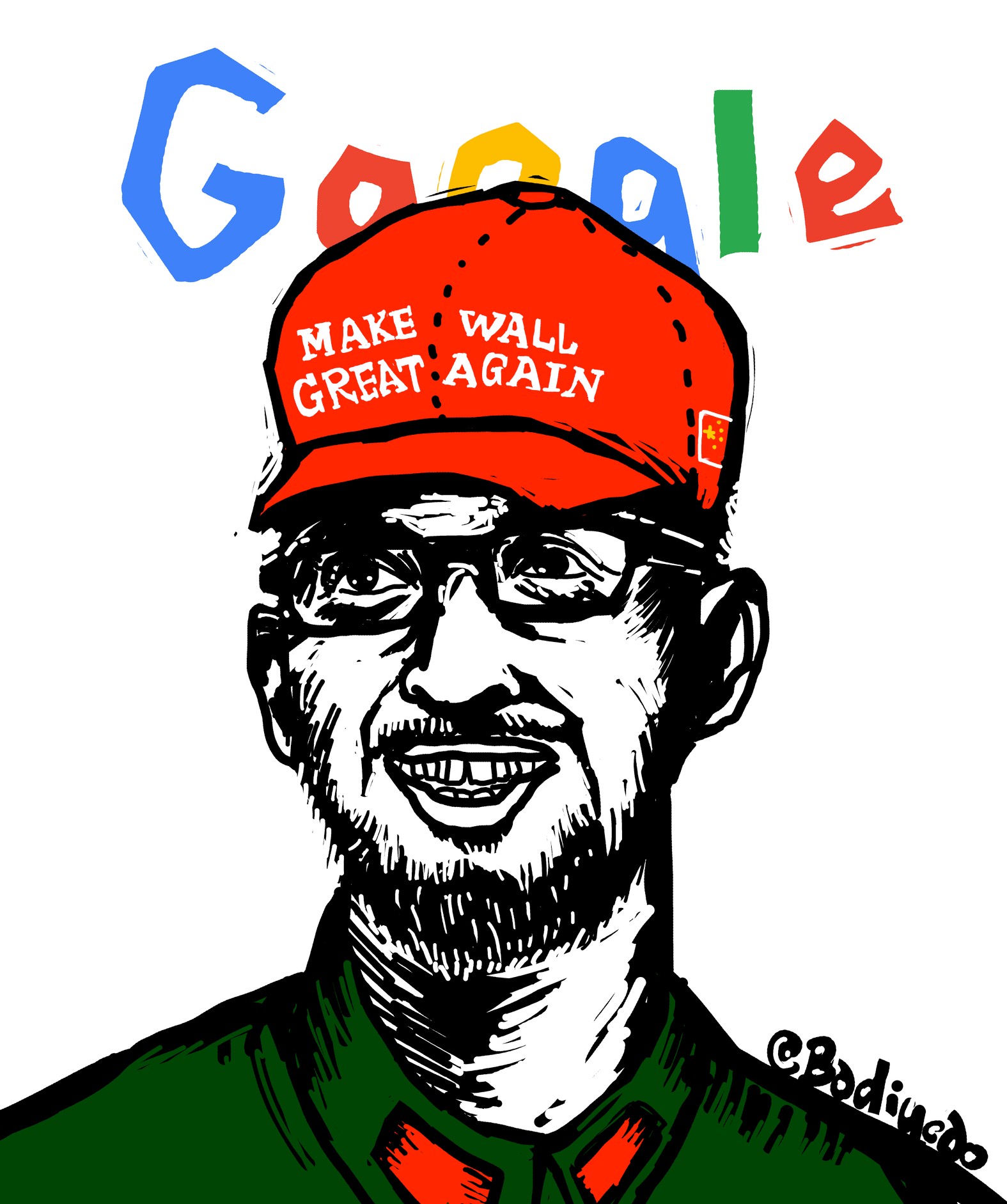
Google has stopped distributing advertisements in China for two websites that review anti-censorship software, in a move that signals the US tech giant’s efforts to curry favour with Beijing.
Last week, VPNMentor, a company that reviews virtual private network services that allow users to bypass China’s internet controls and avoid surveillance, said that Google had refused to sell its adverts to Chinese users, after doing so for more than two years. 
 On Wednesday, Top10VPN, another review site, said it had received the same notice after advertising with Google for several months.
 VPNMentor posted a screenshot of an email to Twitter, appearing to be from Google, saying “it is currently Google policy to disallowed [sic] promoting VPN services in China, due to the local legal restrictions”.
 Foreign businesses and visitors to China, as well as local citizens, rely on VPNs to access the global internet, including platforms such as Google and Facebook, which are blocked by China’s “Great Firewall” of internet controls.
Google runs adverts on third-party websites in China.
 Google said it had “longstanding policies prohibiting ads in our network for private servers, in countries where such servers are illegal”, adding that bans on VPN adverts in China had been in place for several years.
 On Friday, China’s market regulator demanded that internet platforms step up their censorship of adverts.
 However, there is no blanket ban on selling VPNs in China.
Chinese regulators issued a notice in 2017 stating that VPN providers would need to be licensed in order to operate in China.
Regulators told the Financial Times last year that the situation was “complex” and that they were still “researching” how to apply the measures.
 Charlie Smith of GreatFire, a censorship monitoring organisation, criticised Google’s blunt action in relation to VPNMentor and Top10VPN as being too broad.
He said: “There are legally registered VPNs operating in China, so either Google has not kept up to date with local regulations or they are overstepping their boundaries.” 
 David Kaye, the UN special rapporteur on the promotion and protection of the right to freedom of opinion and expression, said that Google’s move “deprived [Chinese users] of the choice to find uncensored material”. 
 “If Google is in the business of expanding access to information, why do they not conceive of their business in those terms in China?” he asked.
 Mr Kaye also questioned whether Google had researched the legal status of the review sites, or “sought ways to ameliorate the impact on expression” before deciding to enforce a ban against them as regards all VPN-related adverts.
 Mark Natkin of Marbridge Consulting, a tech research group in Beijing, said that Google “may be trying to comply with the spirit of the regulation”.
 “Google’s situation is that, based on their past decisions in China, they have a more delicate relationship with the Chinese authorities and feel compelled to make additional efforts to curry favour and get back in the good graces to get approval to re-enter the market,” he added.
Lee Jyh-An, associate professor of law at the Chinese University of Hong Kong, agreed, saying the move was a “signal to show kindness towards the Chinese government”. 
 “Google have withdrawn from China before and that scene wasn’t pleasant, so if they want to come back again, they have to show a stronger ‘kindness’ signal.”
 Google closed its China search engine in 2010 after suffering cyber attacks and periodic blocks from the government.
The company announced that it was no longer willing to censor search results, devastating its relationship with Beijing at the time.
 Google said its decision to block VPNMentor’s adverts was “completely unrelated” to trying to re-enter China.
 “As we’ve said for many months, we have no plans to launch Search in China and there is no work being undertaken on such a project,” the company added, referring to its previously leaked “Dragonfly” plan to bring a censored Google Search back to China.

Call for UK to ban patients travelling to China for 'organ tourism'

Forty MPs back effort before inquiry into China's forced organ harvesting
By Owen Bowcott 


UK patients should be banned from travelling to China for transplant surgery, the government has been told, before an inquiry into allegations of forced organ harvesting from prisoners of conscience.
The call has so far been backed by 40 MPs from all parties before the next session of the independent China tribunal, which is investigating claims that detainees are being targeted by the regime. 
Opening a Westminster Hall debate last week, the DUP MP Jim Shannon urged the UK government to consider imposing an organ tourism ban like those already enacted by Italy, Spain, Israel and Taiwan.
“It is wrong that people should travel from here to China for what is almost a live organ on demand to suit themselves,” Shannon, the MP for Strangford in Northern Ireland, said. 
“It is hard to take in what that means – it leaves one incredulous.
“It means someone can sit in London or in Newtownards and order an organ to be provided on demand. Within a month they can have the operation.
“We need to control that structurally, as other countries have, not simply because it is the right thing to do, but also because it is necessary to protect UK citizens from unwittingly playing a role in the horrifying suffering of religious or belief groups in China.”
The China Tribunal, chaired by Sir Geoffrey Nice QC who was formerly a prosecutor at the International Criminal Tribunal for the former Yugoslavia, has been taking evidence about mispractices from medical experts, human rights investigators and others.
It will hold a second round of hearings on 6 and 7 April in London. 
Its final judgment will be published on 13 June. 
China has been asked to participate but has declined to do so.
In an interim judgment released last December, the tribunal said: “In China forced-organ harvesting from prisoners of conscience has been practised for a substantial period of time involving a very substantial number of victims... It is beyond doubt on the evidence presently received that forced harvesting of organs has happened on a substantial scale by state-supported or approved organisations and individuals.”
Among those killed are members of religious minorities such as Falun Gong, Tibetans, Uighur Muslims and Christian sects. 
In 2014, China announced that it would stop removing organs for transplantation from executed prisoners.
It is not clear how many UK citizens have travelled to China for transplants. 
Waiting times for operations are said to be far shorter than in the west. 
One inquiry suggested that a liver transplant could be arranged privately at a Chinese hospital for $100,000.
Fiona Bruce, the Conservative MP for Congleton, who is also leading the campaign for a ban said during the Westminster debate: “Our government could inquire about the numbers of organ removals and their sources … They could reduce demand by banning organ tourism … This is not a case of a few voluntary organ transplants; it is a case of mass killings through forced organ removal, of religious persecution, of grave allegations of crimes against humanity.”
Mark Field, the Foreign Office minister, acknowledged that there was a growing body of research, much of which was “very worrying” but he believed relatively few people in the UK chose to travel to China for organ transplants.
Introducing a travel ban, he said, would be difficult to police since it would be hard to establish whether people had travelled there for that purpose. 
Field said: “But, it is important that we make them aware that other countries may have poorer medical and ethical safeguards than the UK, and that travelling abroad for treatments, including organ transplants, carries fundamental risks.”

China's crimes against humanity

The Truth about China’s Persecution of Falun Gong
By ETHAN GUTMANN
People practice Falun Dafa, or Falun Gong, meditation and exercises before a protest march against the Chinese government, outside City Hall in Los Angeles, Calif., October 15, 2015. 

There is a certain transgressive thrill in pulling the tail of a sacred cow. 
In that sense, Ms. Tolentino’s piece “Stepping Into the Uncanny, Unsettling World of Shen Yun” (March 19, 2019) is a compliment, a flare in the New York sky that Falun Gong, as a victim group, has finally achieved sacred-cow status. 
But even tail-pulling has an unwritten etiquette: If I wanted to write a critique of, say, traditional Jewish Passover food, I would stick to things such as the texture of gefilte fish rather than condemning the Seder or questioning the existence of the Holocaust. 
And I suspect Ms. Tolentino would agree with me.
Ms. Tolentino was essentially writing a critical dance review of Shen Yun Performing Arts while sprinkling a little snark on — in her view — the cornball conventions of Chinese theater and Falun Gong’s suspicious refusal to adopt Western, politically correct norms. 
Yet her argument suddenly took a weird detour, delivering a skeptical judgement on the charges of Chinese State organ harvesting of Falun Gong (“many experts dispute this”).
Why did she do this? 
Two reasons: A moment of transgressive pleasure is followed by guilt, and guilt must be answered by justification — perhaps the victim group is not really a sacred cow after all? 
Or they have brought their suffering upon themselves? (You know, through hypocrisy or not answering her emails or something). 
The second reason is that even a cursory glance at the credible claims surrounding Chinese organ harvesting will establish that this is not the Holocaust.
Indeed, it’s closer to the Spanish Inquisition — a convert-to-the-Communist-Party-or-die scheme that has spanned two decades and picked up four victim groups on the way: the Uyghurs in 1997, Falun Gong in 2001, Tibetans and House Christians in 2003. 
Overall casualty rate? 
Probably just under that of the Syrian Civil War. 
Tolentino is right; that’s only a fraction of what the Nazi death camps produced in a just a few years.
Yet Ms. Tolentino had many choices in her brief Google search. 
On one side, she found me, and David Kilgour, and David Matas — two Jews and a Presbyterian who have investigated this subject for 13 years and have published books on the subject. 
On the other, she found a Washington Post journalist who, during his brief posting in Beijing, wrote a single story on this issue, with a single quote from a Chinese lawyer (“he had never heard of organs being harvested from live prisoners, as Falun Gong claims.”)
That Chinese lawyer represents Falun Gong detainees in China. 
And that means he is a very brave man — particularly at a time when Chinese lawyers are routinely being thrown into prison, “Black Jails,” and even labor camps. 
Yet even very brave men don’t stand up all that well to electric cattle prods, so it is not surprising that the lawyer didn’t remember hearing anything from his clients about the most politically sensitive issue in China, the state-sponsored organ harvesting of political and religious dissidents.
Ms. Tolentino had choices. 
I’m not surprised that she did not read our published works. 
That can take a month. 
But she could have quoted the New York Times; their previous star China reporter, Didi Kirsten Tatlow, seamlessly fluent in Chinese, wrote six stories on this issue. 
Ms. Tolentino could have easily found that our own House of Representatives passed a resolution in 2016 condemning China for harvesting dissidents, citing our “credible and persistent reports” — as did the European Parliament. 
She could have quoted from the ongoing London China Tribunal, chaired by Sir Geoffrey Nice, probably the most respected human rights prosecutor in the world. 
Again, Ms. Tolentino is right: There is a rival herd of experts who dispute our findings out there. 
But with over a million Uyghurs incarcerated over the last year, blood-and-DNA-tested, ready for organ-tissue matching, those experts are very quiet these days.
Gefilte fish has many memories for me. 
I could write an essay about Jewish food and it might be just as evocative — and critical of how corny the whole Seder thing can be, and emotionally mixed — as Ms. Tolentino’s feelings about the Shen Yun dance performance. 
But the force of my writing still wouldn’t give me the standing to publish in The New Yorker on the Holocaust. 
Only intensive study and the relentless, challenging, scarring, tedious, and exhaustive interviews of witnesses can do that.
I suspect that the author had a nice, mildly transgressive piece in hand. 
Pull the tail a little, maybe even tip the whole cow. 
Then she “stepped into” something, “uncanny and unsettling.” 
It wasn’t Shen Yun, or Falun Gong — or a cowpie for that matter. 
No, it was something evil, with a whiff of the gas chamber about it, something she did not understand. 
And she panicked, but she went ahead and did it anyway. 
I have no clue as to why her editors went along on that midnight ride, but they did. 
And in doing so, they failed their readers — and millions of prisoners of conscience as well.

lundi 1 avril 2019

China is a trade bully. Trudeau needs to stop dithering and fight back

No nation-state, or individuals, should be held to ransom by China
By Diane Francis
Police officers stand guard outside the Canadian embassy in Beijing on January 27, 2019.
It’s time to stop pretending that China is an honourable trading partner.
It is a trade bully and Canada should join the Americans in waging a trade war against Beijing following years of abuse.
The U.S. has imposed tariffs, or laid charges, on China in retaliation for various unfair trade practices and theft of intellectual property, among other practices.
Canada has also been a victim. 
Beijing threw two Canadians in a Chinese jail on suspicion of espionage, and, more recently, suddenly blocked canola imports worth $2.7 billion a year. 
That’s about 40 per cent of Canada’s canola exports.
Such draconian moves were unleashed following the December detainment of Huawei’s chief financial officer Meng Wanzhou in Vancouver on charges of fraud in the U.S. 
She has been free on bail and awaits an extradition hearing this May.
This arrest was not churlish — like China’s arrest of the two Canadians — but constituted a legally binding requirement under extradition treaties. 
Canada was obliged to arrest her upon a formal request by the U.S. and hold a hearing into the merits of U.S. charges. 
The hearing may result in her being freed, or being transported to the States.
China’s measures are excessive and unjust and should be met with commensurate actions. 
Instead of dithering, the Prime Minister must announce a series of counter measures: 
  • the imposition of tariffs on Chinese goods, equivalent to the damage inflicted on Canada’s exports and jailed citizens; 
  • a ban preventing Huawei from doing sensitive telecom work; 
  • and a revamp of trade policies and financial packages to exporters in order to incentivize businesses to pursue other markets.
Obviously, China is a huge market but it’s not the only game in town. 
Most countries don’t incarcerate innocent people or unilaterally abrogate contractual obligations.
Besides, Canada has leverage: In 2018, China bought $29 billion worth of exports from Canada, but shipped as much to Canada as it bought, or $46.4 billion, according to Statistics Canada. 
China, in other words, is more dependent on Canada than the other way around and everything not imported from China can, and should, be imported from countries that respect agreements and the rule of law.
The world is going to divide itself into trading blocs comprised of countries that share values. 
That’s why Canada’s trade with the U.S. and Europe must be its priority export targets. 
Some may argue the U.S. is not reliable, given NAFTA irritants, but these are relatively minor family squabbles. 
China, on the other hand, doesn’t hesitate to mug its trading partners.
There’s also the issue of intellectual property theft. 
The U.S. estimates this costs its economy up to US$600 billion a year. 
Its businesses claim China forces them into joint ventures with Chinese firms that then copy or steal their technologies, ignoring patents and copyrights.
This has happened here. 
For example, Imax Corp., with its giant screen technologies, fell victim to intellectual property theft and may eventually be grievously damaged globally. 
In 2014, Imax won $7 million in a Canadian court against a former employee and software engineer, Gary Tsui, who stole its technology in 2009 and then sold it to a state-owned enterprise in China. 
Tsui has remained outside Canada, ignoring a detention order and injunction by a Canadian court.
China is pushing around many countries, as I wrote recently. 
With the canola assault, it’s time to forge a “fair trading league” with others that will make it clear that an attack against one is considered an attack against all. 
And taking tough action, along with the U.S., is essential.
No nation-state, or individuals, should be held to ransom by China.

UN: China Responds to Rights Review with Threats

Member States Should Seek International Inquiry into Widescale Chinese Abuses
Human Rights Watch

Atushi city concentration camp in East Turkestan

Geneva – China used pressure and warnings to stifle criticism of its poor human rights record throughout the United Nations Human Rights Council session that concluded on March 22, 2019, in Geneva, Human Rights Watch said today. 
China provided no credible response to concerns raised about the government’s rights violations, notably the mass arbitrary detention of an estimated one million Turkic Muslims in China’s East Turkestan colony.
“For years China has worked behind the scenes to weaken UN human rights mechanisms,” said John Fisher, Geneva director. 
“But the growing global outcry over its mistreatment of East Turkestan’s Muslims has sent China into panic mode, using public as well as private pressure to block concerted international action.”
A letter sent by China to ambassadors in Geneva, which Human Rights Watch obtained, warns delegations that “in the interest of our bilateral relations and continued multilateral cooperation,” they should not “co-sponsor, participate in or be present at” a panel event on March 13 on human rights violations in East Turkestan, hosted by the United States, Canada, Germany, the Netherlands, and the United Kingdom. 
In addition, some delegates from the global South told Human Rights Watch that Chinese diplomats had personally approached them and warned them not to attend the event.
China’s rights record was under formal scrutiny at this session as the Human Rights Council considered the report of China’s Universal Periodic Review (UPR), a regular review of the rights record of each UN member state. 
Delegates attending the session identified a number of concerns about China’s efforts to mute criticism and to present a distorted account of its rights record, including:
  • Pressuring UN officials to remove the UN country team and certain nongovernmental organization submissions from UPR materials;
  • Providing blatantly false or misleading responses on critical issues, such as on violations of religious freedom; mass detention centers, and lack of due process safeguards in East Turkestan;
  • Urging delegations to sign up for the UPR to praise China’s rights record;
  • Approaching delegations that criticized China’s rights record to warn of negative consequences to their bilateral relationship;
  • Prevailing upon member states of the Organization of Islamic Cooperation (OIC) to commend China for its treatment of its Muslim population;
  • Flooding speaker lists with government-organized nongovernmental organizations (GONGOs) to uncritically endorse China’s rights record, while not allowing any opportunity for independent China groups to participate in any government consultation or make submissions without fear of reprisals;
  • Seeking to block accreditation of a Uyghur activist, Dolkun Isa, and publicly denouncing him without basis as a “terrorist” during an event held by a nongovernmental group, and denouncing a Uyghur panelist at the state-led side event, ominously citing details of the whereabouts and status of his family members;
  • Exhibiting a massive week-long photo display outside UN meeting rooms depicting Uyghurs as happy and grateful to the Chinese authorities; and
  • Seeking to silence a nongovernmental group from speaking on East Turkestan at the council by raising points of order.
Despite China’s efforts to prevent criticism, numerous government delegations, the UN high commissioner for human rights, UN rights experts, treaty bodies, and many nongovernmental organizations have all drawn attention to China’s sweeping violations in East Turkestan and called for unfettered access for international monitors to conduct an independent assessment.
“It speaks volumes that China felt it necessary to twist arms and mount propaganda displays to try to suppress scrutiny of its rights record,” Fisher said. 
“Now it’s up to governments to take action at the June Council session and show that China is being held to international rights standards.”

Taiwan blasts China for reckless and provocative fighter jet incursion

Taiwanese news media said the last time Chinese jets had crossed the line was in 2011
Agence France-Presse

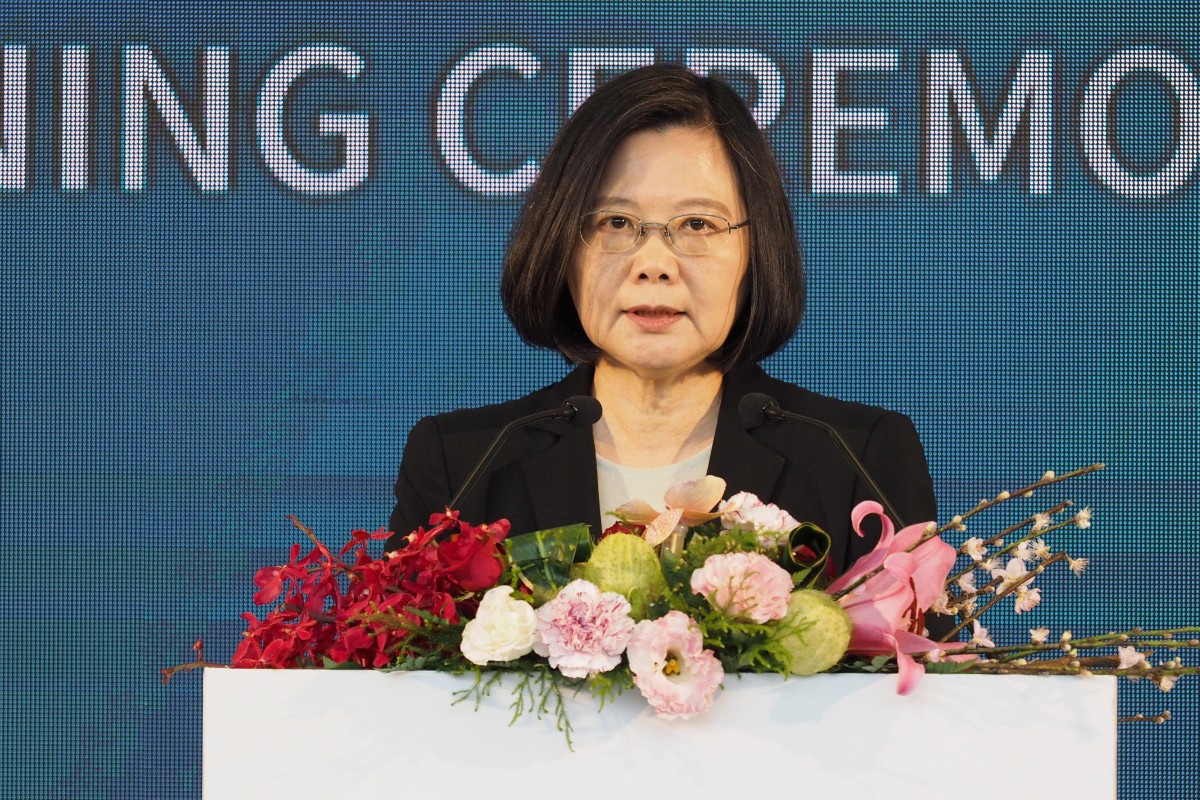
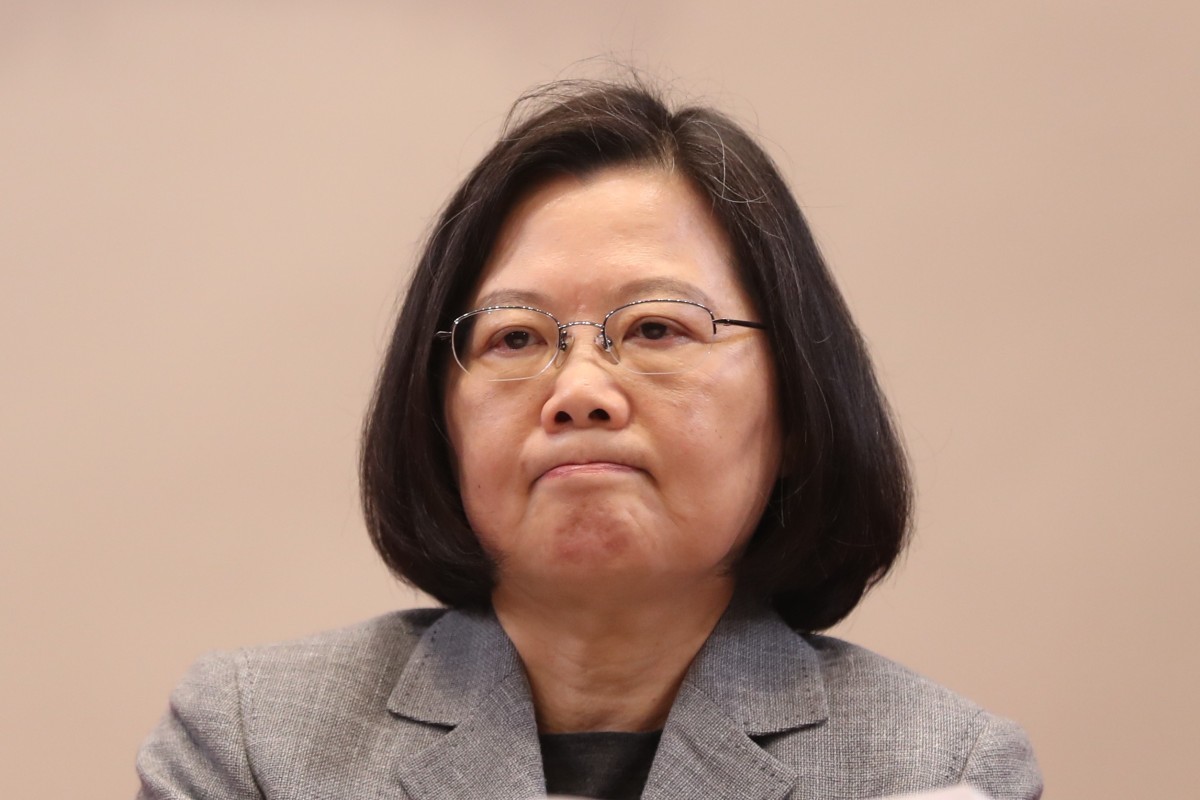
A spokesman for Taiwan President Tsai Ing-wen, above, called China’s flights “provocative and damaging the cross-straits status quo”. 

Taipei hit out at China on Sunday for what it said was a “reckless and provocative” incursion by two fighter jets across a largely respected line dividing the two sides in the Taiwan Strait.
The Defence Ministry said Taiwan scrambled its own aircraft on Sunday morning and broadcast warnings after two J-11 fighter jets crossed over the “median line” within the waters that separate the island from the mainland.
“At 11am, March 31, 2 PLAAF J-11 jets violated the long-held tacit agreement by crossing the median line of the Taiwan Strait,” the Ministry of Foreign Affairs said on Twitter.
“It was an intentional, reckless and provocative action. We’ve informed regional partners and condemn China for such behaviour,” the ministry added.

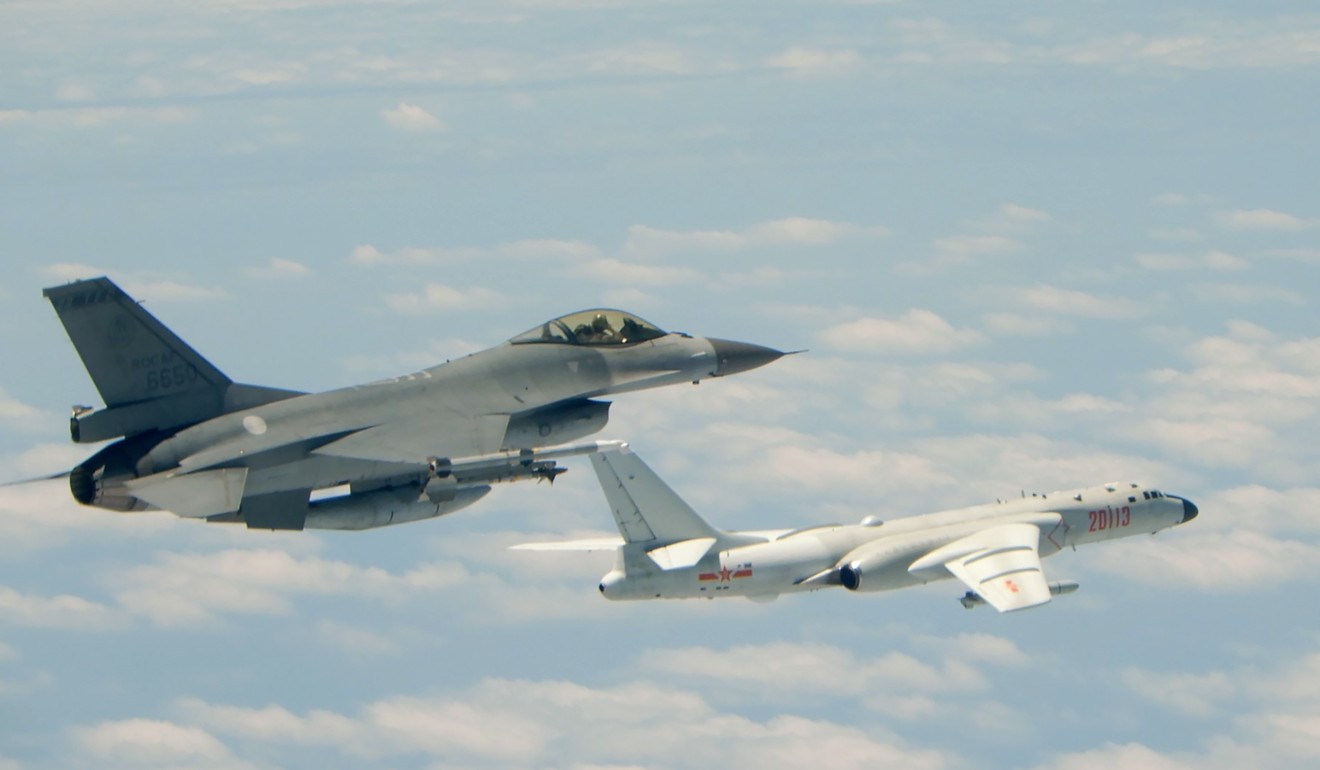
A file photo from May 2018 shows a Taiwanese Air Force F-16 fighter aircraft, left, flying alongside a Chinese People's Liberation Army Air Force H-6K bomber.

China has ramped up the number of fighter and warship crossings near Taiwan or through the straits in recent years, rattling nerves on the island at a time when relations are at a low point.
But it is highly unusual for them to cross the so-called median line, a widely agreed upon boundary that passes through the middle of the straits.
Taiwanese news media said the last time Chinese jets had crossed the line was in 2011.
That incident was portrayed by both sides as an inadvertent mistake by two jets responding to a nearby US spy plane.
But on Sunday, Taipei described the latest incursion as a deliberate act.
Presidential Office spokesman Alex Huang called the flights “provocative and damaging the cross-straits status quo”.
The flights come a week after the US sailed a destroyer and a coastguard ship through the Taiwan Strait, angering Beijing.
Although the straits are an international waterway China often hits out when US or other western navy ships pass through them.
Beijing sees Taiwan as part of its territory awaiting unification, even though the two sides have been ruled separately since the end of a civil war in 1949.
Washington diplomatically recognises China over Taiwan but remains the island’s chief military ally and arms supplier.
Earlier this month Taiwan said it had made a formal request to the US for new fighter jets.

A file photo of the Arleigh Burke-class guided-missile destroyer USS Curtis Wilbur. The flights come a week after the US sailed a destroyer and a coastguard ship through the Taiwan Strait.

Since 2002, the US has repeatedly denied such requests, fearing a possible backlash from Beijing.
But in that time China has massively increased spending on its armed forces, including highly advanced fifth-generation jet fighters.
That has left Taiwan with an ageing air force that analysts say is outgunned and in desperate need of an upgrade.
China has significantly stepped up diplomatic and military pressure on Taiwan since the Beijing-sceptic President Tsai Ing-wen took office in 2016, including staging a series of military exercises near the island.
She will be fighting for reelection in January 2020.
Last week Tsai made a brief stop in Hawaii to deliver a speech, prompting China to lodge an official protest with Washington.

Two Chinas Policy

President Trump nears sale of new F-16V jets to Taiwan, the first such deal since 1992 and signal a new American willingness to back the independent nation.
Bloomberg

President Tsai Ing-wen of Taiwan this month. Taiwan's Air Force is seeking to buy 66 F-16V warplanes from the US. 

The US may finally sell Taiwan the warplanes it has sought for more than a decade to defend against China. 
Their arrival would deal more of a political shock than a military blow to Beijing.
Trump administration officials have given tacit approval to Taipei’s request to buy more than 60 Lockheed Martin Corp. F-16s, according to people familiar with the matter, setting the stage for the first such deal since 1992
While a few dozen fighter jets would hardly tip the military balance against the increasing powerful Chinese military, it would signal a new American willingness to back the democratically run island
“For Beijing, it would be a huge shock,” said Wu Shang-su, a research fellow at the S. Rajaratnam School of International Studies in Singapore.
“But it would be more of a political shock than a military shock. It would be, ‘Oh, the US doesn’t care how we feel.’ It would be more of a symbolic or emotional issue.”
The potential sale is among several gestures of US support for Taiwan in recent months, even as President Donald Trump and Chinese dictator Xi Jinping near a deal to end the costly trade war.
The US also sailed a warship through the Taiwan Strait and accommodated President Tsai Ing-wen’s stopover in Hawaii last week, drawing protests from China, which denounced the moves as “extremely dangerous.”
Renewed US interest in Taiwan follows growing calls in Washington for a “whole-of-government” effort to prevent China from surpassing American military and industrial dominance.
Perhaps nowhere has the power shift been felt more than on Taiwan, an island of 23.6 million people that China aims to eventually control despite 70 years of divided rule.
China has directed its industrial strength toward huge investments in military hardware over the past two decades, building a world-class navy and filling its coastline with missiles capable of hitting Taiwanese targets.
The country spent 23 times more than Taiwan on defence in 2017, up from double in 1997.
New F-16s won’t “change the fundamental balance of capabilities across the strait, nor will it eliminate the threat that China poses to forcibly absorb a democratic Taiwan,” said Scott Harold, an associate director of Rand Corp.’s Centre for Asia-Pacific Policy.

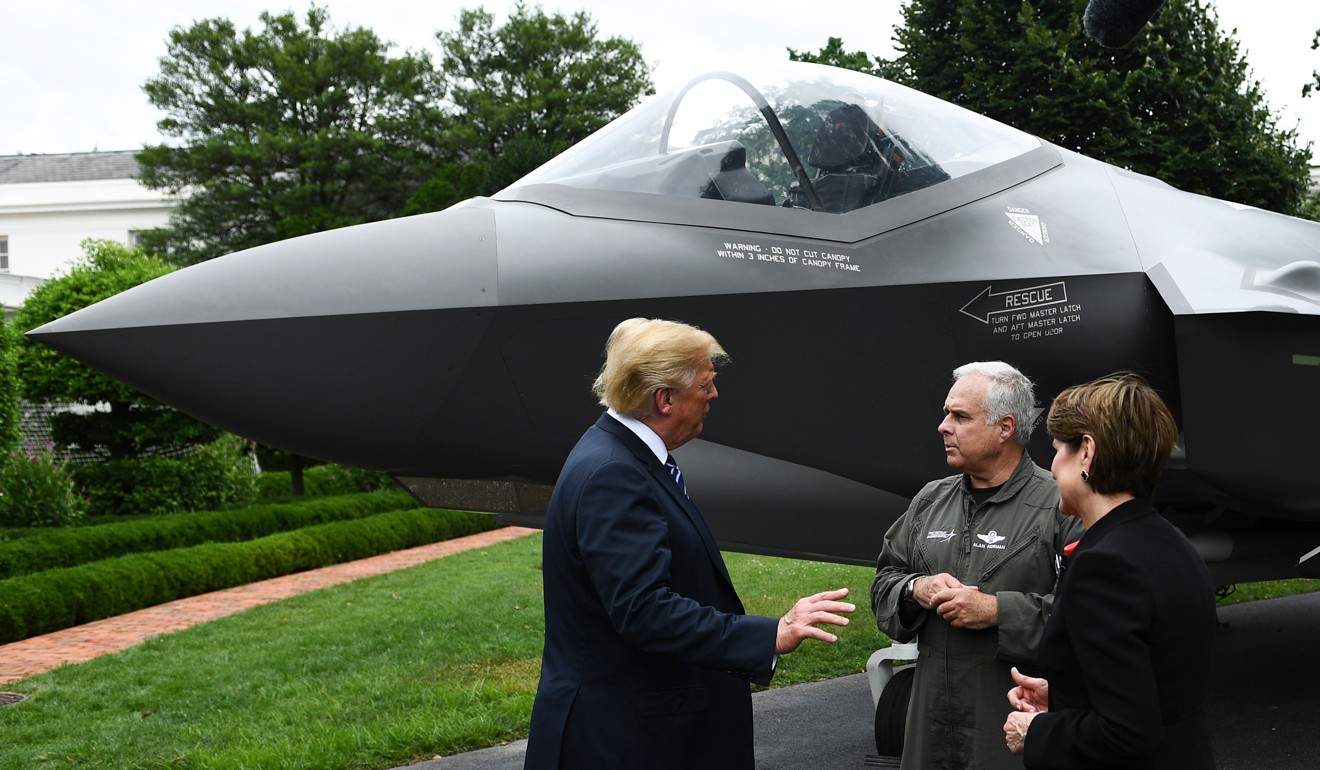
President Donald Trump next to an F-35 fighter jet. The US refused Taiwan’s request for such jets, which would have been more likely to provoke China’s ire. 

“Taiwan will continue to need to invest in missiles, electronic warfare, mines and other advanced conventional and asymmetric capabilities designed to deter, and if necessary defeat, any Chinese effort to use coercion to compel unification,” Harold said.
Rand analysts argued in a 2016 report that China’s sophisticated short-range ballistic missiles could “cut every runway at Taiwan’s half-dozen main fighter bases and destroy essentially all” parked aircraft in a conflict.
Any planes that made it in the air could face Chinese pilots flying jets such as the J-20, a “fifth-generation” stealth fighter considered to be a rival to Lockheed’s advanced F-22s and F-35s.
Still, the F-16 sale would represent a shift by the US, which is obliged to sell “arms of a defensive character” to Taipei under the 1979 Taiwan Relations Act.
Timorous presidents since Bill Clinton have repeatedly rebuffed Taiwan’s requests for new fighter jets and other advanced weapons systems that could provoke Beijing, with Barack Obama agreeing in 2011 to merely upgrade its ageing F-16 fleet.
Tsai said during her visit to Hawaii on Wednesday that a fighter jet deal would “greatly enhance our land and air capabilities, strengthen military morale and show to the world the U.S.’s commitment to Taiwan’s defence.”
The F-16Vs requested by Taiwan are promoted as the world’s most advanced fourth-generation jet, including the latest radar and avionics, even though the original F16 model has been in service for more than 40 years.
The aircraft would help the island respond day-to-day incidents such as air space incursions that fall short of open war and mop up data during routine patrols.

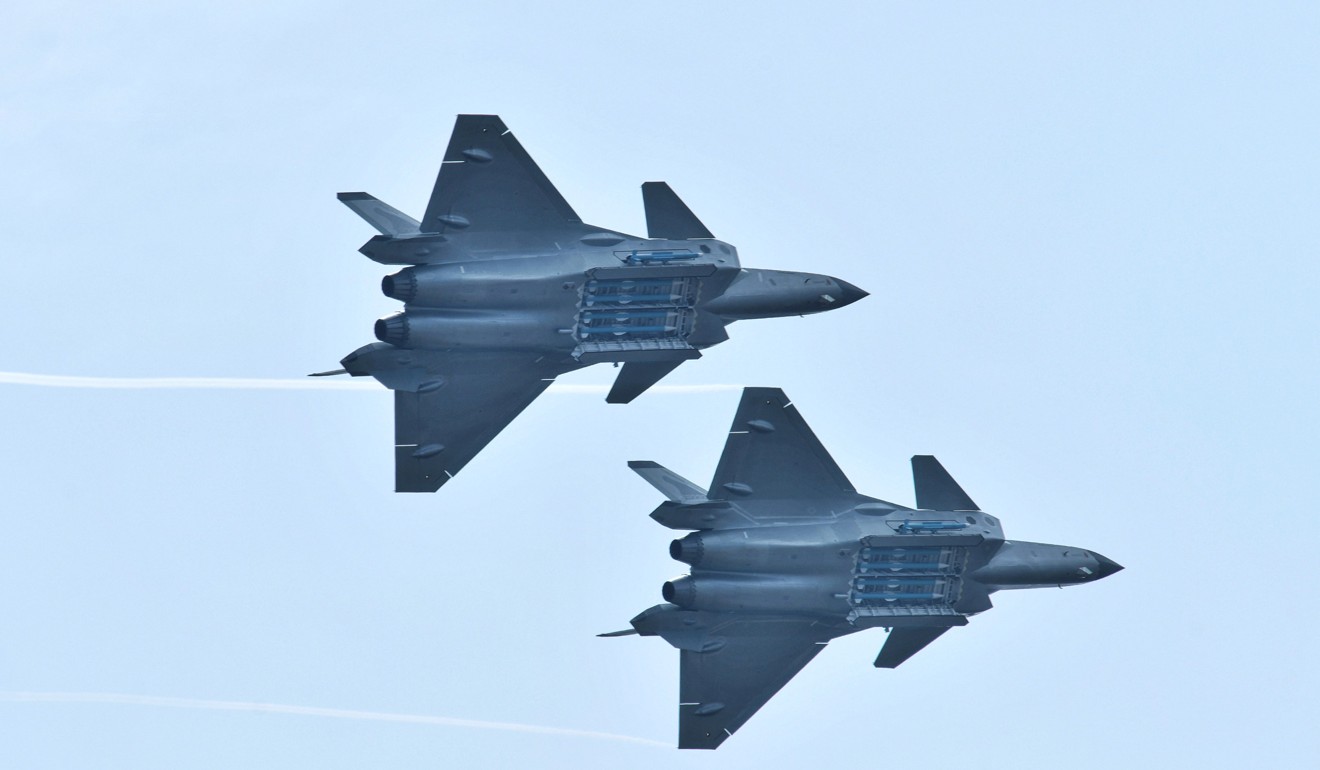
Chengdu J-20 stealth fighter jets of the Chinese People's Liberation Army Air Force. 

The sale could be calibrated to test China’s bottom line without breaching it. 
Xi Jinping would have to decide whether to risk his trade pact with Trump or even an open conflict between two of the world’s most powerful militaries to prevent the sale of a few dozen jets.
The US, meanwhile, refused Taiwan’s request for F-35 fighter jets. 
Not only would the costly aircraft strain Taiwan’s defence budget, a deal for America’s most advanced military technology would be more likely to provoke China’s ire.
“It’s better for us to have F-16s as a first priority,” Feng Shih-kuan, who served as Defence Minister under Tsai until February last year and is now at the Taipei-based Institute for National defence and Security Research. 
“We won’t feel any sadness if we don’t get F-35s.”