mardi 10 juillet 2018

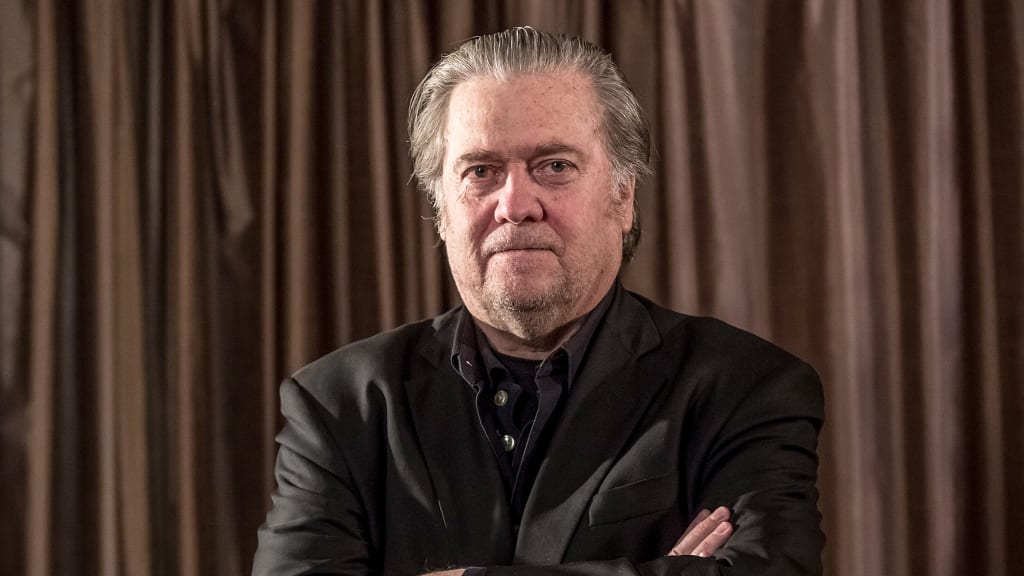
Australia on the front line of clash with China, says Steve Bannon

By Peter Hartcher

Australia, you didn't know it, but you've been at the very forefront of Donald Trump's project. 
"I think Australia is in a fight for the ages" that will decide whether the nations of the West can keep their sovereignty against Chinese intrusion, says Trump's former chief strategist, Steve Bannon, now a coach and adviser to populist movements worldwide.       
"Australia is at the forefront of the geopolitical contest of our time," he tells me in his first interview with an Australian media outlet. 
"What's playing out in Australia is more important than what's happening in the US and other places".
"If we continue on this path we're down, China will control all of the countries of South East Asia and they will control Australia," argues Bannon, the chief executive of Trump's victorious election campaign and the man credited with the creation of "Trumpism".
He says that China's advances in Australia persuaded him that the US had to act to defend itself against Beijing's economic advances.
And Trump took the first decisive action on this agenda on Friday night after months of threats and bluster. 
The President had promised to impose punitive US tariffs on imports from China unless Beijing made dramatic changes to its rules on trade and investment.
With negotiations failing, the first ever US tariffs aimed solely at China took effect at midnight on Friday, Washington time.
A 25 per cent import tax is now in place on aircraft parts and farm ploughs among a long list of US imports from China.
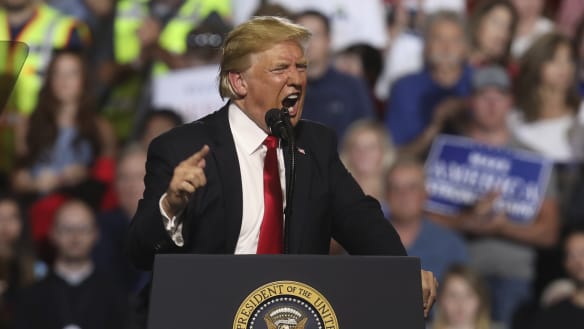
Trump eyes even higher tariffs as China trade war escalates

The value of imports subject to the new tariff is about $US34 billion, with the Trump administration considering applying it to a further $US16 billion worth, plus the possibility of much more to come if China doesn't capitulate. 
Trump had put "America first".
China's Commerce Ministry said that Trump had launched "the largest trade war in economic history". 
It retaliated with tariffs on imports of American soybeans, cars and whiskey, among other products.
Steve Bannon, rather than resisting Beijng's rhetoric, embraces it: "We just started a war on Friday night." 
He was fired after the first seven months of the administration amid tensions in the White House, with Trump saying his former Svengali had "lost his mind" apparently because he'd made remarks critical of some of the Trump family.
Yet Bannon is a staunch defender of the President. 
American media have reported that they remain in regular contact; Bannon says they talk through their lawyers. 
With the Mueller investigation into the Trump campaign and suspected collusion with Russia, discretion is the better part of valour, it seems.
Bannon exults: "I can't emphasise Friday night enough -- it was the day that President Trump stood up for the American worker."
Bannon says that the tariffs are merely emblematic of a much grander confrontation with China: "It's not about tariffs and math, it's about bringing manufacturing jobs back from China, it's about the dignity of workers, self-worth and community.
"Why do you think states like Wisconsin and Michigan and Ohio and Iowa that haven't voted Republican in living memory voted for Donald Trump? Because of China."
Indeed, according to Bannon, "Trump's rise was predicated on two things -- the financial crisis in 2008 that lit a match on the populist movement, and the rise of China as it profited from the West while Western elites looked the other way" because the elites, too, were making money from China even as workers suffered layoffs as a result of China's industrial success.
But Australia's trade position is vastly different. 
While Trump bemoans America's enormous $US366 billion annual trade deficit with China, Australia earns a hefty annual surplus from the China trade.
In fact, Australia generated a surplus of $35.5 billion from its merchandise trade with China last year and a further $13 billion from its trade in services with China, according to recent Australian statistics.
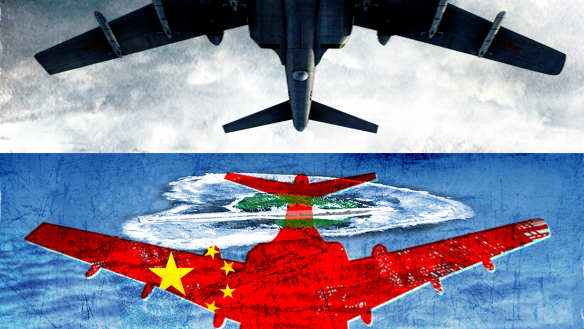
So how could Australia be what Bannon describes as "the canary in the mineshaft"? 
Because, he says, the struggle is not about trade in itself but about domination by the Chinese Communist Party.
"Australia is an object lesson in what to avoid. People [in Australia] played by the rules. It came up gradually, and then it was there."
Chinese investment went into "natural resources, tech, then you have overseas Chinese putting money into politics and now you finally wake up", a reference to the bills now passed by the Parliament to curb foreign interference.
"And you wake up and you say, 'hold on -- who controls our economic base', because doesn't politics ultimately come off who controls the economic base?"
"Because of Australia's example, it will not happen here in the US," says Bannon. 
"It will not be allowed to happen. People are woke."
"You," he tells me, meaning Australia, "are the San Andreas fault between China and the West. These are the two great systems that have built up over 2000 years. You are the representative of Athens and the democratic Western tradition, and China is a Confucian totalitarian system.
"The South China Sea is very quickly going to become the front line. The South China Sea will be the focus of an intense global crisis."
The US and its allies must be resolute in defence of freedom of navigation against relentless Chinese advances, he urges.
And, while Bannon thinks of Australia as having fallen heavily under China's influence, he says Australia can recover because it has "the only people who can match the common sense, grit and determination year after year of the US".
It's a view Bannon developed as a frequent visitor to Australia as a naval officer with the US Pacific Fleet in the 1970s, though he's a touch out of date with 10 years since his last visit.
"I've said it many times, though I've never said it publicly, Australia and Italy are the centre of the two major political developments where the whole issue of the future of the nation state will be decided," according to Bannon.
Italy because it's the front line of the global "populist nationalist revolt", Australia as the civilisational front line against a Chinese Communist Party quest for dominance. 
"I watch it closely. Every day."

Inside China’s Dystopian Dreams: A.I., Shame and Lots of Cameras

By Paul Mozur
A video showing facial recognition software in use at the headquarters of the artificial intelligence company Megvii in Beijing.

ZHENGZHOU, China — In the Chinese city of Zhengzhou, a police officer wearing facial recognition glasses spotted a heroin smuggler at a train station.
In Qingdao, a city famous for its German colonial heritage, cameras powered by artificial intelligence helped the police snatch two dozen criminal suspects in the midst of a big annual beer festival.
In Wuhu, a fugitive murder suspect was identified by a camera as he bought food from a street vendor.
With millions of cameras and billions of lines of code, China is building a high-tech authoritarian future. 
Beijing is embracing technologies like facial recognition and artificial intelligence to identify and track 1.4 billion people. 
It wants to assemble a vast and unprecedented national surveillance system, with crucial help from its thriving technology industry.
“In the past, it was all about instinct,” said Shan Jun, the deputy chief of the police at the railway station in Zhengzhou, where the heroin smuggler was caught. 
“If you missed something, you missed it.”
China is reversing the commonly held vision of technology as a great democratizer, bringing people more freedom and connecting them to the world. 
In China, it has brought control.
Megvii employees at the company’s offices in Beijing.

In some cities, cameras scan train stations for China’s most wanted. 
Billboard-size displays show the faces of jaywalkers and list the names of people who don’t pay their debts. 
Facial recognition scanners guard the entrances to housing complexes. 
Already, China has an estimated 200 million surveillance cameras — four times as many as the United States.
Such efforts supplement other systems that track internet use and communications, hotel stays, train and plane trips and even car travel in some places.
Even so, China’s ambitions outstrip its abilities. 
Technology in place at one train station or crosswalk may be lacking in another city, or even the next block over. 
Bureaucratic inefficiencies prevent the creation of a nationwide network.
For the Communist Party, that may not matter. 
Far from hiding their efforts, Chinese authorities regularly state, and overstate, their capabilities. 
In China, even the perception of surveillance can keep the public in line.
Some places are further along than others. 
Invasive mass-surveillance software has been set up in the west to track members of the Uighur Muslim minority and map their relations with friends and family, according to software viewed by The New York Times.
“This is potentially a totally new way for the government to manage the economy and society,” said Martin Chorzempa, a fellow at the Peterson Institute for International Economics.
“The goal is algorithmic governance,” he added.
Police officers wearing A.I.-powered smart glasses in Luoyang.
The Shame Game
The intersection south of Changhong Bridge in the city of Xiangyang used to be a nightmare. 
Cars drove fast and jaywalkers darted into the street.
Then last summer, the police put up cameras linked to facial recognition technology and a big, outdoor screen. 
Photos of lawbreakers were displayed alongside their names and government I.D. numbers. 
People were initially excited to see their faces on the board, said Guan Yue, a spokeswoman, until propaganda outlets told them it was punishment.
“If you are captured by the system and you don’t see it, your neighbors or colleagues will, and they will gossip about it,” she said. 
“That’s too embarrassing for people to take.”
China’s new surveillance is based on an old idea: Only strong authority can bring order to a turbulent country. 
Mao Zedong took that philosophy to devastating ends, as his top-down rule brought famine and then the Cultural Revolution.
His successors also craved order but feared the consequences of totalitarian rule. 
They formed a new understanding with the Chinese people. 
In exchange for political impotence, they would be mostly left alone and allowed to get rich.
It worked. 
Censorship and police powers remained strong, but China’s people still found more freedom. 
That new attitude helped usher in decades of breakneck economic growth.
Today, that unwritten agreement is breaking down.
China’s economy isn’t growing at the same pace. 
It suffers from a severe wealth gap. 
After four decades of fatter paychecks and better living, its people have higher expectations.
Tourists waiting to visit the Mao Mausoleum in Beijing, under a pole holding 11 surveillance cameras.
Xi Jinping, China’s top leader, has moved to solidify his power. 
Changes to Chinese law mean he could rule longer than any leader since Mao. 
And he has undertaken a broad corruption crackdown that could make him plenty of enemies.
For support, he has turned to the Mao-era beliefs in the importance of a cult of personality and the role of the Communist Party in everyday life. 
Technology gives him the power to make it happen.
“Reform and opening has already failed, but no one dares to say it,” said Chinese historian Zhang Lifan, citing China’s four-decade post-Mao policy. 
“The current system has created severe social and economic segregation. So now the rulers use the taxpayers’ money to monitor the taxpayers.”
Xi has launched a major upgrade of the Chinese surveillance state. 
China has become the world’s biggest market for security and surveillance technology, with analysts estimating the country will have almost 300 million cameras installed by 2020. 
Chinese buyers will snap up more than three-quarters of all servers designed to scan video footage for faces, predicts IHS Markit, a research firm. 
China’s police will spend an additional $30 billion in the coming years on techno-enabled snooping, according to one expert quoted in state media.
Government contracts are fueling research and development into technologies that track faces, clothing and even a person’s gait. 
Experimental gadgets, like facial-recognition glasses, have begun to appear.
Judging public Chinese reaction can be difficult in a country where the news media is controlled by the government. 
Still, so far the average Chinese citizen appears to show little concern. 
Erratic enforcement of laws against everything from speeding to assault means the long arm of China’s authoritarian government can feel remote from everyday life. 
As a result, many cheer on new attempts at law and order.
“It’s one of the biggest intersections in the city,” said Wang Fukang, a college student who volunteered as a guard at the crosswalk in Xiangyang. 
“It’s important that it stays safe and orderly.”
At the Shanghai headquarters of the artificial intelligence start-up Yitu, a network of cameras linked to a facial recognition system monitors employees and can track their movements in the office.

The Surveillance Start-Up
Start-ups often make a point of insisting their employees use their technology. 
In Shanghai, a company called Yitu has taken that to the extreme.
The halls of its offices are dotted with cameras, looking for faces. 
From desk to break room to exit, employees’ paths are traced on a television screen with blue dotted lines. 
The monitor shows their comings and goings, all day, everyday.
In China, snooping is becoming big business. 
As the country spends heavily on surveillance, a new generation of start-ups have risen to meet the demand.
Chinese companies are developing globally competitive applications like image and voice recognition. 
Yitu took first place in a 2017 open contest for facial recognition algorithms held by the United States government’s Office of the Director of National Intelligence. 
A number of other Chinese companies also scored well.
A technology boom in China is helping the government’s surveillance ambitions. 
In sheer scale and investment, China already rivals Silicon Valley. 
Between the government and eager investors, surveillance start-ups have access to plenty of money and other resources.
In May, the upstart A.I. company SenseTime raised $620 million, giving it a valuation of about $4.5 billion. 
Yitu raised $200 million last month. 
Another rival, Megvii, raised $460 million from investors that included a state-backed fund created by China’s top leadership.
At a conference in May at an upscale hotel in Beijing, China’s security-industrial complex offered its vision of the future. 
Companies big and small showed off facial-recognition security gates and systems that track cars around cities to local government officials, tech executives and investors.
Private companies see big potential in China’s surveillance build-out. 
China’s public security market was valued at more than $80 billion last year but could be worth even more as the country builds its capabilities, said Shen Xinyang, a former Google data scientist who is now chief technology officer of Eyecool, a start-up.
“Artificial intelligence for public security is actually still a very insignificant portion of the whole market,” he said, pointing out that most equipment currently in use was “nonintelligent.”
Many of these businesses are already providing data to the government.
Mr. Shen told the group that his company had surveillance systems at more than 20 airports and train stations, which had helped catch 1,000 criminals. 
Eyecool, he said, is also handing over two million facial images each day to a burgeoning big-data police system called Skynet.
At a building complex in Xiangyang, a facial-recognition system set up to let residents quickly through security gates adds to the police’s collection of photos of local residents, according to local Chinese Communist Party officials.
Wen Yangli, an executive at Number 1 Community, which makes the product, said the company is at work on other applications. 
One would detect when crowds of people are clashing. 
Another would allow police to use virtual maps of buildings to find out who lives where.
China’s surveillance companies are also looking to test the appetite for high-tech surveillance abroad. Yitu says it has been expanding overseas, with plans to increase business in regions like Southeast Asia and the Middle East.
At home, China is preparing its people for next-level surveillance technology. 
A recent state-media propaganda film called “Amazing China” showed off a similar virtual map that provided police with records of utility use, saying it could be used for predictive policing.
“If there are anomalies, the system sends an alert,” a narrator says, as Chinese police officers pay a visit to an apartment with a record of erratic utility use. 
The film then quotes one of the officers: “No matter which corner you escape to, we’ll bring you to justice.”
A video showing facial recognition software in use at the Megvii showroom in Beijing.

Enter the Panopticon
For technology to be effective, it doesn’t always have to work. 
Take China’s facial-recognition glasses.
Police in the central Chinese city of Zhengzhou recently showed off the specs at a high-speed rail station for state media and others. 
They snapped photos of a policewoman peering from behind the shaded lenses.
But the glasses work only if the target stands still for several seconds. 
They have been used mostly to check travelers for fake identifications.
China’s national database of individuals it has flagged for watching — including suspected terrorists, criminals, drug traffickers, political activists and others — includes 20 million to 30 million people, said one technology executive who works closely with the government. 
That is too many people for today’s facial recognition technology to parse, said the executive, who asked not to be identified because the information wasn’t public.
The system remains more of a digital patchwork than an all-seeing technological network. 
Many files still aren’t digitized, and others are on mismatched spreadsheets that can’t be easily reconciled. 
Systems that police hope will someday be powered by A.I. are currently run by teams of people sorting through photos and data the old-fashioned way.
Take, for example, the crosswalk in Xiangyang. 
The images don’t appear instantaneously. 
The billboard often shows jaywalkers from weeks ago, though authorities have recently reduced the lag to about five or six days. 
Officials said humans still sift through the images to match them to people’s identities.
Still, Chinese authorities who are generally mum about security have embarked on a campaign to persuade the country’s people that the high-tech security state is already in place.
China’s propagandists are fond of stories in which police use facial recognition to spot wanted criminals at events. 
An article in People’s Daily, the Communist Party’s official newspaper, covered a series of arrests made with the aid of facial recognition at concerts of the pop star Jackie Cheung. 
The piece referenced some of the singer’s lyrics: “You are a boundless net of love that easily trapped me.”
In many places, it works. 
At the intersection in Xiangyang, jaywalking has decreased. 
At the building complex where Number 1 Community’s facial-recognition gate system has been installed, a problem with bike theft ceased entirely, according to building management.
An outdoor screen in Xiangyang displays photos of jaywalkers alongside their names and I.D. numbers. The idea is to embarrass offenders into compliance.

“The whole point is that people don’t know if they’re being monitored, and that uncertainty makes people more obedient,” said Mr. Chorzempa, the Peterson Institute fellow.
He described the approach as a panopticon, the idea that people will follow the rules precisely because they don’t know whether they are being watched.
In Zhengzhou, police were happy to explain how just the thought of the facial recognition glasses could get criminals to confess.
Mr. Shan, the Zhengzhou railway station deputy police chief, cited the time his department grabbed a heroin smuggler. 
While questioning the suspect, Mr. Shan said, police pulled out the glasses and told the man that what he said didn’t matter. 
The glasses could give them all the information they needed.
“Because he was afraid of being found out by the advanced technology, he confessed,” said Mr. Shan, adding that the suspect had swallowed 60 small packs of heroin.
“We didn’t even use any interrogation techniques,” Mr. Shan said. 
“He simply gave it all up.”

Two-China Policy

U.S. warships pass through Taiwan Strait amid China tensions
By Phil Stewart, Idrees Ali, Jess Macy Yu

WASHINGTON/TAIPEI -- Two U.S. warships passed through the Taiwan Strait on Saturday on a voyage that will likely be viewed in the self-ruled island as a sign of support by President Donald Trump amid heightened tension with China.
“Two U.S. Navy ships conducted a routine transit through the international waters of the Taiwan Strait on July 7-8 (local time),” Captain Charlie Brown, a spokesman for U.S. Pacific Fleet, told Reuters in a statement.
“U.S. Navy Ships transit between the South China Sea and East China Sea via the Taiwan Strait and have done so for many years,” Brown said.
U.S. officials, speaking on condition of anonymity, said the destroyers USS Mustin and USS Benfold carried out the passage.
Earlier on Saturday, Taiwan’s Defence Ministry said the ships were moving in a northeastern direction, adding that the situation was in accordance with regulations.
Washington has no formal ties with Taiwan but is bound by law to help it defend itself and is the island’s main source of arms. 
China regularly says Taiwan is the most sensitive issue in its ties with the United States.
The passage through the Taiwan Strait, the first such one by a U.S. Navy ship in about a year, follows a series of Chinese military drills around the island that have stoked tensions between Taipei and Beijing.
China claims Taiwan as its own and has never renounced the use of force to bring under its control what it sees as a wayward province. 
Taiwan has shown no interest in being governed by the ruling Communist Party in Beijing.
The move comes as a U.S.-China trade fight is seen as dragging on for a potentially prolonged period, as the world’s two biggest economies flex their muscles with no sign of negotiations to ease tensions.
Reuters first reported last month that the United States was considering sending a warship and had examined plans for an aircraft carrier passage, but ultimately did not pursue that option perhaps because of concerns about upsetting China.
The last time a U.S. aircraft carrier transited the Taiwan Strait was in 2007, during the administration of George W. Bush, and some U.S. military officials believe a carrier transit is overdue.
U.S. overtures towards Taiwan, from unveiling a new de facto embassy to passing the Taiwan Travel Act, which encourages U.S. officials to visit, have further escalated tension between Beijing and Taipei.
U.S. Defence Secretary Jim Mattis discussed the delicate issue of Taiwan during his trip to China last month.
“The U.S. sending military ships through the Taiwan Strait is both a demonstration of its continuing support to Taiwan and of its willingness to exercise its maritime rights in China’s periphery,” said Abraham Denmark, a former deputy assistant secretary of defence for East Asia under Barack Obama.
China has alarmed Taiwan by ramping up military exercises this year, including flying bombers and other military aircraft around the island and sending its carrier through the narrow Taiwan Strait separating it from Taiwan.
In recent months, China’s air force has held military manoeuvres near the island, which Taipei has called intimidation.
China’s hostility toward Taiwan has grown since Tsai Ing-wen from the pro-independence Democratic Progressive Party won presidential elections on the island in 2016.

With eye on China, New Zealand buys US anti-submarine jets

  • $1.6 billion purchase of US military aircraft announced
  • New Zealand seeking to help counter China's buildup in South China Sea
By Brad Lendon

New Zealand announced a $1.6 billion purchase of US military aircraft on Monday as it seeks to integrate its forces with US and Australian allies that are trying to counter a Chinese military buildup in the Pacific.
The purchase of the four Boeing P-8A Poseidon maritime patrol aircraft "strengthens the coalition Government's Pacific Reset by providing a maritime patrol capability with the significant range and endurance needed to assist our partners in the region," a statement from New Zealand Defense Minister Ron Mark said.
New Zealand's announcement comes on the heels of the release Friday of its Strategic Defense Policy Statement for 2018. 
In it, New Zealand warns of China's increasing influence in the Pacific, including its expanded military presence in the South China Sea, where Beijing is fortifying islands near some of the world's key shipping lanes.
The 40-page document says China is challenging the existing order in the region while also increasing its involvement and investment in Pacific island nations where New Zealand's influence has long held sway.
New Chinese policy priorities could potentially damage "human rights, arms control and non-proliferation efforts," it says.
Meanwhile, Australia and the US are trying to reinforce regional peace and stability with a focus on "maritime security and freedom of navigation," the document says.

Meshing with allies
Mark noted that he twin-engine P-8As, which can be used for submarine hunting as well as intelligence gathering and surveillance, are also in the inventories of the US, Australia and the United Kingdom.
Those nations, along with New Zealand and Canada, are part of the so-called Five Eyes alliance, which shares intelligence gained from spying activities.
"Maintaining a maritime patrol capability is essential for New Zealand's national security, and for our ability to contribute to global security efforts," Mark's statement said.
China on Monday blasted the "groundless accusations" in the New Zealand defense paper.

Responsible international citizens
Speaking at a news conference Monday announcing the P-8A deal, New Zealand's acting prime minister, Winston Peters, brushed off Chinese complaints about the defense policy statement.
"We're not here to make people happy. We're here to be responsible international citizens doing our best to preserve the neighborhood in which we live and to preserve our sovereignty," said Peters, New Zealand's foreign minister who is running the government while Prime Minister Jacinda Ardern is on maternity leave.
Monday's aircraft purchase and New Zealand's rationale for it were good news for Washington, which has been busy trying to strengthen its Pacific alliances in the face of what it sees as an increased Chinese threat.
New Zealand naval forces this month are participating in the US Navy's RIMPAC exercises, the world's largest naval drills.
Among the other nations in the Hawaii-headquartered war games are Vietnam, Malaysia and the Philippines, which all have claims in the South China Sea.
China was disinvited from the US-led exercises over its militarization of the South China Sea islands.
New Zealand, meanwhile, was given an expanded role in the 25-nation RIMPAC, serving as sea combat commander for the first time in 26 editions of the biennial war games.
Among the hardware New Zealand sent to RIMPAC are two P-3 Orion aircraft, the planes the P-8As will be replacing.
New Zealand expects the P-8As, which are based on Boeing's 737 airliner, to enter service in 2023.
Mark, the defense minister, said New Zealand would also be looking to acquire other smaller surveillance aircraft, including drones, to work in areas close to the island nation.
"This will free up the new P-8A fleet to fly more missions, in the South Pacific and further afield," he said.

Liu Xia, Detained Widow of Nobel Peace Laureate, Leaves China

By Jane Perlez
Liu Xia, the widow of the 2010 Nobel Peace Prize recipient Liu Xiaobo, at her home in Beijing in 2012.

BEIJING — The ailing widow of Liu Xiaobo, the Chinese democracy advocate and Nobel Peace Prize laureate who died of cancer last year under police guard, left China for Europe on Tuesday after a high-level diplomatic campaign by the German government.
Diplomats said Liu Xia, Mr. Liu’s widow, flew to Helsinki, Finland, on Finnair. 
Her final destination is expected to be Germany.
Ms. Liu’s brother, Liu Hui, posted a message soon after the flight took off saying she had left for Europe “to start her new life.” 
He thanked all the supporters who had helped win her release from years of house arrest and strict police supervision.
Chancellor Angela Merkel of Germany raised Ms. Liu’s case directly with China’s dictator, Xi Jinping, during a visit to Beijing earlier this year, a gesture that underscored her opposition to China’s treatment of Ms. Liu and her husband, European diplomats said.
Ms. Liu, 57, had consistently asked to leave China since the death of her husband last July, and had pleaded to be freed from detention.
The Chinese Foreign Ministry told reporters at a regular news briefing on Tuesday that Ms. Liu had been granted permission to leave for Germany for medical reasons.
Her release by the Chinese government came one day after a human rights dialogue between European Union and Chinese officials in Beijing ended Monday. 
An annual summit meeting between China and the European Union is scheduled for next week in Beijing.
Ms. Liu was placed under police surveillance in 2010, the same year her husband was awarded the Nobel Peace Prize for what the committee called “his long and nonviolent struggle for fundamental rights in China.” 
He was not allowed to go to Oslo to receive the prize; Ms. Liu was also barred from attending the ceremony.
Mr. Liu, who was detained in 2008 after promoting a pro-democracy charter, died of liver cancer at age 61 while serving an 11-year prison sentence for “inciting subversion of state power.”
Though he was being treated at a Chinese hospital, the government did not reveal his illness until it was in its late stages, and it would not allow Mr. Liu to travel abroad for medical care.
Ms. Liu has friends in Germany, and had asked the Chinese authorities to let her go there so she could receive treatment for depression.
In a recorded telephone call released in May by the Chinese dissident Liao Yiwu, who lives in exile in Germany, Ms. Liu said: “It would be easier to die than to live. Nothing would be simpler for me than dying in defiance.”
European diplomats had said over the last several months that China had left Ms. Liu in limbo as a show of resolve against Chinese human rights dissidents, despite aggressive efforts by Germany to press for her release.
After Ms. Merkel’s visit to Beijing in the spring, the Chinese authorities let the Europeans know that if Ms. Liu’s case was not publicized, her release would be possible, a European diplomat with knowledge of the case said.
In Hong Kong, at a makeshift statue of Mr. Liu that has become a fixture near the city’s Victoria Park, supporters of the couple expressed relief at Ms. Liu’s departure from China.
“What happened was tragic,” one passer-by, Katie Wong, said of the couple and their ordeal. 
“The both of them have helped China so much, I now wish for her to have a good, relaxing life with her newfound freedom.”

samedi 7 juillet 2018

China Will Lose The South China Sea Game

By Panos Mourdoukoutas 

China wants to control the entire South China Sea. 
Every inch of it. 
That’s why will lose all of it, one day.
In the South China Sea game, China is one player playing against all the rest: The Philippines, Brunei, Malaysia and Vietnam. 
China is also playing against the navies of US, Japan, France, the UK, and Australia. 
These navies seek to enforce the freedom of navigation in the vast trade waterway. 
Close to $5 trillion in merchandise moves through every year.
Why is China playing against everyone else? 
For a couple of reasons. 
One of them is that the waterway is very important to its vision -- becoming the next global economic leader.
It’s the beginning of China’s maritime silk road.
“Insofar as China is concerned, its maritime silk road begins from the South China Sea,” says Vijay Eswaran, Malaysian entrepreneur and Chairman of QI Group of Companies.
“It sees itself playing a more significant role in maritime trade in the future.”
Another reason is that China sees the South China Sea as its own property. 
“China viewed the South China Sea (SCS) as its own,“ adds Vijay. 
All of it, and the resources that are hidden beneath, which China wants to exploit. 
That’s why it is building artificial islands.
And that feeds Chinese nationalism, needed to support and reinforce the political status quo.
What about the overlapping claims from neighboring countries? 
 “China does not see any of the other overlapping claims from the neighboring countries to the South China Sea as a threat,” adds Vijay.
And it uses intimidation to make sure that this won’t happen. 
When China lost a United Nations-linked tribunal international arbitration to the Philippines on the South China Sea disputes a year and a half ago, Beijing took a couple of steps to make sure that Duterte wouldn't do anything with it.
The first step was to threaten Duterte with war should he dare to enforce the ruling. 
The second step was to promise a generous investment to help the Philippines deal with its many problems.
And it worked. Duterte quickly flip-flopped, and forgot all about the ruling, as was written in previous pieces here.
More recently, China applied “Duterte's model” to intimidate Vietnam. 
Last July Vietnam announced that it will stop its oil exploration efforts, following a stark warning by Beijing that it will attack Vietnamese oil and gas bases.
Still, there are multiple navies that are prepared to challenge China’s ambitious mission. 
“It is the potential Western influence, i.e. the US, France and the UK and their navies, that are having more of an impact on Chinese policy in the region.“
Is China prepared to fend off this challenge? 
It’s hard to say.
What isn’t hard to say is that countries that play a game against all end up losing.
That’s what happened in neighboring Japan in the past, and it could happen to China in the future.
Meanwhile, investors in the financial markets of the region should closely watch any developments that will bring China closer to an open confrontation with America and its allies.

jeudi 5 juillet 2018

Europe's Seven Quislings: The European Politicians in Beijing’s Orbit

Fifth column: Former leaders from France, U.K., Germany, France boost Chinese interests
By Alan Crawford and Patricia Suzara
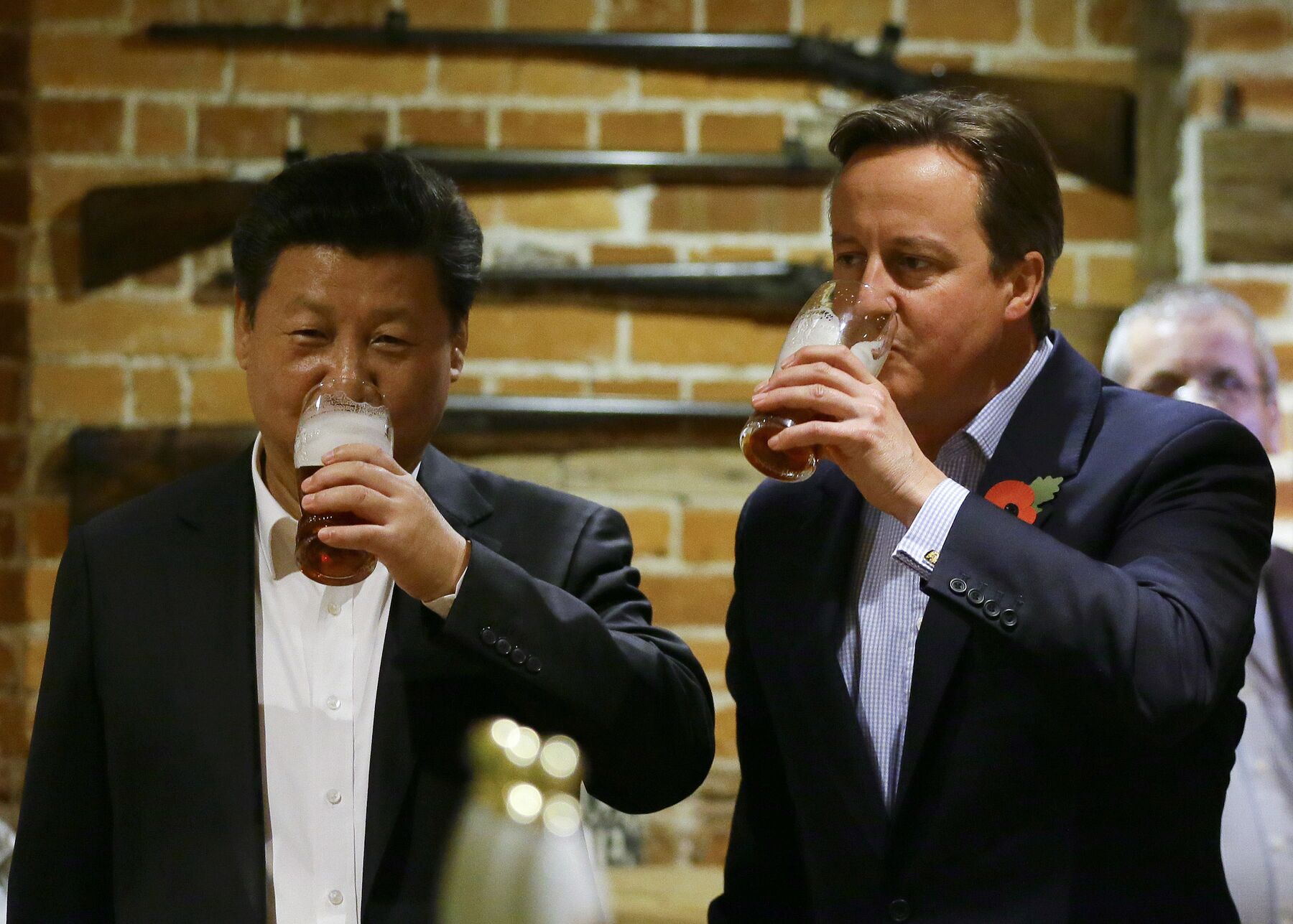
Xi Jinping and David Cameron.

David Cameron and Romano Prodi come from opposite ends of Europe’s political spectrum, but they have much in common. 
Both have left high office, boast an extensive network of connections, and now work in some capacity for China.
The former British and Italian prime ministers are far from alone: Across Europe, politicians past and present are taking positions on China’s growing global reach.
Some such as Anders Fogh Rasmussen, the former Danish premier and head of NATO, warn that Europe must gird itself against China’s rise. 
Far more are riding the wave and helping China’s onward march. 
It’s a dilemma likely to feature at an EU-China summit this month.
Following are a selection of Europe’s more prominent China advocates.

China’s Allure
European politicians turn to China after leaving office

David Cameron
Cameron, who was U.K. prime minister from 2010 until his resignation in 2016 after losing the Brexit referendum, made China a focus of his premiership. 
He announced a “golden era” of British-China relations aimed at boosting bilateral trade and investment, and approved a controversial deal allowing Chinese involvement in the Hinkley Point nuclear development. 
In October 2015, during a visit to the U.K., Xi Jinping posed for a selfie with Cameron at Manchester City soccer ground. 
Two years later and no longer in office, Cameron was made the head of a $1 billion China-U.K. fund supporting China’s massive Belt and Road Initiative infrastructure plan.

Dominique de Villepin
As France’s foreign minister, De Villepin came to global prominence in 2003 when he argued the case against the U.S.-led war in Iraq at the United Nations in New York. 
He went on to serve as France’s prime minister under President Jacques Chirac. 
He’s since become a regular commentator on Chinese affairs and advises Chinese companies on their international expansion plans through his consultancy Villepin International.

"Le traître français"

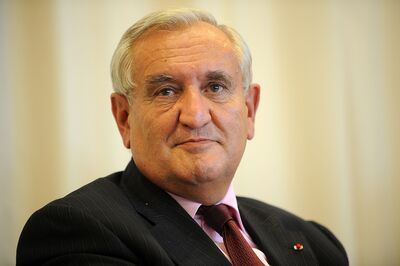
Jean-Pierre Raffarin
Another former French prime minister, Raffarin sits on the board of the Bo'ao Forum for Asia (BFA), an annual showcase for world leaders that is China’s answer to Davos. 
Xi Jinping chose this year’s Bo'ao Forum to deliver his message of a “new phase of opening up.” 
A prominent China advocate, Raffarin is also a member of the strategic committee of the France China Foundation, a body which brings together French and Chinese leaders and whose backers include Bank of China.

Romano Prodi
Prodi served two terms as Italy’s prime minister a decade apart, with a five-year stretch as president of the European Commission -- the European Union’s executive body -- in between. 
An economist and former Goldman Sachs adviser, Prodi sits on the board of the Bo'ao Forum. 
He was cited in the China Daily as welcoming Xi’s speech to the forum in April, praising the president’s “strong determination in safeguarding globalization, free trade and open economy.” 
Prodi is also a member of the board of the China Europe International Business School.

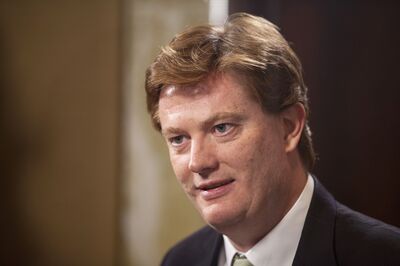
Danny Alexander

Alexander was Chief Secretary to the U.K. Treasury from 2010 to 2015, during David Cameron’s first-term coalition government with the Liberal Democrats. 
As such he was part of the administration that announced the golden era of ties with China. 
In an interview with China’s Xinhua news agency, Alexander later said that within government he had “advocated strongly that the U.K. should join the AIIB,” as the Asian Infrastructure Investment Bank is known. 
Knighted after losing his parliamentary seat at the 2015 election, Sir Danny was appointed vice president of the AIIB in February 2016.

Philipp Roesler
Roesler endured turbulent times during his spell as junior coalition partner in Chancellor Angela Merkel’s second-term coalition cabinet, first as minister for health and then German economy minister and vice chancellor. 
After losing his seat in the 2013 election along with all his Free Democratic Party lawmakers, Roesler retired from politics and joined the managing board of the World Economic Forum. 
In December, he was made CEO of HNA Group Co.’s New York-based charity, Hainan Cihang Charity Foundation Inc. 
The nonprofit holds 29.5 percent of HNA, which had about $180 billion in assets at the time of Roesler’s appointment.

Rudolf Scharping

Scharping was German defense minister from 1998 to 2002 under Social Democratic Chancellor Gerhard Schroeder. 
During his watch, the German army took part in the NATO-led attack on Yugoslavia, its first combat mission since World War II. 
His consultancy, Rudolf Scharping Strategie Beratung Kommunikation AG (RSBK), boasts of its “long years of contact with Chinese and German decision makers” and specializes in business development for companies and institutions in China. 
RSBK is involved in a German-Chinese Economic Conference, to be held in Frankfurt in November, focused on the Belt and Road Initiative.