dimanche 4 juin 2017

Chinese Fifth Column: The Enemy Within

Ban Official Chinese Student Organizations Abroad
  • Chinese embassies finance the student organizations, including through dinners, parties and travel.
  • The manner in which the CSSA controls speech of not only Chinese students, but Chinese dissidents, professors, and even the Dalai Lama, means that CSSA erodes the richness of critical Chinese and other voices, decreasing the diversity of viewpoints available on campus.
  • Student members of the CSSA have been accused of espionage; this includes in Canada, and through its chapter in Belgium, from which student spies sent agents to the U.K., France, Netherlands, and Germany.
By Anders Corr

Chinese Students and Scholars Associations (CSSA) seek to monitor and control the speech of Chinese students and professors in Australia, according to a report on June 3. 
Similar monitoring and control by student organizations was reported in the United States in May. Chinese student organizations not only curtail free speech, but prescribe correct speech, for example a CSSA demonstration welcoming Li Keqiang in Australia, and protests against a Dalai Lama speech at the University of California, San Diego (UCSD), and against a presentation on human rights at Columbia University in New York City. 
The groups have launched similar interventions at Duke University in North Carolina, and in the United Kingdom. 
In May, a Chinese graduate student, Yang Shuping, gave a commencement speech at the University of Maryland in support of clean air and freedom of speech. 
The local CSSA denounced her in a video with multiple Chinese students praising China. 
State-controlled media in China condemned her, Chinese netizen complaints went viral, and likely intimidated, she apologized.
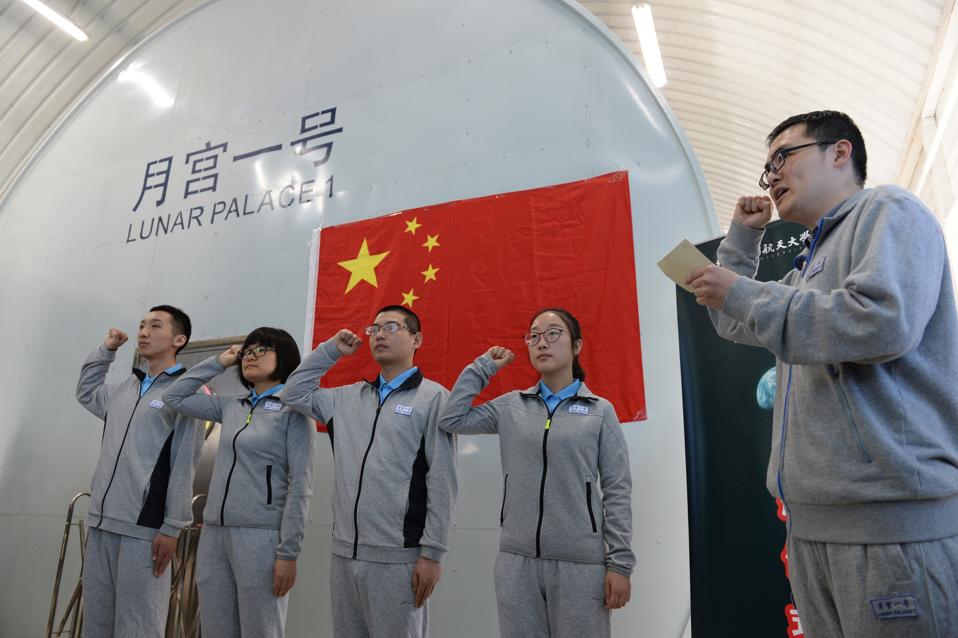
Four student volunteers take an oath before entering the Lunar Palace 1, a laboratory simulating a lunar-like environment, for an initial 60-day stay, in Beijing on May 10, 2017. Four postgraduate students from the capital's astronautics research university Beihang entered the 160-square-metre (1,720-square-foot) cabin -- dubbed the 'Yuegong-1', or 'Lunar Palace' -- on May 10, as Beijing prepares for its long-term goal of putting humans on the moon. 

This type of control and influence of Chinese students abroad has persisted since at least the late 1980s. 
Today, there are about 150 chapters of the CSSA. All of them are officially recognized by the Chinese government.
Student members of the CSSA have been accused of espionage. 
This includes in Canada, and through its chapter in Belgium, from which student spies sent agents to the U.K., France, Netherlands, and Germany.
The targets of infiltration were large laboratories and universities. 
One student intern in France was convicted in 2005 for “database intrusion”, spent just two months in prison, and became an instant hero.
Humorously, at least one chapter of the CSSA considers “political revolutions” to be within its mandate. 
The CSSA at Michigan Technological University has a constitution that admits its connection to the Chinese embassy, and states, “However, C.S.S.A. will not participate in any political revolutions, unless in special conditions.”
Chinese embassies finance the student organizations, including through dinners, parties and travel. 
One chapter copied embassy text to its website.
Columbia University disbanded its chapter of the CSSA in 2015. 
Its website stated one of its missions as, “facilitating the perceptions of China's peaceful rise.”
Embassies attempt to handpick officers, and in the case of the Cambridge University chapter, supported the suspension of a CSSA election to keep its favored president, Chang Feifan, in place for an additional term. 
This resulted in the university disbanding the organization until it held an election, which she lost after reportedly breaking the rules against bribery by bringing up to 100 people out to formal dinners. That was one bright moment in the history of the CSSA.
Such government intervention, propaganda and strictures on freedom of speech are contrary to the principles of academic freedom. 
In Monash, Australia, the leader of a Chinese student group had an aggressive encounter with a campus pharmacy that resulted in the removal of the Epoch Times, a newspaper run by a Chinese spiritual and dissident group, the Falun Gong. 
A lecturer was suspended because of an exam question about a common Chinese saying that Chinese officials only tell the truth when they are drunk or careless. 
Similar to the saying, in vino veritas, the question nevertheless offended Chinese students. 
Firing the instructor will cause other professors to walk on eggshells not to offend Chinese students, resulting in increasingly antiseptic instruction devoid of anything that might offend. 
That will decrease learning, and increase doldrums, for all students. 
In the case of the Dalai Lama speech, UCSD caved to the CSSA and promised an apolitical speech. 
To proscribe a topic in the speech of the Dalai Lama, a Nobel Peace Prize laureate, is laughable for an institution of higher learning that purports to academic freedom. 
In the case of the Maryland student, the CSSA response, in conjunction with other state responses, bordered on harassment given the power that the Chinese state has on her and her family in China. She likely apologized from a sense of duress. 
There was no “safe space” for her thoughts in Maryland despite our constitutional right to freedom of speech. 
Restrictions on freedom of speech is an issue for which all students who want diversity should demand redress. 
Legitimate student-led organizations should oppose state-influenced organizations like the CSSA not because it is Chinese, but because it represses free thought and does not, because it may not, represent the diversity of Chinese perspectives. 
If a Chinese student organization does not represent the full diversity of Chinese perspectives, it is not simply Chinese, it is more particular. 
In this case, its messaging represents the Chinese Communist Party (CCP). 
There is a big difference between China and the party. 
Not labeling the CSSA for what it is, is not truth in advertising.
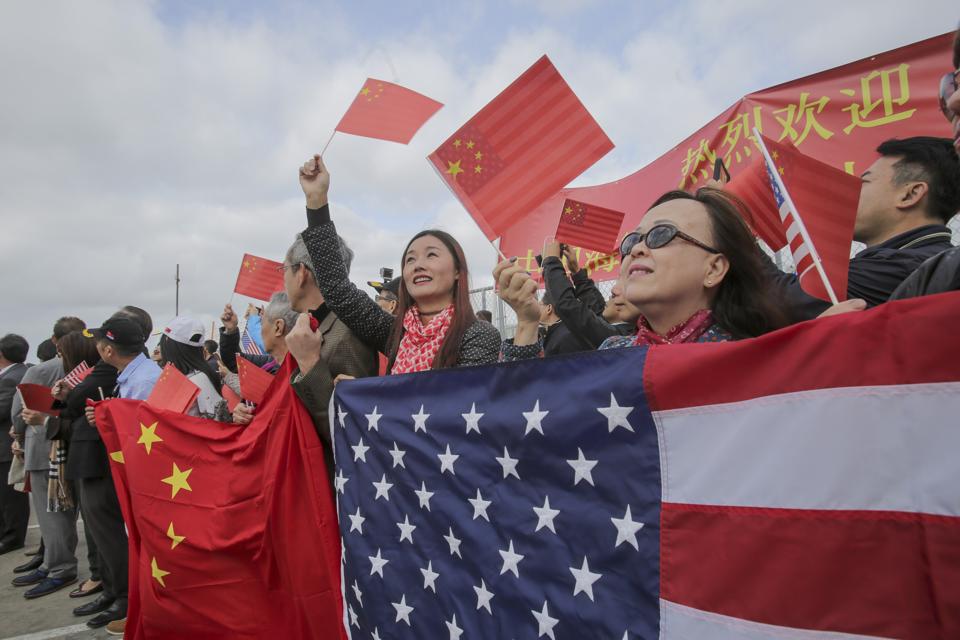
The fifth column: Local Chinese Americans greet the Chinese Navy vessels in San Diego on December 6, 2016 during Chinese Navy four day visit to California. 

These authoritarian and ultimately coercive organizations should be banned or curtailed by not only university rules, which are likely to be lax due to revenues from full tuition paid by Chinese students, but by law, in order to protect the freedoms of our democracies, the academic independence of our universities, and the personal freedom of Chinese students studying abroad. 
Protecting these freedoms is a protection for hundreds of thousands of Chinese students, including 329,000 Chinese students who study in the U.S., and 150,000 in Australia.
If Chinese students in our democracies do not feel free to speak their minds, they are akin to second-class citizens. 
That is an ethical corruption of diversity, and of our egalitarian and democratic principles. 
And, don’t believe the CCP hype.

Master in Democracy

Learn from us on democracy, Taiwan tells China on Tiananmen anniversary
By J.R. Wu | TAIPEI
A banner with a photo of a pro-democracy movement in Beijing's Tiananmen printed on it is displayed at an exhibition, two days before the 28th anniversary of a military crackdown of the movement, in Hong Kong, China June 2, 2017. 
A liquor bottle bearing a label commemorating the 1989 military crackdown on a pro-democracy movement in Beijing's Tiananmen is shown at a news conference, two days before the 28th anniversary of the crackdown, in Hong Kong, China June 2, 2017. 

Taiwan's president offered on Sunday to help China transition to democracy, on the anniversary of China's bloody crackdown on student-led pro-democracy protests in and around Beijing's Tiananmen Square.
Tsai Ing-wen said that the biggest gap between Taiwan and China is democracy and freedom, needling Beijing at a time when relations between China and the self-ruled island are at a low point.
"For democracy: some are early, others are late, but we all get there in the end," Tsai said, writing in Chinese on her Facebook page and tweeting some of her comments in English on Twitter on the 28th anniversary of the June 4, 1989, crackdown.
"Borrowing on Taiwan's experience, I believe that China can shorten the pain of democratic reform," Tsai said.
Beijing distrusts Tsai and her ruling Democratic Progressive Party because it traditionally advocates independence for Taiwan. 
Beijing says the island is part of China and has never renounced the use of force to bring it under its control.
After nearly 40 years of martial law imposed by the Nationalists on Taiwan, the island in the late 1980s began its own transition to democracy, holding direct presidential elections since 1996.
"When democracy is in front of you, no country can ever go back," Tsai wrote.
China's Taiwan Affairs Office did not immediately respond to a request for comment on Tsai's remarks. 
The Tiananmen crackdown is a taboo subject in China.
However, tens of thousands of people were expected to gather later in the day in Hong Kong to mark the anniversary, the only place in China where such large-scale public commemorations happen.
Beijing sent tanks to quell the 1989 protests, and has never released a death toll. 
Estimates from human rights groups and witnesses range from several hundred to several thousand.
On Friday, Foreign Ministry spokeswoman Hua Chunying said that China had long ago reached a conclusion about the events of that period.
"I hope you can pay more attention to the positive changes happening in all levels of Chinese society," she said, without elaborating.
In Beijing, security was tight as usual at Tiananmen Square, with long lines at bag and identity checks. 
The square itself was peaceful, thronged with tourists taking photos.
One elderly resident of a nearby neighborhood, out for stroll at the edge of the square, said he remembered the events of 28 years ago clearly.
"The soldiers were just babies, 18, 19 years old. They didn't know what they were doing," he told Reuters, asking to be identified only by his family name, Sun.
While some search terms on China's popular Twitter-like microblog Weibo appeared to be blocked on Sunday, some users were able to post cryptic messages.
"Never forget," wrote one, above a picture of mahjong tiles with the numbers 6 and 4 on them, for the month and day of the anniversary.

China vs. Islam

Muslim children forced to drop religious names: Names such as Islam, Quran and Mecca must be changed amid pro-Communist rallies.
By Benjamin Haas in Hong Kong

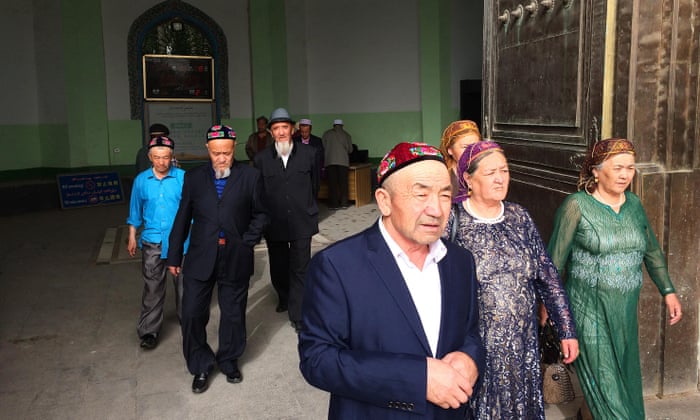
Worshippers leave Kashgar’s Id Kah mosque in Xinjiang during Ramadan. 

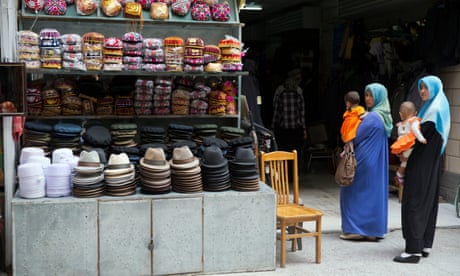
Muslim children in China’s far western Xinjiang region are being forced to change their “religious” names and adults are being coerced into attending rallies showing devotion to the officially atheist Communist party.
During Ramadan, the authorities in Xinjiang have ordered all children under 16 to change names where police have determined they are “overly religious”. 
As many as 15 names have been banned, including Islam, Quran, Mecca, Jihad, Imam, Saddam, Hajj, Medina and Arafat.

China bans religious names for Muslims in Xinjiang
In April authorities banned certain names for newborns that were deemed to have religious connotations, but the new order expands forced name changes to anyone under 16, the age at which Chinese citizens are issued a national identity card.
The order coincided with millions gathering at 50,000 individual rallies across Xinjiang this week to pledge allegiance to the Communist party. 
More than a quarter of the region’s population sang the national anthem at 9am on 29 May and pledged allegiance to the Communist party, according to state media reports.
Xinjiang’s Muslims mostly belonging to the Uighur ethnic group, a Turkic people. 
The region has occasionally seen sporadic violence which China blames on international terrorist groups. 
But overseas observers say the vast majority of incidents are a result of local grievances.
“Terrorists are the scum of the Uighur people, they are the common enemies of the people of all ethnic groups,” said a Communist party cadre leading one of the rallies in Urumqi, the capital of Xinjiang. 
“We must treat the enemy harshly and brush away the old to make a clean sweep, we should raise our swords high and in no way be lenient.”
State media accounts of the mass rallies gave no indication as to a reason for the sudden display of patriotism. 
Photos of some rallies showed paramilitary troops in full body armour armed with assault rifles attending the ceremony.
“Fundamentally these rallies are just a show of force, and part of the audience is the Han Chinese population in Xinjiang, to show the power of the state,” said Michael Clarke, a political science professor at the Australian National University and expert on Xinjiang. 
“But in terms of the Uighur population, it’s difficult to see how these kinds of mass rallies will win the hearts and minds over average Uighurs, and will likely do quite the opposite.”
Xinjiang’s capital, Urumqi, is more than 3,000km away from Beijing.
Human rights groups accuse China of restricting Uighurs’ freedom of religion and expression and authorities routinely deny passports to members of the ethnic group. 
The government has also encourages mass migration by Han Chinese to the area and they now make up roughly 45% of the population.
Xinjiang has seen an increasingly invasive security state since Xi Jinping came to power in 2012, Clarke added, including hiring thousands of police.
The region is at the centre of Xi’s Belt and Road initiative, a $900bn development aimed at building closer ties within Asia and beyond by constructing large-scale infrastructure.
In recent months authorities began confiscating Qur’ans published before August 2012, declaring them illegal for containing “extremist content”, according to a report by US-funded Radio Free Asia.
On the same day as the mass rallies, officials in Xinjiang announced they had expelled a Communist party member for attending religious activities at a local mosque. 
It was not clear if the man was a government official or simply a private citizen who was also a party member.
Rules announced last year also forbid retired officials from attending religious ceremonies and ban them from holding beliefs.

Australia's New Masters

The Chinese Communist Party's power and influence in Australia
By Nick McKenzie, Richard Baker, Sashka Koloff and Chris Uhlmann
Tony Chang's activities in Brisbane meant that his terrified father in China feared he was being "watched and tracked".

University student Tony Chang had suspected for months that he was being secretly monitored, but it was a panicked phone call from a family member in China that confirmed his fears.
It was June 2015 and Mr Chang's parents had just been approached by state security agents in Shenyang, in north-eastern China, and invited to a meeting at a tea house. 
It would not be a cordial catch-up.
As Mr Chang later detailed in a sworn statement to Australian immigration authorities, three agents warned his parents about their son's involvement in the Chinese democracy movement in Australia.
"[The agents] pressed the point that my parents must ask me to stop what I am taking part in and keep a low profile," the statement said.
From a Brisbane share house littered with books and unwashed plates, the Queensland University of Technology (QUT) student told Four Corners the agents had intelligence about his plans to participate in a protest in Brisbane on the anniversary of the Tiananmen Square massacre, and also during the Dalai Lama's visit to Australia.
Mr Chang's activities in Brisbane meant that his terrified father in China feared he was being "watched and tracked".
His father, a cautious, apolitical man, had already spent years worrying about his unruly son. 
In 2008, when Mr Chang was 14, he was arrested for hanging Taiwan independence banners on street poles in Shenyang.
Tony Chang was questioned for several hours when he was a teenager in Shenyang, China.
His family was forced to call on Communist Party contacts to ensure the teenager was released after several hours of questioning.
After Mr Chang was questioned again in 2014 for dissident activities, he decided it was no longer safe to remain in China. 
He applied for an Australian student visa.
The June 2015 approach to his parents back in China was the second time in two months that security agents had warned Mr Chang's family to rein in his anti-communist activism in Australia.
These threats helped convince the Australian Government to grant Mr Chang a protection visa.
Mr Chang's treatment as a teen is typical of the way the party-state deals with dissidents inside China, as revealed in a joint investigation by Four Corners and Fairfax Media.
But the monitoring of the student in Brisbane and his decision to speak out about the threats to his parents in Shenyang, despite the risk it poses to them, provides a rare insight into something much less well known: the opaque campaign of control and influence being waged by the Chinese Communist Party inside Australia..

An influence-and-control operation by the Communist Party
Part of this campaign involves attempts to influence Australian politicians via political donors closely aligned with the Communist Party — something that causes serious concern to Australia's security agency, the Australian Security Intelligence Organisation (ASIO).
But some of the 1 million ethnic Chinese living in Australia are also targets of the Communist Party's influence operations.
On university campuses, in the Chinese-language media and in some community groups, the party is mounting an influence-and-control operation among its diaspora that is far greater in scale and, at its worst, much nastier than any other nation deploys.
In China, it is known as qiaowu. 
The most recent chief of Australia's diplomatic service, Peter Varghese, who is now chancellor at the University of Queensland (UQ), said China's approach to influence-building was deeply concerning, not least because it was being run by an authoritarian one-party state with geopolitical ambitions that are not in Australia's interests.
"The more transparent that process [of China's influencing-building in Australia] is, the better placed we are to make a judgment as to whether it is acceptable or not acceptable, and whether it is covert or overt," Mr Varghese said.
"This is an issue ASIO would need to keep a very close eye on, in terms of any efforts to infiltrate or subvert our system which go beyond accepted laws and accepted norms."
The depth of the concern at the highest levels of the defence and intelligence establishment can be measured in recent public statements by the departing Defence Force chief and the director-general of ASIO.
Australia's domestic spy chief Duncan Lewis has warned Parliament that Chinese interference in Australia were occurring on "an unprecedented scale".
"And this has the potential to cause serious harm to the nation's sovereignty, the integrity of our political system, our national security capabilities, our economy and other interests," Mr Lewis said.
A China expert, Swinburne professor John Fitzgerald, agrees.
"Members of the Chinese community in Australia deserve the same rights and privileges as all other Australians, not to be hectored, lectured at, monitored, policed, reported on and told what they may and may not think," he said.

The coercion category
The definitive text on Beijing's overseas influence operations is Qiaowu: Extra-Territorial Policies for the Overseas Chinese by China expert James To.
Citing primary documents, Mr To concludes the policies are designed to "legitimise and protect the Chinese Communist Party's hold on power" and maintain influence over critical "social, economic and political resources".
Those already amenable to Beijing, such as student group members, are "guided" — often by Chinese embassy officials — and given various benefits as a means of "behavioural control and manipulation", Mr To said.
Those regarded as hostile, such as Mr Chang, are subjected to "techniques of inclusion or coercion".

Australian academic Feng Chongyi is another who falls into the "coercion" category.
Feng Chongyi has made it his life's mission to democratise China.
In March, Dr Feng travelled to China to engage in what he called the "sensitive work" of interviewing human rights lawyers and scholars across China.
He told Four Corners he expected to be closely watched and harassed when he arrived in Beijing, but accepted it simply as an irritating feature of his job.
"It's an open secret that our telephone is tapped, we are followed everywhere. But that is a little thing that we have to accept if we want to work in China," the University of Technology Sydney (UTS) China scholar and democracy activist said.
Dr Feng is a small, energetic man who has retained his Communist Party membership in the hope that he will live long enough to see some results from what has become his life's mission: democratising China.
But he is also a realist, which meant he was initially unconcerned when, on March 20 and after he had arrived in the city of Kunming, he was approached by agents from the Ministry of State Security (MSS).
Dr Feng was driven to a hotel three hours away to be questioned.
He expected the matter to end there but, a day later, he realised he was being followed by security agents to the sprawling port city of Guangzhou. 
There he was told his interrogation would continue.
"That's the time when I really realised something serious is happening," he recalled.

'I was in deep trouble'
In a Guangzhou hotel room, the security agents subjected Dr Feng to daily six-hour questioning sessions, all of it videotaped.
Many of the questions were about his activities in Sydney, including the content of his lectures at UTS, the people in his Australian network of Communist Party critics, and his successful efforts to stop a concert glorifying the Communist Party founder Mao Zedong.
Then the agents turned their attention to his family, asking him specific questions to show him that his wife and daughter were also being closely watched.
He described the change in tactics as a means of getting him to fully submit to his inquisitors' demands.

Chongyi Feng's detention in China was designed to intimidate Chinese Australians who are critical of the Chinese Government's interference in Australian domestic affairs.

It was the only part of his story that the wily academic hesitated to recall, as if emotion might have overtaken him.
"I can suffer this or that but I'll not allow ... my wife and my daughter and my other family members [to] suffer from my activities," he said. 
"That is the thing that's quite fearful in my mind."
When his inquisitors demanded Dr Feng take a lie detector test on March 23, he called his wife who told him to make a run for it.
A few hours later, after midnight, Dr Feng crept out of his hotel, hoping to board a 4:00am flight.
But as he sought to check in, an airport official told him he could not leave China because he was suspected of endangering state security.
"At that point, my wife told my daughter that I was in deep trouble," Dr Feng said.
His daughter immediately called a foreign affairs specialist in the Australian Government and asked for help.
Dr Feng's questioning continued for six more days until his daughter was contacted by an Australian Government official and told he would be permitted to board a flight back to Australia.
In his final interrogation session, the MSS agents presented Dr Feng with a document to sign that forbade him from publicly discussing his ordeal.
But by then, his detention had already been covered by several Australian media outlets. 
When he landed at Sydney airport on April 1, a small group of supporters was waiting for him with banners.
Dr Feng believes his treatment in China was designed to send other academics, along with his supporters in the Chinese-Australian community, a message to "stay away from sensitive issues or sensitive topics".
"Otherwise they can get you into big trouble, detention or other punishment," he said.
Dr Feng was greeted by a small crowd of supporters when he arrived back in Australia in April. 

Campus patriots
Mostly though, the Communist Party's influence on Australian university campuses takes a subtler form, and works through the Chinese Students' and Scholars' Associations.
The Communist Party targeted these patriotic associations after the Tiananmen Square student uprising as a way of maintaining control over overseas students.
In Australia, which has 100,000 Chinese students, the associations are "sponsored" by Chinese embassy and consular officials.
Lupin Lu, an amiable 23-year-old communications student who is president of the Canberra University Students' and Scholars' Association, explained how Chinese embassy officials played an active role in organising a large student rally to welcome Li Keqiang when he visited Australia in March.
The Chinese Master: Malcolm Turnbull with Li Keqiang during his March visit to Australia. 

On the day, the rally had two shifts, the first starting at 5:00am.
Ms Lu insisted it was students rather than the embassy calling the shots.
"I wouldn't really call it helping," she insisted of the embassy's role, while confirming it provided flags, transport, food, a lawyer and certificates for students that would help them find jobs back in China.
"It's more 'sponsoring'," Ms Lu told Four Corners.
Ms Lu said her fellow students were willing to assemble at 5:00am to welcome Li because of their pride at China's economic rise.
Other factors include an early education system that extols the virtues of the Communist Party and the reality that positive connections with the Government can help a person land a job in China.
Federal police officers still describe with awe events in 2008 at the Olympic torch rally, when hundreds of chartered buses entered Canberra from NSW and Victoria, delivering 10,000 Chinese university students "to protect the torch".
"If the Aussie embassy in London issued a similar call to arms to Australian students in London, there would be two students and a dog," an officer said.
Ms Lu had another way of motivating her fellow students to assemble before dawn: she stressed the importance of blocking out anti-communist protesters.
Would she go so far as to alert the embassy if a human rights protest was being organised by dissident Chinese students?
"I would definitely, just to keep all the students safe," she said. 
"And to do it for China as well."
The extent to which this student nationalism is directed and monitored from Beijing, and what this means for academic freedoms, is uncertain.
But last year, ANU Emeritus Professor and the founding director of the Australian Centre on China in the World, Geremie Barme, was so concerned he wrote a lengthy letter to chancellor Gareth Evans.
Professor Barme's fears were sparked by a series of viral nationalistic videos created and posted by a Chinese ANU student Lei Xiying.
One of Mr Lei's videos, "If you want to change China, you'll have to get through me first", attracted more than 15 million hits.
"I would opine that Mr Lei is an agent for government opinion carving out a career in China's repressive media environment for political gain," Professor Barme wrote.
Professor Barme said Mr Lei was sponsored by an authoritarian government that routinely threatens scholars and journalists.
"Make no mistake, it is officially sanctioned propaganda," Professor Barme said.
He urged the university to confront the issue by debating it openly. 
His supporters have said that request was ignored.

'We are real media'

A gracious host, Sam Feng is in a gregarious mood when he invites us to the headquarters of Pacific Times, the once proudly independent community Chinese-language newspaper he founded in the 1980s.
Over Chinese tea, he scoffs at suggestions that his paper is involved in financial dealings with an arm of the Chinese Communist Party that shapes its coverage.
"It is false. It is fake ... they don't need to do that," he said, while insisting that questions of bias should be directed to Western media outlets whose coverage supports the US version of the world.
"We are real media," Mr Feng explained of his small team of staff.
But corporate records suggest his paper is less independent than he claims.
Subsidiaries of the Communist Party's overseas propaganda outlet, the Chinese News Service, own a 60 per cent stake to Mr Feng's 40 per cent in a Melbourne company, the Australian Chinese Culture Group Pty Ltd.
The results of this joint-venture deal appear evident in the newspaper's content, vast chunks of which are supplied direct from Beijing where propaganda authorities control the media.
UTS associate professor Dr Feng describes Pacific Times as one of several Australian Chinese-language media outlets that have forgone any semblance of editorial independence in exchange for deals offered by the Communist Party's propaganda apparatus.
"It used to be quite independent or autonomous," he said. 
"But... the newspaper now is identical [to] other newspapers that exclusively focus on the positive side of China."
In a backroom in Sam Feng's West Melbourne headquarters is evidence suggesting his Beijing dealings extend beyond what is placed in his newspaper.
A well-placed source leaked to Fairfax Media photos of dozens of placards resting against a wall of the room.
"We Against Vain Excuse for Interfering in South China Sea," reads one of the placards.

See how China is converting reefs to military facilities by building artificial islands in the South China Sea.

To a casual observer, the placards would barely warrant a glance.
But along with other information provided by the source, they point towards what Australian security officials suspect: that the Chinese Communist Party has a hand in encouraging protests in Australia.
"The Chinese would find it unacceptable if Australia was to organise protests in China against any particular issue," former DFAT chief Peter Varghese said.
"Likewise, we should consider it unacceptable for a Chinese government to be [encouraging], organising, orchestrating or bankrolling protests on issues that are ultimately matters for the Australian community or the Australian Government."
The placards stored at Pacific Times were handed out to hundreds of protesters who marched in Melbourne on July 23, 2016, to oppose an international tribunal ruling — supported by Australia — that rejected Beijing's claim over much of the South China Sea.
Of Pacific Times owner Sam Feng, the source said the newspaper owner sought to keep the Chinese Communist Party onside for commercial reasons: "He is a nationalist, but he just cares about business."
A review of the corporate records of other large Chinese-Australian media players reveals the involvement of Communist Party-controlled companies.
Those who turn down offers to become the party's publishing partners and seek to print independent news face the prospect of threats, intimidation and economic sabotage.
Don Ma, who owns the independent Vision China Times in Sydney and Melbourne, said 10 of his advertisers had been threatened by Chinese officials to pull their advertising.
All acquiesced, including a migration and travel company whose Beijing office was visited by the Ministry of State Security every day for two weeks until they cut ties with the paper.
Mr Ma said he was happy to speak publicly because he had already been blocked from travelling to China.
Don Ma embraces freedom of the press.

His journalists, though, request their names and images not be used when we visit his Sydney and Melbourne offices. 
They are fearful of retribution.
Ex-DFAT chief Mr Varghese and Swinburne's Professor Fitzgerald said Australia should require more accountability and transparency around the way the Communist Party and its proxies are operating in the media and on university campuses.
Professor Fitzgerald has warned Communist Party influence operations in Australia not only risk dividing the Chinese community, but sparking hostility between it and other Australians.
"The Chinese community is the greatest asset we have in this country for managing what are going to be complex relations with China over the next decades — in fact for centuries to come — and we need them to help us in managing this relationship," he said.
"If suspicion is sown about where their loyalties lie, then we lose one of our greatest assets in this country now."
Mr Ma has not only endured economic sabotage from the Communist Party, but a campaign of vilification from pro-Beijing members of the local Chinese community.
Yet he keeps publishing, not only because he embraces freedom of the press but because many members of the disparate Chinese community urge him to keep doing so.
"I felt that the media here, all the Chinese media, was being controlled by China," he said.
"This is harmful to the Australian society. It is also harmful to the next generation of Chinese. Therefore, I felt I wanted to invest in a truly independent media that fits in with Australian values."

Watch 'Power And Influence: How China's Communist Party Is Infiltrating Australia' on Four Corners, ABC TV, Monday 8:30pm.

Australian sovereignty under threat from China's Fifth Column

  • A joint Four Corners-Fairfax investigation reveals Beijing is active in Australia across an array of fronts
  • The former Defence secretary and ASIO's chief have both voiced concerns about Chinese interference in Australia
  • The interference campaign is especially active on university campuses and in the Chinese-language media in Australia
By Nick McKenzie, Chris Uhlmann, Richard Baker and Sashka Koloff

A five-month investigation reveals the extent of Beijing's influence in Australian politics and Chinese communities. 

The defence and intelligence community believes that attempts by the Chinese Communist Party to exert its influence in Australia pose a direct threat to our nation's liberties and its sovereignty.
That fear has been confirmed by a five-month-long Four Corners-Fairfax investigation which shows Beijing is active across a vast array of fronts — from directing Chinese student associations, threatening Australian-based Chinese dissidents, seeking to influence academic inquiry, co-opting community groups and controlling most Chinese-language media.
And Monday night's Four Corners program will track the millions in opaque Chinese-linked donations to show how it buys access and influence in Australian politics.

China's Communist Party is monitoring the activities of university academics and students engaged in anti-communist activism in Australia.

The depth of the concern at the highest levels of the defence and intelligence establishment can be measured in recent public statements by the departing Defence secretary and the director-general of the Australian Security Intelligence Organisation (ASIO).
Australia's domestic spy chief Duncan Lewis warned Parliament that espionage and Chinese interference in Australia were occurring on "an unprecedented scale".
"This has the potential to cause serious harm to the nation's sovereignty, the integrity of our political system, our national security capabilities, our economy and other interests," Mr Lewis said.
The outgoing Defence Department secretary, Dennis Richardson, named China as being "very active" in espionage and pointed to an equally troubling campaign of monitoring and coercion here.
"The Chinese government keeps a watchful eye inside Australian Chinese communities and effectively controls Chinese language media in Australia," Mr Richardson said.

Student's parents threatened and an academic detained
The Four Corners-Fairfax team has interviewed Queensland university student, Tony Chang, whose anti-Communist activities in Australia saw his China-based parents threatened by Ministry of State Security (MSS) agents.
QUT student Tony Chang's parents were threatened by Chinese agents.

Academic Dr Feng Chongyi made headlines in March when he was detained in China and questioned for 10 days by MSS agents.
When he was finally allowed to leave, the agents demanded Dr Feng sign a document that forbade him from publicly discussing his ordeal.
He has broken his silence to say his treatment in China was designed to send a message to anti-Communist elements in the Chinese-Australian community: "Stay away from sensitive issues or sensitive topics".
Dr Feng Chongyi was detained in China for 10 days by MSS agents.

The Communist Party keeps watch over the 150,000-strong Chinese students studying in Australian universities by controlling the Chinese Students' and Scholars' Associations.
The Four Corners-Fairfax investigation will show how the Chinese Embassy in Canberra orchestrated a mass student rally to welcome Li Keqiang in March and stressed the importance of blocking out anti-Communist protesters.
And it will detail how a "spontaneous" demonstration pushing China's sovereignty over the South China Sea in Melbourne last year was coordinated by one of the many Australian-based Chinese-language media companies that acts as a propaganda arm for Beijing.
Those few media companies that don't toe the party line face the threat of being driven out of business.
Don Ma, who owns the independent Vision China Times, told the Four Corner-Fairfax team that 10 of his advertisers pulled their cash after being threatened by Chinese officials.
Owner of Vision China Times, Don Ma.

The Beijing office of one migration and travel company was visited by the Ministry of State Security every day for two weeks until it cut ties with his paper.
Mr Ma has not only endured economic sabotage from the Communist Party but a campaign of vilification from pro-Beijing members of the local Chinese community.
Yet he keeps publishing, not only because he embraces freedom of the press, but because many members of the disparate Chinese community urge him to keep doing so.
"I felt that the media here, all the Chinese media, was being controlled by China," Mr Ma said.
"This is harmful to the Australian society. It is also harmful to the next generation of Chinese. Therefore, I felt I wanted to invest in a truly independent media that fits in with Australian values."

Watch 'Power And Influence: How China's Communist Party Is Infiltrating Australia' on Four Corners, ABC TV, Monday 8:30pm.

samedi 3 juin 2017

The Necessary War

China Won’t Hand the U.S. Navy Victory Like Japan Did
BY JAMES HOLMES

Otto von Bismarck once reportedly quipped that Providence favors “fools, drunkards, and the United States of America.” Exhibit A: the Battle of Midway.
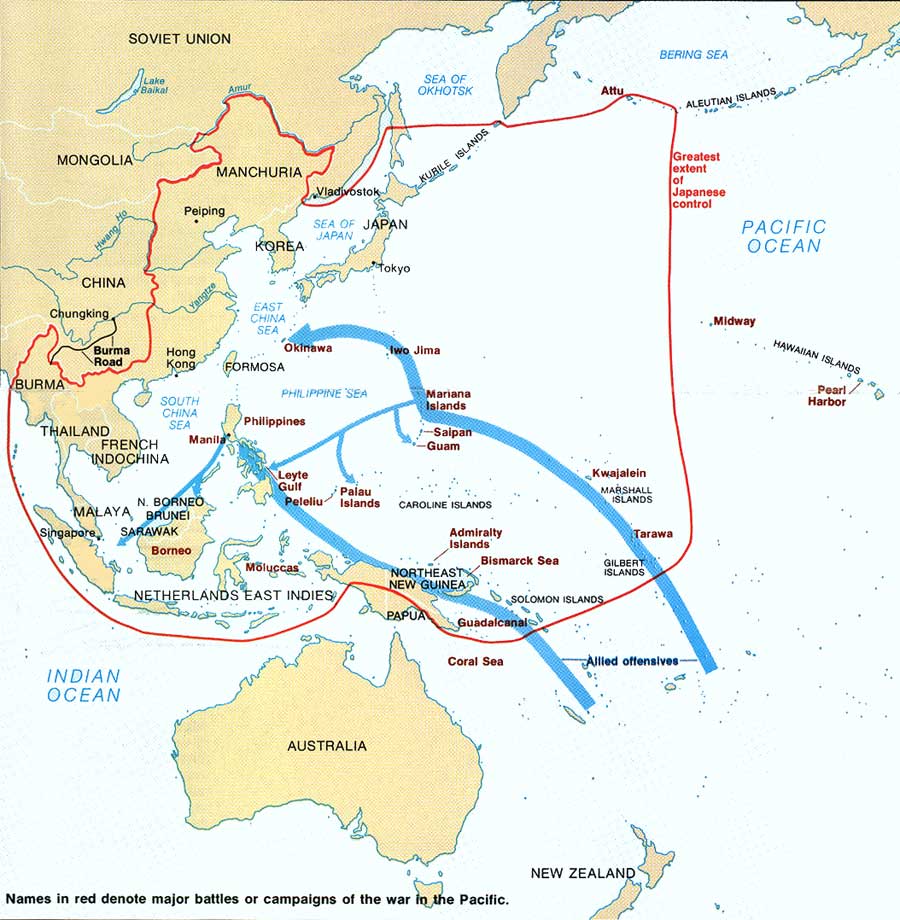
That’s the June 1942 high-seas clash in the Pacific Ocean where the U.S. Navy reversed the six months of disaster that followed the Imperial Japanese Navy’s surprise attack on Pearl Harbor.
There’s nothing wrong with ballyhooing the 75th anniversary of Midway. 
An inferior American force steamed into battle and won big, preparing the way for ultimate victory. But make no mistake: The U.S. Navy was both fortunate in its Japanese foe during World War II and the beneficiary of farsighted political leadership at home.
Neither condition holds today. 
If America were to be involved in a major naval battle in the Pacific today, it would likely be with a decaying fleet, against a more evenly matched opponent such as China, and the result could easily turn out differently. 
Midway thus represents a warning as well as a cause for celebration.
A quick recap: The battle took place northeast of the Midway Islands, about halfway in the Pacific between Asia and North America. 
It culminated six months to the day after the Japanese sent the same fleet to pummel the American battle line at Pearl Harbor. 
At a critical moment, dive bombers flying from the USS Enterprise, Yorktown, and Hornet swooped from Pacific skies on the morning of June 4, raining death on Japan’s Kido Butai, or carrier strike force. 
Aviators set three of four Imperial Japanese Navy, or IJN, carriers ablaze within a span of eight minutes. 
The fourth was a smoking ruin before the day was through. None survived.
Japanese naval aviation suffered a hammer blow from which it never fully recovered. 
Midway hurt the IJN far worse than Pearl Harbor hurt the U.S. Navy. 
After all, the Japanese raid struck mainly at American battleships — platforms in the process of being superseded by carriers as the core of naval warfare. (The attack missed the U.S. carriers, which were at sea on Dec. 7, 1941.) 
By contrast, the Kido Butai was the principal striking arm of the IJN, with an unblemished combat record.
Midway gutted Japanese sea power, and the island state’s industrial capacity was too sparse to permit swift construction of new carriers. 
The battle thus doomed Japan’s campaign of Pacific conquest, forcing it onto the defensive. 
If you map Pacific military actions up to June 1942, the arrows all point outward from Japan — but they turn inward after Midway, pointing back at the heart of Japan’s doomed empire.
So we should rejoice in the naval aviators’ heroics and celebrate the tactical artistry of Adm. Ray Spruance, the cerebral commander of Task Force 16, and on and on. 
But it’s tough to imagine any future foe displaying the same strategic and operational indiscipline as Imperial Japan, which frittered away scarce military resources all over the map.
By the spring of 1942, in the months leading up to the fateful battle, the leadership of the IJN was debating what to do next, having already accomplished all its previous goals. 
One faction pushed for the Midway gambit, which envisioned luring out and destroying the carriers that had struck at Tokyo during the Doolittle Raid that April. 
Another wanted to grab parts of the Aleutian Islands. 
Still another clamored to go after Port Moresby, a harbor in New Guinea. 
As my new colleague Craig Symonds points out, rather than choose among these courses of action, the leadership opted to do everything nearly simultaneously.
It started off on the Australian coast. 
An IJN detachment fought the Battle of the Coral Sea in May 1942 and saw one of the Kido Butai’s fleet carriers damaged. 
That carrier, Shokaku, retired to Japan to refit — reducing the carrier fleet’s strength for Midway. 
The Kido Butai went into Midway with a 4-3 carrier advantage rather than the 5-3 advantage it might have commanded had the leadership exercised some operational prudence. 
At the same time as the Kido Butai was headed for Midway, another IJN naval force was headed to seize the Aleutian Islands near Alaska, further dividing Japan’s strength.
And if that wasn’t enough, Japanese commanders broke the Midway fleet into four separate forces and positioned those forces too far from one another to render mutual support. 
Worse, the “Main Body” of battleships and its retinue of lesser warships maintained radio silence throughout the encounter. 
Far from the fighting in the super-dreadnought Yamato, the Main Body’s centerpiece, Adm. Isoroku Yamamoto couldn’t even issue orders to the fleet he was commanding. 
In short, Japanese commanders were culpable for disaster — and should have seen it coming.
Such a conflict is conceivable once again. 
China is mounting a challenge to the U.S.-led international order put in place after the overthrow of Imperial Japan in 1945. 
Beijing claims sovereignty over most of the South China Sea, the same expanse Japan coveted for its natural resources.
Under the law of the sea — of which the United States is the chief guarantor despite lawmakers’ refusal to consent to it — no one is sovereign over waters and skies beyond 12 nautical miles from coastal states’ shorelines. 
This air and sea space represents a commons; it belongs to everyone and no one.
China, moreover, is contesting Japan’s administration of the Senkaku Islands in the East China Sea.
It wants to upend a status quo dating to Tokyo’s annexation of the archipelago in 1895. 
In brief, China sees a vital interest in overturning the international order while the United States sees a vital interest in preserving that order — presumably by force of arms.
Still, it’s doubtful that China — the most probable candidate to play the part of Imperial Japan today — would succumb to the strategic overreach of the IJN.
Beijing has exercised impressive restraint amid its rise in recent decades, keeping its foreign-policy ambitions within its military and economic means.
While its navy has made tentative forays into the Indian Ocean and other waterways, China has mostly kept its naval forces concentrated in the China seas, where it sees vital interests at stake.
It deploys distinct superiority over fellow Asian states as a result of its self-restraint.
Yet it has refrained from directly challenging the U.S.-Japan alliance, which operates a powerful combined fleet and enjoys a backstop in the form of the U.S. Pacific Fleet, based in Guam, Hawaii, and West Coast seaports.
But if a battle were to break out, there’s no telling how it would turn out.
It would depend on whether China fragmented its navy into small detachments that attempted to fulfill every commitment Beijing has undertaken, all at the same time, or stayed focused and did one thing at a time — devoting the bulk of available resources to doing that one thing before moving on to the next.
If the People’s Liberation Army leadership does the latter, it could be hard to beat; if the former, the Chinese challenge ought to prove manageable, much as it was in the case of Imperial Japan.
It is certainly possible that the leadership would act unwisely, breaking up its naval resources in an effort to do everything, everywhere, more or less concurrently.
China divides the People’s Liberation Army Navy into three fleets scattered up and down the Asian seaboard in peacetime. (It also backs up those fleets with shore-based firepower in the form of aircraft and missiles. That’s an equalizer that was unavailable to IJN forces fighting in the Central Pacific, thousands of miles from home.)
Chinese commanders might keep the navy divided in wartime, and they too might yield to the temptation to try to do everything at once.
But it would be imprudent for U.S. naval commanders to bank on it.
Better to assume opponents will fight wisely and chart strategy accordingly.
That will require political leadership — specifically, congressional leadership — of the sort the U.S. Navy benefitted from enormously at Midway.
By 1940, long before the United States entered World War II, lawmakers like Rep. Carl Vinson pushed through the Two-Ocean Navy Act.
What that means, in effect, is that shipbuilders commenced bolting together a second — not to mention bigger and badder — U.S. Navy before the outbreak of war.
The republic deployed what amounted to one complete U.S. Navy in the Atlantic Ocean and another in the Pacific.
In short, Vinson & Co. gave the Navy a head start on World War II.
The two-ocean Navy was destined to arrive in the Pacific theater starting in 1943.
It would arrive in overwhelming numbers and capability — and the masterminds of the Midway operation knew the shiny new fleet was on its way. 
Consequently, Adms. Spruance, Frank Jack Fletcher, and Chester Nimitz could afford to be venturesome with the battered fleet left to them after Pearl Harbor.
It’s easy to gamble with a tool when you have a spare.
Today’s U.S. Navy enjoys no such luxury.
Washington infighting has left the U.S. Navy a force in decay.
Midway was an aircraft carrier battle.
How well positioned is today’s carrier fleet to fight such an action?
Well, delays in routine upkeep and overhauls have struck hard at the Navy’s 10 nuclear-powered carriers.
Most of the fighter jets that operate from their flight decks are grounded at present for want of maintenance.
The Navy’s margins have gotten mighty thin, with just 275 ships in the inventory, commitments across the globe to fulfill, and “near-peer” troublemakers such as Russia and China to stare down. Each asset appears precious when you have so few.
That’s doubly true of carriers, where the latest model, the USS Gerald R. Ford, will set taxpayers back almost $13 billion — not counting airplanes, stores, and everything else an aircraft carrier requires to do its work.
Commanders might find it tough to hazard such a vessel in combat, knowing they could lose such a pricey asset — and 10 percent of the nation’s carriers — in an afternoon.
America, it seems, will go to war with the Navy it has — and might prove risk-averse about fighting it.
Nor has the nation’s political leadership acted to fix the shortfall.
The Navy leadership has gone on record favoring a 355-ship fleet, the Donald Trump administration espouses 350, and think tanks have compiled “fleet architecture” studies bumping the figure as high as 414.
As yet, though, little has happened on the shipbuilding front.
No counterpart to the Two-Ocean Navy Act of 1940 is in the works.
The administration’s 2018 budget proposal keeps procurement rates flat.
The Congressional Budget Office estimates the soonest a 355-ship fleet could be at sea would be 2035 — and that’s if resources start flowing this year.
This makes for a pale imitation of the World War II buildup.
Where’s Carl Vinson when you need him?
Midway was a damned close-run thing as it stood.
Seventy-five years on — with a leaner U.S. Navy facing more formidable foes — a Pacific encounter could go another way altogether.
Some introspection should quiet the chest-thumping about U.S. naval prowess that has been heard of late.
Taking competitors lightly is no way to prepare for serious strategic competition.
It’s also slipshod politics. Could Vinson have rammed the Two-Ocean Navy Act through Congress after disparaging the Japanese and German menaces?
Doubtful.
Tell elected representatives China or Russia remains a second-rate competitor and they’ll fund a second-rate U.S. Navy to handle the challenge.
China may remain the weaker antagonist in the Pacific, but look at the U.S.-China competition in relative terms.
Japan had to slay a giant to prevail in the Pacific War.
China merely needs to outface a somewhat stronger adversary operating thousands of miles from home while operating in Beijing’s own backyard.
Its strategic and operational predicament, then, is far more manageable than Imperial Japan’s.
As a great man once counseled, don’t do stupid shit and you may go far.
So Bismarck may have been correct.
Providence may smile on America.
But dourer commentators such as yours truly might append a corollary to his wisecrack.
Namely, that Providence helps those who help themselves.
And the United States has done precious little to help itself in naval affairs.
Midway represented a sensational triumph, and all honor to the warriors who brought it about.
Now let’s start re-creating the industrial and military preconditions that made victory possible.
Let’s help ourselves — and win back fortune’s favor.

Sina Delenda Est

Mattis Says China’s Militarization of Man-Made Islands Unacceptable
By William Ide
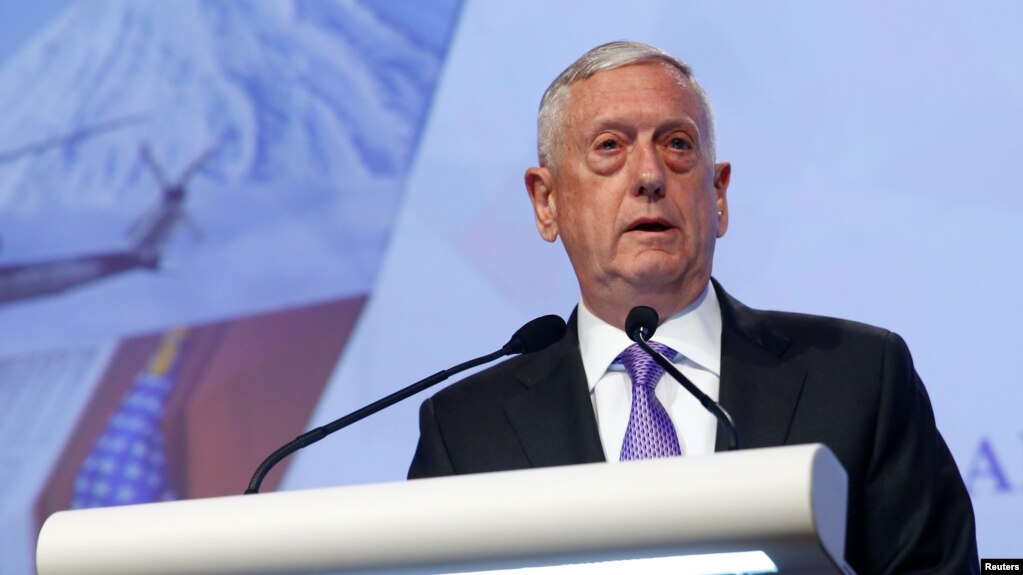
U.S. Secretary of Defense James Mattis speaks at the 16th IISS Shangri-La Dialogue in Singapore, June 3, 2017.

SINGAPORE — U.S. Secretary of Defense James Mattis applauded China’s efforts to work with the international community on North Korea at an annual security forum in Singapore Saturday. 
But when it came to the South China Sea, he called China’s ongoing militarization of man-made islands there and its disregard for international order, unacceptable.
“We cannot accept Chinese actions that impinge on the interests of the international community, undermining the rules-based order that has benefited all countries here today (at the forum), including, and especially China,” Mattis said, in a speech to delegates and the media at the Shangri-La Dialogue.
He said that while competition between the world’s two largest economies was bound to occur, conflict is not inevitable.
“Artificial island construction and indisputable militarization of facilities on features in international waters undermines regional stability,” he said, noting that China’s military buildup of the man-made beachheads differed from what other countries had done.
Beijing’s approach is different not only in terms of the nature of weaponization on the artificial islands, Mattis said, but for “China’s disregard for international law, it’s contempt for other nation’s interests and its efforts to dismiss nonadversarial resolution of issues.”
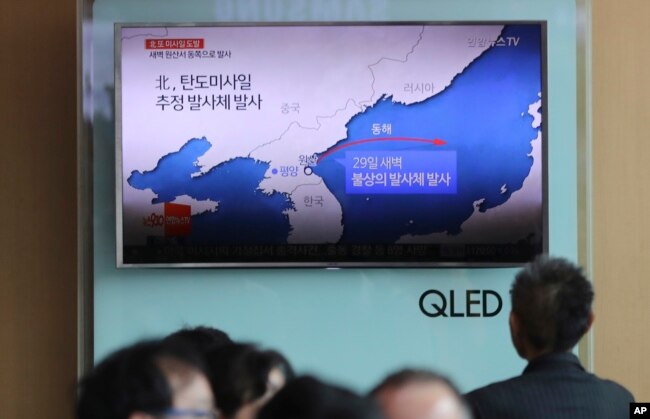
People sit in front of the TV screen showing a news program reporting about North Korea's missile firing, at Seoul Train Station in Seoul, South Korea, May 29, 2017.
North Korea a priority

Since coming to office, Donald Trump has made North Korea a top priority, and in his speech, Mattis echoed concerns the administration has about the clear and present danger the North poses to the region and beyond.
“Coupled with reckless proclamations, the current North Korean program signals a clear intent to acquire nuclear-armed ballistic missiles, including those of intercontinental range, that pose direct and immediate threats to our regional allies, our partners, and all the world,” he said.
His tough remarks dispelled speculation that the administration was keeping quiet about the South China Sea in exchange for China’s cooperation in dealing with Pyongyang. 
Mattis said the interests of the United States allies would not be used as bargaining chips.
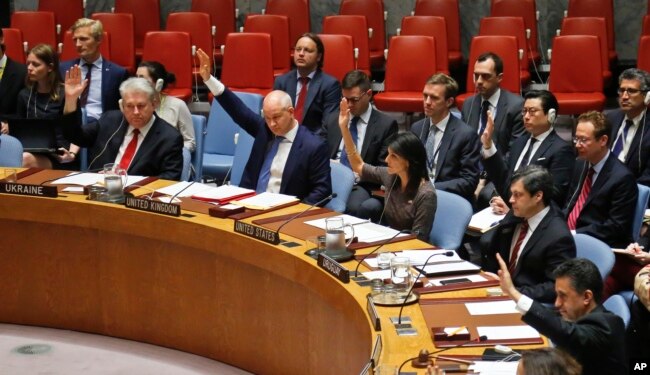
Ambassadors to the United Nations raise hands in a Security Council resolution vote to sanction North Korea at U.N. headquarters in New York, June 2, 2017.

New sanctions, new diplomacy

Without elaborating, the defense secretary said countries are working on new, enhanced sanctions and diplomatic efforts to put more pressure on North Korea. 
In addition to words and support, however, he said action was needed as well — from all parties.
“The Trump administration is encouraged by China’s renewed commitment to work with the international community toward denuclearization,” he said. 
“Ultimately we believe that China will come to recognize North Korea as a strategic liability and not an asset. A liability inciting increased disharmony and causing peace-loving populations in the region to increase defense spending.”
While relations between Pyongyang and Beijing have grown increasingly frayed in recent years under the administration of Kim Jong-Un, China is still North Korea’s biggest ally and supporter. Analysts argue that Beijing does not want the issue to be resolved because of the possibility that it could lead to a unified Korea and put the United States right on its northeastern doorstep.