jeudi 2 mars 2017

Chinese Bully

South Korea's Lotte Duty Free website crashed after attack from Chinese hackers
By Joyce Lee and Heekyong Yang | SEOUL

Lotte Duty Free on Thursday said a cyber attack using Chinese internet protocol (IP) addresses has crashed its website, the latest report of irregularity from a South Korean firm in China since Seoul decided to deploy a U.S. missile defense system.
A distributed denial-of-service (DDoS) attack, which overloads servers with requests, began slowing all four language versions of the website at 11:00 a.m. (0200 GMT) and crashed them all around 12:00 p.m., Lotte Duty Free said in a statement.
The attack comes after affiliate Lotte International Co Ltd on Monday approved a land swap to allow the U.S. Terminal High Altitude Area Defence (THAAD) system on what was once its property, in response to the North Korean missile threat.
Neighboring China objected to the deployment of the system, which has a radar capable of penetrating Chinese territory, saying it will destabilize regional security while doing little to contain heightened security risk on the Korean peninsula.
Russia also opposed the deployment, scheduled for completion this year.
Lotte Duty Free on Thursday said the first wave of the attack on its website was detected on its Chinese language version on March 1. 
The eventual crash did not occur during a peak traffic time, so lost business would be at most a couple of hundred thousand U.S. dollars, it said.
The Chinese website for the entire Lotte Group, www.lotte.cn, is also down. 
It has been offline since Wednesday due to a virus, spokesman Kim Min-suk told Reuters on Thursday.
"The (two) websites have been down and we are working to get them back online," Kim said, declining to comment on the nature or origin of the virus or the origin of the DDoS.
The ultimate origin of DDoS attacks is not necessarily the same as the IP addresses used.
Lotte Duty Free said it expects its website to be fully back online after 6 p.m. (0900 GMT) after strengthening security.

DIFFICULTIES
South Korean companies have reported increasing difficulties in China since deployment was confirmed in November, with Chinese state media calling for a boycott of South Korean goods. 
South Korean artists have also said performances had been canceled without clear explanation.
A spokesman at Lotte Mart told Reuters that the retailer's website was accessible on e-commerce platform JD.com (lottemart.jd.com), but that the site did not appear in search results. 
Lotte Mart has asked JD.com to address the issue, the spokesman said.
JD.com declined to comment.
Also this month, Lotte Group said Chinese authorities halted construction at a multi-billion dollar real estate project after a fire inspection.
Shares in Lotte Group's flagship retailer, Lotte Shopping Co Ltd, which has about 120 stores in China, fell as much as 7.8 percent on Thursday. 
Lotte Confectionery Co Ltd shares fell 2.8 percent, while the benchmark share price index rose 0.5 percent.
The South Korean government expressed concern on Thursday about the plight of South Korean firms in China since the deployment was announced. 
It said it would continue to engage Beijing in dialogue to ensure activities of South Korean companies in China are not hindered.
"To be sure, the challenges we face are serious," Foreign Ministry Spokesman Cho June-hyuck told a news briefing on Thursday.
Chinese foreign ministry spokesman Geng Shuang said at a regular news briefing the same day that China opposes all forms of hacking and is willing to work with other nations to oppose it.
"As for the 'guesswork' of Lotte, I won't make a comment. But I think there is no clear answer as to the reason (for the attack). This is just their guess," Geng said.

Islamic Terror vs Chinese Terror

The Islamic State Pledged to Attack China Next 
China’s anti-Islamic policies have pushed some even moderate Muslims to radical outlets

BY ROBBIE GRAMER

The Islamic State is now setting its sights on China, releasing on Monday a half-hour video in which they pledged to “shed blood like rivers” in attacks against Chinese targets. 
Experts say it’s the first threat the terrorist organization has leveled against China.
“Oh, you Chinese who do not understand what people say. We are the soldiers of the Caliphate, and we will come to you to clarify to you with the tongues of our weapons, to shed blood like rivers and avenging the oppressed,” an Islamic State fighter said in the video, which was analyzed and translated by U.S.-based SITE Intelligence Group. 
The video showed fighters, including heavily-armed children, praying, giving speeches, and executing suspected informants.
The video appeared to be the terrorist group’s “first direct threat” against China, Michael Clarke of the Australian National University, told Agence France-Presse.
At first glance, China may seem like a strange target for the Islamic terrorist group. 
It has no real military footprint in the Middle East, and while Beijing is getting more involved in the region’s energy business, it’s not involved in the U.S.-led anti-ISIS coalition in Iraq and Syria. 
But experts say China entered the terrorist group’s crosshairs over its treatment of ethnic minority Muslims, the Uighurs, who are concentrated in East Turkestan.
Beijing is taking an increasingly hard line against unrest there. 
On Monday, thousands of police — backed by helicopters and armored vehicles — staged a mass rally, the fourth this year, as a show of force, Reuters reported. 
A Xinjiang Communist Party official pulled no punches as 1,500 cops were dispatched to problematic cities.
“Bury the corpses of terrorists and terror gangs in the vast sea of the people’s war,” Reuters reported the official saying.
Amnesty International slammed the Chinese government for its past crackdowns on the group, including repressing religious ceremonies and jailing Uighurs. 
China’s “anti-Islamic policies have pushed some even moderate Muslims to radical outlets,” said Dru Gladney, an expert on western China at Pomona College.
A 2016 study from New America, a Washington-based think tank, found 114 Uighurs from East Turkestan joined the Islamic State. 
East Turkestan furnished the highest number of foreign ISIS fighters from any one province of the world outside of Saudi Arabia and Tunisia, the study found.
The video could garner ISIS more publicity in western China and spark inspiration for new attacks, Gladney told Foreign Policy. 
But he cautioned it didn’t necessarily mean the Islamic State would begin directly coordinating terrorist assaults in China.
Ethnic Uighurs have carried out attacks already, including a May 2014 attack in East Turkestan’s capital of Urumqi that killed 43 and wounded 90. 
But for the most part, Uighur extremists carry out attacks on a much smaller and less coordinated scale. 
That likely won’t change, despite newfound ISIS-backing, Gladney said.
But the Chinese government’s heavy-handed tactics to root out extremism, including military mobilizations and violent repression, could backfire and fuel the rise of more extremism, he added. 
“They have been trying to swat flies with baseball bats,” he said.

Religious suppression creates ‘black market’ for believers in China

“Security forces across the country detain, torture, or kill believers from various faiths on a daily basis.” -- Freedom House
By NATHAN VANDERKLIPPE

China's ongoing destruction of churches and removal of crosses from church buildings. 

BEIJING — Beijing’s tightening grasp on religion has “created an enormous black market” for the fast-growing ranks of Chinese believers.
Under Xi Jinping, followers of many faiths have been pushed “to operate outside the law and to view the regime as unreasonable, unjust, or illegitimate,” says The Battle for China’s Spirit, a lengthy report released this week by Freedom House, a Washington-based NGO that advocates for civil liberties.
The report documents Christians barred from gathering for Christmas, Muslims jailed for praying outdoors and Tibetan Buddhists forced into “patriotic re-education.”
“Chinese officials have banned holiday celebrations, desecrated places of worship, and employed lethal violence,” the report finds. 
“Security forces across the country detain, torture, or kill believers from various faiths on a daily basis.”
In the last two weeks alone, authorities have required the installation of GPS monitoring devices on private cars in one prefecture of China’s heavily-Muslim western Xinjiang region, and then marshalled a huge display of military force in the capital, Urumqi, where more than 10,000 armed troops gathered for what local media called an anti-terror rally.
A recent report by United Nations human rights investigators, meanwhile, called attention to “severe restrictions of religious freedom” in Tibet, noting mass evictions from two monasteries, the demolition of monastic homes and mining at a holy mountain. 
The Freedom House report documents many other measures in China.
“Extensive surveillance, ‘re-education’ campaigns, and restrictions on private worship affect the spiritual lives of millions of people,” the report finds. 
“And increasingly, economic reprisals and exploitation have become a source of tension and a catalyst for protests,” the report finds.
Religion has, from the time of Mao Zedong, existed uncomfortably in a state run by the formally atheist Communist Party. 
But for much of the past two decades, authorities have taken a more lenient approach to religious observance, allowing underground places of worship into the open. 
Religion has flourished, with hundreds of millions of people flocking to beliefs of all stripes.
Some of this has been encouraged under Xi, too, whose administration favours Buddhism and Taoism, religions the Communist Party sees as domestic belief systems that can help to instill a common sense of moral value and purpose.
At the same time, however, China has embarked on a broad effort to squeeze out foreign influence and civil society in order to reassert the authority of the state.
In a landmark speech on religion last spring, Xi urged monks, imams and pastors to “interpret religious doctrines in a way that is conducive to modern China’s progress,” and called on cadres to “guide and educate the religious circle and their followers with the socialist core values.”
Communist Party leadership sees “religion as a kind of existential threat to the party state. It creates a counterideology that can mobilize people quite quickly and quite passionately to oppose the party state,” said James Leibold, an expert on Chinese ethnic policy at La Trobe University in Melbourne, Australia.
Draconian repression of some beliefs, like Falun Gong, is long-standing. 
But under Xi, religious suppression has grown broader and deeper, Prof. Leibold said. 
“As a result, we’re seeing increasing controls across the board, from Catholicism to Tibetan Buddhism to Islam.”
China’s religious policies are not uniform, and deeply entangled with its treatment of ethnic groups.
In Tibetan areas, for example, Buddhist monks face heavy restrictions on travel and religious instruction. 
Elsewhere in China, officials are erecting new Buddhist and Taoist temples. 
The treatment of Islam, too, is not uniform across the country. 
Muslims in Xinjiang live under restrictive rules on dress, facial hair and observance of important religious occasions, such as Ramadan. 
Hui Muslims observe their faith with more freedom, although Hui, too, are facing more severe treatment, Prof. Leibold said.
The treatment of Tibetans and Uighurs offers a glimpse of the downward spirals that can emerge under harsh policies.
In Xinjiang, what’s needed is de-escalation, “some kind of a peace process like the British had in Northern Ireland,” said Ian Johnson, a Pulitzer-winning journalist and author of The Souls of China: The Return of Religion After Mao. 
But that’s difficult to do when strict government policies have largely eliminated moderate voices and civil society.
“It’s a tough hole for them to climb out of there,” he said. 
“And this is going to be the largest conflict area for religion and state in China going forward.”
Elsewhere, China has so far been more lenient. 
Though hundreds of crosses were removed from churches in Zhejiang province, such action has barely been seen elsewhere – and virtually all Zhejiang churches remain open.
There are signs, however, that China is preparing for stronger action. 
Draft rules released last fall threaten fines for those who rent space to unregistered religious organizations, and new restrictions on contact and financial transactions between Chinese believers and foreign groups.
Mr. Johnson warned that such a strategy could “create a lot more problems for them than they think. They’re essentially picking a fight with people who are not likely to back down.” 
Under Mao, he noted, the Christian church roughly quadrupled in size despite the imprisonment and death of pastors and priests.
The Chinese church enjoys far more freedom today than it did then. 
Still, some religious leaders, worried about the changes they are seeing, have begun to discuss how they might adapt. 
Authorities have refused to allow the commercial publication of Christian books and told philosophy professors to expunge discussion of Christianity, which poses problems to the teaching of Western thinking influenced by the church.
“We do see efforts to limit the influence of religion among youth, and in educational situations,” said Brent Fulton, president of ChinaSource, a resource site for Christianity in China, and author of several books on the Chinese church. 
“There have been Christians who have been questioned extensively about their relationships with foreigners.”
In response, some pastors have talked about rethinking their religious organizations, which might include splitting large congregations into smaller family churches. 
Others see no reason to change, Mr. Fulton said.
“They would say, ‘We’re used to having our phones tapped. We’re used to having our meetings monitored. We’re used to being called in to drink tea with the police. So that’s normal. We just deal with that and we continue to do what we do.’”

mercredi 1 mars 2017

Sina Delenda Est

US Flexes Its Military Muscle Off China
By Robert Windrem

As China flexes its military muscle in the South China Sea, the U.S. is responding with its own show of force that includes ships, fighter jets and submarines, as well as the test launch of nuclear-capable missiles.
According to internal military reports reviewed by NBC News, almost every week brings another display of U.S. hardware in the waters off China, in a response that has only grown more aggressive since the inauguration of President Trump.
A U.S. Navy carrier battle group centered on the aircraft carrier USS Carl Vinson is now moving through the South China Sea, the stretch of Pacific bounded by China, Vietnam and the Philippines.
Three attack submarines, the USS Alexandria, USS Chicago and USS Louisville, have deployed in the Western Pacific in the past month, and at least one has entered the South China Sea.
Also in February, the U.S. sent a dozen F-22 Raptor stealth fighters to Tindal AB in northern Australia, the closest Australian military airbase to China, for coalition training and exercises.
It's the first deployment of that many F-22s in the Pacific.
And if that didn't get the attention of the Chinese government, the U.S. just tested four Trident II submarine-launched ballistic missiles during a nuclear war exercise, sending the simulated weapons 4,200 miles from the coast of California into the mid-Pacific.
It's the first time in three years the U.S. has conducted tests in the Pacific, and the first four-missile salvo since the end of the Cold War.
The U.S. effort is deliberately broad and overt, according to Pentagon officials, and is meant to be obvious to the Chinese government.
U.S. ambassador to South Korea Mark Lippert fafter a meeting with South Korean officials at the Foreign Ministry in Seoul on March 17, 2015.

Mark Lippert, the former U.S. ambassador to South Korea and deputy national security advisor during the Obama administration, said America is trying to send a message about freedom of navigation, "free and open commerce and [the] rule of law."
"You have to remember what is stake here is principles," Lippert told NBC in an interview. "Adhering to those principles has led to the unprecedented economic and democratic growth in the region. The Chinese are challenging our freedom of navigation."
In the last decade, China has converted dozens of tiny islands and coral outcroppings -- many claimed by other countries — into forward military bases, adding airfields, piers and other facilities.
The new bases range from the Paracel Islands in the northern part of the sea, claimed by Vietnam, to the Spratlys in the south near the Philippines and Malaysia.
The construction, sometimes on reclaimed land, has extended China's defensive perimeter hundreds of miles from the mainland.

A satellite image shows what CSIS Asia Maritime Transparency Initiative says appears to be anti-aircraft guns and what are likely to be close-in weapons systems.

In January, Secretary of State Rex Tillerson said during his confirmation hearings that the U.S. would block China's access to the disputed islands, and send a "clear signal" that "island-building stops."
Lippert says the Pentagon's recent actions are meant to checkmate any attempt by the Chinese to exploit any turmoil from the U.S. presidential transition, particularly one as dramatic as that from Obama to Trump.
"During a transition," he explained, "the Chinese and United States will test each other, feeling around a bit".
"Is the Obama policy, which has been fairly aggressive on protecting these principles, going to continue, or is there going to be change?
"What this says is that, for now, nothing has changed."
Two U.S. Air Force F-22 Raptor stealth jet fighters fly near Andersen Air Force Base, Guam, in this handout photo dated August 4, 2010. 

The recent operations are just the tip of the spear.
An NBC News analysis of military movements in the region notes other major operations and basing decisions, including:
-- A new, continual bomber presence at Andersen AFB in Guam, after two decades of absence. Last fall, in fact, the U.S. deployed all three of its strategic bombers - the B-52, B-1 and B-2 - at Andersen. It was the first time all three were deployed to the Pacific.
-- Other transits of the South China Sea by U.S. warships and submarines, culminating with this winter's Vinson transit;
-- The build-up of modernized ballistic missile defense systems in South Korea and Japan as well as increased integration with the militaries of Japan and South Korea.
-- Increased port calls in Vietnam, Indonesia, the Philippines and Brunei, all countries that have challenged Chinese sovereignty over the islands and outcroppings in the region. The U.S. military presence in the Philippines is now bigger than it's been in 25 years.
-- An almost continual air and naval presence in Singapore, increasingly a major U.S. ally. The littoral combat ship USS Coronado has spent all of 2017 in and out of Singapore. It's the only forward-deployed ship of this new, futuristic class.
-- Deployment of the new F-35B Lightning II fifth-generation fighters at Iwakuni AB on the Japanese island of Okinawa. It's the first permanent deployment of the aircraft overseas.
Birds fly by a U.S. Naval littoral combat ship docked on the Mobile River in Mobile, Ala., on Nov. 30, 2016.

While some of the operations are primarily prompted by North Korea's nuclear saber-rattling, all of them are meant to be noticed by Chinese authorities.
A senior Navy officer told NBC News that the Trump administration had inherited the Obama "pivot" to Asia.
"This is a perfect example of how routine can stay routine or be a flash point for greater tension," the officer said.
New satellite images show structures built by the Chinese military on islands in the South China Sea. Analysts believe they can house surface-to-air missiles.

The Chinese, of course, have not been inactive.
On February 10, U.S. and Chinese military planes had what the Pentagon describes as "an unsafe close encounter" near Scarborough Shoal in the South China Sea.
A war of words ensued.
There have also been joint Chinese-Russian naval exercises in recent months.
On Tuesday, Reuters reported that the People's Liberation Army has nearly finished building two dozen structures on three atolls in the Spratly Islands that U.S. military analysts believe could house surface-to-air missiles, a dramatic uptick in capability.

Sina Delenda Est

Why It's In China's Best Interest To Prevent A U.S.-South Korean Alliance
Ralph Jennings

You hear a lot that China clings to its friendship with otherwise widely distrusted North Korea because it needs a secure, private buffer between its own heavily armed country and Asian neighbors aligned with rival superpower the United States. 
This idea has come out of the academic symposium chambers into palpable reality with China’s stern opposition to plans by South Korea and the United States to deploy a Terminal High Altitude Area Defense anti-missile system in response to weapons tests by the secretive Communist regime in Pyongyang.
Beijing is clearly mad about something. 
Its state-controlled Global Times newspaper said in July after the U.S.-South Korean plan was announced that China “must review and readjust its Korean Peninsula strategies.” 
And so it has: China is pressing tourists to avoid South Korea despite short flight times and cultural allure. 
Korean pop concerts are being canceled in China, too.
“The Chinese government is likely to continue applying economic coercion and diplomatic pressure in efforts to influence South Korean domestic politics and reverse the decision,” says Leif-Eric Easley, assistant professor of international studies at Ewha University in Seoul.

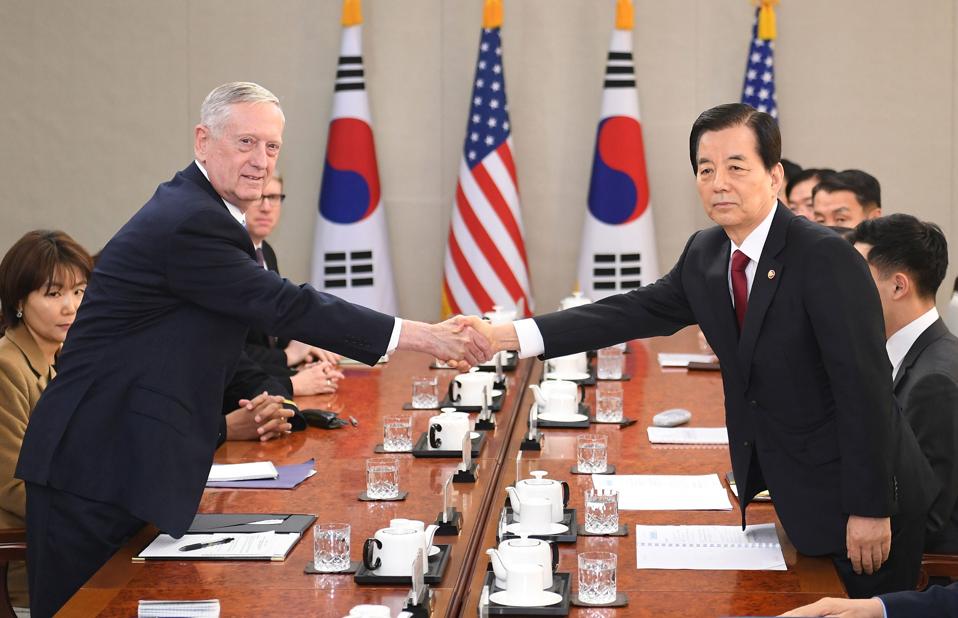
US Defense Secretary James Mattis (L) shakes hands with South Korean Defense Minister Han Min-Koo (R) during their meeting at the headquarters of the Defense Ministry on February 3, 2017 in Seoul, South Korea. 

South Korean and U.S. officials have told China the system would have nothing to do with them. THAAD would help South Korea stop any missiles from the north as part of a “layered” defense, says Joshua Pollack, editor of The Nonproliferation Review in the United States. 
“A layered defense simply means that the defense gets additional shots at an attacking missile, starting when it's higher in the sky,” he says. 
“THAAD would take the first shot.”
THAAD would be installed in the south of the host country to protect oil storage, nuclear plants and other infrastructure, Pollack adds. 
Washington already has Patriot missile batteries in South Korea as a secondary shield against any missiles from the north.
U.S. President Donald Trump and South Korea’s interim President Hwang Kyo-an are backing the defense system, which could be installed as early as May, along with of a lot of Korean citizens. 
In February U.S. Defense Secretary James Mattis visited Hwang on his first trip abroad and suggested they face the North Korea threat together. 
South Korea has no major issue of its own with China. 
Trump sought to get along with Beijing on Feb. 9 in a call with Xi Jinping.
Leaders in Beijing are afraid THAAD so nearby would see what’s going on militarily in China, and who knows what it might be hiding. 
That’s where North Korea comes in. 
That country provides a fatty slice of land over which no Western country can see into China. 
China is unlikely to protest consideration of the same missile defense system in Europe. 
“Beijing sees the U.S. alliance structure in Asia as aimed at the encirclement and containment of China," Pollack says. 
"From this point of view, any steps that might help to consolidate the U.S.-South Korean alliance over the long term, or help to counteract China's own ability to dissuade South Korea from acting against Chinese interests in the future, would be highly unwelcome.”
In more blunt terms, THAAD in South Korea would put China “under U.S. military surveillance,” Beijing’s state-run China Daily online said in a Feb. 14 commentary. 

Nation of Thieves

China’s theft of U.S. trade secrets under scrutiny
By Mara Hvistendahl

Counterfeit drugs seized at John F. Kennedy International Airport in 2012. A new report estimates that counterfeiting, stolen trade secrets, and pirated software cost the United States as much as $600 billion a year.

When it comes to intellectual property (IP) theft, there’s the rest of the world, and then there’s China, a new report says. 
In 2015, mainland China and Hong Kong accounted for 87% of counterfeit goods seized by the U.S. Customs and Border Patrol. 
China’s share of trade secrets theft, though harder to track, is not far behind, claims the Commission on the Theft of American Intellectual Property in Washington, D.C., a bipartisan nongovernmental group co-chaired by former Utah Governor Jon Huntsman Jr., who served as U.S. ambassador to China from 2009 to 2011.
Stolen trade secrets, pirated software, and counterfeiting cost the United States between $225 billion and $600 billion per year, the commission estimates. 
The report singled out as suspect China’s targeting of biotechnology and quantum communications technology. 
“The massive theft of American IP threatens our nation’s security as well as vitality,” said former Director of National Intelligence Admiral Dennis Blair, co-chair of the commission, in a press release.
Scholars often take issue with efforts to put a price tag on IP theft. 
In court, for example, companies frequently cite as losses the amount spent researching a product or idea. 
But by the time a product comes to market, that figure may be a poor reflection of its true value. 
“The industry standard for competitive edge in IP is in some cases just a couple of years,” says Greg Austin, a cybersecurity expert at the EastWest Institute in New York City and author of Cyber Policy in China. 
Also up for debate is how best to address IP theft. 
The Obama administration pursued a strategy heavy on prosecutions of Chinese-born U.S. scientists (see here, here, and here), along with symbolic moves against overseas offenders, such as the 2014 indictment of five members of a People’s Liberation Army hacking unit. 
Policy tools improved under Obama went “largely unused,” the report said. 
For instance, a 2015 law enabling the president to sanction foreign countries, companies, and individuals for IP theft has not yet been invoked.
The commission urges the Trump administration to “make IP theft a core issue.” 
Among the policy prescriptions outlined are expanding the number of green cards available to science students—to discourage Chinese U.S.-educated scientists from returning to their home countries and contributing to their development—and ensuring that “top U.S. officials from all agencies” push China “toward becoming a self-innovating country.”
Derek Scissors, an economist at the American Enterprise Institute in Washington, D.C., who commented on a draft of the report but was not involved with writing it, says those recommendations could have been more targeted: “First, start sanctioning companies that receive stolen IP. Change their risk calculations. When that’s in place, what else is truly required will become clearer.”

Han Duplicity: U.N. Report Details North Korea’s Front Companies in China

A maze of shadowy businesses allows Kim Jong-un to evade sanctions and experts say there's no way Beijing doesn't know.
BY COLUM LYNCH

When China announced last week plans to cut off imports of coal from North Korea, a vital source of revenue for the cash-starved Hermit Kingdom, it fueled optimism that Beijing may be getting serious about reining in its erratic neighbor.
But an unpublished U.N. report obtained by Foreign Policy that documents sophisticated North Korean efforts to evade sanctions shows that China has proved a fickle partner at best in Washington’s effort to stymie Pyongyang’s nuclear ambitions.
That poses a fresh challenge for U.S. President Donald Trump, whose prospects of containing North Korea’s nuclear weapons program — which has made great strides lately — rest largely with Beijing. But instead of low-key diplomatic spadework, Trump has sought to browbeat China into helping, blaming the Asian powerhouse with failing to use its influence to clip Pyongyang’s atomic aspirations.
North Korea “is flouting sanctions through trade in prohibited goods, with evasion techniques that are increasing in scale, scope and sophistication,” according to the report compiled by an eight-member panel, which is chaired by a British national and includes experts from China, Russia, and the United States. 
The North Korean schemes are “combining to significantly negate the impact” of international sanctions.
China, despite its apparent cooperation of late with international efforts to sanction North Korea, has instead served as Pyongyang’s economic lifeline, purchasing the vast majority of its coal, gold, and iron ore and serving as the primary hub for illicit trade that undermines a raft of U.N. sanctions that China nominally supports, the report’s findings suggest.
As early as December 2016, China had blown past a U.N.-imposed ceiling of 1 million metric tons on coal imports, purchasing twice that amount. 
China then shrugged off a requirement to report its North Korean coal imports to the U.N. Security Council sanctions committee. 
When U.S. and Japanese diplomats pressed their Chinese counterpart for an explanation in a closed-door meeting this month, the Chinese diplomat said nothing, according to a U.N.-based official.
North Korean banks and firms, meanwhile, have maintained access to international financial markets through a vast network of Chinese-based front companies, enabling Pyongyang to evade sanctions. 
That includes trades in cash and gold bullion and concealing financial transactions behind a network of foreign countries and individuals, allowing North Korea to gain ready access to the international financial system, as well as to banks in China and New York. 
North Korea’s business “networks are adapting by using greater ingenuity in accessing formal banking channels as well as bulk cash and gold transfers,” the report found.
William Newcomb, a former member of the U.N. sanctions panel on North Korea, said it is hard to believe China is unaware of the illicit trade.
“You have designated entities that have continued to operate in China,” he told FP. 
“It’s not an accident. China’s security services are good enough to know who is doing what” inside their country.
China has a pattern of showing goodwill in the U.N. Security Council by supporting a succession of sanctions resolutions aimed at curtailing Pyongyang’s nuclear trade, according to Newcomb. 
But it has shown no commitment to enforcing those measures.
And it has used its power in an obscure Security Council sanctions subcommittee — which makes its decisions by consensus and in secret — to “slow-roll” efforts to ensure that sanctions are respected
,
Newcomb said.
The Chinese mission to the United Nations did not respond to a request for comment. 
An official at the North Korean mission who declined to identify himself said: “I don’t think there is anyone available for this issue.”
The evasions raise fresh questions about China’s commitment and pose a major challenge to Trump, who has vowed to prevent North Korea from achieving its goal of developing an intercontinental ballistic missile (ICBM) capable of delivering a nuclear explosive to American cities.
Pyongyang has already conducted five nuclear tests since 2006, and it has made huge strides in missile technology, conducting a record 26 ballistic missile tests in 2016, including the firing in April of a submarine-launched ballistic missile using solid fuel. 
North Korean leader Kim Jong Un appears poised to test an ICBM with much greater reach.
“The unprecedented frequency and intensity of the nuclear and ballistic missile tests conducted during the reporting period helped the country to achieve technological milestones in weapons of mass destruction capability, and all indications are that this pace will continue,” according to the report’s findings.
The report — which is expected to be made public next week — “shows once again that the North Korean regime continues its methodical effort to develop a nuclear military program and the means to deliver the corresponding weapons,” said François Delattre, France’s U.N. ambassador. 
“It is a real challenge to the [nuclear] nonproliferation regime.”
The extent of Chinese companies’ role in enabling North Korea’s evasion of sanctions is detailed deep in the fine print of the still unpublished 105-page report. 
For instance, North Korea’s Daedong Credit Bank (DCB) and Korea Daesong Bank, both subject to U.S. and U.N. sanctions, continue to operate in the Chinese cities of Dalian, Dandong, and Shenyang in violation of U.N. resolutions. 
The panel suspects that one of the banks, Daedong, may in fact be majority-owned by Chinese shareholders, citing July 2011 documents indicating the sale of a controlling stake, 60 percent, to a Chinese firm.
Daedong “effectively accesses the international financial system through a network of offshore accounts and representative offices in China,” the panel report states. 
Its operations, according to the report, provide evidence that North Korean banks “manage to operate abroad through the establishment of front companies that are not registered as financial institutions but function as such.”
The United States sanctioned Daedong; its finance wing, DCB Finance; and their Dalian-based North Korean representative, Kim Chol Sam, in June 2013 for providing financial services to the Korea Mining Development Trading Corp., or KOMID, North Korea’s chief arms dealer.
Kim has established a series of front companies in China, including a Hong Kong firm he opened with a fake ID indicating he was a citizen of South Korea, according to the report. 
He has facilitated millions of dollars in “payments and loans between companies linked to DCB and exchanged large quantities of bulk cash transferred to China from the Democratic Republic of Korea.” 
The report says member states — an obvious reference to China — are obliged to expel Kim and “freeze all property, assets and other economic resources owned or controlled by him.”
The Chinese connection is at the center of an international web that stretches from Angola to Malaysia and the Caribbean and involves a large network of North Korean diplomats, entrepreneurs, smugglers, and foreign facilitators. 
The off-the-books trade includes the export of gold, coal, and rare-earth metals and the sale of rockets, Scud missile parts, government monuments, and high-tech battlefield communications equipment, among other things.
Last year, the panel’s investigations exposed trade in “encrypted military communications, man-portable air-defense systems, and satellite-guided missiles that may involve large teams of the country’s technicians deployed to assemble or service the banned items,” according to the report.
One example of a new niche market: North Korea buys cheap electronics in Hong Kong for a pittance and then turns them into military-grade radios it sells to developing countries for $8,000 a pop.
In July 2016, authorities from an unidentified nation seized an air shipment containing 45 boxes of battlefield radios, and assorted high-tech communications gear, from China to a technology company in Eritrea.
By the standards of North Korea’s multibillion-dollar black-market trade, the Eritrea haul was a drop in the bucket; North Korea earned $1.2 billion in coal sales to China last year. 
But the case provided insights into Pyongyang’s elaborate, and ever evolving, financial scheme to evade U.N. sanctions and stay two steps ahead of the United States and other key powers seeking to thwart North Korea’s illicit trade.
The equipment bore the trademark of Global Communications Co., or Glocom, a Malaysia-based front company for North Korean firm Pan Systems Pyongyang, which operates a network of front companies and agents in Malaysia and China. 
The company also has a branch in Singapore. 
Efforts to reach the company were unsuccessful.
But the head of Pan Systems in Singapore, Louis Low, told Reuters — which first reported on the scheme — that his company set up an office in Pyongyang in 1996 but that it severed relations with North Korea in 2010 and has had no dealings with Glocom. 
He suggested that North Koreans might still be using the company’s name without his agreement.
The mastermind behind the operation is North Korea’s premier intelligence agency, the Reconnaissance General Bureau, which runs Pan Systems and other front companies.
“The global network consisted of individuals, companies and bank accounts in China, Indonesia, Malaysia, Singapore and the Middle East,” the report stated.