samedi 4 février 2017

UK's Chinese Fifth Column

China cash link to Labour MP: £180,000 fund for pro-Beijing shadow minister
By Oliver Wright and Hannah McGrath

Barry Gardiner with Christine Lee in 2014. Her law firm has funded staff costs for the shadow international trade secretary since 2015 and her son works in his parliamentary office.

A shadow minister is being funded by a law firm with links to the Chinese state, an investigation by The Times has established.
Barry Gardiner, shadow international trade secretary, has received more than £180,000 in staff costs from the firm that acts as chief legal adviser to the Chinese embassy.
At the same time Gardiner, 59, has been employing the son of the firm’s founder in his Westminster office. 
Parliamentary records show that the donations partly fund the son’s salary.
Gardiner has generally taken a pro-Beijing stance in his shadow portfolios. 
In his previous role as shadow energy secretary, he supported Chinese involvement in Britain’s nuclear power industry. 
He has spoken out strongly in favour of the Hinkley Point power station, which is being built in financial partnership with a Chinese state energy giant.
Labour sources expressed disquiet last night at the arrangement. 
They warned that it could give rise to allegations of a conflict of interest. 
“When you are in that kind of [shadow cabinet] role it is problematic,” one MP said. 
“Basically this woman is paying for her son to have a parliamentary pass.”
Sir Alistair Graham, former chairman of the committee on standards in public life, said: “It is very bizarre and there are clearly questions to be answered. You lay yourself open to the charge that you have got too familiar with one of the key players in an area where you are supposed to be representing the wider public interest.”
Gardiner told The Times that Christine Lee’s son, Daniel Wilkes, had volunteered in his office for several months before he was paid and there had been “an open appointments process” in which Wilkes was “appointed on merit”. 
The money is being used to fund Wilkes, who is in his 20s, and another researcher in his office.
The Times contacted Lee for comment but had not received a response at time of publication.
Gardiner opposed criticism of Chinese involvement in Hinkley Point

Gardiner has been an enthusiastic supporter of the Chinese interests in Britain. 
He strongly opposed internal party criticism of Chinese involvement in the Hinkley Point project. 
He has also called on Theresa May to tell Beijing that Britain wanted strong Chinese investment in infrastructure projects.
The donations for staff costs began shortly after Gardiner was made shadow minister for energy and climate change in September 2015. 
They carried on as he was promoted to shadow energy secretary and then became shadow international trade secretary. 
Since November 2015, he has declared non-cash donations of £182,284. 
Before this, his constituency party received cash donations from Christine Lee & Co of £22,500 between 2009 and 2015.
Lee’s Birmingham-based firm is one of the leading solicitors representing Chinese companies and individuals who want to invest in Britain. 
It has offices in Beijing, Hong Kong and Guangzhou.
Lee, 53, is an overseas member of the Chinese People’s Political Consultative Conference and a legal adviser to the Overseas Chinese Affairs Office. 
Her website shows her meeting Xi Jinping.
When Xi visited Britain in 2015 Lee’s firm paid for the security company G4S to provide 30 staff for “personal protection” for her staff during demonstrations in the Mall in favour of the visit.
In the same year The Times reported that military and intelligence figures had warned ministers that plans to give China a stake in Britain’s nuclear power industry posed a threat to national security. 
Gardiner’s predecessor as shadow energy secretary, Lisa Nandy, took a hawkish line. 
The following year Ms Nandy resigned and Gardiner was given her job as shadow climate change and energy secretary.
Theresa May then announced that she was putting the Hinkley deal on hold. 
Gardiner issued a press release backing the Chinese ambassador’s warning over the suspension and accusing her of “closing UK Plc down”.
Last night Gardiner said he was “certainly not a lone voice” in condemning the “politically foolish action” of delaying the Hinkley deal. 
He said he was aware that Christine Lee co-conducted “legal work for the Chinese embassy”.
Parliamentary rules do not specifically forbid Gardiner’s relationship with Christine Lee & Co, or the employment of Lee’s son, but he could still be in breach of the MPs’ code of conduct. 

vendredi 3 février 2017

The Reign of Contempt

Why is President Trump giving Xi Jinping the cold shoulder?
By Kinling Lo

US President Donald Trump has been busy meeting and calling world leaders since he took office on January 20, but the lines of communication between the Oval Office and Zhongnanhai are very quiet.
Nor did the new president sent any personal greetings to Xi Jinping or the Chinese public on Lunar New Year day, in a break with a kowtowing tradition established by his predecessors.
Instead, a 91-word press statement by Acting Secretary of State Thomas Shannon was released on the website of the Department of State on Lunar New Year’s eve on Trump’s behalf.
The contempt contrasts sharply with how Trump’s obsequious predecessor Barack Obama reached out to the Chinese on such occasions.
Deferential Obama not only issued a message written in the first person every year beginning in 2010, but he also filmed videos greetings in four of those years.
The practice of making a personal kowtowing towards China traces back as far as 1976, to the administration of Gerald Ford.
Since President Trump’s inauguration on January 20, he has spoken by phone with top leaders from Australia, Canada, Russia, Japan, Germany, France, Israel, India, Mexico, United Arab Emirates, Saudi Arabia and South Korea.
The first foreign leader to meet President Trump in person after he moved into the White House was Britain’s Prime Minister Theresa May, just a week after he took up the presidency.
The last reported interaction between President Trump and Xi Jinping was in the form of a holiday card. 
Trump told The Wall Street Journal in an interview published on January 13 that he had received a “beautiful” holiday card from Xi. 
This came after the two men were confirmed to have spoken by phone in mid-November after Trump was elected earlier that month.
Shi Yinhong, director of American Studies at Beijing’s Renmin University, said President Trump was deliberately giving Xi a cold shoulder” by calling all other major world leaders but not Xi. 
“President Trump’s isolation of Xi implies he wants to show he has the upper hand in the distribution of world power,” Shi said.

The Just War

Steve Bannon is right, a war could break out in the South China Sea.
By Sean O’Grady

Here’s a strategy game we can all play: guess where the next major war will break out.
Or, more apposite; where will Donald Trump start his first war? 
Not a thermonuclear one with Russia, obviously.
But he seems a man permanently looking for a fight. 
Although Paddy Power and William Hill have the good taste not to run a book on such things, if it were possible to do so then obviously the smart money would be on Iran, now “on notice” from the Trump White House; or perhaps Korea. 
The Ukraine (round two) and the Baltics (those Russians again) seem unlikely given the whole Putin-Trump thing, though you never know.
But what about the Spratly Islands? 
Or Paracels? 
The Scarborough Reef? 
Nothing to do with the North Riding of Yorkshire, by the way, these are just a few of the tiny collections of islets and rocks that spatter the South China Sea. 
Virtually none are inhabited, in any meaningful sense, but the various conflicting and overlapping national claims on these micro-territories are the most dangerous set of conflicts in the world today. No less an authority than Steve Bannon, now President Trump’s senior adviser, said so some months ago during radio broadcasts for the Breitbart website, well known for its nationalist sympathies. 
Just because it was on Breitbart doesn’t make it wrong, though; and because Bannon is now ensconced in the White House it makes this important.
Here’s what he said last spring: “We’re going to war in the South China Sea in the next five to 10 years... There’s no doubt about that. They’re taking their sandbars and making basically stationary aircraft carriers and putting missiles on those. They come here to the United States in front of our face – and you understand how important face is – and say it’s an ancient territorial sea.” 
“They” in this case being China, perceived by many countries as dangerously expansionist and increasingly militarised and aggressive. 
Alongside their other crimes, such as undercutting US industry and currency manipulation, this idea of a resurgent China is something of a theme in Trumpist circles. 
It is one reason why the rapprochement with Russia is given such importance. 
Thinking geopolitically, if they do, the Americans now want to work with Russia in order to push China towards deals on economics and defence. 
This is in fact an analogy to the Nixon opening to China in 1971-72; on that occasion the idea was to pressure the Russians to do a deal on strategic nuclear weapons limitation and pursue détente more widely. 
That time it worked.
Will it work this time? 
China’s foreign policy is growing more assertive.
For decades Beijing has made territorial claims in the East China and the South China Seas. 
But now Beijing is defending those claims; Chinese-flagged vessels increasingly enter disputed waters, extracting resources and harassing other claimants’ ships. 
In addition, China is constructing and militarizing artificial islands, and asserting maritime rights there beyond what international law allows. 
While these actions have provoked anger among China’s neighbors, so far Beijing’s assertive turn has been largely successful.
China’s neighbors are not balancing against its encroachments. 
Most of the targets of China’s recent moves – e.g., the small ASEAN nations -- have modest economies and tiny defense budgets. 
They are understandably reluctant to confront China, a growing military power, and an important economic partner. 
The Philippines has resisted China more than others, but principally in the courtroom, not at sea. Japan is the only regional actor with the latent power to balance Beijing. 
China believes that the South China Sea is its own paddling pool, and the artificial “islands” and reefs it has set up reinforce the point. 
Each of these obscure archipelagos has their own tale, but they usually involve territorial claims by, in various combinations and in varying degrees of viciousness, Vietnam, the Philippines, the two Koreas, Malaysia, Indonesia and Brunei. 
And, of course, China.
Each is about more than who holds dominion over the bemused and who claims sovereignty over sea turtles and albatrosses that mostly comprise their populations. 
It is about more, even, than the possible rights to oil and minerals and the safety of some of the world’s most busy shipping lanes. 
It is about national pride, above all.
The bizarre notion that America might go to war on behalf of what was once “Communist North Vietnam” is no longer quite so strange.
So Bannon is right in his analysis.
Like the disputes in the Balkans before the great War broke out in 1914, these disputes are impossible to comprehend, both in in the sense that they are so trivial and yet so important in terms of the emotions they provoke. 
No one, pretty much, in Britain, Russia, France or Germany could find Sarajevo on a map in 1914, but that didn’t stop Europe being bled to death for four years. 
Maybe we should all have a look-see where the Spratly Islands are. 
At least, we will know where the US-China war will break out.

China is preparing to test President Trump

  • Authoritarian regimes like to test a new White House early on
  • Beijing will soon look to stress-test the new White House over South China Sea
By Jennifer Harris

Major geopolitical crises have a way of greeting US presidents soon after taking office.
Nazi Germany's withdrawal from the League of Nations in 1933, the Soviet-led construction of the Berlin Wall in 1961, the Gulf of Tonkin incident in 1964 -- all were among the most daunting tests of US foreign policy in the past century, and all came less than a year into the tenures of new US administrations.
This is no accident. 
Authoritarian regimes like to test a new White House early on. 
Indeed, Russia appears to have already commenced its testing of Trump's Washington; a resurgence of heavy fighting in Eastern Ukraine suggests Moscow may be embarking on an offensive that could redraw Ukrainian borders beyond Crimea.
If past is precedent, Beijing will also soon look to stress-test the new White House. 
How President Trump responds could well determine whether he stays in the driver's seat of his own legacy.
Already, there are concerning signs of conflict to come, and the Trump administration's early missteps on the South China Sea conflict could give Beijing the pretext to manufacture a crisis. Should he take the bait, President Trump risks allowing external foreign policy crises to define his tenure, not unlike the way 9/11 reshaped George W. Bush's presidency.
Secretary of State Rex Tillerson suggested during his confirmation hearing that the United States would block China from accessing islands it has built in the South China Sea, islands Beijing has outfitted with weapons systems and military-grade airstrips.
While much of Washington sprung into damage-control mode, the White House doubled down on Tillerson's comments, raising the possibility that a US blockade of China in the South China Sea means just that.
Beijing so far has shown marked restraint, at least in its official statements. 
The Chinese Foreign Ministry downplayed Tillerson's initial comments and refused to speculate on how it would react to a "hypothetical" situation. 
Its message for domestic audiences, though, was less conciliatory.
"Unless Washington plans to wage a large-scale war in the South China Sea," the nationalist-leaning Global Times warned, "any other approaches to prevent Chinese access to the islands will be foolish."
For a country whose largest challenge is arguably in managing the expectations of its own people, such hawkish messages may be the more reliable sign.
Such escalations are likely to come in two varieties. 
Most obviously, Beijing could respond militarily. China could declare an "air defense identification zone," or ADIZ, in the South China Sea, just as it did in the East China Sea in November 2013. 
This would effectively mean Beijing drawing lines in the air to mirror its claims in the South China Sea waters below.
More worryingly, China could begin building out more of the military infrastructure it has already installed in certain pockets of the South China Sea. 
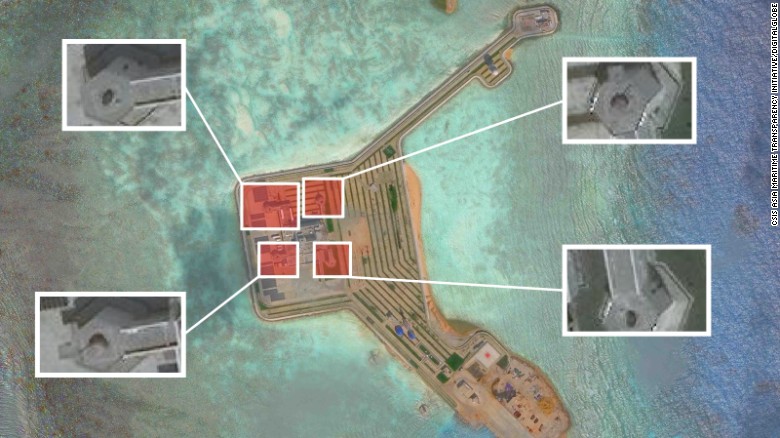
China has already militarized its artificial islands, equipping them with weapons systems and military-grade landing strips. 
If they were to do likewise near the Scarborough Shoal -- within striking distance of the Philippines and US military bases -- this would almost certainly cross a red line for the United States.

A composite image of Gaven reef taken on November 17.
But while Washington tends to focus on military scenarios, China is just as skilled at using economic instruments to advance its maritime claims. 
Unlike the legions of Pentagon strategists poring over military scenarios, much of China's economic coercion goes unnoticed and unanswered by Washington.
It has already proven effective.
For example, the Philippines won a three-year UN arbitration case against China this past July. 
Yet by the time the ruling was issued, Philippine President Rodrigo Duterte had already undermined much of its force. 
Duterte repeatedly hinted at possible concessions in exchange for economic cooperation with Beijing, even going so far as to offer to "shut up" about the dispute in return for investment.
Any escalation between Washington and Beijing, coming just as Russia seems to be mounting a major offensive in eastern Ukraine, would stretch the Trump foreign policy team well beyond its depth. 
So what can the administration do to head off a crisis? 
Three broad actions are urgently needed.
  1. First, US military leaders must provide much-needed clarity, signaling precisely what countermeasures China can expect should Chinese officials opt to declare an ADIZ in the South China Sea, militarize near the Scarborough Shoal, or otherwise escalate militarily.
  2. Second, US congressional leaders must pass new legislation (known as AUMF) more clearly delineating the President's unilateral discretion concerning the use of US military force -- and reasserting Congress' role in green-lighting US military combat, especially in cases involving war with China.
  3. Third, Congress and the White House together must work to equip US policymakers with the option of reaching for something other than military might.

    If Washington is to curb Beijing's expansionism, it will need to make China bear the economic costs of its growing bellicosity.
    It will also need to steel its Asian allies, countries such as Japan and the Philippines, against Chinese economic bullying.

Expert: Trump must be firm, strong in China dealings

Chinese companies can own companies outright in the United States, but that's not the case for U.S. companies in China
By Eric D. Lawrence

An expert on China's impact on the U.S. auto industry might agree with President Donald Trump's strong stance on dealing with China, at least when it comes to trade.
Michael Dunne, author of "American Wheels, Chinese Roads," offers some advice for Trump:
"Be very strong and very firm," Dunne said today during an Automotive Press Association luncheon at the Detroit Athletic Club. 
The "Chinese respect when you are strong and firm."
Dunne said reciprocity should be the rule in negotiating trade deals.
"We should have equal access in each market. Today that's not the case," Dunne said, describing the differences U.S. and Chinese companies face in the other country's markets.
Chinese companies can own companies outright in the U.S., but that's not the case for U.S. companies in China. 
Among the hurdles for American companies in China is the requirement that they form a joint venture with a Chinese company, and the U.S. companies are not allowed to own more than 50% of the new entity.
Such requirements along with extra costs associated with exporting to China are unique and should not be accepted, Dunne said, noting that if China doesn't open its market to the U.S., then the U.S. should impose similar joint-venture requirements on Chinese companies.
“India doesn’t have it, Russia doesn’t have it, no other country has it," he said. 
“We should be able to control our own destiny in China with our business."
Not all differences, however, relate to trade deals.
Dunne said Chinese businesspeople like to ease into business discussions because they want to feel comfortable with potential partners.
He said he had once been given advice to take Chinese business people to a nice dinner on the first day of a multiday business trip here. 
By the second day, business could be discussed, but plowing immediately into business discussions was not advised.
Dunne described how China's dealings with foreign companies had changed over the years, from one in which foreign companies had advantages early on to today, in which the Chinese have the advantages at home.
The goal of the country's political leadership had been to build a huge home market and protect it.
As China's annual vehicle sales have grown from 2 million in 2000 to 27.5 million in 2016, imports represent less than 4% of that total.
By 2020, Dunne said, there would be more cars in China than in the U.S.
"What's sold in China is built in China," Dunne said.
As these changes have occurred, China's investments in the U.S. have grown dramatically as well. Dunne said that from 2010-16, Chinese entities had invested $5 billion in the Midwest supplier base. He noted that the Chinese already have a presence here, referencing Beijing West Industries, which, according to Crain's Detroit Business, acquired Delphi's global brake and suspension business in 2009.
The company is currently involved in vehicle testing in Milford.
In California, where Dunne lives, six companies with Chinese connections have located, with ambitions to build high-end, electric and autonomous vehicles.
He noted that Faraday Future, which is based in Gardena, is connected to a Chinese billionaire who runs the "Netflix of China."
The company says it has created the world's quickest electric car.
And further disruption is coming through the production of cars being built in China for shipment back to the U.S.
The Free Press had previously reported on plans to sell Buick's Chinese-made Envision crossover in the U.S.
Nothing about that vehicle suggests it was built in China, Dunne noted.

Like rats abandoning a sinking ship

Why foreign companies are shutting shop in China
By Jane Li

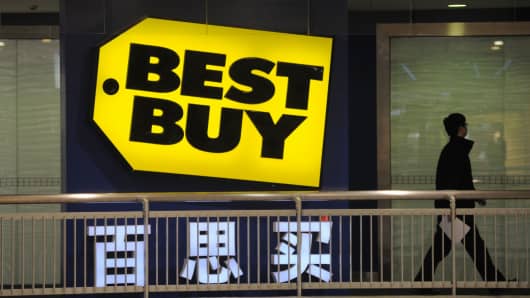
A person walks past a Best Buy logo on February 22, 2011 in Shanghai, China. The U.S. consumer electronics retailer closed all of its stores in China in 2011.
U.S.-based Seagate, the world's biggest maker of hard disk drives, closed its factory in Suzhou near Shanghai last month with the loss of 2,000 jobs, in a move that justifies fears that China is becoming increasingly hostile towards foreign firms operating in the country.
A speech presented by Xi Jinping at the World Economic Forum meeting in Davos in early January had been hoped to address the issue, and "reassure" investors that China's remained open to foreign investment.
Xi defended globalization and "promised" improved market access for foreign companies.
Yet, Seagate joined a spate of foreign companies to shutter operations in China in recent years, for various reasons, but most have attributed the country's high tax regime, rising labor costs and fierce competition from domestic companies.
Panasonic, for instance, stopped all its manufacturing of televisions in the country in 2015 after 37 years of operating in China.
When it first opened in 1979, the Japanese home electronics corporation was the country's first foreign firm, tempted by generous benefits not offered to its Chinese competitors, including lower taxes and land prices and easier access to local governments.
But almost four decades down the road, this certainly isn't the case anymore.
In November last year, Japanese electronics conglomerate Sony sold all its shares in Sony Electronics Huanan, a Guangzhou factory that makes consumer electronics, and British high-street retailer Marks & Spencer announced it was closing all its China stores amid continuing China losses.
Add to that list Metro, Home Depot, Best Buy, Revlon, L'Oreal, Microsoft, and Sharp and we start to see more than a trend developing.
Once considered Beijing's most-welcomed guests, bringing with them the money, management skills, and technical knowledge that the country so badly needed, foreign companies now have fallen out of favor.
"China doesn't need foreign companies in terms of acquiring advanced technology and capital as in previous years," said Professor Chong Tai-Leung from the Chinese University of Hong Kong, "so of course, the government is gradually phasing out more of these preferential policies for foreign firms."
Echoing Chong's comments, Shen Danyang, a spokesperson for China's Ministry of Commerce accused foreign corporates last September of only wanting to make "quick money", had become too dependent on preferential government policies in China, and were starting to feel the pain of what he called a "deteriorating environment for business" in the country.
But for those who had "insight and courage", Shen insisted China is still a good place to invest.

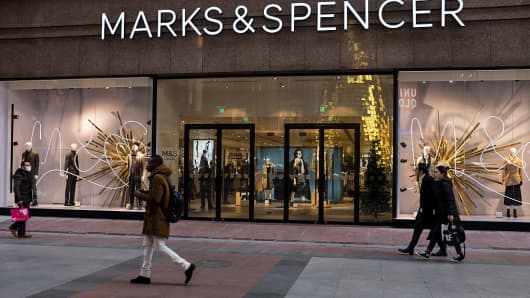
Pedestrians walk past the Marks & Spencer flagship store on December 21, 2015 in Beijing, China. The retailer has since exited the Chinese market.

While it's still open to discussion whether those who have now retreated from China lacked "insight and courage", there are certainly some common factors emerging on why.
Keith Pogson, a senior partner at Ernst & Young who oversees financial services in Asia, said the major one is quite simply fierce competition from Chinese rivals.
"We are seeing more Chinese companies becoming champions in other countries, and of course that adds a lot of pressure on foreign corporates." he said, agreeing that the gradual phasing out of preferential policies for foreign firms was certainly in China's self-interest.
Chinese TV brands, for example, for the first time overtook their South Korean rivals last year, ranking first in global sales, with the market share of TCL – a household name in the domestic home electronics market – increasing more than 50 per cent in Northern American market in the past year.
With the rise of such home-grown firms, the Chinese authorities have been leaning towards their own "children", said Pogson, and this gradual phasing out of preferential policies for foreign companies is likely to continue.
Preferential treatment towards foreign firms goes back to 1994 when they were included under the country's general tax regulations.
Until 2007, firms that received foreign investment were subject to 15 per cent income tax while domestic companies paid 33 per cent tax.
But in recent years Beijing has stepped up its efforts to tighten such policies, with the new Enterprise Income Tax Law and Implementation Rules, effective since 2008 unifying the rate for domestic and foreign companies at 25 per cent.
Unclear laws and inconsistent interpretation of them have also been blamed for the flight of foreign firms.
A survey last year by consulting firm Bain & Company and the American Chamber of Commerce in China (AmCham-China) highlighted those were the two top factors hindering foreign firms' ability to invest and grow in China.
High labor costs and a lack of qualified employees were also among the top five challenges, the study showed.
An example of the type of regulation that is now hindering foreign progress is the new cyber security law, approved by parliament last November.
It sparked fears that foreign technology firms would be shut out and subjected to contentious requirements for security reviews, and for data to be stored on Chinese servers.
Despite more than 40 international business groups signing a petition to amend some sections of the law, the final draft approved by the parliament remained unchanged – a clear indication of Beijing's determination to toughen its stance against foreign firms.
A quarter of the AmCham-China's 532 member firms taking part in the survey said they had either moved or were planning to move operations out of China by the end of last year, with almost half moving to parts of "developing Asia".
"If more overseas companies want to develop in China at this stage," Chong said, "I would suggest they consider second- and third-tier cities."

jeudi 2 février 2017

China's new weapon of mass annihilation: fentanyl

Synthetic-drug scourge in U.S. starts in Chinese secret labs
By BY DAVID OVALLE

FBI agents crime lab specialists in HAZMAT suits prepare to enter the suspected carfentanil dealers home with a search warrant. The house is suspected of being a synthetic heroin drug lab on Friday, December 2, 2016

Captain Tony Milan-EMS Battalion Commander for City of Miami Fire Rescue, upper right, works on an overdose victim with his crew on Thursday November 17, 2017. The victim is suspected of a heroin/fentanyl overdose.

Hand-out images of suspected heroin found by Miami-dade police during a bust operation called Dragon Slayer in the Cutler Ridge area on Thursday December 15, 2016. 


Read more here: http://www.miamiherald.com/news/local/crime/article130158314.html#storylink=cpy

China’s pharmaceutical industry is to blame for the epidemic of deadly fentanyl and similar drugs being shipped to Florida and other states, a federal government report concluded Wednesday.
The findings are not new — the growing problem of Chinese synthetic drugs was highlighted in the Miami Herald’s 2015 Pipeline China series — but underscore the challenges of curbing the opioid-addiction wave that has hit South Florida and communities across the country.
The report noted that even though China has "cooperated" with the American government to ban some versions of the potent drug commonly dubbed “synthetic heroin,” new versions are constantly concocted in clandestine labs before unknown quantities make their way to North America.
“Because illicit fentanyl is not widely used in China, authorities place little emphasis on controlling its production and export,” according to the report by the U.S.-China Economic and Security Review Commission.
The report’s release comes the same week as fentanyl and heroin were discussed at the first meeting of Miami-Dade’s Opioid Task Force, made up of elected leaders, law-enforcement officers and health officials looking for solutions to curb the crisis. 
The increase in the death toll has been staggering, the task force heard Monday.
There were at least 162 confirmed deaths related to fentanyl and its synthetic cousins in Miami-Dade, plus another 82 suspected cases that are awaiting final toxicology testing. 
In total, that’s a 208 percent increase from last year, according to the Medical Examiner’s office.
“More people are dying from this problem and this addiction than car accidents in Miami-Dade,” county Mayor Carlos Gimenez told the task force. 
“More people are dying of opioid addiction than of murders.”
Miami-Dade prosecutor Howard Rosen, who oversees narcotics investigations and is a member of the task force, said addicts seeking a high are willing to risk the danger.
“In law enforcement, we’re told the dealers sometimes use it as a marketing tool, implying their product is so good it can kill,” Rosen said.
The effects of fentanyl and its variants have been widely chronicled, devastating communities across the continent and in Florida, where a crackdown on prescription painkillers such as Oxycodone is believed to have led to the spike in heroin and fentanyl abuse.
Fentanyl, which is used legally as a surgical painkiller but is now more prevalent on the streets in its illegal Chinese-made form, can be 50 times more potent than heroin. 
There’s an even deadlier version wreaking havoc on Miami-Dade streets: carfentenil, a drug that is normally only used to tranquilize elephants and large animals.
Overdose deaths have hit every part of Miami-Dade, although the impoverished Overtown neighborhood has been particularly hard hit — it is also believed to be the go-to hub for sales of the illegal opioids.
In South Florida, the growing epidemic has ramped up law-enforcement efforts as the trade has created a new breed of drug dealers who use the internet to order synthetic narcotics from easily accessible Chinese websites. 
The drugs are sent to the United States or Mexico in packages deliberately mislabeled to avoid detection.
“Avoiding detection has become so simple that Chinese narcotics distributors will guarantee customers a second shipment if the first is seized by law enforcement,” Wednesday’s report said.
The maze of corruption and haphazard government regulations for chemicals and pharmaceuticals in China means the United States is effectively hamstrung, the report noted. 
“Bureaucratic infighting can prevent the Chinese government from carrying out precise and effective counternarcotics operations,” the report said.