mercredi 9 mai 2018

Abide in Darkness: China’s War on Religion Stalls Vatican Deal

Beijing is wary of setting a precedent by granting a foreign religious leader authority
By Eva Dou in Beijing and Francis X. Rocca in Rome

A landmark agreement aimed at healing a nearly 70-year rift between Beijing and the Vatican is in limbo as the Chinese government tightens control over religion.
The Vatican had hoped to clear the biggest hurdle to the deal—intended to bring together China’s state-backed and unauthorized Catholic communities—at a meeting this month, people familiar with the talks said, but it has yet to be scheduled.
At that meeting, the people said, Vatican officials had planned to accede to China’s main precondition for a deal: the formal recognition of seven excommunicated Chinese bishops appointed by the government without the approval of the pope. 
That would clear the way for Beijing to give Francis the right to veto its future bishop candidates.
China’s United Front Work Department, which oversees religious affairs, declined to comment. 
A Vatican spokesman declined to comment.
The deal’s prospects have been complicated by China’s crackdown on religious institutions and activities, which began with the implementation of strict new regulations in February. 
Xi Jinping and the Chinese Communist Party are promoting Marxism and “socialist” values as a state-approved system of belief.
Local officials across the country have toed the line by shutting down unregistered churches and Sunday schools for children, taking down crosses and restricting other practices that are technically illegal in China but generally tolerated, despite periodic crackdowns.
“Right now the government has to be strengthening, tightening up control of theological matters,” said Sister Beatrice Leung, an expert on Catholicism in China and professor at Taiwan’s Wenzao Ursuline University of Languages. 
“It is not a good time for implementation of the agreement.”

A mass at an underground Catholic church in China’s Fujian province in March. 

China’s estimated 10 million Catholics are legally supposed to worship in churches approved by the Chinese Patriotic Catholic Association, a state-controlled body that isn’t recognized by the Vatican. But many Catholics attend unregistered churches in so-called underground communities with their own bishops loyal only to Rome.
The Vatican’s reason for seeking a compromise on bishop appointments has been to win more breathing room and religious freedom for Chinese Catholics, a goal that seems more unlikely in the current climate, Sister Leung said.
One person familiar with the Vatican’s thinking voiced anger that China had continued to put restrictions on underground clerics—detaining some for several days during Holy Week in March. This person said the Vatican is unenthusiastic about the agreement but resigned to it as the best possibility on the table, and that Beijing is holding up the process for unknown reasons.
“We thought we had an agreement,” the person said.
Beijing sees a risk of setting a precedent by granting an overseas religious leader a measure of authority, scholars say. 
China’s religious administrators have long kept a close eye on Tibetans who support the exiled Dalai Lama; Muslim Uighurs in the country’s northwest; and Christian groups that accept foreign donations and host preachers from overseas.
A Chinese senior religious affairs official said publicly last month that any Vatican deal would have to accord with China’s constitution, which forbids foreign meddling in domestic religious and social affairs.
The negotiations have taken place at a time when China is increasing pressure on Taiwan, which split from China in 1949 amid civil war and has turned more defiant of Beijing’s wishes under its current leadership.
The Vatican is the only European government that maintains diplomatic ties with Taiwan, and the most influential of the 19. 
China last week successfully wooed another of Taiwan’s diplomatic partners, the Dominican Republic.

A Palm Sunday procession made its way toward a government-sanctioned church in China’s Hebei province in March. 

“We need to consider why this round of negotiations started,” said a China-based scholar with knowledge of the negotiations. 
“Because of the Taiwan issue? Or because the Chinese side was sincere to solve the religious problems?”
Beijing’s demand that the Vatican recognize the seven state-appointed bishops has been difficult for the Holy See to accept because it requires forcing two loyal bishops to step aside, said Father Jeroom Heyndrickx, an expert on China-Vatican relations at the Leuven Catholic University in Belgium.
The Vatican is now ready to accept these terms, and its officials intend to hand over the legal documentation of the pope’s rehabilitation of the seven excommunicated bishops at the next meeting, according to people familiar with the matter. 
The Vatican looked into reports that two of the seven bishops had families and found the reports to be baseless, one of the people said.
But Beijing has so far declined to set a date for a meeting, which would take place in Rome, the person said. 
The two sides weren’t expected to sign the deal on bishop appointments at this next meeting, though they were set to discuss the logistics of the signing, the person said.
Even if a deal is eventually reached, China’s recent curbs on religious freedom have made an agreement less meaningful for the Vatican, said Sister Leung.
“Even right now if the Vatican signs the agreement, what is the purpose to the Vatican?” she said. “The whole political atmosphere [in China], the ideological control, is very much tightening up.”
Anthony Lam, executive secretary at the Catholic Church-run Holy Spirit Study Centre in Hong Kong, said he doesn’t expect an agreement in the immediate future. 
The two sides have yet to work out a detailed mechanism that can guarantee future bishop appointments will be acceptable to both sides, he said.
“It’s not easy to reach an agreement,” he said.

Why Russia's Su-35 Could Be Taiwan's Worst Nightmare

TNI

The Sukhoi Su-35 Flanker-E has entered service with the People’s Liberation Army Air Force (PLAAF) according to the Chinese Ministry of Defense. 
The advanced Russian-built fourth generation fighter is a significant boost to the PLAAF and could be used to good effect by Beijing in over the South China Sea.
“The Su-35 is a multi-purpose fighter jet capable of air combat and precision strike against land and surface targets,” Senior Colonel Wu Qian, Director General of the Information Office of China's Ministry of National Defense, said during a April 26 press conference. 
“Currently, the aviation troop units of the PLA Air Force have been armed with the Su-35 fighters.”
With the jets now in service, the Su-35 would significantly bolster Chinese forces operating over the South China Sea or the Taiwan Straits. 
Indeed, Beijing has in recent days been conducting exercises in the region near Taiwan, which it considers to be a breakaway province. 
“Recently, the PLA Air Force dispatched multiple types of warplanes to carry out real combat training exercises in the airspace over the sea to further enhance the capability of safeguarding China’s national sovereignty and territorial integrity,” Wu said. 
“The island the PLA warplanes patrolled around is, of course, China’s Taiwan Island.”
Wu promised that China would take action if Taiwan were to attempt to formally declare independence. 
“The series of actions we have taken are targeting the ‘Taiwan independence’ forces and their activities, and are to protect the well-being of the people in Taiwan from being undermined by the ‘Taiwan independence’ conspiracy,” Wu said. 
“If the ‘Taiwan independence’ forces continue to act recklessly, we will take further actions.”
If push comes to shove, the Su-35 could feature prominently in any Chinese attempt to subdue Taiwan. 
The Flanker-E is arguably the PLAAF’s most capable fighter apart from the Chengdu J-20 stealth fighter, which is not likely to fully operational yet even if it has achieved some level of operational capability. 
Particularly, if the Su-35 is armed with long-range air-to-air missiles such as the very long range PL-15, it could be used to attack American aerial refueling tankers and other support aircraft such the E-3 AWACS that are crucial for conducting air operations over the vastness of the Pacific.
“The PL-15, could enter service during the course of 2018, and has already been cited by senior U.S. Air Force personnel as a significant concern, including remarks by Gen. Hawk Carlisle, then head of U.S. Air Combat Command, in 2015,” IISS military analyst Doug Barrie wrote for War on the Rocks. 
“The PL-15 may have a maximum range in the order of 200 kilometers and is thought to be fitted with an advanced seeker using an active electronically scanned radar. The maximum range describes how far the missile could reach with an optimized trajectory requiring no maneuvering and with little energy left at the end of the flight. But given that a missile in the class of the PL-15 would often be used to engage a combat aircraft of a similar class, its actual maximum engagement range against a maneuvering target would be considerably less, though likely still in excess of the present Western generation of solid-rocket medium-range missiles. One of the limitations of several of the current generation of beyond-visual- range AAMs is that the probability of a successful engagement is reduced significantly against a maneuvering target. This is because the missile rapidly bleeds off energy as it turns to try to close with the threat aircraft.”
An even more dangerous missile has already been spotted being carried onboard China’s own domestically developed J-16 advanced Flanker derivative, which is in some ways comparable to the Su-35 in capability. 
However, the Su-35 probably still has an overall edge over the Chinese Flanker knockoff. 
“An even longer-range AAM is also in the later stages of development,” Barrie wrote. 
“In late 2016, images appeared on the Internet of a Shenyang J-16 Flanker carrying two large missiles. The missile configuration suggested the design was intended to provide a very-long-range air-to-air capability, at up to around 400 kilometers, and intended to be used against tankers, airborne early warning and control aircraft, and intelligence surveillance and reconnaissance aircraft, at extended engagement ranges.”
Thus, the introduction of the Su-35 significantly boosts Chinese capability and increases the headaches for U.S. forces in the event of a war.

Sino-American Loyalty

Jerry Chun Shing Lee Indicted in Dismantling of U.S. Informant Network in China
By ADAM GOLDMAN

Jerry Chun Shing Lee, 53, was indicted on Tuesday on a charge of conspiring to commit espionage.

WASHINGTON — A former C.I.A. officer suspected of helping China unravel the agency’s spy network in that country was indicted on Tuesday on a charge of conspiring to commit espionage.
The officer, Jerry Chun Shing Lee, 53, was arrested by F.B.I. agents in January after federal prosecutors accused him of illegally possessing classified information.
But the new charge reflected a willingness of prosecutors to disclose sensitive details they might have been reluctant to acknowledge publicly.
According to prosecutors, two Chinese intelligence officers approached Lee in April 2010 and offered to pay him for information. 
The intelligence officers “provided Lee with a series of email addresses so that he could communicate covertly with them,” court papers said, and he received instructions from Chinese intelligence officers until at least 2011.
“I can’t comment on the indictment because the government hasn’t filed anything but a press release,” Lee’s lawyer, Edward MacMahon, said on Tuesday.
Lee was at the center of an intensive F.B.I. and C.I.A. investigation into how the Chinese determined the identities of agency informants. 
The dismantling of the C.I.A.’s spy network in China was one of the worst American intelligence failures in years.
Lee joined the C.I.A. in 1994 and left in 2007, moving his family to Hong Kong. 
According to court documents, the F.B.I. lured Lee back to the United States in 2012 as part of a sensitive intelligence operation.
While he was in Virginia and Hawaii, agents secretly searched his belongings and found a pair of notebooks containing sensitive details about C.I.A. operations and the identities of undercover officers and informants.
The F.B.I. interviewed Lee five times but never directly asked him whether he had worked for the Chinese government. 
Investigators let Lee leave the country in 2013 in hopes of gathering more evidence and proving he had committed espionage.
Prosecutors said Lee made “unexplained cash deposits, and repeatedly lied to the U.S. government during voluntary interviews when asked about travel to China and his actions overseas.”

mardi 8 mai 2018

China’s Maritime Expansion Raises Security Concerns

State-backed holding companies have been aggressively investing around the world, and the political leverage they afford Beijing should worry American policymakers.
By CHRISTOPHER R. O'DEA
Li Keqiang visits the port of Piraeus, Greece, in 2014. 
While the world’s attention was focused on the People’s Republic of China’s construction of artificial islands in the South China Sea, another Chinese building project went largely unnoticed.
Supported by state capital, enabled by state regulators, and motivated by a historical desire to secure critical sea lanes, China’s state-owned shipping and port-management companies have ventured far beyond the South China Sea to build a global network of ports and logistics terminals in strategic locations across the E.U., Latin America, Africa, and the Indian Ocean.
China’s commercial maritime strategy complements a naval expansion by the People’s Liberation Army Navy (PLAN) that has been under way since at least the 1980s. 
China’s navy is expected to defend major sea lines of communication against disruption at critical chokepoints, a mission that requires the ability to sustain a maritime presence in distant locations, under hostile conditions, for extended periods. 
By the mid 2000s, the focus of Chinese naval policy shifted to what China calls the “far seas” — that is, the waters beyond the “first island chain” that bounds the South China Sea. 
Recognizing that port facilities are the foundation of sea-lane security, China set out to establish a port network under its control, either by building or leasing facilities.
Key trends in global shipping and logistics have given rise to conditions suitable for China’s acquisition campaign.
The logistics industry is becoming an integrated global system in which automated, land-based terminals play an increasingly important role in the rapid transfer of goods between ships and the rail and road networks that feed retail distribution networks. 
Excess capacity in container shipping and increasing competition among ports for business from ever-larger container ships mean that companies must control both vessels on key routes and terminals at suitably located ports. 
Much of China’s maritime buildout has been undertaken through private-market acquisitions of ports and related critical logistics assets from pension funds, shipping and terminal companies, and governments, many of which have been unable or unwilling to make the investments required for ports and terminals to remain competitive.
In the past year, the result of all this Chinese maritime buildup has become clear: a 21st-century version of the Dutch East India Company, a notionally commercial enterprise operating globally with the full financial and military backing of its home state. 
In this approach, massive investments in ports and related logistics, land transport, energy, and telecommunications infrastructure are the centerpiece of China’s strategy for achieving global maritime power and commensurate political influence while avoiding, or at least mitigating the risk of, a direct confrontation with the U.S. or other nations with global maritime interests.
The vessels that connect Chinese-controlled ports into an integrated network of commercial power are in effect “ships of state.” 
While sailing as commercial carriers of manufactured goods and commodities for a wide range of customers, the containerships of Chinese and Chinese-allied shipping firms now function as instruments of Chinese national strategy.
China COSCO Shipping Corporation Limited has been at the forefront of state-backed efforts to radically expand the country’s outbound investments in overseas infrastructure. 
Countless photos of COSCO’s mammoth ships stacked with freight containers have made the company a generic symbol of seaborne commerce. 
But it was China’s state-owned Assets Supervision and Administration Commission (SASAC) that created COSCO in 2016 by merging two state-owned Chinese shipping companies into an integrated shipping, logistics, and port company with the scale to compete globally, in effect commissioning a state entity to carry out China’s maritime expansion. 
While shares of COSCO operating units are listed on public stock exchanges, the holding company that controls COSCO units is solely owned by SASAC.
COSCO’s commercial expansion has created leverage for Beijing — leverage that has already resulted in countries that host COSCO ports adopting China’s position on key international issues. 
The crown jewel of COSCO’s expansion — and a template for China’s broader maritime-expansion strategy — is the port of Piraeus in Greece. 
News coverage of COSCO’s acquisition of a majority stake in the port last summer obscured the sustained, deliberate, and comprehensive effort China has undertaken in Greece since 2008, when COSCO first obtained the right to operate two piers at Piraeus, at the time a backwater port struggling with labor issues.
In 2016, COSCO acquired control of the Piraeus Port Authority S.A., the publicly listed company created by the Greek state to oversee the port, winning a bid to operate and develop the port for 40 years in exchange for an annual fee of 2 percent of the port’s gross revenue and more than $550 million in new investments in port facilities. 
Under severe financial stress, Greece opted for a broad form of privatization typically used in developing nations, which enables the private investor — in this case COSCO — to act as owner, regulator, operator, and developer of the entire port, in effect transferring governmental powers granted by an EU nation to an entity now under the supervision of the Communist Party of China.
COSCO did not hesitate to exert its control. 
At the first annual meeting of the Port Authority board since it became Piraeus’s majority owner last summer, COSCO proposed allowing board meetings to be held in China as well as Greece; when the Greek State objected that the proposal would amount to changing the domicile of the port company to China, COSCO adjourned the meeting for a few days to allow Greece to present its legal argument, then re-convened the meeting and adopted the proposal. 
For its part, China reaped diplomatic support last June when Greece blocked an EU statement at the United Nations Human Rights Council that was critical of China’s human-rights record, calling it “unconstructive criticism of China.”
China’s naval presence has bolstered Sino–Greek diplomatic alignment. 
A PLAN task force made a four-day “goodwill” visit to Piraeus last July that included joint exercises in the Mediterranean, and returned to the port last October after a cruise to Saudi Arabia. 
China has used commercial operations as a rationale for developing the military capabilities of its maritime network since 2008, when the Chinese navy first took part in multilateral anti-piracy operations to protect commercial shipping in the Gulf of Aden and along Somalia’s Indian Ocean coast. 
To secure a site on the Gulf that the Chinese navy could use for replenishment, China Merchants Port Holdings — another company controlled by SASAC — acquired 23.5 percent of the port of Djibouti in 2013. 
In 2015, China began to build a naval support base there.
Government officials claimed that the Djibouti operation was purely logistical — until Chinese troops were deployed troops to the site last July. 
The military aspect of Chinese maritime expansion now overshadows the development of Djibouti’s commercial port. 
The top American military commander in Africa told a House Armed Services Committee hearing in March that the U.S. would face “significant consequences” if the Chinese restricted the use of the Djibouti port, which provides access to Camp Lemonnier, the only American base in Africa. Concerns about access increased early this year after Djibouti’s president terminated the contract of DP World, a company based in the United Arab Emirates, to manage a container terminal it had built at the Djibouti port in 2006. 
The abrupt move sparked reports that Djibouti intended to turn over the terminal to Chinese operators and bring in other port companies to build new terminals.
China’s maritime frontier has reached South America as well: China Merchants Port Holdings has acquired a key terminal in Brazil’s second-largest port, another Chinese SOE is building a new port in Brazil’s northeast, and Brazilian carrier pilots have helped train Chinese pilots in carrier aviation.
Resistance to China’s maritime expansion has been scant. 
In April, the EU and Italy alleged that Chinese criminal gangs are committing tax fraud by not reporting imports through Piraeus. 
In July, a German business newspaper reported that EU diplomats in Beijing had prepared a briefing for an EU–China summit that sharply criticized Chinese investments in ports and other strategic assets for seeking to further Chinese interests and aid Chinese companies. 
But China has rebuffed previous EU efforts to level the playing field and increase transparency, and despite the tax-fraud allegations, COSCO is ramping up major new investments in Piraeus, including a ship-repair dock and a telecommunications system from Huawei.
There are, however, signs that the U.S. is beginning to recognize the strategic implications of China’s maritime expansion. 
In late April, the Committee on Foreign Investment in the U.S. (CFIUS) raised national-security concerns about COSCO’s taking control of a heavily automated container terminal in Long Beach, Calif., the largest port in the U.S. 
The terminal is part of COSCO’s pending purchase of Orient Overseas International Ltd., another member of COSCO’s shipping alliance, which now operates the facility.
While it’s likely that COSCO will have to agree to divest the terminal to win U.S. approval of the purchase, CFIUS has an opportunity to raise the bar by making such approval contingent upon COSCO’s selling the Long Beach terminal to a company that is not financed by Chinese sources, or one allied with any Chinese shipping or port SOEs through the opaque holding-company structures that China has used to build its commercial maritime network.
But in the long term, most of China’s port and shipping acquisitions won’t be subject to CFIUS reviews. 
From 2007 to 2017, China’s annual seaborne imports soared by more than 160 percent, accounting for 49 percent of the growth in world trade, and global shipping lanes are likely to become increasingly contested as China works to secure its supply lines. 
By creating a global port network, China will project power through increased physical presence and use the oceans that have historically protected the U.S. from foreign threats to challenge U.S. maritime supremacy. 
Economic challenges and backlash from disgruntled host countries could slow China’s port-buying spree. 
But the U.S. can no longer assume that its maritime supremacy will remain unquestioned forever.

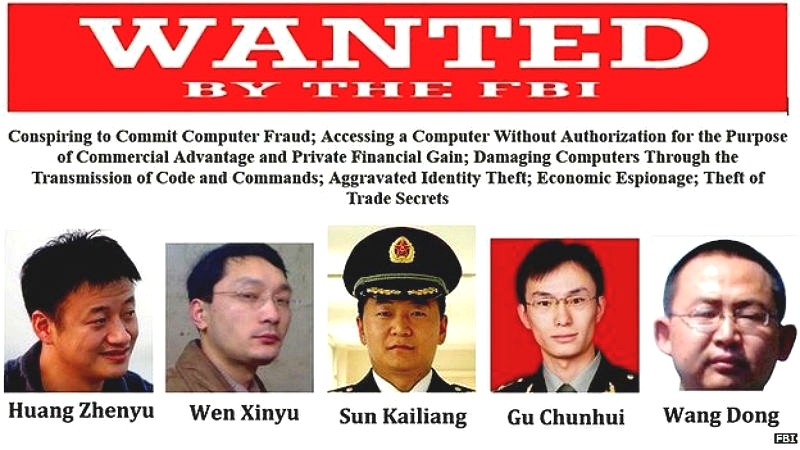
Hackers in China are part of massive government group

Hacks that were previously thought to be the work of unrelated groups have actually been coordinated by China since at least 2009
BY ZOEY CHONG


There's a Chinese proverb that roughly translates to "One chopstick is easily broken, but a bundle of chopsticks is unbreakable."
Multiple hacking groups in China previously thought to be individual actors are actually part of a larger, long-running, state-sponsored umbrella group, according to threat research group 401TRG at Denver-based security company ProtectWise.
The larger group, which 401TRG dubbed the Winnti umbrella, is an "advanced and potent threat" with a primary long-term mission that is politically focused, the researchers warn in a report released last week. 
Winnti refers to a "custom backdoor used by groups under the umbrella," 401TRG said in its report.
Hacking activities are not uncharted waters for China. 
According to a report earlier this year from security company Recorded Future, the Chinese government lied about belatedly informing the Chinese public of security flaws in order to hide exploits it was using in attacks.
The state-sponsored campaigns stretch back to 2009, with some reports of potential activity as far back as 2007, 401TRG said. 
These include some highly visible operations uncovered by Kaspersky Lab in 2013 and Trend Micro in 2017, as well as attacks targeting journalists reported by the Citizen Lab.
People working for the umbrella group typically begin by phishing users who may provide a stepping stone to a target network, according to the report. 
Data is then harvested using malware, though "campaign themes have matured" this year with "code signing certificates and software manipulation" becoming more popular.
"Gaming studios and high tech businesses" in China, Japan, South Korea and US have been the group's initial targets
While Winnti umbrella attackers usually use their own command-and-control servers to mask their actual location, 401TRG said, they have occasionally made "sloppy" mistakes that provide clues to their Chinese origins. 
In these cases, they "mistakenly" accessed machines using IP addresses linked to a China Unicom network in the Xicheng District of Beijing.
The group continues to function, the report said.

Chinese Paranoia

Statement from the Press Secretary on China’s Political Correctness

President Donald J. Trump ran against political correctness in the United States. He will stand up for Americans resisting efforts by the Chinese Communist Party to impose Chinese political correctness on American companies and citizens.
On April 25, the Chinese Civil Aviation Administration sent a letter to 36 foreign air carriers, including a number of American carriers. This notice demanded that carriers change how “Taiwan,” “Hong Kong,” and “Macao” are identified on their websites and in their promotional material so that the references fall in line with the Communist Party’s standards.
This is Orwellian nonsense and part of a growing trend by the Chinese Communist Party to impose its political views on American citizens and private companies.
China’s internal Internet repression is world-famous. China’s efforts to export its censorship and political correctness to Americans and the rest of the free world will be resisted.
The United States respects the broad freedom private companies have in their interactions with their customers, both in the United States and abroad. This respect is essential for a robust global marketplace.
The United States strongly objects to China’s attempts to compel private firms to use specific language of a political nature in their publicly available content.
We call on China to stop threatening and coercing American carriers and citizens.

Malaysia Is Fed Up With Chinese Cash

Belt and Road funding has become a bitter election issue.
By Adam Minter
Too much of a good thing? 

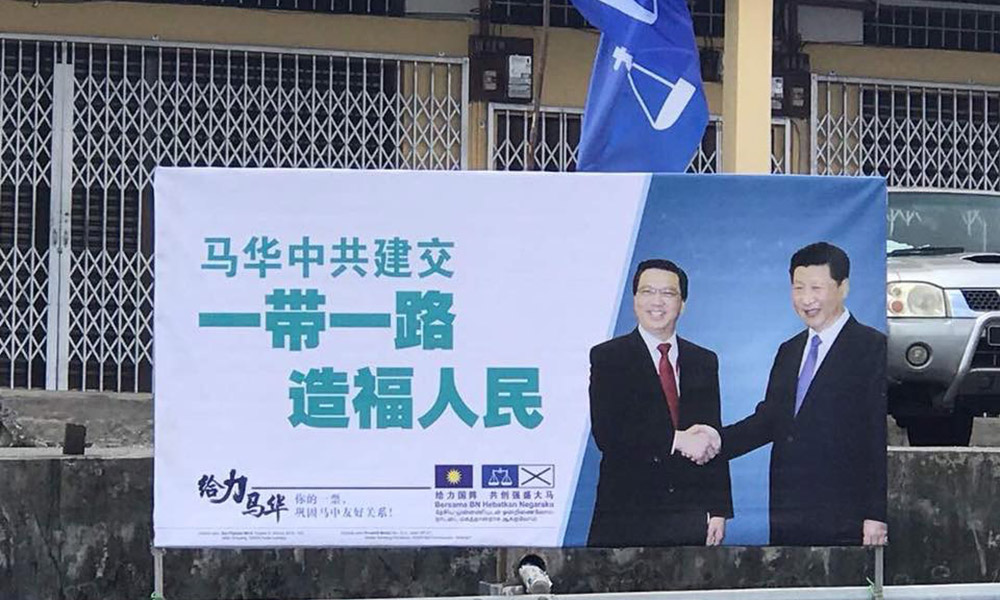
Xi Jinping won't be on the ballot when Malaysians vote for a new government on Wednesday. 
But he is on election billboards. 
Although it's probably not a role that Xi would've chosen for himself, China's influence on Malaysia's economy has become one of the most bitterly contested issues in a bruising campaign.
That's certainly awkward for China, which presents itself as a champion of economic development around the world. 
Increasingly, though, its vision isn't shared. 
In Malaysia and elsewhere, popular opposition to Chinese investment is rising, driven by the perception that its benefits flow only one way. 
In that sense, Malaysia's election should be a wakeup call.
Until recently, Malaysia actually sent far more investment to China than the other way around. 
But in 2013, Xi announced his signature Belt and Road initiative, a $1.5 trillion infrastructure project spanning 80 countries. 
It's designed to knit distant markets more closely to China, while also spurring local development. Malaysia's strategic location on the Strait of Malacca, through which about 40 percent of global trade flows, makes it a prime destination for such investment.
And China has indeed invested. 
So far, there are $34 billion worth of government-backed projects underway, including a gas pipeline and the $17 billion (at least) East Coast Rail Link. 
China's private sector is splurging, too: Between 2012 and 2016, Malaysia received $2.37 billion in Chinese real-estate investment, ranking it third among Belt and Road countries. 
Chinese money is also pouring into manufacturing, energy, and metals, as well as logistics and e-commerce.
Malaysia's current government has welcomed these investments as needed infusions into an economy battered in recent years by low oil prices and scandal-driven financial uncertainty. 
But several factors have started turning Malaysians against them.
For one thing, there are widespread fears about how China is financing these big projects and whether Malaysia can actually meet its payments. 
Last year, Sri Lanka handed over its Port of Hambantota to Chinese state-controlled firms in return for $1.1 billion in relief from debts incurred building the port. 
That development wasn't missed in Malaysia, where China has been lending just as aggressively.
Chinese companies are also notorious for importing workers, equipment and materials from back home, rather than relying on local resources. 
In the case of Malaysia's rail link, the government has even cited language barriers to defend the practice. 
Similar complaints have been aired from Ghana to the Philippines.
Chinese real-estate investment, meanwhile, has spurred jealousy, sovereignty concerns and xenophobia. 
Between 2012 and 2016, foreigners accounted for about 35 percent of residential land transactions in Malaysia, with Chinese making up the majority. 
Most notable is the massive Forest City development off the Straits of Johor, which is expected to eventually have 700,000 residents. 
So far, 70 percent of the buyers have been Chinese. 
The units, costing upward of $250,000, are out of reach for most locals.
Malaysia's opposition, led by former Prime Minister Mahathir Mohamad, hasn't shied away from exploiting these concerns. 
In a recent interview with Bloomberg News, Mahathir invoked both Sri Lanka's loss of Hambantota and the surge of foreigners into Forest City as reasons to scrutinize China's investment splurge. 
"No country wants to have an influx of huge numbers of foreign people into their country," he said.
It's a potent message. 
In 2015, Sri Lanka's president lost a reelection bid over accusations that he was too cozy with China, and his successor is now coming under similar attack. 
Although Mahathir is unlikely to unseat Prime Minister Najib Razak on Wednesday, his criticisms are taking a toll, as evidenced by the government's increasingly elaborate defenses of Chinese investment. 
No matter who wins, the Malaysian public will have become more cynical about China's role in its economy.
For China, that's surely an unwelcome development. 
But Belt and Road investment will become a divisive political issue in other countries unless China ensures that it doesn't become a burden for places that can ill afford it. 
That means lending on less onerous terms, hiring locally, and generally making sure that the benefits of its largesse are more widely shared.
Such steps won't make everyone happy. 
But they'll go a long way toward keeping Xi Jinping off of other election billboards.