The New York Times

China’s assertive campaign to police discourse about its policies, even outside of its borders, and the acquiescence of American companies eager to make money in China, pose a dangerous and growing threat to one of this nation’s core values: the freedom of expression.
The Communist state is becoming more and more aggressive in pressuring foreign companies to choose between self-censorship and the loss of access to what will soon be the world’s largest market.
An old list of taboo topics, sometimes described as the “three Ts” — Tibet, Tiananmen and Taiwan — has been joined by newer subjects that must not be mentioned, including protests in Hong Kong and China’s mistreatment of its Muslim minority.
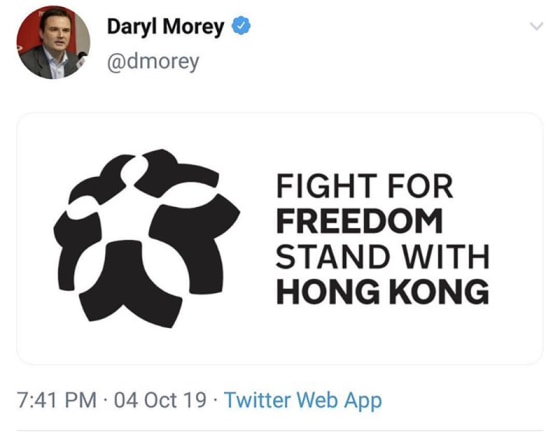
This month, China responded to a tweet by Daryl Morey, the general manager of the Houston Rockets, in support of the Hong Kong protesters — a message he posted while in Japan, on a website that is not even accessible in mainland China — by demanding Mr. Morey’s firing and by canceling broadcasts of N.B.A. games, a histrionic display intended not just to punish the N.B.A. but also to intimidate other foreign firms into censoring themselves.
The Constitutions of China and the United States both enshrine freedom of speech, but China’s totalitarian regime has long taken a narrow view of that freedom — and American companies have long accepted those restrictions while doing business in China.
Now, however, China is seeking to control not just what is said in China but what is said about China, too.
If China has its way, any topic it deems off limits will be scrubbed from global discourse.
For the first time since the end of the Cold War, the United States finds itself in a contest of ideas and principles with a country in its own weight class.
For the first time since the end of the Cold War, the United States finds itself in a contest of ideas and principles with a country in its own weight class.
But this time is different.
The United States and China are economically intertwined.
But China is engaged in the kind of cultural imperialism it often decries.
China insists that its national interest is at stake.
China insists that its national interest is at stake.
So is the national interest of the United States and other free nations.
China has taken a hard line, and it’s time for the United States to respond in kind.
The United States and American businesses have a duty to not appease the censors in Beijing — even if the price of insisting on free expression is a loss of access to the Chinese market.
The N.B.A., to its credit, is standing firm.
The N.B.A., to its credit, is standing firm.
After an initial round of obsequious apologies prompted widespread criticism in the United States, the league’s commissioner, Adam Silver, said that the league was committed to free expression and that players and other league personnel remained free to speak their minds despite what he described as “fairly dramatic” financial repercussions from lost business in China.
“We wanted to make an absolutely clear statement that the values of the N.B.A., these American values — we are an American business — travel with us wherever we go,” Mr. Silver said on Thursday in New York.
“We wanted to make an absolutely clear statement that the values of the N.B.A., these American values — we are an American business — travel with us wherever we go,” Mr. Silver said on Thursday in New York.
“And one of those values is free expression.”
But far too many American companies have shown that their values are for sale.
But far too many American companies have shown that their values are for sale.
They don’t even haggle much over the price.
Last year, the Chinese government demanded that foreign airlines remove references to Taiwan from their websites, because China views Taiwan as a renegade province.
The four American airlines affected by the order — American, Delta, Hawaiian and United — present themselves to the world as representatives of the United States.
The American flag is painted on the outside of their planes; the interiors are American territory.
But instead of standing up for American values, the airlines complied with China’s orders.
Other recent examples of capitulation include the fashion retailer Coach destroying T-shirts that read “Hong Kong,” rather than “Hong Kong, China,” and Marriott firing a social media manager in Omaha for “liking” a tweet posted by a group that backs Tibetan independence.
Increasingly, China doesn’t even need to raise an eyebrow for global businesses to blink: American companies are engaged in proactive appeasement.
Increasingly, China doesn’t even need to raise an eyebrow for global businesses to blink: American companies are engaged in proactive appeasement.
In the new animated movie “Abominable,” released by DreamWorks, a subsidiary of Comcast, one scene includes a map of China with a boundary line encompassing most of the South China Sea.
The United States does not recognize that line; neither do the other nations that border the sea, including Vietnam, which pulled the film from theaters.
ESPN, a Disney subsidiary, displayed a similar map of China — showing what is known as the “nine-dash line” in the South China Sea — on a recent broadcast.
Comcast and Disney are, of course, free to advocate for the Chinese Communist Party’s position, and against the American and global consensus, in the continuing dispute over China’s international boundaries.
Comcast and Disney are, of course, free to advocate for the Chinese Communist Party’s position, and against the American and global consensus, in the continuing dispute over China’s international boundaries.
But by all appearances, the decisions were both less principled and more pernicious: The companies acquiesced in China’s view of the world simply because that was the path of least resistance.
Some companies have tried to evade the issue by insisting they want to avoid politics altogether. Blizzard Entertainment, a subsidiary of the California video game maker Activision Blizzard, banned a user for shouting “Liberate Hong Kong, revolution of our times” during an online tournament earlier this month, and confiscated $10,000 in winnings.
Some companies have tried to evade the issue by insisting they want to avoid politics altogether. Blizzard Entertainment, a subsidiary of the California video game maker Activision Blizzard, banned a user for shouting “Liberate Hong Kong, revolution of our times” during an online tournament earlier this month, and confiscated $10,000 in winnings.
The company, which later returned the money and commuted the ban to a six-month suspension, said it would have taken the same action if a player had shouted in opposition to the Hong Kong protesters.
A rival company, the Los Angeles-based Riot Games, announced its own ban on political speech, warning players to “refrain from discussing” political issues, including the Hong Kong protests. (Tencent, a Chinese conglomerate, holds a 5 percent stake in Activision and owns the entirety of Riot.)
Companies face particular pressure on the internet because deference to physical geography is no longer a viable standard.
Companies face particular pressure on the internet because deference to physical geography is no longer a viable standard.
“When in Rome, do as the Romans do,” has lost its meaning.
On the internet, one is always at home and always in Rome, too.
But there is, or should be, a critical point of difference between American and Chinese internet businesses.
Corporations are the creatures of a particular state, however much their executives prefer to think of their operations as multinational.
American companies choose to operate under the laws of the United States and to reap the benefits of life in the United States — and they ought to be held accountable for upholding the values of the United States.
American companies should feel a responsibility for maintaining the right to free expression in the internet spaces they create and operate.
Otherwise, they risk becoming the enforcers of a corporate regime of global censorship that takes its marching orders from Xi Jinping.
Mark Zuckerberg, the chief executive of Facebook, which is banned in China, said this week that the character of the internet must not be taken for granted.
Mark Zuckerberg, the chief executive of Facebook, which is banned in China, said this week that the character of the internet must not be taken for granted.
“Today, the state of the global internet around the world is primarily defined by American companies and platforms with strong free expression values. There’s just no guarantee that will win out over time.”
Facebook’s role as the private manager of the nation’s public square generates constant controversy, most recently over its refusal to prevent politicians from disseminating clear falsehoods.
Facebook’s role as the private manager of the nation’s public square generates constant controversy, most recently over its refusal to prevent politicians from disseminating clear falsehoods.
And the debate over its policies highlights the challenges and contradictions of America’s commitment to free expression.
Yet Mr. Zuckerberg is undoubtedly correct that his imperfect company, along with other American tech giants, are the guardians of free expression on the internet.
The responsibility of American companies is to maintain that commitment to free expression even if the price is not doing business in China.
It is a price The New York Times, and several other media companies, already pay.
Donald Trump has weakened the ability of American companies to stand up for American values, including free expression, by making clear he does not share those values and by failing to firmly oppose China’s demands.
It is a price The New York Times, and several other media companies, already pay.
Donald Trump has weakened the ability of American companies to stand up for American values, including free expression, by making clear he does not share those values and by failing to firmly oppose China’s demands.
A White House spokeswoman last year described China’s order to airlines as “Orwellian nonsense,” but the administration, which has been so quick to threaten China with harsh consequences for its trade policies, did not defend the airlines by warning of similar consequences for China’s efforts to suppress free speech.
If American companies are to stand up for American values, their own government should be in their corner.
Back in 2009, North Carolina State University canceled an appearance by the Dalai Lama, whom China regards as an enemy of the state.
Back in 2009, North Carolina State University canceled an appearance by the Dalai Lama, whom China regards as an enemy of the state.
The explanation offered by the school’s provost, Warwick Arden, was memorably frank: “China is a major trading partner for North Carolina.”
What Arden and the many Americans in positions of authority who have since followed him down that disgraceful path seem to forget is that North Carolina is also a major trading partner for China.
Those fearing the loss of what the United States gets from China would do well to consider that China fears the loss of what it gets from the United States.
And the government can buttress American companies by making clear that penalties for free speech will be met in kind.
The proper response to a Chinese threat to prevent American planes from landing in China is to make clear that Chinese planes would not be allowed to land in the United States.
America also can strengthen its hand by making common cause with other nations that value free expression.
America also can strengthen its hand by making common cause with other nations that value free expression.
China has placed similar pressure on the Italian company Versace; German companies, including Mercedes-Benz; and airlines from around the world.
America’s commitment to human rights, including the freedom of expression, has always required careful tending and firm resolve.
America’s commitment to human rights, including the freedom of expression, has always required careful tending and firm resolve.
It now faces an especially stern test.
The world is watching — and talking.