Affichage des articles dont le libellé est Hamburg. Afficher tous les articles

lundi 22 octobre 2018

Chinese Peril

Coming soon to a military base near us: China
BY DOV S. ZAKHEIM

With China very much in mind, Congress has passed the Foreign Investment Risk Review Modernization Act, or FIRRMA, mandating the Committee on Foreign Investment in the U.S. (CFIUS) to review and, if necessary, block both foreign attempts to acquire real estate in sensitive areas and joint ventures that could involve the transfer of American technology to foreign companies.
At the same time, however, China has established its footprint in key logistical hubs worldwide and is seeking to expand it even further.
Its growing global logistical reach could pose serious national security challenges for the United States and its allies.
China has built a naval base in Djibouti, on the Horn of Africa, from which its ships have been operating since 2017. 
It financed the construction of the Sri Lankan port of Hambantota; when Sri Lanka could not repay its debts to China, Beijing obtained a 99-year lease on the port. 
At the end of June 2018, the Sri Lankan government announced that it would move the headquarters of its southern fleet to the Chinese-operated port. 
Whether this move will result in Chinese constraints upon Sri Lanka’s freedom of action remains to be seen, but it cannot be ruled out.
Yet, it is China’s increasing presence in Europe and its environs that may well be the cause of greatest concern for Washington, and should be for its allies. 
China has obtained a significant presence on the territory of four NATO allies — Greece, the Netherlands, Belgium and Germany — and almost managed to do so in a fifth. 
China capitalized on Greece’s financial crisis in 2008 to begin operating a container facility in Piraeus, the port of Athens; it since has acquired a 35 percent stake in Rotterdam’s Euromax container terminal, which can take the world’s largest container ships, as well as a 20 percent holding in Antwerp’s container terminal, one of the fastest-growing terminals in Europe. 
In July 2017, the Hamburg Port Authority awarded the construction of a new container terminal to a Chinese conglomerate.
Rotterdam, Antwerp and Hamburg are Europe’s three biggest ports.
The fifth attempt at a NATO incursion — a near-miss for China — was its attempt through the China Communications Construction Company, a state-owned enterprise, to expand and modernize three disused airfields in Greenland
The company asserted its intention was merely to expand tourism in the sparsely populated island. But Greenland hosts an American base in Thule, which operates systems related to missile warning and space-related missions. 
Moreover, should China deploy aircraft to these bases, its reach would extend to at least part of Western Europe. 
Not surprisingly, the Chinese bid was extremely worrying to Danish defense officials, especially since China already had sought to acquire a former American facility in Greenland, only to have the deal vetoed by the Danish government.
In fact, the Chinese attempt to win the construction contract for the three airports posed a much more difficult challenge for the government in Copenhagen. 
Denmark is responsible for Greenland’s foreign policy and national security, but Greenlanders manage their internal affairs — and the government in Nuuk considered the decision regarding the airfields to be a domestic matter. 
It was only at the eleventh hour that a Danish company was able to edge out the Chinese and come up with the winning bid.
Most recently, China has expanded its presence in the eastern Mediterranean, along NATO’s southern flank. 
In addition to operating the port of Piraeus, China now has won the right to build two facilities in Israel’s ports of Haifa and Ashdod
Haifa is the headquarters of the Israeli Navy while Ashdod also hosts an Israeli naval base. 
Moreover, American warships, including aircraft carriers, dock at both ports. 
China’s presence in the two Israeli ports thus would enable China to monitor not only Israeli operations and communications but, whenever the U.S. Navy is on a port visit, those of the United States as well.
Retired Israeli and American naval commanders have expressed their concerns about the awarding of these port contracts to the Chinese. 
Israel should take a lesson from the Danes and become far more active in blocking Chinese attempts to penetrate its infrastructure. 
Israel has no equivalent of CFIUS but, clearly, it needs to establish one posthaste, and do so in a manner that, like FIRRMA, has few loopholes. 
Indeed, our other NATO allies should do the same; they must close any loopholes that exist in their foreign investment laws.
Finally, Israel should reconsider the award of the contracts to China or, at a minimum, demonstrate to Washington that China will not be able to monitor American naval operations. 
Should it be unable to do so, Washington should cancel any planned port visits to Israel. 
China’s efforts to gain access to American operations and tactics is troubling enough; our allies and friends should not make it easier for Beijing.

samedi 1 juillet 2017

The EU must stand up to China

The scandalous treatment of Nobel prizewinner Liu Xiaobo means Europe has to challenge Xi Jinping over human rights at next week’s G20 summit
By Natalie Nougayrède

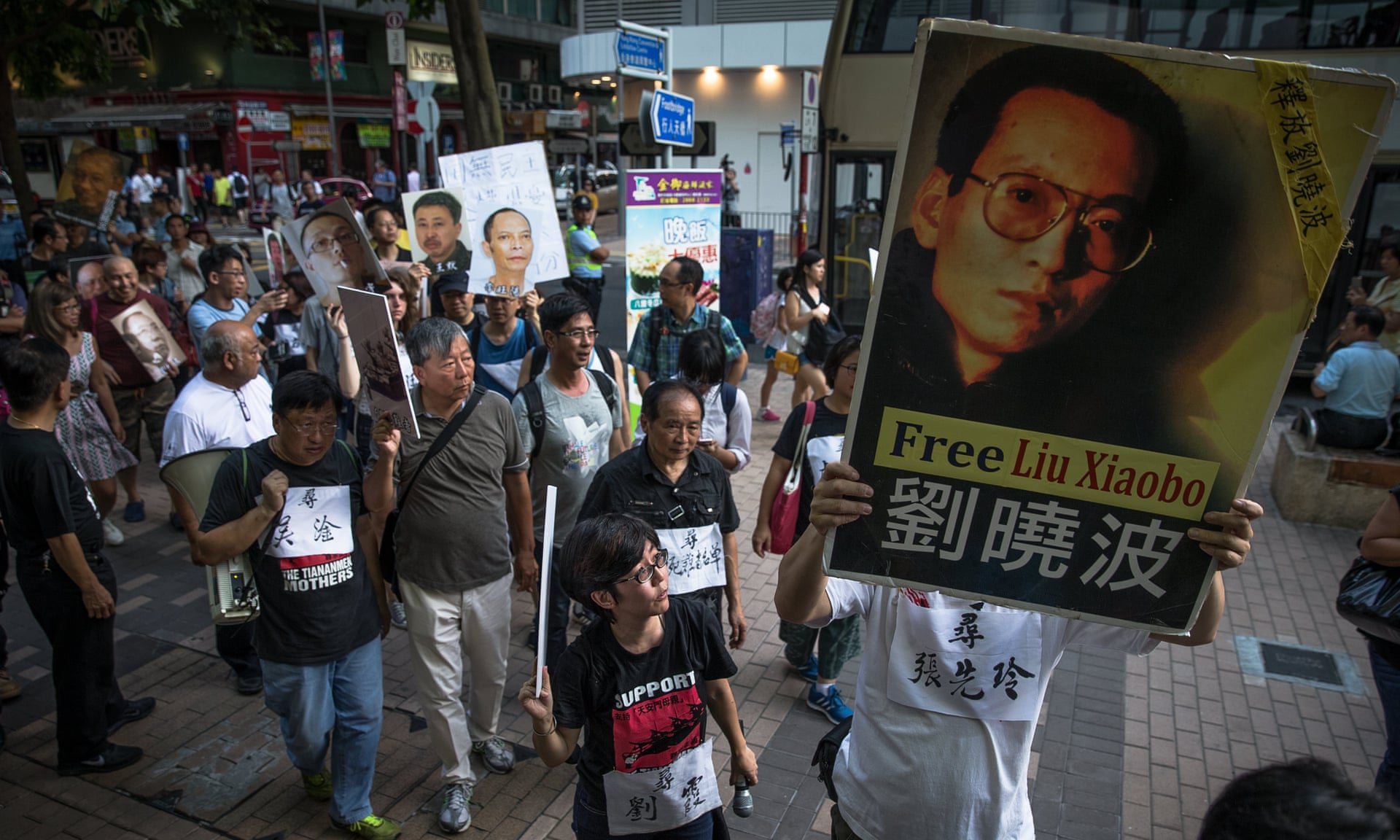
A pro-democracy protest in support of Liu Xiaobo and other jailed activists, in Hong Kong yesterday. ‘Who will cry out Liu’s name in Hamburg?’ 

Next week Donald Trump and Xi Jinping travel to Europe for a G20 summit in Hamburg
Who do you think will attract the most protests? 
Very probably Trump. 
But what about attitudes towards the Chinese leader, whose regime is currently preventing the Nobel peace prize winner Liu Xiaobo from travelling freely to receive cancer treatment in a place of his choice? 
Surely this scandal warrants a strong reaction.
Yet Liu’s oppressors are counting on silence. 
Hamburg is a unique occasion to try to help an iconic dissident and, more than that, to push back against autocracy and defend universal values. 
Will this happen? 
Will the protesters readying themselves to descend on the city also carry “Free Liu!” banners?
Like Nelson Mandela and Andrei Sakharov in their time, Liu is a symbol of the struggle for dignity and human rights across the world, not just in his own country. 
His bravery is indisputable, his cause is universal, and his plight is scandalous.
His illness was recently revealed. 
He is dying, and he is kept under duress. 
His friends say he wants to travel outside China with his wife. 
The Chinese leadership has so far refused the request. It treats him as a criminal. In short, it is intent on making everyone forget about Liu. 
That’s how dictatorships operate.
So who will cry out Liu’s name in Hamburg? 
Alongside the anarchists and radical leftwing activists, hardline militants are promising to create a “hell” of demonstrations
There’s hardly any sign they have Liu in mind. 
More importantly, Europe’s leaders should be preparing to speak with one voice on upholding a rules-based global order: will they include UN human rights conventions in that?
Angela Merkel, the host of a summit being held in the city of her birth, has made it plain that confronting Trump on climate change, trade and multilateralism are her priorities. 
“If you believe you can solve the problems of this world with isolationism and protectionism you are very wrong,” she’s warned. 
She’s laid out the question that stands before Europe: “What role will the continent play in the years to come?” 
Note: she hasn’t said much about dealing with Xi on human rights.

Liu Xiaobo (left) is fed to by his wife, Liu Xia, in a hospital in China. Last month he was diagnosed with liver cancer, and his request to travel abroad for treatment has been denied. 

It’s easy to ascribe this to the cynicism that comes with protecting business interests: China is an important economic partner for Germany, and its political leverage increases with every investment or buy-up it secures in other European countries too. 
Witness Greece vetoing an EU condemnation of China’s human rights record at the UN in June.
But a larger diplomatic factor is in play: China has positioned itself as a power that might help Europe counter Trump’s views on climate and trade, and is fast capitalising on Europe’s need for its cooperation – as Xi’s performance in Davos, to loud applause, illustrated.
Here’s the crux, however: Europe feels on the up these days, and wants to show it is more confident. Its leaders insist that, with Trump in the White House, there is a growing need to be steadfast on one of the EU’s key principles: an open world where individual rights and international norms are protected, not threatened.
Citizens want that too. 
The supporters of autocrats such as Vladimir Putin – Xi’s international ally – have, after all, hardly come out victorious in recent elections across the continent. 
Against that backdrop, surely Liu’s case is one on which Europe’s voice must be heard much more clearly and combatively.
Liu’s tragedy is not just about one man – nor is it something Europe should minimise. 
Liu was imprisoned for penning Charter 08, a political manifesto calling for basic freedoms in China that was inspired by the history of eastern European dissidents in the communist bloc. 
Its particular reference was to Czechoslovakia’s Charter 77, with Václav Havel at its helm. 
He went on to become president of his country in 1990, and in many ways acted as a moral voice in Europe.
At a time of democratic backsliding in eastern Europe, a wholehearted defence of Liu would help cement the EU’s commitment to its values, and demonstrate an awareness of what courage can do in politics. 
The “power of the powerless” (to quote the title of one of Havel’s memorable texts) is what Liu symbolises.
Memories of this part of Europe’s history should be rekindled – they carry urgent messages for today. And there is another special European responsibility here: like Liu, the EU was awarded the Nobel peace prize (in 2012), in recognition of six decades of work in promoting “peace and reconciliation, democracy and human rights”.

Fifth column: Greece blocks EU's criticism at UN of China's human rights record

Sadly, as Liu’s fate hangs in the balance there has been only a modest level of support for him in official EU statements. 
France, it is true, has indicated it would be ready to welcome him. 
European diplomats in Beijing are said to be closely following Liu’s situation. 
But as worthy as these steps may be, they fall short of expressly – and officially – addressing the significance of what is at stake. 
Liu’s battles should rank alongside those of other globally applauded emblems of nonviolent resistance to oppression, such as Martin Luther King or Aung San Suu Kyi.
Xi is coming to Europe and will appear before the world’s cameras at the first Trump-era G20
Now is the time for Europeans who care about the world they want to live in to show some solidarity on human rights – not just on climate and trade. 
Now is the time for some naming and shaming. 
If the Chinese leader gets through this summit without any pressure over Liu’s full freedom, the illiberal state model he promotes will only be strengthened. 
No one would stand to gain.
Targeting Trump in Hamburg is understandable, but we can confidently hope America’s democratic system will one day get the better of him. 
There are no such checks and balances in China, as Hong Kong dissidents well know. 
Chinese human rights activists have only their courage to count on, and the hope that the outside world, its citizens and its democratic governments, will somehow show support.
If you’re getting ready to protest in Hamburg, think about Liu Xiaobo. 
This is the time and place to act: to show you care about one man’s brave struggle against a regime’s impunity. 
It wouldn’t be about “western imperialism”: it would be about people power. 
Liu is like that man.