Affichage des articles dont le libellé est special economic zones. Afficher tous les articles

mercredi 20 juin 2018

VIETNAMESE SEE SPECIAL ECONOMIC ZONES AS ASSAULT FROM CHINA

The South China Sea dispute, along with memories of the 1979 border war, run deep in the Vietnamese national psyche, making SEZs viscerally unpopular
BY BENNETT MURRAY

The Vietnamese government is confronting a rising tide of public anger as its parliament debates a controversial bill to create three new special economic zones (SEZs), raising fears of Chinese encroachment on Vietnamese soil.
Although Vietnam already has 18 SEZs, the new concerns largely stem from a provision that would allow 99-year leases in some cases within the three new zones in Quang Ninh and Khanh Hoa provinces, as well as on Phu Quoc Island. 
The bill does not explicitly mention any particular country but it is widely presumed China, Vietnam’s largest trading partner, would dominate investments in the SEZs.
Attempting to allay concerns, Prime Minister Nguyen Xhan Phuc announced on Thursday the government would adjust the 99-year time frame but did not elaborate.
“In recent days, we have listened to a lot of intellectuals, the people, members of the National Assembly, senior citizens and overseas Vietnamese,” Phuc said.
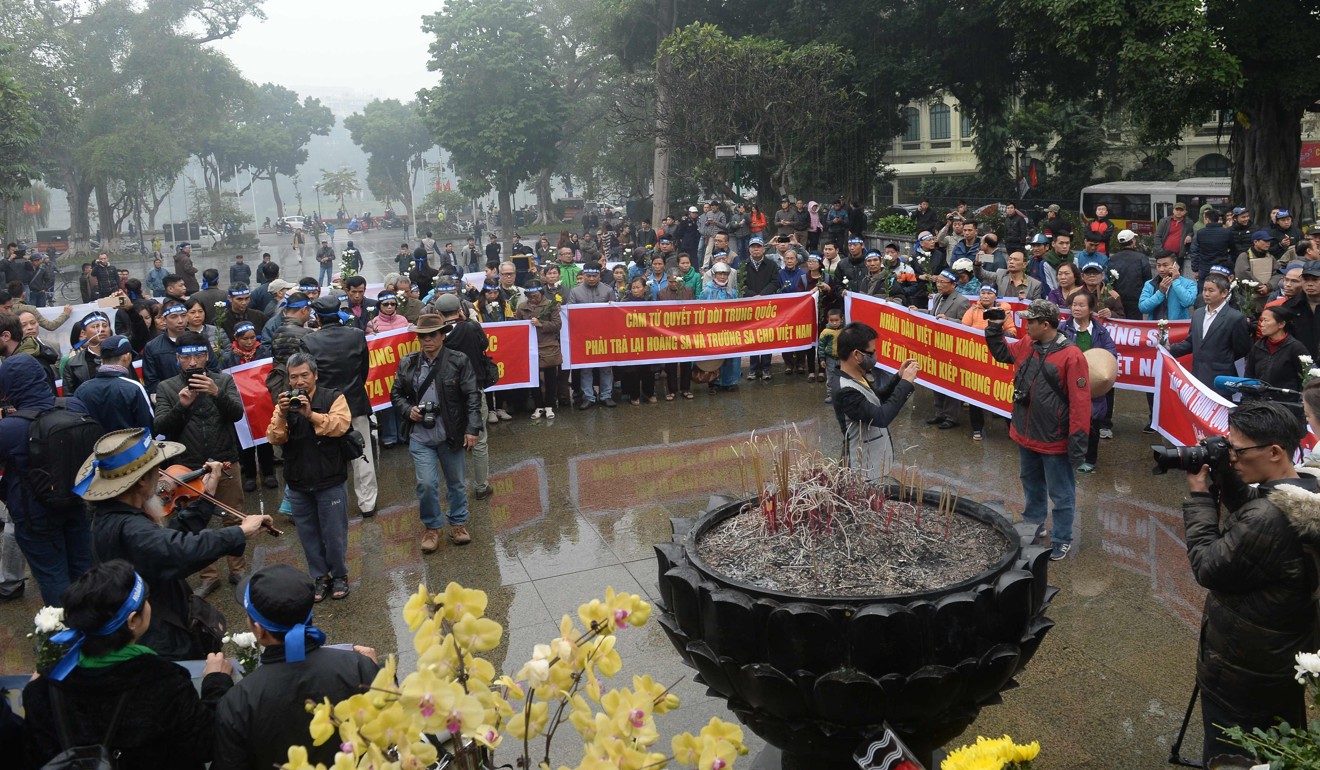
Activists stage a rally marking the 42nd anniversary of the 1974 naval battle between China and then-South Vietnamese troops over the Paracel Islands, in front of the statue of Vietnamese King Ly Thai Tô in Hanoi. 

Nguyen Chi Tuyen, a Hanoi-based dissident blogger with 42,500 Facebook followers, said he rarely saw such public interest in the National Assembly, a legislature that usually acts as a rubber stamp for the Communist Party’s Central Committee.
“This time they’ve got a lot of attention from the people, not just activists or dissidents but the normal people,” he said, adding that anti-China sentiment has fuelled anger.
He was unimpressed by Phuc’s pledge to adjust the 99-year lease provision.
“It’s not how long, but this is one kind of selling our land to foreigners under the so-called SEZs,” Tuyen said.
With popular Vietnamese anger towards China simmering over Beijing’s maritime claims in the South China Sea, Le Dang Doanh, a retired senior economic adviser to the government and member of the Communist Party, said he fears an explosive response from the public should the bill pass. 
That the proposed SEZ in Quang Ninh province is not far from China’s Guangxi autonomous region is of particular concern, he added.
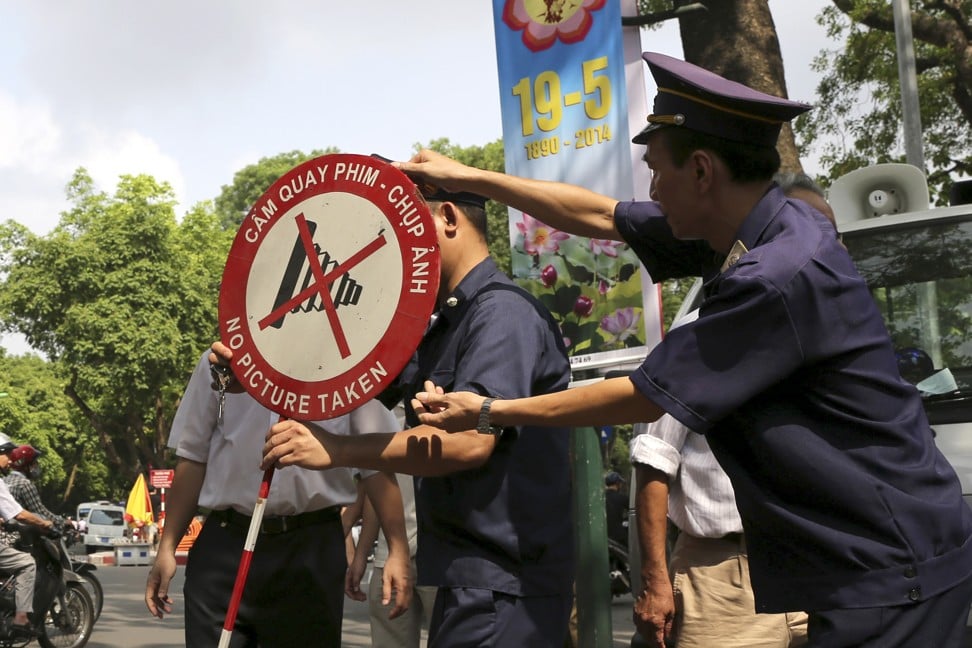
Vietnamese security officers move a sign advising people not to take photographs near the Chinese embassy in Hanoi after authorities forcibly broke up small protests against China in May 2014. 
“If now the Chinese occupy the three special economic zones, especially the one in Quang Ninh, it will trigger a very strong reaction from the Vietnamese people,” said Doanh, adding that he had signed a petition asking to postpone passage of the law.
Tuyen said the South China Sea dispute, along with memories of the 1979 border war, run deep in the national psyche, making SEZs viscerally unpopular.
“We have a long history with the Chinese people, they always want to invade our country, so it is dangerous to allow them to use these SEZs to control our country,” he said.
In recent years, the maritime dispute has prompted rare public protests in the one-party communist state. 
Demonstrations turned violent in 2014 following China’s deployment of the Hai Yang Shi You 981 oil rig in the South China Sea, with at least 21 killed and 100 injured in clashes targeting Chinese-owned factories, although many were owned by firms from other countries. 
The government has since cracked down on anti-China protests.
Nguyen Quang A, a retired banker and prominent pro-democracy activist, said the government must guard against suspicions it has become too cosy with fellow communists to the north.
“There are a few issues which are very dangerous for the legitimacy of the Communist Party in Vietnam, and that is one,” said Quang A, himself a former party member.


China's expansionism fuels protests in Vietnam

Popular opinion has concluded that China will be the main beneficiary of pending economic policy in Vietnam, triggering two weeks of protests. The proposed economic zones will enable Chinese companies to take over the coast with little regard for the environment or fishermen. 
By Martin Petty

Protests by thousands of people in cities across Vietnam are showing just how easy it is to unite public opinion and mobilize dissent when an issue has one key ingredient: China.
The demonstrations, which are technically illegal, sprung up for a second consecutive week on Sunday, stoked by fears that proposed coastal economic zones for foreigners would be beachheads for an invasion of Chinese businesses.
The proposal makes no mention of China. 
But Vietnamese minds were already made up, with popular Facebook posts reinforcing deep-rooted suspicion that Chinese interests are influencing state policy.
Central to the issue is a combustible mix of generations of anger over Chinese bullying, and a lack of faith in Vietnam's ruling communist party to do anything about it.
"The government underestimated the amount of anti-China sentiment in the country," said Murray Hiebert, a Southeast Asia specialist at the Center for Strategic and International Studies in Washington.
"There's a constant undertone among many in Vietnam that the government isn't doing enough to protect the country's sovereignty against China," Mr. Hiebert added.
Social media such as Facebook, used by half of Vietnam's 90 million people, makes such fervor easy to stoke and hard to contain.
After protests spanned cities nationwide, the National Assembly last week postponed its vote on the economic zones until October.
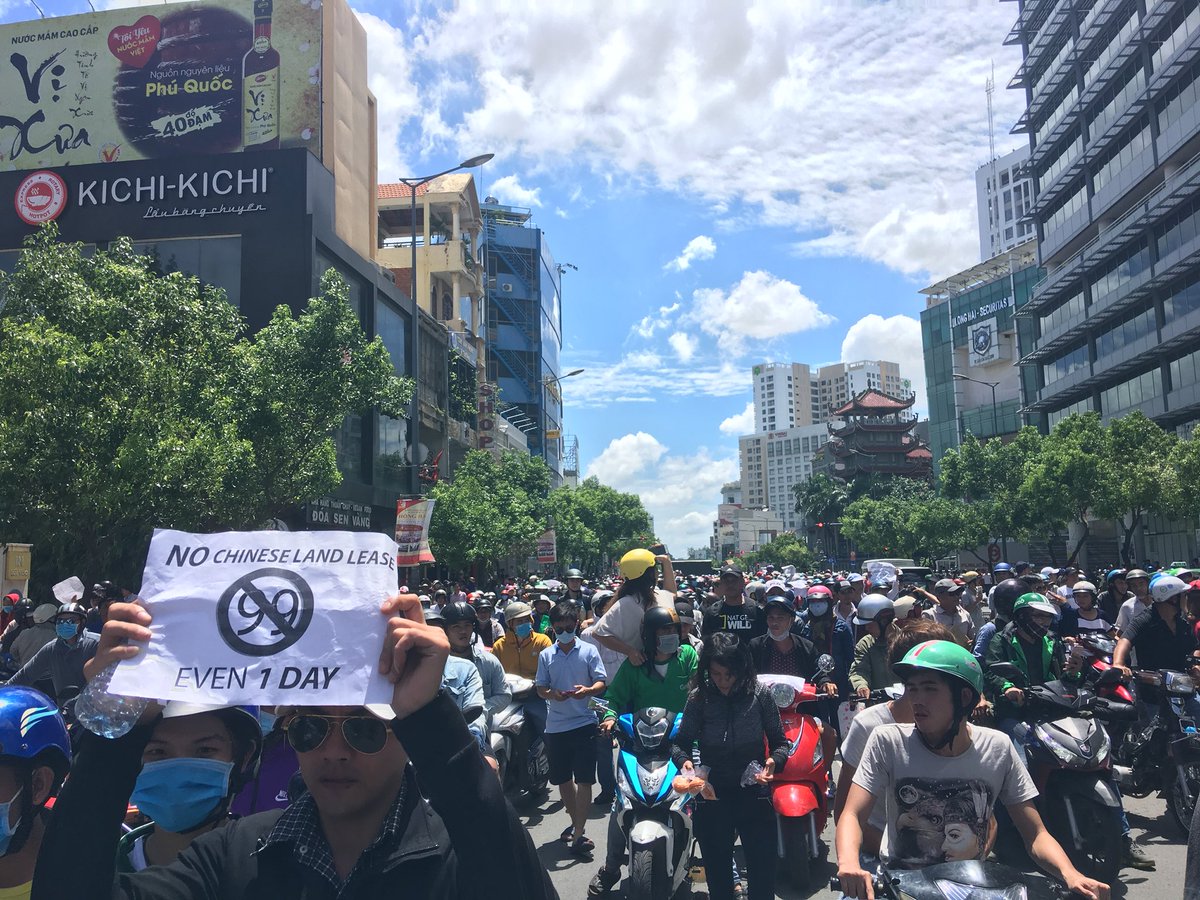
Security was tightened on Sunday to prevent protests in major cities, but thousands still gathered in central Ha Tinh province, many with signs saying "No leasing land to Chinese communists for even one day."
Tensions are likely to persist as long as China pushes its Belt and Road initiative to advance its overseas business, and takes stronger action to fortify its claims over almost the entire South China Sea.
China has been accelerating construction and militarisation in the Spratly and Paracel islands claimed by Vietnam, and in March pressured Hanoi to suspend some major offshore oil drilling for the second time in the space of a year.
The Vietnamese government's resistance to Chinese pressure has been very limited.
The communist party top brass rarely acknowledges anti-China sentiment even exists in Vietnam. 
On Friday, house speaker Nguyen Thi Kim Ngan skirted the issue, saying the legislature "appreciates the people's patriotism and their profound concerns about important issues."
Party chief Nguyen Phu Trong weighed in on Sunday to reassure the public about the economic zones, which have 99-year leases, but also made no specific mention of China.
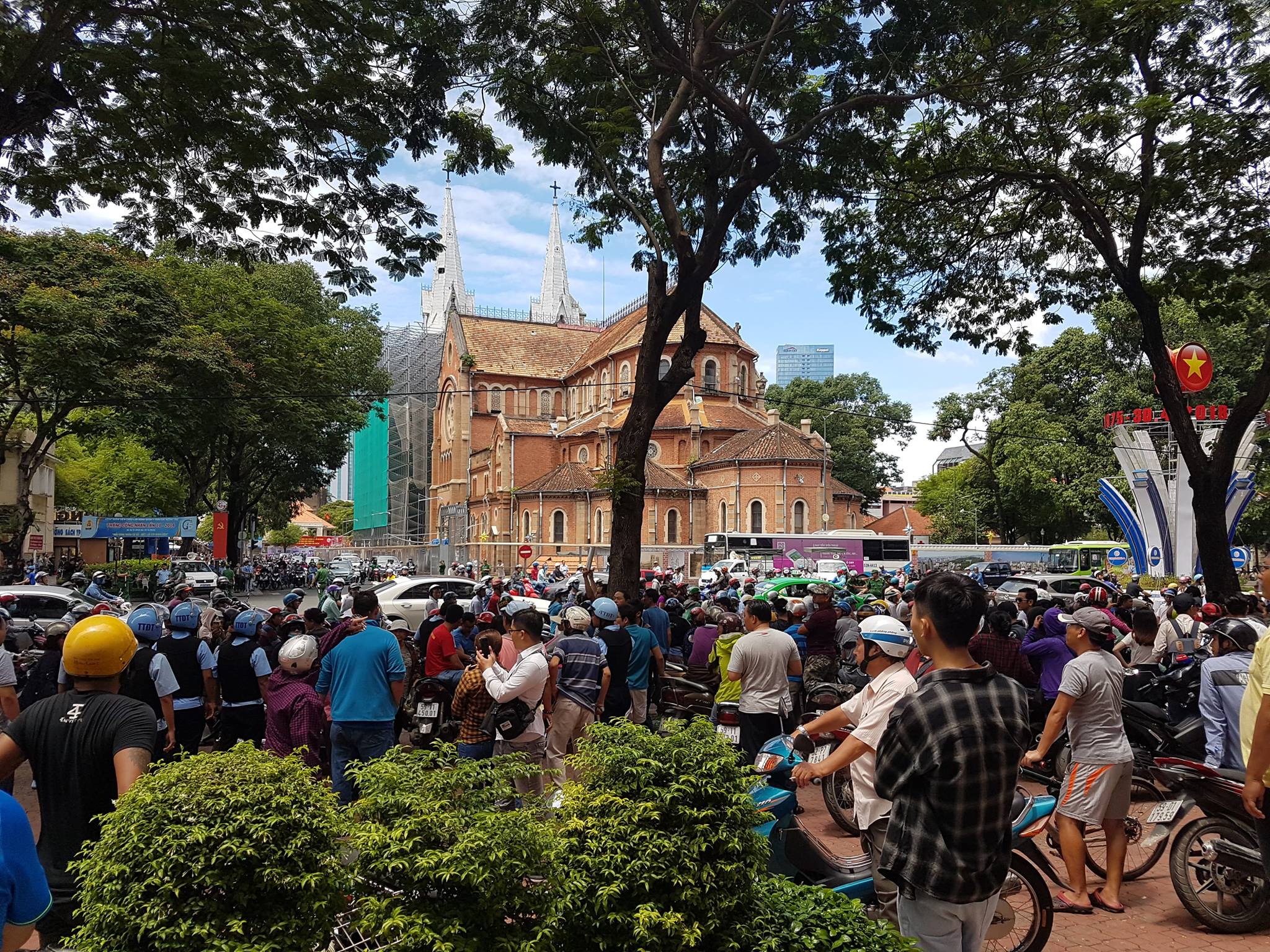
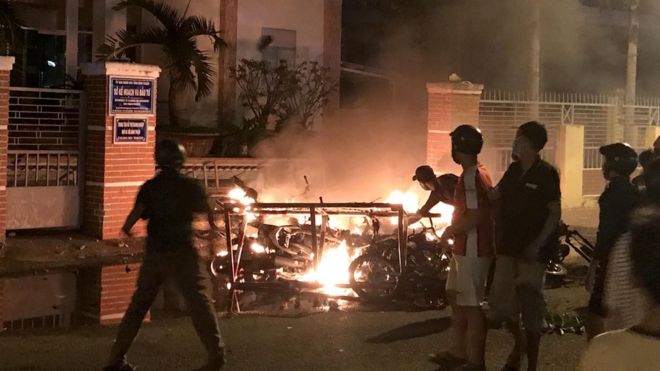
The June 10 protests were in large part peaceful, but turned violent in central Binh Thuan province, where vehicles were set ablaze and angry mobs hurled rocks and charged at riot police.
Tran Vu Hai, a prominent lawyer, said the anger had been festering for years in Binh Thuan, where China is blamed for assaulting fishermen, polluting the land with a Chinese-built power plant, and for deforestation to mine minerals exported primarily to China.
Hai said people were venting fury not only at China, but at a local government, which is perceived as being corrupt and enslaved by destructive Chinese commercial interests.
"They don't investigate why people are irritated and they don't solve the people's problems," he said. "The trust in the authority in that area has already been lost."
The turnout and coordination of protests is now emboldening ordinary Vietnamese, but also complicating the party's difficult balancing act of tolerating some dissent while keeping it under control.
That risks angering a vital trade partner that can hold Vietnam's economy hostage.
The protests are being taken seriously by China; its diplomatic missions in Vietnam held meetings last week with Chinese business groups, local government and local media.
In one of several postings on the embassy's website, it said charge d'affaires Yin Haihong "demanded" that Vietnamese authorities protect Chinese businesses and citizens.
Ms. Yin said the embassy had been informed by the Vietnamese authorities that people with "ulterior motives" had "deliberately misrepresented the situation and linked it to China."
The recent rallies follow similar protests in 2014 after China's deployment of an oil rig off central Vietnam, and months of demonstrations in 2016 over an environmental disaster at a steel plant run by Taiwan's Formosa Plastics.
Responding to questions from Reuters, Vietnam foreign ministry spokeswoman Le Thi Thu Hang made no mention of China but said "extremists" had "incited illegal gatherings." 
Lawmakers say it is time to revisit a long-delayed law to regulate demonstrations. 
The constitution allows freedom of assembly, but protests are often broken up by police and participants held for "causing public disorder."
Others say it's time to listen more to public opinion.


lundi 18 juin 2018

Chinese Peril

China’s control over economic zones leads to more protests in Vietnam
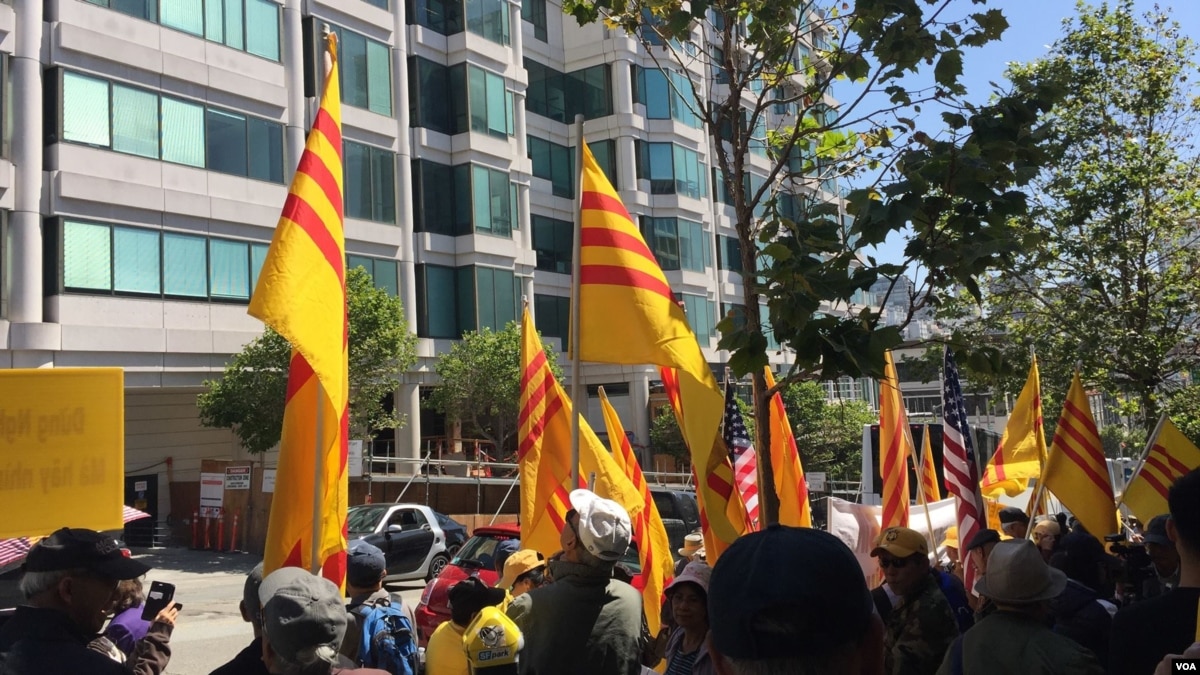
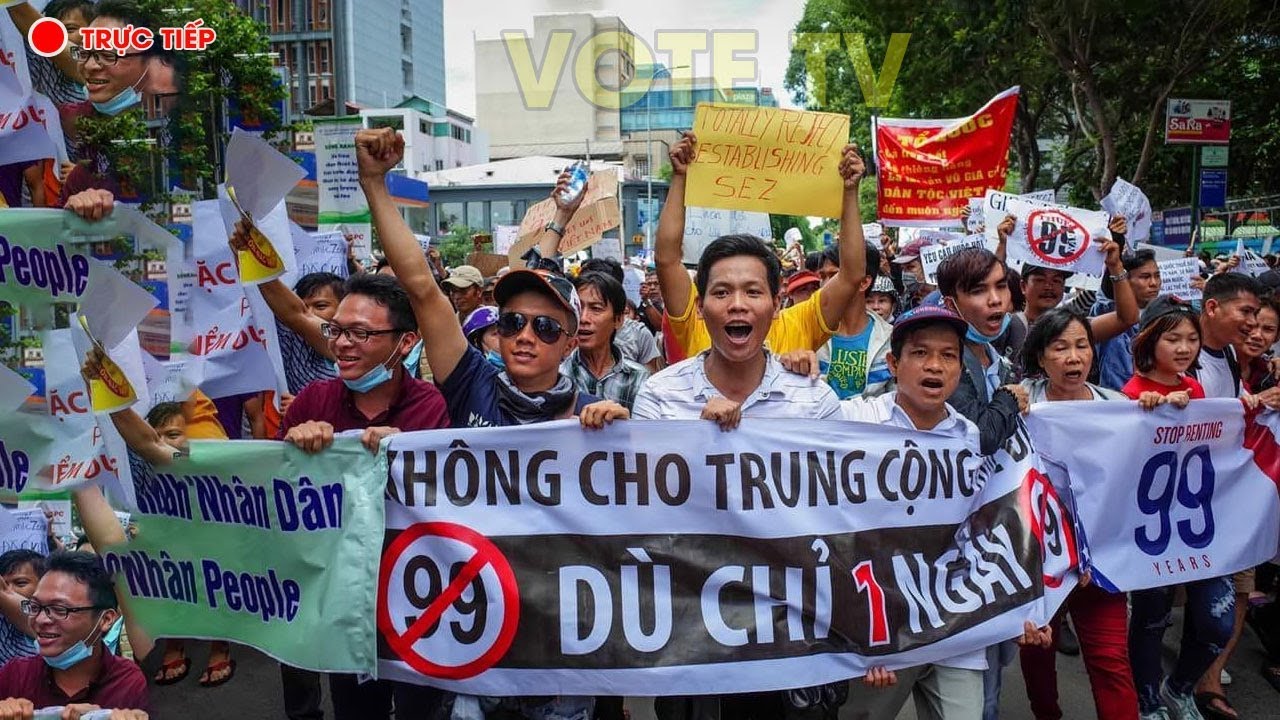
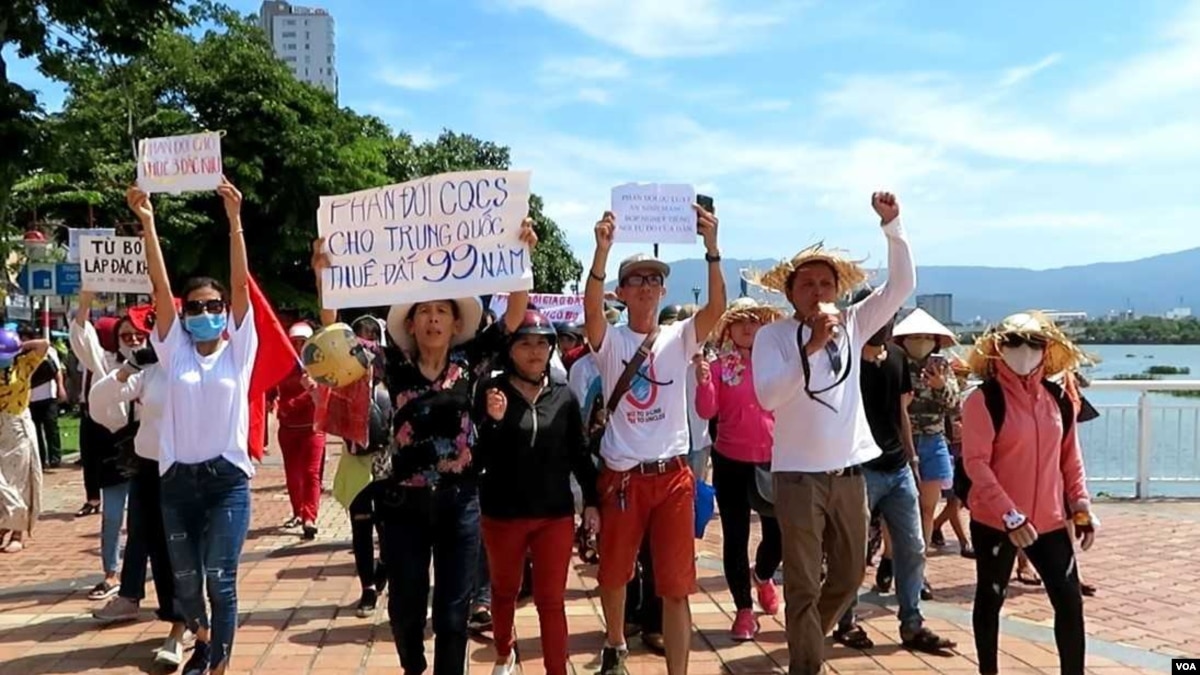
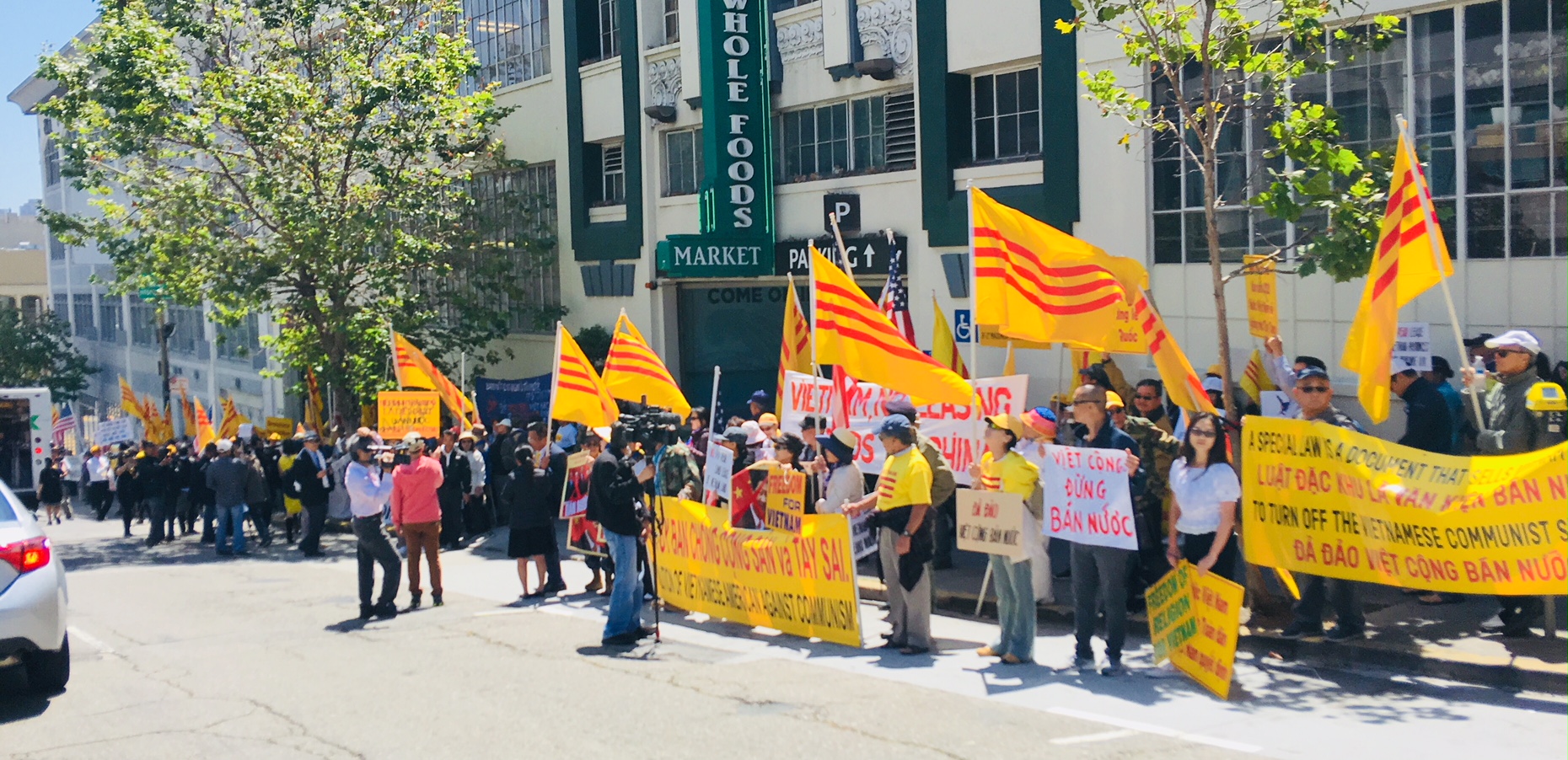
Protesters held signs that said “No leasing land to Chinese communists for even one day” and “Cybersecurity law kills freedom”.
AP


Image result for bieu tinh chong luat dac khu

Image result for bieu tinh chong luat dac khu
Image result for bieu tinh chong luat dac khu BINH THUAN
Vietnamese police have arrested eight more people after protests a week ago over a proposed law on special economic zones that protesters fear would fall into the hands of Chinese investors.
The men from the south central province of Binh Thuan were accused of disturbing public order, opposing officials and damaging state property, the state-run Tuoi Tre newspaper reported.
Protests against the law took place across the country, including in the southern commercial hub of Saigon where seven people were arrested for allegedly disturbing security and opposing officials.
Protesters fear the three proposed special economic zones, where land could be rented for up to 99 years, would be dominated by investors from China.
Lawmakers have postponed the passage of the law until October.
Security on Sunday was tight in many cities and provinces in Vietnam, with a large presence of police in public areas. 
But in central Ha Tinh province, live-stream footage on Facebook showed thousands of people attending a Sunday mass protesting peacefully against the laws.
Protesters held signs that said “No leasing land to Chinese communists for even one day” and “Cybersecurity law kills freedom”.
Witnesses said there were no clashes with police during the two-hour protest.
The Vietnamese government has vowed to punish “extremists” it said had instigated rare clashes with police in Binh Thuan province. 
Protesters hurled bricks and Molotov cocktails at police, damaging some government buildings.
Charge d’affaires of the Chinese embassy in Vietnam, Yin Haihong, said on Friday that the cause of this incident was internal affairs in Vietnam and there was no connection with China.
“However, the incident still has a negative impact on Sino-Vietnamese relations;” Yin said in an embassy statement.

jeudi 14 juin 2018

American Is Detained After Joining Anti-China Protest in Vietnam

By Austin Ramzy
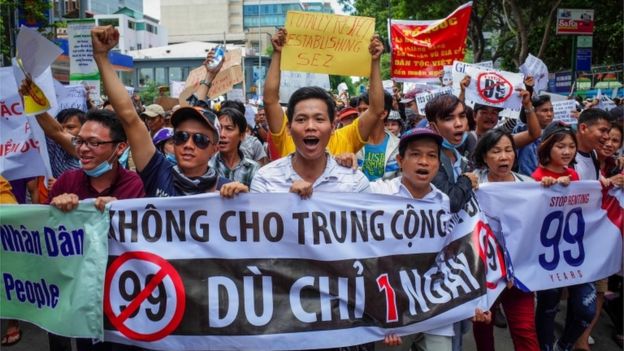
Protesters in Saigon, Vietnam, on Sunday held banners denouncing a proposal to create special economic zones favorable to China.

HONG KONG — An American citizen was among dozens of people arrested in Vietnam this week during protests against proposed special economic zones that have raised fears of Chinese encroachment.
The American, Will Nguyen, was visiting Saigon ahead of his graduation this summer from a master’s program at the University of Singapore, according to a statement from his family and friends.
Mr. Nguyen, 32, a Houston native who graduated from Yale, took part in protests on Sunday. 
He was “beaten over the head and dragged into the back of a police truck,” after the authorities moved to quash the demonstrations that day, according to the statement.
A video from the protests shows Mr. Nguyen, with blood smeared across his face, being dragged by a group of men. 
He is later shown standing in the bed of a pickup truck topped with emergency lights.
He was taken to a police station, but his current whereabouts and physical condition are not known, the statement said.
Mr. Nguyen’s family fled South Vietnam after the war that led to its collapse, he wrote in a recent piece for the website New Naratif that discussed the conflict and the country’s history of divisions between North and South.
“He is a proud Vietnamese-American, and passionate about his studies, specifically Southeast Asian studies, in which he majored,” his sister, Victoria Nguyen, said by email.
Pope Thrower, spokesman for the United States Embassy in Hanoi, said the embassy was “aware of media reports that a U.S. citizen was arrested in Vietnam.”
Will Nguyen, 32, of Houston, has been studying at the University of Singapore.
“When a U.S. citizen is detained overseas, the U.S. Department of State works to provide all appropriate consular assistance,” he added. 
“Due to privacy considerations, we have no further comment.”
From Saigon, Mr. Nguyen posted a series of tweets documenting the protests on Sunday, with crowds of people marching down city streets.
“I can’t stress how enormous of an achievement this is for the #Vietnamese people,” he wrote. 
“The people are exercising their civic duty to protest injustice.”
One image he posted shows a protester who was struck by police officers lying on the street while another person helps him. 
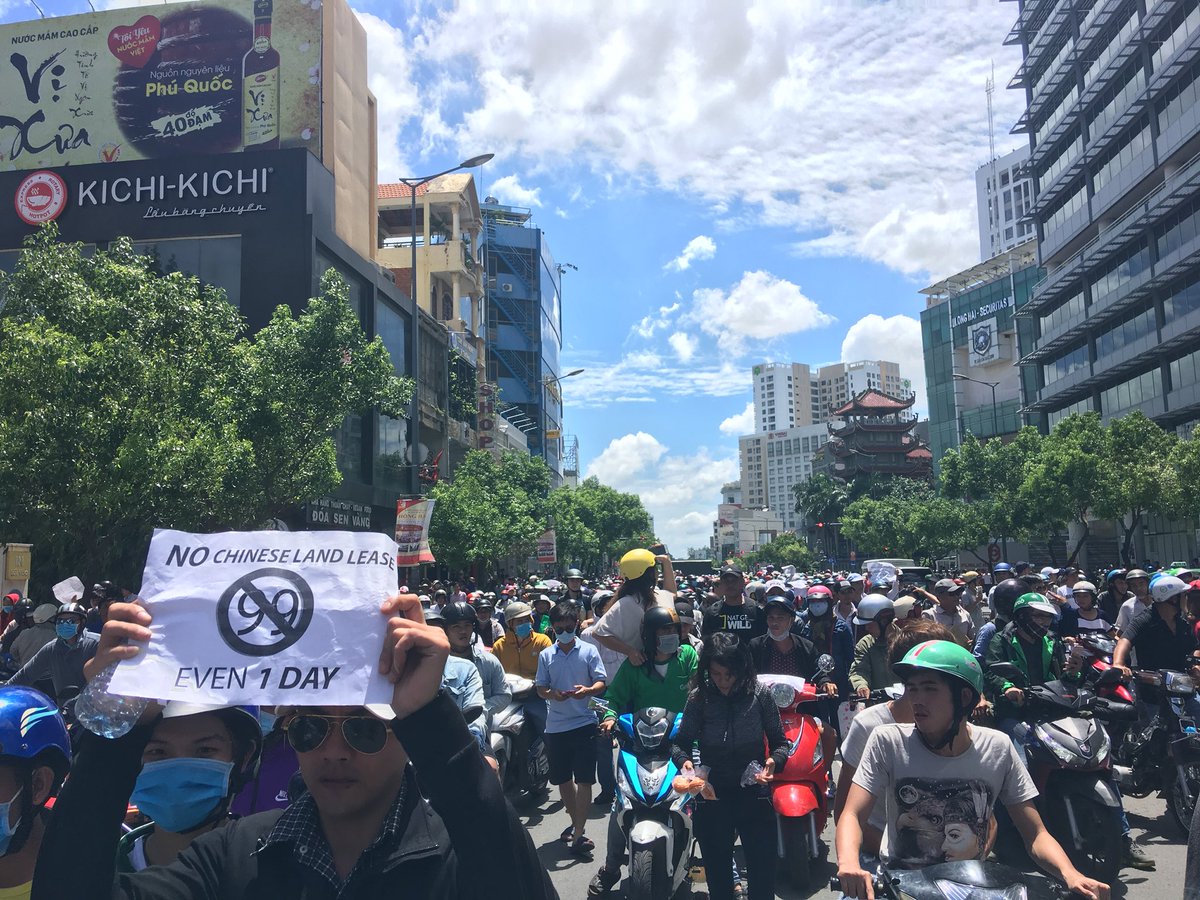
Another shows a protester holding a sign that reads, “No Chinese Land Lease Even 1 Day.”
Mr. Nguyen’s family has not been able to reach him, but his hosts at an Airbnb rental did reportedly speak with him shortly after his detention. 
Police officers showed up at the apartment two days later to confiscate his laptop, passport, credit cards and a change of clothes, his family said.
In addition to the special economic zones, protesters said they were concerned about a proposed cybersecurity law. 
The state-controlled news media in Vietnam reported that 102 people were arrested Sunday in the southeastern province of Binh Thuan, where thousands of protesters blocked a highway and later set fire to public buildings. 
Protests were also reported in Hanoi, the capital.
The proposed special economic zones would give leases of up to 99 years to foreign investors in three areas that would have fewer administrative restrictions than the rest of the country. 
The proposal has stirred fear that it would undermine national security by giving China control over parts of Vietnamese territory.
Vietnam and China have overlapping claims in the South China Sea, and Chinese efforts to extend control have set off protests in Vietnam. 
In 2014, China moved an offshore drilling rig into waters that Vietnam considers part of its exclusive economic zone, which prompted large demonstrations and efforts by Vietnam to force the rig to move.
The two countries fought a brief but bloody border war in 1979, when China invaded Vietnam in an attempt to punish its neighbor for toppling the Khmer Rouge in Cambodia.

mardi 12 juin 2018

Axis of Evil

Vietnam detains 100 after anti-China economic zone protests turn violent
BBC News
Protests turned violent in Binh Thuan province -- where more than 100 people were detained
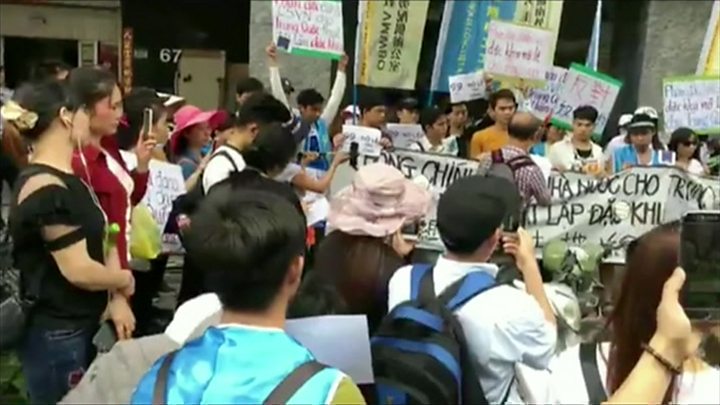
Scores of people have been detained by Vietnamese police amid protests against plans for special economic zones (SEZs) that many fear will be dominated by Chinese investors.
Molotov cocktails and rocks were lobbed at the People's Committee Headquarters in south-eastern Binh Thuan province, where police said 102 people were held.
The proposed law would give foreign investors 99-year leases on SEZ land.
MPs had been set to vote on it this week but this has been delayed.
The decision to postpone the vote in an attempt to defuse the protests was seen as a major concession by the ruling communist party in response to large-scale street demonstrations.
The chairwoman of parliament, Nguyen Thi Kim Ngan, said that people's opinions "will always be heard".
China's embassy in Hanoi has warned its citizens to be careful, referring to the protests as "illegal gatherings" that had included some "anti-China content".
Demonstrators had gathered in various parts of the country over the weekend, including the major urban centres of Hanoi, the capital, and Saigon.
Some carried anti-China banners, including one reading: "No leasing land to China even for one day."
Protests in the cities were quickly suppressed, but authorities faced much greater public anger in Binh Thuan, where demonstrators threw rocks, set vehicles alight, and briefly occupied the local government headquarters. 
State media outlets said dozens of police officers were injured.
On Monday, police formed barricades with their shields across roads into the town, and numerous explosions could be heard, as tear gas was fired into the crowd.
At a fire station attacked by protesters, riot police have laid down their shields and equipment and withdrawn in an apparent peace gesture.

Protests are a rare sight in Vietnam

Why are the economic zones controversial?
The bill offers companies operating in the SEZs greater incentives and fewer restrictions, in an attempt to promote growth in target areas.
But protesters suspect that the communist government will award Chinese investors leases in the three economic zones in the north-east, south-east and south-west of the country, and that this would be a pretext for Chinese control over Vietnamese land.
In Binh Thuan, anti-Chinese sentiment combined with simmering anger over industrial pollution and land disputes, to ignite a flammable cocktail of local grievances, says BBC South East Asia correspondent Jonathan Head.
Demonstrators are also objecting to a cyber security bill, scheduled for a vote on 12 June. 
Human Rights Watch says it would give the government broad powers to quash dissent online.

Why the anger towards China?

China once colonised Vietnam, the two countries fought a border war less than 40 years ago, and Vietnam contests Chinese control of a number of islands in the South China Sea.
As a result, Vietnam's leaders must always tread a delicate line between maintaining relations with their powerful neighbour, and avoiding provoking anti-Chinese sentiment in a fiercely nationalist population.
Roughly $5 trillion worth of global trade passes through the South China Sea annually, and a number of countries claim disputed islands there.
Vietnam has seen protests over the maritime disputes in recent years, including in 2014, when Chinese citizens fled the country in their thousands after violence targeting foreign-owned businesses.

Protesters bring China issue to the fore
By Giang Nguyen

This is the biggest challenge for Vietnam's Prime Minister Nguyen Xuan Phuc since his government was sworn in more than two years ago with a pledge to stamp out corruption and revitalise the economy.
The three special economic zones are meant to be "mini Singapores" - business-friendly environments complete with high-tech hubs.
But Phuc appears to have underestimated deep-seated resentments against China, and the speed at which protesters can utilise social media to organise street marches in cities including Hanoi and Saigon.Protesters like those who marched in Saigon have said they will demonstrate again
While some are fearful of the Chinese influence in Vietnam under the economic zone proposals, others are concerned about plans for a new cyber security bill. 
The latter has angered Facebook users in particular, who fear the authorities will be given too much power, while online surveillance could become the norm.
Critics said the government had lost touch with reality as it tried to push two controversial laws through a parliament where many MPs are openly against both.
Those against the SEZ law include three advisers to the PM.

lundi 11 juin 2018

Axis of Evil: Hanoi selling out economic zones to Beijing

By Paul Nguyen Thanh

Hanoi – "What the authorities are doing is selling out our country to China," said Mr Thuận, a Catholic elementary school teacher, reacting to upcoming trade agreements between the Vietnamese government and its Chinese "communist brothers".
Like him, millions of Vietnamese fear that the authorities will subject the country to the will of Beijing, when on 15 June the National Assembly votes a bill on "special administrative-economic zones".
In particular, lawmakers will decide on the creation of three important Chinese economic hubs in Vân Đồn (Quảng Ninh province), Bắc Vân Phong (Khánh Hòa) and on Phú Quốc Island (Kiên Giang).
If approved, thanks to special incentives, the plan would allow Chinese red capitalists to acquire, for 99 years, the rights to exploit the areas, located in regions of significant geopolitical and historical interest.
The Vietnamese, at home and abroad, are afraid that these areas may become tô giới, kingdoms dominated by China, thus undermining national sovereignty.
Vân Đồn is a strategic island district in the northeastern province of Quảng Ninh, on the border with China.
Located off the Bay of Bái Tử Long, it includes 600 islands and reefs covering an area of ​​more than 550 km2.
Established in 2006, the Special Economic Zone in ​​Bắc Vân Phong covers ​​1,500 km2 and is a major tourist and economic centre.
From this area it is possible to monitor the trade routes that crisscross the South China Sea, which is Beijing’s goal.
Phú Quốc island, 574 km2, provides instead control over the Gulf of Thailand, a fundamental passage for ships that sail the Pacific and Indian oceans.
Justifying the concerns of the citizens, former parliamentarian Nguyễn Minh Thuyết said yesterday that "The Spratly and the Paracel Islands have already ended up in the hands of Beijing. To these must be added the forests along the border, key areas for Vietnam, as well as the coasts of Nha Trang, Đà Nẵng and Vũng Áng, in Hà Tĩnh province.”
"These areas are being intensively exploited and the environment is devastated. The pollution of soil, water and air is damaging the health of the millions of people who live there."
For Nguyễn Xuân Nghĩa, a well-known Vietnamese-American journalist and an international economics expert, "The contents of the draft law on the three autonomous special economic zones concern the survival of the nation and its people. We must consider that the three areas could be given in concession to a foreign country for almost a century."
Over the years, Vietnamese and international experts have said that "the main projects of the Chinese government in Vietnam have failed or have damaged the environment in a terrible way".
These include the Highland Bauxite Project, the Formosa Steel Company plant in Vũng Áng (Hà Tĩnh province), and projects in Dung Quất and Nhân Cơ projects etc.
Despite this, the Vietnamese government continues to pursue a very risky economic policy.
Experts warn that, once in control of these three economic zones, Beijing could deploy armed forces to protect its interests.
Once they have granted the concession, Vietnamese authorities will no longer have access to the territories.
"I am a Catholic, and my voice is of little importance,” Mr Thuận told AsiaNews.
“I cannot call on the Vietnamese to protest against the government. However, what the authorities are doing is selling out our country to China. Catholics must become aware of this and help save the nation.”
"By getting these territories, China could control almost all of Vietnam by 2020, exercising its 'soft power' on the local economy, finance and culture. If this happens, Catholicism would be even more threatened by communism and would face immense difficulties."