Affichage des articles dont le libellé est Bruce Lee. Afficher tous les articles

mercredi 23 octobre 2019

Chinazism

Quentin Tarantino shows how to take a stand against China and shame the censors
By Sonny Bunch Quentin Tarantino speaks at the Grammy Museum in Los Angeles on Oct. 2. 

Leave it to Quentin Tarantino, a filmmaker whose body of work demonstrates a keen understanding of the power of stories to mold our perceptions of the world, to show lesser lights how to take a stand against authoritarian repression.
Chinese officials abruptly canceled the release of “Once Upon a Time... in Hollywood” in that country last week. 
According to the Hollywood Reporter, the shocking move came after Shannon Lee, Bruce Lee’s daughter, complained to Chinese officials about the film’s representation of her father as a boastful fool fought to a standstill by a mere stuntman.
Tarantino, one of the rare directors with the power to demand final cut on his (relatively expensive) films, reportedly has no intention of re-editing the picture — not for Shannon Lee, not for Chinese censors squeamish about the film’s graphic violence, not for any reason. 
And in so doing, Tarantino proves yet again that he is one of the most important, most interesting, most provocative and most honest filmmakers working today.
Aside from his accountants and the bean counters at Sony, one can only guess how much money Tarantino is leaving on the table by sticking to his guns; he reportedly negotiated a massive back-end deal when selling his services on “Once Upon a Time,” asking for upwards of 25 percent of the first-dollar gross. (A “Sony insider” told the Hollywood Reporter he did not get this figure, but he probably got something close to it if he didn’t: according to Deadline, Tarantino earned something like $75 million between “Inglourious Basterds” and “The Hateful Eight.”)
On top of that are second-order financial considerations for Tarantino. 
Refusing to play ball with China might make studios more reluctant to back the auteur on projects going forward; even if he only has one more film in him, as he has promised, alienating revenue sources is a risky play. 
But for a true artist — someone with vision and confidence in it — it’s the only play to make.
Tarantino’s refusal to play ball is a vital statement of artistic freedom. 
But it’s only half the story. 
That he needed to defend the integrity of his movie at all is due to the actions of scolds who give the lie to the idea that advocates for social responsibility in film are not in league with censors.
“I think part of what is so troubling to me is that it places a lot of responsibility on the audience to interpret what’s factual and what’s not factual,” Shannon Lee told Vanity Fair around the time of the film’s release. 
Lee was not referring to the fact that Tarantino flagrantly messes with the course of history by negating the Manson Family’s murders of Sharon Tate and her friends at her house on Cielo Drive in Los Angeles. 
No, she was complaining about the artistic interpretation of her father as preening and cocky rather than her preferred depiction, humble and modest.
Her real complaint is not that audiences might have to sort through fact and fiction. 
It’s that Tarantino eschews her mythologizing. 
But the “Pulp Fiction” director is under no obligation to back up her family’s conception of the best-known Lee.
Jen Yamato, writing in the Los Angeles Times, noted all the ways critics of the scene believed it to be out of bounds. 
Jeff Yang suggested the treatment of Bruce Lee flirted with “exploitation.” 
Nancy Wang Yuen decried the idea that Lee’s “kung fu becomes a joke, and his philosophizing becomes a fortune cookie.” 
Combined with the fact that Tarantino refused to take seriously a ridiculous question about the number of lines of dialogue Margot Robbie had as Sharon Tate, and that’s it: “Once Upon a Time … in Hollywood” was slapped with the most dreaded of labels: “problematic.”
Of course, that designation didn’t really matter all that much, given that the vast majority of people really don’t care about these teapot tempests. (Repeat after me: Twitter is not real life.) 
If only there were a way to make the filmmaker care. 
By, say, partnering with a band of fascists and censoring his work with the aid of the government. Then our moral arbiters could make real change happen. 
Then they could truly achieve justice.
Tarantino’s refusal to revisit his film for the censors should shame not only those who would sell out Hong Kong protesters and imprisoned Uighurs so they can sell a few more sneakers and a few more movie tickets. 
It should also give pause to all who would denounce an artist for pursuing a vision that defies the bounds of political correctness. 
We’re often told that pursuing political correctness isn’t censorship — it’s just politeness.
Apparently, that’s not always the case.

vendredi 6 septembre 2019

7 Ways Hong Kong Protesters Used Low-Tech Hacks to Fight Back

For the past months, the people of Hong Kong have used some ingenious methods to withstand a high-tech police force.
By David Hambling


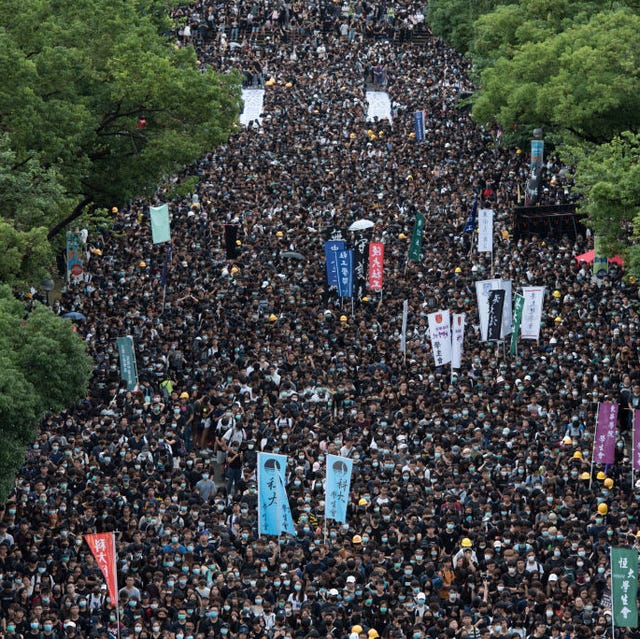
Hong Kong has seen a struggle between a powerful high-tech police force and peaceful pro-democracy protesters. 
This week, Hong Kong leader Carrie Lam announced she would withdraw a controversial extradition bill to allow suspects to be extradited to mainland China, giving in to the protesters' main demand. 
Lam’s climbdown signals victory for low-tech ingenuity over the police state, won with umbrellas, traffic cones, Allen keys, and the philosophy of Bruce Lee.

1 Holding Back the Tears
Tear gas has been the Hong Kong police’s main weapon for breaking up demonstrations. 
Protesters developed tactics to neutralize the tear gas with quick-reaction squads. 
Early tactics involved smothering the grenade with a wet towel or trying to throw it back with heat-proof gloves, but things have now evolved.
In this video, as soon as a grenade landed near the protesters' lines and started spewing gas, the first squad member rushed out and placed a traffic cone over the top of the device, so that the cloud could not spread. 
A second squad member then poured water through the hole at the top of the traffic cone, from a plastic bottle dousing the grenade.
Another surprisingly effective new tactic is to stick the still-smoking grenade in a thermos flask full of mud to douse it.

2 Umbrella Squad

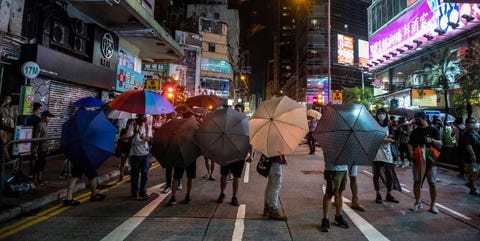
The umbrella is one of the symbols of the Hong Kong protests, and the protesters are sometimes called the Umbrella Movement
The umbrellas are a visible sign of protest, but they also have practical uses: Demonstrators started bringing them to protests in 2014 as protection against pepper spray used by the police. 
Sometimes the protesters lock umbrellas together to form the modern equivalent of a shield wall against spray.
Umbrellas are also used for screening
When tear gas grenades are being doused, other team members hold up umbrellas to hide their colleagues from police observation and prevent rubber bullets being aimed at them.
Protesters employed umbrellas in their actions to bring the transport system to a halt, using them to jam subway doors open.

3 Bluetooth Revolution

Smartphones are a powerful tool for a surveillance state, allowing them to track people and monitor their activities via social media postings. 
Protesters are careful not to post from demonstrations, or take selfies. 
They've also found ways to use apps for their own ends.
Some protests are organized via the secure Telegram app
Chat groups can have tens of thousands of members, and a polling function allows the participants to vote on what action they should take. 
This is sometimes used tactically, to decide whether a protest should remain in one spot or move on.
The authorities have tried to stop this type of activity by cutting the phone signal in specific areas. Protesters responded by using alternative technology, in particular the AirDrop function built into iPhones and the Bridgefly app, both of which communicate via Bluetooth.

4 Laser Weapons
There are no official figures, but the South China Morning Post estimates that there are at least 50,000 CCTV cameras in Hong Kong. 
Surveillance is everywhere, and the authorities have increasingly been combining it with facial recognition technology to identify target protesters.
Protesters wear gas masks not just against tear gas, but also to obscure their faces. 
And, unsurprisingly, they've also started bringing down the masts that support CCTV cameras. 
In a novel tactic, laser pointers are used to defeat the cameras and dazzle police, making protests look like something out of Star Wars.
Laser pointers have become a protest tool in their own right. 
After a student was arrested for possessing a pointer, hundreds of protesters turned up to shine lasers at the dome of the Hong Kong Space Museum to show support.

5 Hard Headed Protest

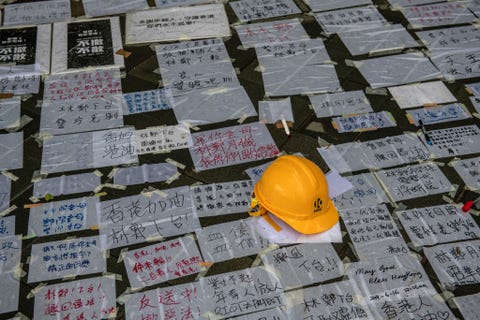
Many of the protesters wear yellow hard hats, partly as protection against the batons that Hong Kong police wield enthusiastically
Others have taken to wearing sports helmets, and local shops have sold out of all types of protective headgear.
Like the umbrella, the hard hat has become a symbol of the resistance, so people have started wearing them as a form of mute protest against the authorities
Commuters and shop assistants can be seen wearing them, some customized with messages like “We Love Hong Kong” or “I just want to get home safe.”
In a pointed show of solidarity, Hong Kong journalists wore helmets at a police press briefing. Because you can’t arrest someone just for wearing a hat, can you?

6 "Be Water"

The Hong Kong protestors built barricades and blocked streets, but they didn't stay long. 
They often dispersed as soon as the police showed up in force, using phone apps to coordinate their actions in flashmob-type actions before riot police could respond.
“We’re going around to stop the police from catching us,” one woman told reporters
“We need to be like water.”
“Be Water” has become one of the slogans of the movement. 
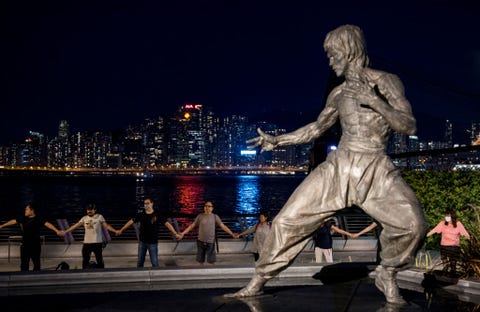
It's taken from the philosophy of Hong Kong martial arts movie legend Bruce Lee, who advocated that one “must be shapeless, formless, like water.”
The whole protest movement is deliberately formless, so there are no leaders to arrest. 
And its fluid tactics—disappearing when the opposition is strong and appearing where they are weak— successfully outmaneuvered the police.

7 Hand Signals
Allen keys, pliers, and scissors have been vital weapons in the protestor’s armory. 
The scissors cut cable ties securing street barriers, and the Allen keys unlock the nuts that fasten them together. 
This way protestors can remove obstacles and use them to build their own barricades outside police stations and other strategic spots.
Because such tools are in short supply, Antony Dapiran of the New Statesman observed crowds of protesters using special hand signals to request relevant items, which were then passed along by a human chain to where they were needed. 
These chains can stretch more than a kilometer in an impressive display of coordination, a low-tech, but effective distribution system.

mercredi 10 mai 2017

Chinese Martial Arts: 2000-Year-Old Cultural Fraud

M.M.A. Fighter’s Pummeling of Tai Chi Master Rattles China
By DIDI KIRSTEN TATLOW

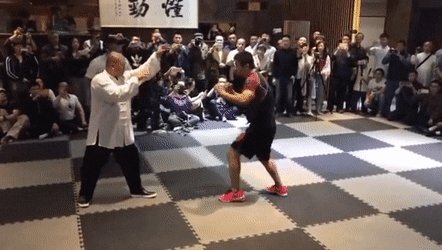
Destroying Chinese cultural myths: Wei Lei, the tai chi master, faced off against Xu Xiaodong, the mixed martial arts fighter, in Chengdu.

BEIJING — For weeks, the mixed martial arts fighter Xu Xiaodong had been taunting masters of the traditional Chinese martial arts, dismissing them as overly commercialized frauds, and challenging them to put up or shut up.
After one of them — Wei Lei, a practitioner of the “thunder style” of tai chi — accepted the challenge, Mr. Xu flattened him in about 10 seconds.
Mr. Xu may have proved his point, but he was unprepared for the ensuing outrage.
When video of the drubbing went viral, many Chinese were deeply offended by what they saw as an insult to a cornerstone of traditional Chinese culture.
The state-run Chinese Wushu Association posted a statement on its website saying the fight “violates the morals of martial arts.” 
The Chinese Boxing Association issued similar criticism.
An article by Xinhua, the state news agency, called Mr. Xu a “crazy guy,” saying that the fight had caused people to question whether Chinese martial arts were of any use and even to ask, “What exactly are traditional Chinese martial arts?”
The reaction has been so furious that Mr. Xu has gone into hiding.
“I’ve lost everything, my career and everything,” he said in a message circulating online
“I think many people misunderstand me. I’m fighting fraudulence, but now I’ve become the target.”
Many people around the world assumed that this debate had long been settled. 
Mixed martial arts fighters have for years held exhibition fights against practitioners of traditional Chinese martial arts.
The old ways, for all their balletic grace, lost decisively.
Known broadly as wushu, traditional Chinese martial arts include such disparate disciplines as qigong, categorized as an “internal” practice that is mostly spiritual, and kung fu, an “external” art that is practiced by the monks of the Shaolin Temple and was popularized around the world by Bruce Lee
There are hundreds of styles of wushu in China, and many overlap.
Tai chi, while a martial art, is viewed by many today as a spiritual breathing and balance exercise enjoyed by people of all ages, usually performed in slow motion in a quiet park instead of a fight ring.
Mixed martial arts, or M.M.A., is a “no-holds-barred” fighting style developed over the last century from fighting styles around the world. 
It began to gain popularity in the United States in the 1980s. 
While it is violent, it does have rules — including no biting, spitting or gouging.
The fight between Mr. Xu and Mr. Wei was brutal. 
As Mr. Wei circled slowly, arms outstretched in a calm tai chi defense, Mr. Xu lunged, jabbed him to the floor, then used a “ground and pound” technique to subdue him. 
It was all over in about 10 seconds.

Mr. Xu did not respond to a request for an interview sent to his personal Weibo account a few days after the fight on April 27. 
Shortly afterward, his account was taken down as the authorities rushed to try to tamp down the controversy.
A woman reached by telephone at the Battle Club in southeast Beijing, where Mr. Xu works, said he was not giving interviews. 
She declined to give her name.
On Wednesday morning, the door of the Battle Club, in the dingy basement of a high-rise, was locked. 
Photographs of Mr. Xu and other M.M.A. fighters decorated the walls of the stairwell.
An electrician lingering by a cigarette shop at the top of the stairs said he practiced wushu and had come to check out the club after hearing about the controversy. 
He said that Mr. Xu had been right to pose his challenge, even though it had infuriated people.
“No one can avoid fighting,’’ said the man, who gave only his surname, Lian, and a social media username, Ruyi.
He said defenders of the traditional martial arts were incensed that Mr. Xu had dared to say that they staged impressive performances but were ineffective fighters and that, by doing so, he had threatened their livelihoods.
Yet Mr. Xu’s ultra-aggressive assault on his tai chi rival had missed an important point, Mr. Lian added.
“The key difference between what Mr. Xu does and martial arts is that martial arts isn’t a competitive sport,’’ he said. 
“It’s not about really hurting. It’s about giving your opponent ‘face.’ And Mr. Xu’s style is about beating your opponent to near death.”