- China's former president Hu Jintao committed $9.3b on a media expansion project in 2009
- Beijing is also buying up broadcast space on foreign airwaves and inside newspapers
- Media freedom in China is among the worst in the world — ranking 176 out of 180 countries

In September 2018, billboards adorned with kangaroos and pandas began popping up around Australia's capital cities as part of a $500 million advertising campaign urging viewers to "see the difference" on China's Central Global Television Network (CGTN) — available on Foxtel and Fetch TV.
But "seeing the difference" comes with an important caveat.
China's media is being wielded as a tool to shape public opinion and serve the ideological aims of the Chinese Communist Party (CCP) across the globe.
And, as a part of its efforts, Beijing is training up foreign journalists, buying up space in overseas media, and expanding its state-owned networks on an unprecedented scale.
When the international arm of China Central Television (CCTV) news rebranded and became CGTN in 2016, Chinese dictator Xi Jinping urged the media organisation in a congratulatory letter to "tell China stories well" and spread China's voice.
The message was seen as part of Beijing's ambition to build a new global narrative around China while also challenging liberal democracy as the ideal developmental and political framework.
But as China continues to extend its reach across the world, some Western countries are pushing back.
In the same month CGTN billboards sprung up across Australia, the United States ordered the network and China's state-run media agency Xinhua to register as foreign agents over fears they could be used as tools for political interference.
And observers say that China is quickly understanding the importance of information warfare, and the power of media to shape public opinion not just at home, but around the world.
China splashes billions on global influence campaign

Chinese dictatorXi Jinping urges CGTN to "tell China's stories well".
Under Xi's leadership, China's role on the world stage has transformed.
Graeme Smith, a research fellow at the Australian National University's College of Asia and the Pacific, told the ABC that while China was "sort of very happy to hang back" in the past it was now actively seeking to exert its influence.
"In the expression of [China's former paramount leader] Deng Xiaoping, to 'hide your strength and bide your time' — the hide and bide maxim has now very much gone by the wayside," said Dr Smith, who is also the host of the China-themed Little Red Podcast.
The CCP's aspiration has grown beyond just controlling news domestically — where many Western media outlets, including the ABC, are now blocked in one of the most restrictive media environments in the world — it now wants to create a "new world media order" beyond its borders.
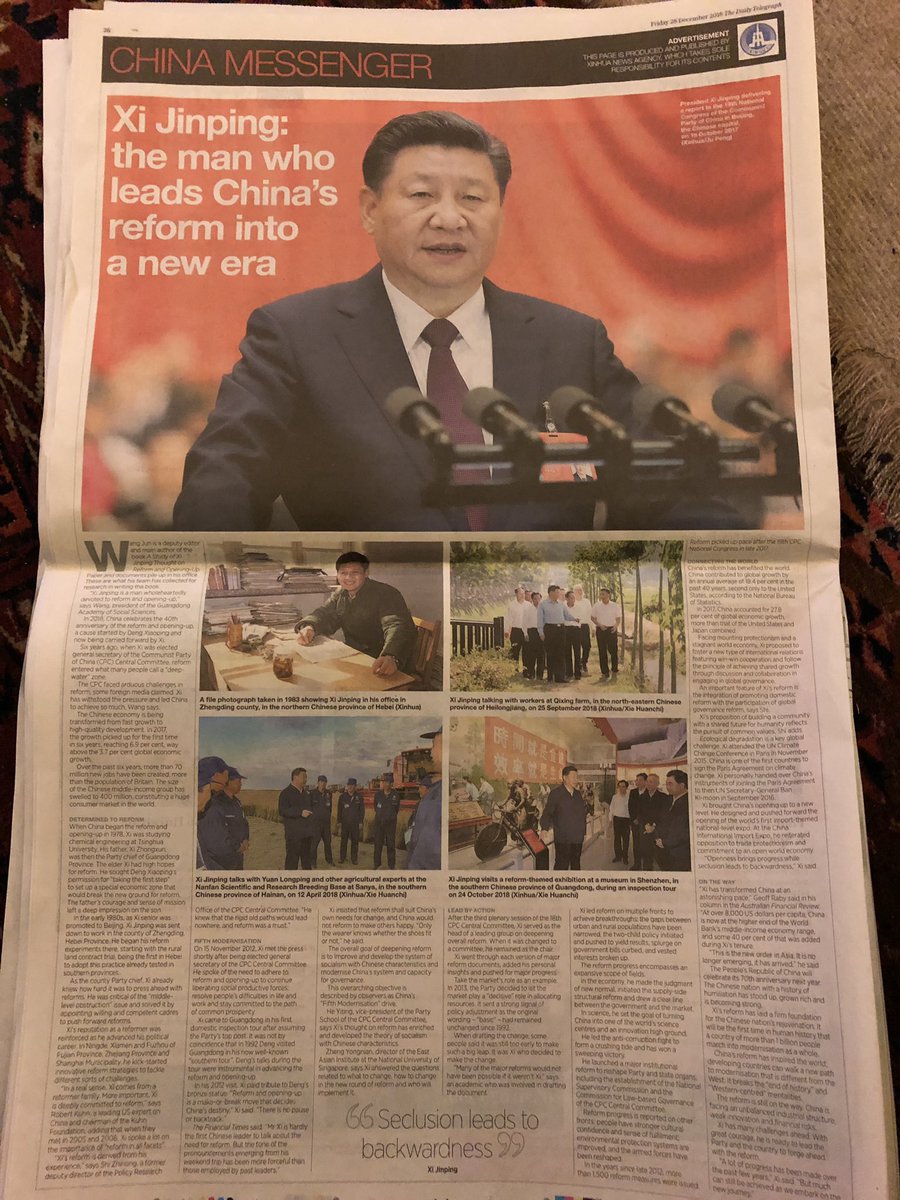
New Xinhua propaganda vehicle, China Messenger, in @Telegraph: “China’s reform... breaks the “end of history” and”Western-centered” mentality.
In a Wall Street Journal opinion editorial published in 2011, Li Congjun, former president of Xinhua, called for the "resetting of rules and order" in the international media industry where information flowed "from West to East, North to South, and from developed to developing countries".
Meanwhile, a five month investigation published in The Guardian in December revealed the "astonishing scope and ambition" of China's world-wide propaganda campaign over the past decade.
This included a commitment by Xi's predecessor, Hu Jintao, in 2009 to spend 45 billion yuan ($9.3 billion) on a media expansion campaign to develop CCTV, Xinhua and the People's Daily newspaper.
According to a report released by the Pentagon this month, Xinhua launched 40 new foreign bureaus between 2009 and 2011 alone.
That number jumped to 162 in 2017 and it aims to have 200 by 2020.
CGTN has just opened a bureau in London in addition to ones already established in Nairobi and Washington, broadening the presence of its already-large number of correspondents around the world, including in Australia.
It claims to be broadcasting to 1.2 billion people in English, Russian, Arabic, French and Chinese — including 30 million households in the US — which would make it the world's largest television network.
CGTN has just opened a bureau in London in addition to ones already established in Nairobi and Washington, broadening the presence of its already-large number of correspondents around the world, including in Australia.
It claims to be broadcasting to 1.2 billion people in English, Russian, Arabic, French and Chinese — including 30 million households in the US — which would make it the world's largest television network.
'Tell China's story well'
 CGTN claims to be broadcasting to 1.2 billion people in English, Russian, Arabic, French and Chinese.
 The emergence and relative success of non-Western, state-sponsored global media players like Russia Today and Al Jazeera have provided China with potential business models to replicate.
"In a sense what they want CGTN to be is what the BBC is to the British people, so an agent of soft power and, as Xi Jinping puts it, [to] tell China's stories well," Dr Smith said.
"There seems to be a lot more ambition about what CGTN is expected to do in the world."

Billboards adorned with kangaroos and pandas are popping up in Australia's capital cities.
Buzzfeed reported in June last year that CGTN was on a recruitment drive to hire more than 350 journalists for its London bureau.
In a climate of job cuts and dwindling revenues for Western news outlets — there was little surprise there were reportedly 6,000 applicants for the first 90 job openings to "report the news from a Chinese perspective".
But prospective CGTN journalists be warned — "telling China's story well", as Xi implores, means in no uncertain terms joining the ever-growing propaganda apparatus of the CCP.
Haiqing Yu, an associate professor in the school of media and communication at RMIT University, said China had the "most extensive network of media organisations" in the world, and employed thousands of non-Chinese mainly native English speaking journalists, editors, managers and PR personnel.
Dr Yu said those people were known in Chinese as "wu mao" — or 50 cent — a colloquial term for internet commentators hired by Chinese authorities to manipulate public opinion.
"Even though they would not agree to the term, I would say many of them are willing collaborators, or [work for] practical reasons, because the pay is really good," she explained.
A central tenet of China's media expansion has been to repudiate Western values of journalism and supplant them with party-friendly principles.
A leaked 2013 government edict — known as "Document 9" — openly attacked Western media saying "the West's idea of journalism undermines our country's principle that the media should be infused with the spirit of the party".
Media freedom in China is among the worst in the world — Reporters Without Borders' (RSF) World Press Freedom index ranks China 176 out of 180 countries.
"In China … it's impossible for professional journalists to publish anything that would not be in line with the party's views," Cedric Alviani, director of Reporters Without Borders' East Asia bureau, told the ABC.
"It's harder and harder even for civil bloggers or netizens to be able to post views that aren't in line with the party's."
 Many Western media outlets are blocked in China due to the Great Firewall.
Meanwhile, Beijing has also actively cracked down on international news websites including the ABC's while claiming that the internet is "fully open".
Mr Alviani said the major problem now is that not only might Chinese citizens lose their hope to have press freedom but China's move to influence the media world beyond its borders was also posing a major threat for democracies.
"If the Chinese new world media order happens someday … it will be a world in which basically journalists are the mouthpiece of the states all around the world," he said.
Buzzfeed reported in June last year that CGTN was on a recruitment drive to hire more than 350 journalists for its London bureau.
In a climate of job cuts and dwindling revenues for Western news outlets — there was little surprise there were reportedly 6,000 applicants for the first 90 job openings to "report the news from a Chinese perspective".
But prospective CGTN journalists be warned — "telling China's story well", as Xi implores, means in no uncertain terms joining the ever-growing propaganda apparatus of the CCP.
Haiqing Yu, an associate professor in the school of media and communication at RMIT University, said China had the "most extensive network of media organisations" in the world, and employed thousands of non-Chinese mainly native English speaking journalists, editors, managers and PR personnel.
Dr Yu said those people were known in Chinese as "wu mao" — or 50 cent — a colloquial term for internet commentators hired by Chinese authorities to manipulate public opinion.
"Even though they would not agree to the term, I would say many of them are willing collaborators, or [work for] practical reasons, because the pay is really good," she explained.
A central tenet of China's media expansion has been to repudiate Western values of journalism and supplant them with party-friendly principles.
A leaked 2013 government edict — known as "Document 9" — openly attacked Western media saying "the West's idea of journalism undermines our country's principle that the media should be infused with the spirit of the party".
Media freedom in China is among the worst in the world — Reporters Without Borders' (RSF) World Press Freedom index ranks China 176 out of 180 countries.
"In China … it's impossible for professional journalists to publish anything that would not be in line with the party's views," Cedric Alviani, director of Reporters Without Borders' East Asia bureau, told the ABC.
"It's harder and harder even for civil bloggers or netizens to be able to post views that aren't in line with the party's."
 Many Western media outlets are blocked in China due to the Great Firewall.
Meanwhile, Beijing has also actively cracked down on international news websites including the ABC's while claiming that the internet is "fully open".
Mr Alviani said the major problem now is that not only might Chinese citizens lose their hope to have press freedom but China's move to influence the media world beyond its borders was also posing a major threat for democracies.
"If the Chinese new world media order happens someday … it will be a world in which basically journalists are the mouthpiece of the states all around the world," he said.
'Brainwashed' by 'Western values of journalism'
 Media freedom in China is among the worst in the world
According to RSF, China also has one of the world's highest incarceration rates for journalists — and its leaders make it no secret the media is an arm of the state.
In 2016, Xi told journalists that "all the work by the party's media must reflect the party's will, safeguard the party's authority, and safeguard the party's unity".
"They must love the party, protect the party, and closely align themselves with the party leadership in thought, politics and action," he said.
 China has one of the most restrictive media environments in the world.
 In a slick 2017 video produced as part of a documentary series showcasing some of China's best journalists, CGTN host Pan Deng said many outside China are "brainwashed" by "Western values of journalism".
Meanwhile another CGTN presenter slammed Western media on air for its partiality in painting the CCP "in a one-dimensional, superficial way".
"That has been the fallacy of the Western media when it comes to reporting on China, not lying, but never telling the whole truth," she said.
With little room to stray from the party line, examples have emerged where staff felt they acted more as agents of the state than journalists.
According to a report in Canada's Ottawa Magazine, Xinhua reporter Mark Bourrie was assigned to cover a visit by the Dalai Lama to Ottawa in 2012 and was asked to find out what was said in a private meeting between then prime minister Stephen Harper and the Tibetan spiritual leader.
 The Australian Financial Review started publishing content from China's Caixin Global last year.
 Mr Bourrie reportedly confronted the bureau chief Dacheng Zhang when he discovered his report was not to be published.
Zhang told Mr Bourrie the information gathered was to be sent directly to Beijing for intelligence purposes — leading Mr Bourrie to resign on the spot.
The bureau chief later denied the allegations, saying Xinhua's policy was to "cover public events by public means" and that it was up to the agency's editing rooms to decide how and what to publish.
While Dr Smith, the host of the Little Red Podcast, said he didn't think it was the primary role of journalists to act as agents, he believed they could end up collecting material for the Chinese state that was never intended to be broadcast.
As China's media continues to expand internationally, questions are also being raised over the CCP's influence over both private and state-owned companies abroad.
'Borrowing the boat to get to the sea'
 Chinese language radio airwaves in Australia have been bought by China Radio International or CRI affiliated companies.
 The expansion of Xinhua and CGTN is happening alongside a more opaque campaign of buying up broadcast space on foreign airwaves and inside newspapers.
The Chinese saying "borrowing the boat to get to the sea" has been used to describe the covert way in which Beijing has been able to infiltrate local media across the world by using overseas airwaves to disseminate its message.
A 2015 Reuters investigation revealed there were at least 33 radio stations across 14 countries "that are part of a global radio web structured in a way that obscures its majority shareholder: state-run China Radio International (CRI)".
US officials charged with monitoring foreign media ownership and propaganda admitted they were unaware of the Chinese-controlled radio operations until contacted by Reuters.
And when the ABC pulled out from broadcasting via shortwave in the Pacific region in 2017, CRI wasted little time taking over those very same frequencies to broadcast its own news.
The decision was met by an outcry from affected listeners, but the ABC insisted at the time the shortwave technology was out of date and it would save $1.9 million by cutting the service, which it said would be reinvested in expanding content and services.
According to Dr Smith, Chinese language radio in Australia is being bought up by CRI or CRI-affiliated companies across major Australian cities.
"They have effectively monopolised the Chinese language airwaves," he said.
"If you're looking for an alternate voice you either have to go on the internet … there aren't many alternatives if you're just turning on the radio."

"They have effectively monopolised the Chinese language airwaves," he said.
"If you're looking for an alternate voice you either have to go on the internet … there aren't many alternatives if you're just turning on the radio."
Caixin signed an agreement to share content with the Australian Financial Review.
A 2016 report in the Sydney Morning Herald quoted Australian Chinese media sources saying that the majority of the Chinese language media in the country was owned or controlled by the Chinese state or its affiliates.
"At least in that space they've gotten quite good at ensuring that their stories are the ones that are told and not the others," said former CIA analyst Peter Mattis, who is now a fellow in the China programme at the think tank Jamestown Foundation.
"We can see that not only in Chinese language media, but also in content sharing agreements reached within Australia and plenty of other newspapers in Africa or Latin America, to ensure that their positions and their China coverage are the stories that get out."
These "content sharing agreements" are commercial arrangements that allow China to publish its own coverage in newspapers around the world in the form of handouts or inserts.
A 2016 report in the Sydney Morning Herald quoted Australian Chinese media sources saying that the majority of the Chinese language media in the country was owned or controlled by the Chinese state or its affiliates.
"At least in that space they've gotten quite good at ensuring that their stories are the ones that are told and not the others," said former CIA analyst Peter Mattis, who is now a fellow in the China programme at the think tank Jamestown Foundation.
"We can see that not only in Chinese language media, but also in content sharing agreements reached within Australia and plenty of other newspapers in Africa or Latin America, to ensure that their positions and their China coverage are the stories that get out."
These "content sharing agreements" are commercial arrangements that allow China to publish its own coverage in newspapers around the world in the form of handouts or inserts.
China's 'soft power could drive the wheel of its friendship'
 China Watch was a monthly supplement published by China Daily that used to be distributed in papers including the Sydney Morning Herald.
 Newspapers adorned with full-page spreads and glowing assessments of Xi Jinping can now be found from Europe, to Africa, to Latin America.
Fairfax media — now taken over by Nine News — raised eyebrows when it included the China Watch lift-out in its newspapers on a monthly basis as part of a paid deal with the state-run China Daily, although it is understood to have been removed since November 2018 along with other supplements that have since ceased.
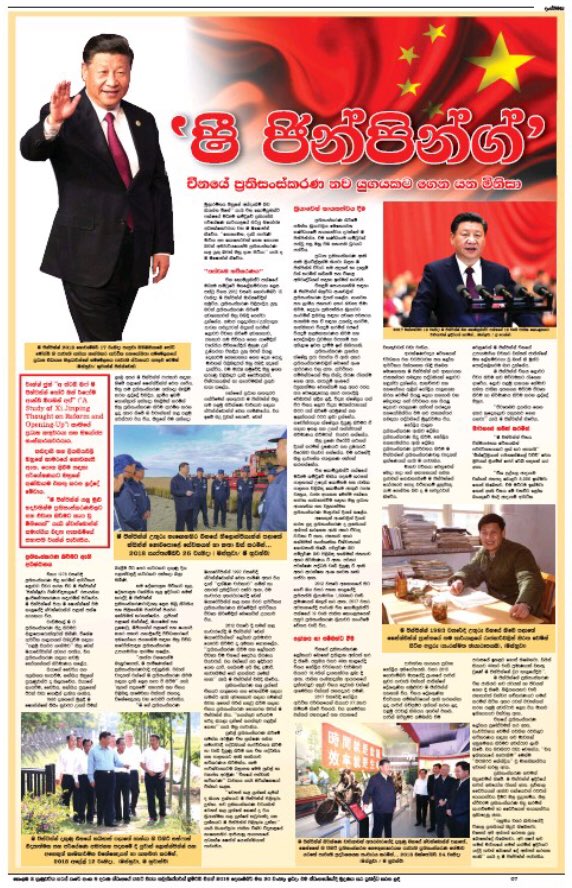
Full page advertisement in Sunday Lankadeepa Sinhala Newspaper promoting Chinese dictator Xi Jinping
China Daily's deputy editor-in-chief Kang Bing said at the time that Fairfax Media's presence in both Australia and New Zealand "means the influence of China Daily will be spread to cover the two most important countries in Oceania".
He added that China's "soft power could drive the wheel of its friendship with Australia and New Zealand", according to quotes carried by the Chinese newspaper.
But the surreptitious nature in which these inserts are included means many readers are unlikely to be aware that they're consuming content sponsored by the Chinese Government.
"Yes they look different, yes it's a little bit culture, but it still looks like it's part of a newspaper, maybe it's a special magazine part of it," Mr Mattis said.
"And you see the articles up on the website in these organisations, it's not always clear that they are completely distinct from them.
"The casual reader could quite easily miss it, especially if they weren't primed to look for it in the first place."
Questions have also been raised about the Australian Financial Review's decision to sign a content-sharing agreement with Beijing-based Caixin Global last November.
Who's winning the information war?
 China Radio International is the little-seen power behind a global web of radio stations.
 Beijing announced last year that it would amalgamate its state radio and television arms — CGTN and China Radio International — to eventually form the world's largest propaganda network, the Voice of China.
Its name would indicate that it hopes to rival America's state-sponsored media arm, Voice of America.
However some experts say China's foreign media push, while astonishing in scale, is more a lame-duck in execution.
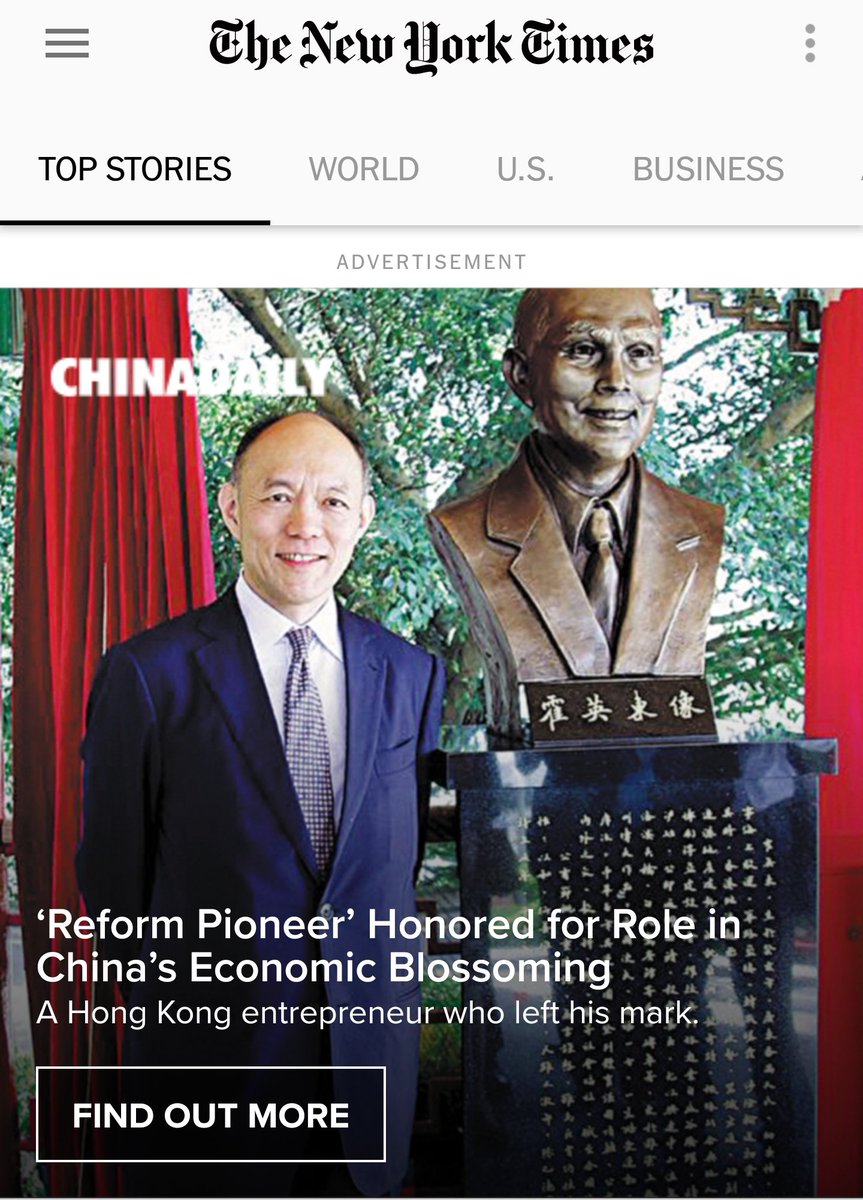
Rasmus Kleis Nielsen: "A hell of an ad. I know inserts from China Daily are also used in prints, but I am seeing these more and more on online news sites".
Unlike Russia Today and Al Jazeera, China's foray into global media has been unable to draw much journalistic clout, and how many people are tuning in is unclear.
CGTN's 73 million Facebook followers may appear robust (more than Al Jazeera and the BBC combined), but two-thirds of the network's traffic is thought to come from China.
CGTN America's YouTube videos often attract fewer than 1,000 viewers — those on the BBC regularly attract more than 50,000.
Sarah Cook, a China expert from US think tank Freedom House, claims more people in America's major cities watch content produced by NTDTV — a network created by the Falun Gong, a spiritual movement that is banned in China — than that of CGTN.
Observers point out the network's failure in numbers could in part be due to the often dreary and predictable programming, as well as the ongoing blocking of major video platforms like YouTube within China's borders.
"It's caught between these two goals, it wants to be the BBC, but at the same time it wants to please the party bosses — and what pleases the party bosses isn't the kind of thing that's going to get you tuning in to be entertained," Dr Smith said.
Dr Yu, citing Yuezhi Zhao from Simon Fraser University in Canada, said China's soft power push for national branding or reshaping its national image, was "mission impossible".
"It's wasting money, it's against the common interests of most people and it's not sustainable," she said.
"She mentioned the importance of … [how it] is not about how you want to influence people, it's about having the confidence in your own values.
"[It's about] what kind of values system do we have as Chinese that's convincing, that's shareable with the rest of the world. That should be the [basis] of China's soft power."
Not the kind of thing that'll make you want to watch TV
When Beijing's domestic CCTV outlet rebranded as CGTN back in 2016, little changed in the way of programming.
"Literally the very first few minutes of CGTN's life was a series of dot points of Xi Jinping with these kind of Sphinx-like [cryptic] quotes, 'China must understand the world' and 'the world must understand China'," Dr Smith said.
"It was really, not the kind of thing that would make you want to tune into a TV station".
Other sections have proved controversial.
A video produced by Xinhua's official YouTube channel New China TV at the height of China's border stand off with India in 2017 highlighted the sometimes clumsy and unsophisticated nature of China's media apparatus.
Titled the Seven Sins of India, it used racist language and depictions, many thought it revealed a level of ignorance to social conventions acceptable on the world stage.
CGTN was also criticised for a racist rant against foreigners and Jews in 2012 on Weibo by the host of its leading talk show Dialogue — Yang Rui is still presenting the show.
Xinhua and CGTN — unlike Russia Today or Al Jazeera — have not yet created a palatable international brand.
"They've got a challenge that they haven't really dealt with previously," Mr Mattis said.
"How do you build an audience? How do you make something interesting, useful, informative while at the same time undermining Western narratives? It's not an easy thing."
A video produced by Xinhua's official YouTube channel New China TV at the height of China's border stand off with India in 2017 highlighted the sometimes clumsy and unsophisticated nature of China's media apparatus.
Titled the Seven Sins of India, it used racist language and depictions, many thought it revealed a level of ignorance to social conventions acceptable on the world stage.
CGTN was also criticised for a racist rant against foreigners and Jews in 2012 on Weibo by the host of its leading talk show Dialogue — Yang Rui is still presenting the show.
Xinhua and CGTN — unlike Russia Today or Al Jazeera — have not yet created a palatable international brand.
"They've got a challenge that they haven't really dealt with previously," Mr Mattis said.
"How do you build an audience? How do you make something interesting, useful, informative while at the same time undermining Western narratives? It's not an easy thing."
'A much more effective strategy' in Africa
Audiences in the West may prove a challenge to win over — but there is concern that Africa is more vulnerable to China's creeping media buy-ups.
"It's very different in Africa I think and it has been a deliberate strategy on the part of the Chinese state," Dr Smith said.
A 2018 report by the Pew Research Centre indicated an overall decrease in China's global favourability rating — but African nations were among the most likely to express favourable attitudes towards Beijing.
With a less robust media environment and countless cash-strapped local networks, China has been more active in infiltrating and controlling African media.
"If you look at the kind of offerings [that] are available in CGTN for Africa, you have these very sophisticated programs that look just like the BBC — and yet they're reporting about Africa with African hosts," Dr Smith said.
"So I think in Africa it is a much more effective strategy."
China has also been active in influencing the reporting of local media.
In just one example, Beijing offered financial and logistical assistance to extend the FM range of Zambia's public broadcaster.
Ostensibly, this was done to improve a public service, but independent analysis from the Centre for International Media Assistance later found bias for the ruling party in its content.
Ostensibly, this was done to improve a public service, but independent analysis from the Centre for International Media Assistance later found bias for the ruling party in its content.
Soft power or soft invasion?
 Beijing is yet to shake off global perceptions that it's an authoritarian state.
 The scale and, at times covert, nature of China's push has rattled security pundits across the Western world — but questions remain over how effective Beijing's media projections are.
It has developed a more robust and sophisticated media strategy but its broadcasters appear hamstrung by the requirements of toeing the party line which hinder its ability to produce widely appealing content.
But Peter Mattis warns this is not fundamentally a soft power campaign.
"I think a really key thing to remember about this is that it's often referred to as a soft power push — and this isn't soft power," he said.
"Soft power as it was defined is innately passive, it's about the attractiveness of one's culture, values and political systems, and the behaviours that result from those things.What China's doing is not soft, it's actually active and it's invasive."
That may be the real kicker.
Beijing is yet to shake off global perceptions that it's an authoritarian state, without a message of hope or change, to sell to the world.
Instead its tactics are increasingly bullish in attempting to control the medium — not just the message.
"I think over the last ten years … the push has been less about messaging and more about the medium," Mr Mattis said.
"This way they can crowd out other stories, they can have essentially a monopoly on the information environment — that makes it easier for their narratives to be received and accepted."
The ABC sought comment from CGTN and the Ministry of Foreign Affairs but received no reply at the time of publication.

