Affichage des articles dont le libellé est Joshua Wong. Afficher tous les articles

lundi 27 janvier 2020

Unfree Speech by Joshua Wong review – a call to arms for the Snapchat generation

The Hong Kong protests leader, a veteran activist at just 23, on his extraordinary decade – and what comes next
By Tim Adams

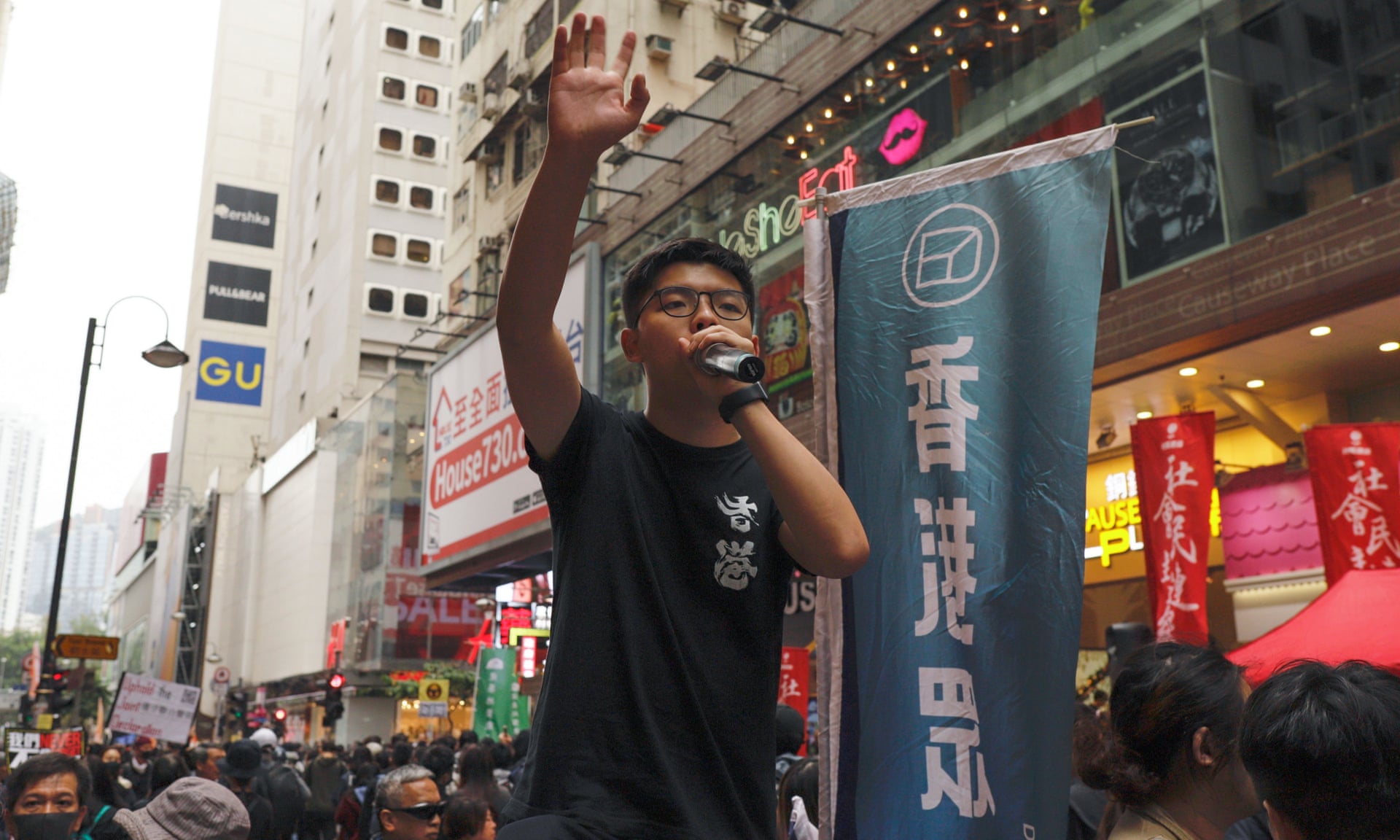
Joshua Wong addressing the crowd in Hong Kong, 1 January 2020. 

I don’t know if it counts as a demographic anomaly or a new world order, but our social media decade has seen the emergence of teenage political changemakers – the guerrilla wing of influencer culture. 
While Greta Thunberg may have become the most recognisable of these adolescent activists, the model was established by Joshua Wong, who at the age of 14 engineered a rare political climbdown by the Hong Kong government, and by 17 was on the cover of Time magazine as “the Face of Protest”.
Wong, now 23, and having spent many months in prisons and detention centres, is the gnarled veteran leader of the “umbrella movement” against creeping Chinese authoritarianism. 
In a blurb to this book Thunberg describes him as “the future that has already come”. 
Wong’s story is not unlike Thunberg’s to the extent that a stubborn school-based protest that might have once been confined to the human-interest pages of the local newspaper quickly became first a national and then a global concern.
This book is a memoir of an extraordinary decade in which Wong went from a nerdy obsession with Marvel comics to a Netflix documentary in which he was characterised as a superhero for democracy. It is also a call to arms to that generation that has known nothing but Instagram and Snapchat – a manifesto to “follow news sites for warning signs of political polarisation”, to use “fact-checking media”, to get out from behind their screens “to attend rallies and help organise election campaigns” and to remember, above all, any effort to preserve democracy “starts with one voice, one flyer and one speech”.
Wong half-believes he was born to the role. 
His Christian parents, who married in the weeks after the Tiananmen Square massacre named him Joshua after the Old Testament hero of Jericho, bringing down walls with his trumpet solo. 
His mother recalls him babbling like an orator from birth, and dyslexia meant that he learned to be a speechmaker to prove his intelligence. 
His first protest movement was for an improvement in school dinners at the United Christian College in Hong Kong
He graduated quickly to organising against a new national curriculum, announced by the island’s government.
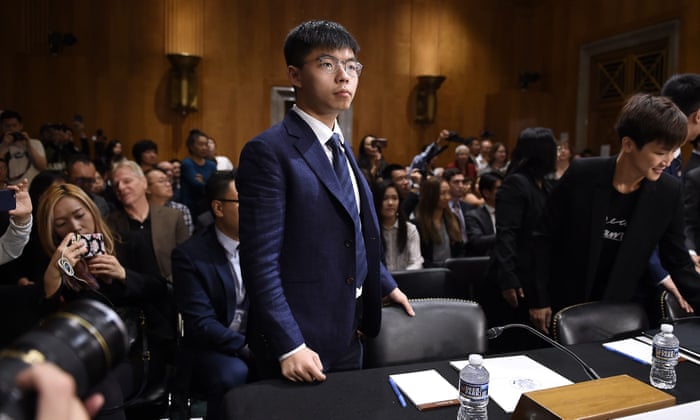
Joshua Wong at a US congressional hearing on China in September 2019.

Wong was part of the first school year to have been born after Britain’s handover of Hong Kong to China in 1997. 
The new curriculum, with its insistence on a “recognition of identity”, came with a manual that praised the Chinese Communist party as “an advanced and selfless regime” and argued that “toxic bipartisan politics” in the west led to the “suffering of its people”. 
Wong and his best mate, Ivan Lam, created a Facebook page outlining resistance to the curriculum and set up street stalls and staged small-scale sit-ins to channel protest.
By 2012, a tight group of friends had grown to 10,000 Scholarism followers; Wong spent nearly every evening after school giving soapbox speeches and press interviews. 
In July that year, he led a mass protest of 100,000 people and by August – just before a new term started – his activists occupied the Admiralty Square outside the government headquarters; Ivan Lam went on hunger strike. 
By day nine of the occupation, the government chief executive, CY Leung, withdrew the plans for the “brainwashing curriculum”.
That success was only the beginning for Wong. 
The next battle was over the government’s flaky commitment to the people’s right freely to elect its chief executive. 
Beijing’s backtracking on that promise in 2017 forced the Scholarism activists back out onto the streets. 
Admiralty Square had been fenced off, but in a rallying speech Wong called for supporters to scale the barrier. 
He was pulled down from the top of the fence by riot police. 
It was only when he was released on bail after 48 hours in solitary confinement that he got to see the news footage of the demonstration. 
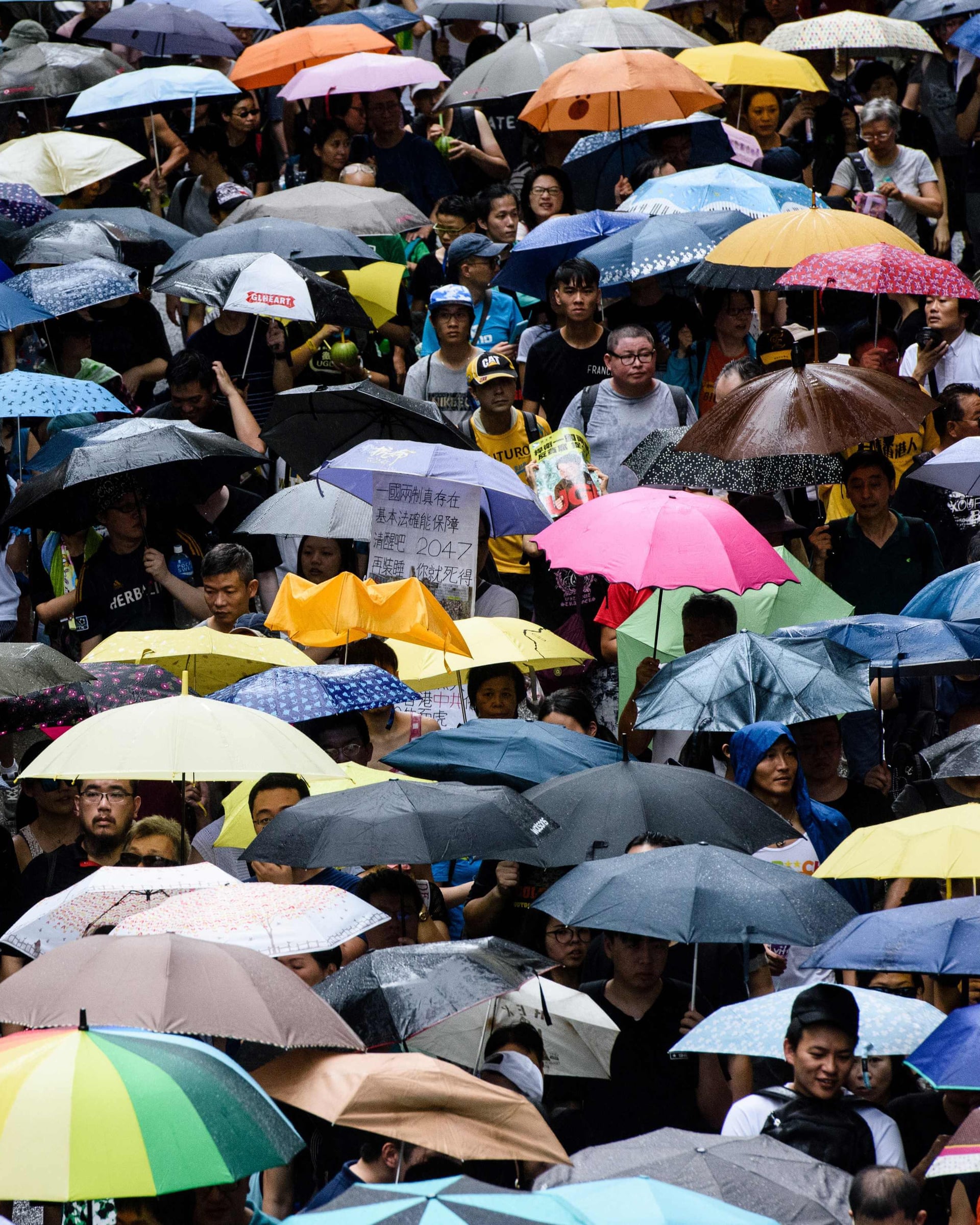
The following day 200,000 protesters had descended on the square; when the police fired teargas into the crowd, many of the protesters had defended themselves with umbrellas – and a new movement had been born.
Ever since, Wong has been in and out of jail while the authorities have tried and failed to subdue the ongoing protests. 
Much of the second half of this book, which is sometimes written with the flattened tone of a court report or legal document, consists of Wong’s letters from prison, trying to keep up with events on the outside, while characteristically taking up causes on the inside, including a campaign to outlaw the prison practice of shaving inmates’ hair.
On his release Wong sought to use his platform to argue that what began as Hong Kong’s student protest is increasingly all of our concern. 
Hong Kong is in many ways the test case, his book insists, not just for China to try its authoritarian muscle but also as part of a “much broader threat to global democracy”. 
In May 2019 Wong returned to prison for seven weeks for violating a court injunction involving the umbrella movement, nearly 6,000 of whose number had by then been arrested. 
His greatest regret, he joked at the time, was that he would miss the latest Marvel Avengers film. Wong had watched its predecessor many times – and seen in its subtitle a lesson for superheroes, however modest, however young, the world over. 
“The ‘infinity war’ that has ravaged Hong Kong for years, I’m afraid, may be soon coming to a political theatre near you…”

Unfree Speech: The Threat to Global Democracy and Why We Must Act Now by Joshua Wong is published by Penguin (£9.99) To order a copy go to guardianbookshop.com or call 020-3176 3837

mardi 21 janvier 2020

'Hong Kong is at a crossroads': inside prison with the student who took on Beijing

Joshua Wong was 20 when he was sentenced in 2017 to six months for his role in Hong Kong’s pro-democracy ‘umbrella movement’
By Joshua Wong

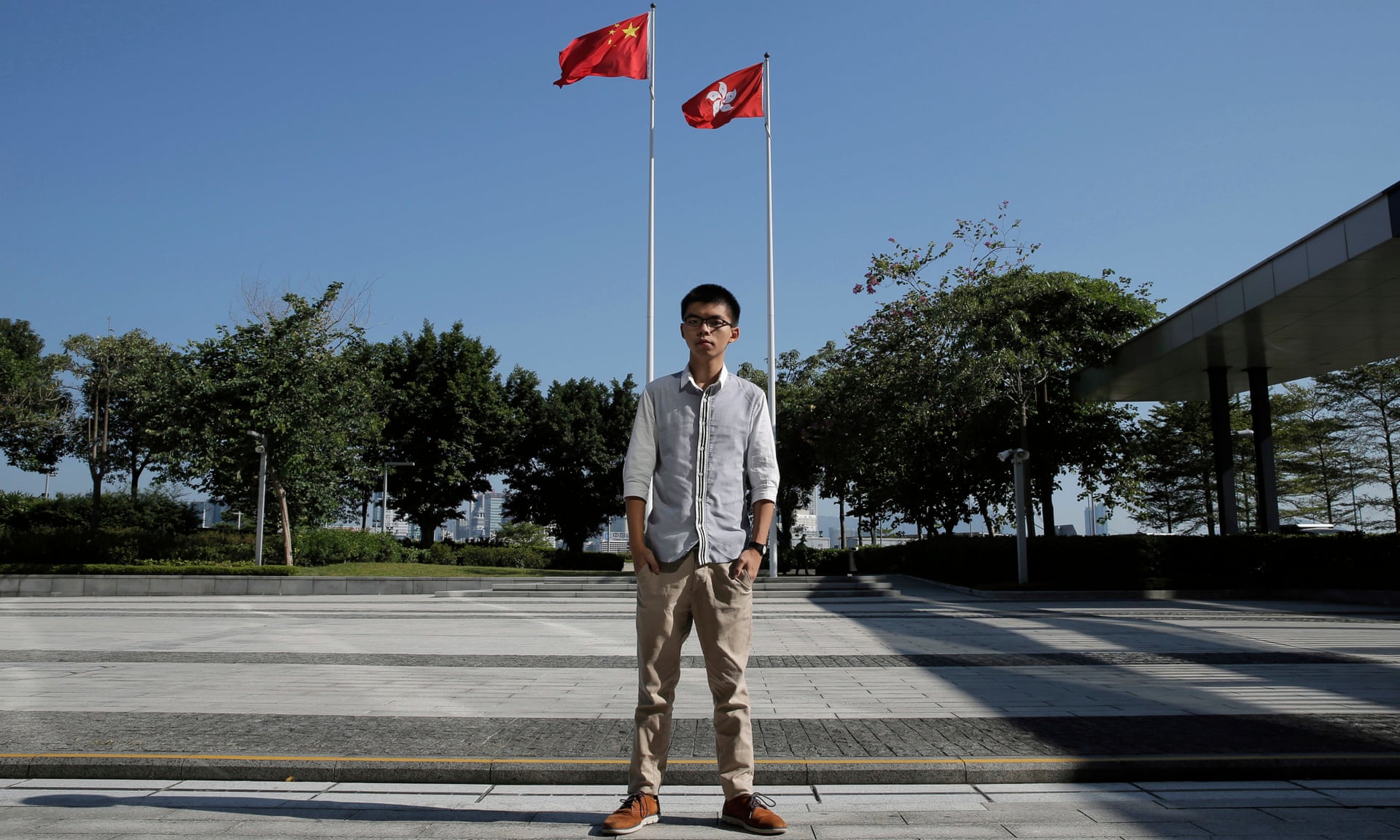
Joshua Wong outside the legislative council in Hong Kong, 2017. 

DAY 2 Friday, 18 August 2017
The last words I said before I was taken away from the courtroom were: “Hong Kong people, carry on!”
That sums up how I feel about our political struggle.
Since Occupy Central – and the umbrella movement that succeeded it – ended without achieving its stated goal, Hong Kong has entered one of its most challenging chapters.
Protesters coming out of a failed movement are overcome with disillusionment and powerlessness.
The appeal sentencing of myself and my fellow umbrella leaders Nathan Law and Alex Chow has dealt yet another devastating blow to the morale of pro-democracy activists.
Even though it feels as if we have hit rock bottom, we need to stay true to our cause.
We must.
To my friends who have decided to walk away from politics, I hope my being here and writing you this letter will convince you to reconsider.
If not, our sacrifices will have been for nothing.
I miss my mum’s hand-brewed milk tea terribly, and the chicken hotpot at the street-food restaurant where my friends and I always hang out.
That’s the first place I’ll visit as soon as I’m out of here.
But at the moment, my biggest worry is the state of my political party.
Ever since Nathan and I co-founded Demosisto in April 2016 we’ve suffered a series of significant setbacks.
Four weeks ago, Nathan lost his hard-won seat at the legislative council (LegCo) after he and five other members were disqualified on the grounds that they had failed to properly recite their oaths during the swearing-in ceremony.
Nearly everyone is now out of a job, while half of our executive committee is behind bars, or will be in the coming weeks.


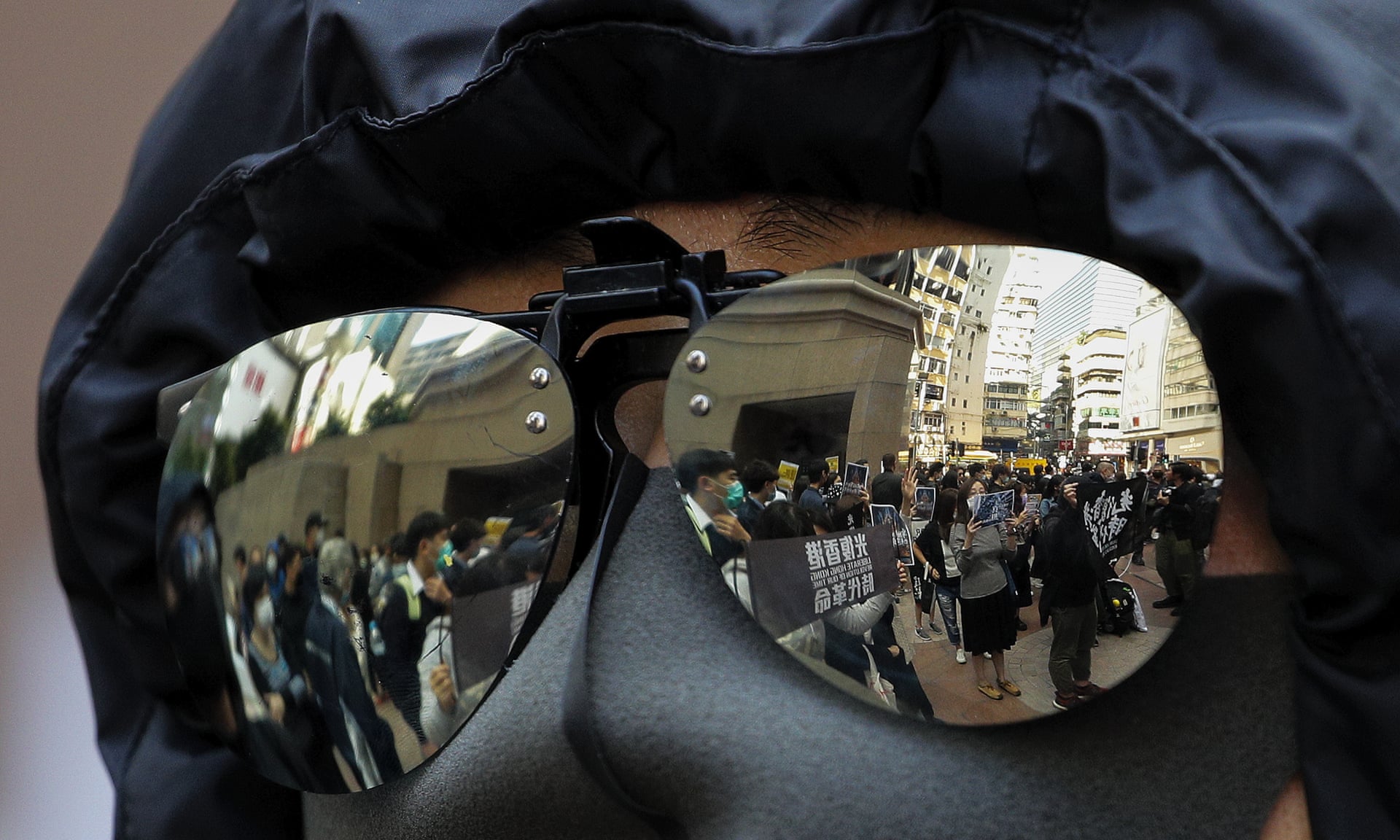
A pro-democracy demonstrator at Causeway Bay, Hong Kong, January 2020.

My message to the pro-Beijing camp? Don’t celebrate too soon.
I began my journey in 2012 when I led the campaign against the national education curriculum.
It’s been a tumultuous five years.
I didn’t shed a single tear when the judge announced my sentence, not because I was brave but because I wanted my supporters to embrace my loss of freedom as a necessary step on our collective path to democracy.
To quote JK Rowling’s Hagrid: “What’s coming will come and we’ll meet it when it does.”
Hong Kong is at a crossroads.
The ruling regime will stop at nothing to silence dissent.
For those who dare to stand up to them, the only way forward is together.
And tonight, alone in my cell, I ask you to keep your chin up and use your tears, anger and frustration as motivation to charge ahead. Hong Kong people, carry on!

DAY 3 Saturday, 19 August 2017
I’ve been assigned a two-person cell.
My cellmate seems friendly enough, although we didn’t have a chance to say much to each other before the lights went out.
So far the biggest source of discomfort is perhaps the bed.
In fact, calling it a bed is an over-statement.
It’s nothing more than a wooden plank with no mattress.
But, then again, if I could spend 79 nights sleeping on a highway during the umbrella movement I’m sure I can get used to this too.
Twice a day, the news is broadcast on the PA system.
This morning I was woken up by a story about Chris Patten, the last governor of Hong Kong.
“Mr Patten told reporters that he was heartened by the sacrifices made by Joshua Wong, Alex Chow and Nathan Law, and that he believed these three names will be carved into history ...”
It felt surreal to hear my name mentioned.
The reality that I’m a convicted criminal has finally sunk in.

DAY 8 Thursday, 24 August 2017

Joshua Wong, the student who risked the wrath of Beijing: ‘It’s about turning the impossible into the possible’

I feel a little embarrassed about the enormous media attention that Alex, Nathan and I received last week.
Local newspapers plastered my picture on their front pages the day after I was sent to prison.
The reality is that countless others are being tried or are about to be tried in Hong Kong for their activism work.
Many face much harsher prison terms than we do.
Being phoneless is like having my limbs cut off or an itch I can’t scratch.

DAY 9 Friday, 25 August 2017
LegCo member Shiu Ka-chun, nicknamed “Bottle”, came to see me this morning.
I met him six years ago, when I was a 14-year-old secondary school student and he a social worker and radio presenter.
He later hosted some of my anti-national education rallies.
In the documentary Netflix made about me, Joshua: Teenager vs Superpower, there is a scene in which I appear on Bottle’s radio show and he asks if I have a girlfriend.
“My mum told me it’s too early for me to be dating,” I reply, and everyone in the studio bursts out laughing.
Neither of us would have guessed that five years later we would be talking to each other on different sides of a glass partition.

DAY 10 Saturday, 26 August 2017
A prison supervisor approached me this afternoon for a chat about recent news events.
He began by declaring himself to be an “independent”, and that he’s neither a “yellow ribbon” (a supporter of the umbrella movement) nor a “blue ribbon” (a supporter of the government and the police).
He asked me whether I had any regrets about entering politics and ending up behind bars, before launching into a 30-minute monologue on my conviction.
His point – if there was one: we all got what we asked for.


A protest march on 1 July 1 2017, coinciding with the 20th anniversary of the city’s handover from British to Chinese rule.

DAY 11 Sunday, 27 August 2017
Like every other day since I arrived, a handful of inmates and I spent most of today sweeping the 2,000-sq ft canteen.
We clean after every breakfast, lunch and dinner.
Most twentysomethings in Hong Kong live with their parents and many middle-class households have a live-in maid.
My family is no exception.
I’ve never cleaned this much in my life and I keep telling myself that it’s good for my character.
Twice a day, a senior correctional officer visits the facility.
All inmates have to stand in a straight line with our chests out, make a fist with both hands, and stare, not straight ahead, but 45 degrees upwards.

DAY 15 Thursday, 31 August 2017
Today I had my first dreaded morning march.
I’m scrawny and spend nearly all my spare time playing video games and watching Japanese anime.I don’t go out much and I’ve never been athletic or particularly coordinated.
I’ll be lucky to get through the march without embarrassing or hurting myself.

DAY 18 Sunday, 3 September 2017
Three years ago, I joined hundreds of thousands of brave citizens in the largest political movement in Hong Kong’s history with the simple goal to bring true democracy to our city.
We asked to exercise our constitutional right to elect our own leader through a fair and open election. Not only did the Hong Kong government – appointed by Beijing and under its direction – ignore our demands, it also arrested and charged many of us with illegal assembly.
Until recently, the charge of unlawful assembly was used only to prosecute members of local gangs. In the past, the term “political prisoner” conjured up frightening images of dissidents in mainland China being rounded up and thrown into jail.
It’s hard to imagine that the term now also applies to Hong Kong.
As Beijing’s long arm reaches into every corner and threatens our freedoms and way of life, the number of prisoners of conscience is only going to increase.
Unfortunately, few foreign governments are willing to take on the world’s second largest economy and hold its actions to account.
For instance, I was disheartened by the latest Six-Monthly Report on Hong Kong published by the British foreign secretary, Boris Johnson.
Despite the political persecution of activists like me, he concluded that the “one country, two systems” framework was “working well”. 
As a signatory to the Sino-British joint declaration on Hong Kong, Britain has both a moral and a legal obligation to defend its former subjects and speak up on their behalf.

DAY 27 Tuesday, 12 September 2017
More than one inmate has asked me: “How much do they pay you to do your political stuff?”
At first I thought they just wanted to provoke me with accusations that I take money from foreign governments.
But I’ve slowly realised the questions are genuine.
Most people don’t understand why any sane person would risk prison to do what I do if it wasn’t for money.

DAY 41 Tuesday, 26 September 2017
Today is the third anniversary of my Civic Square siege, the event that set in motion the umbrella movement and a turning point in my life.
This time three years ago, I scaled a metal fence near the government headquarters and called on other protesters to follow me.
I was tackled by a dozen police officers and taken into custody.


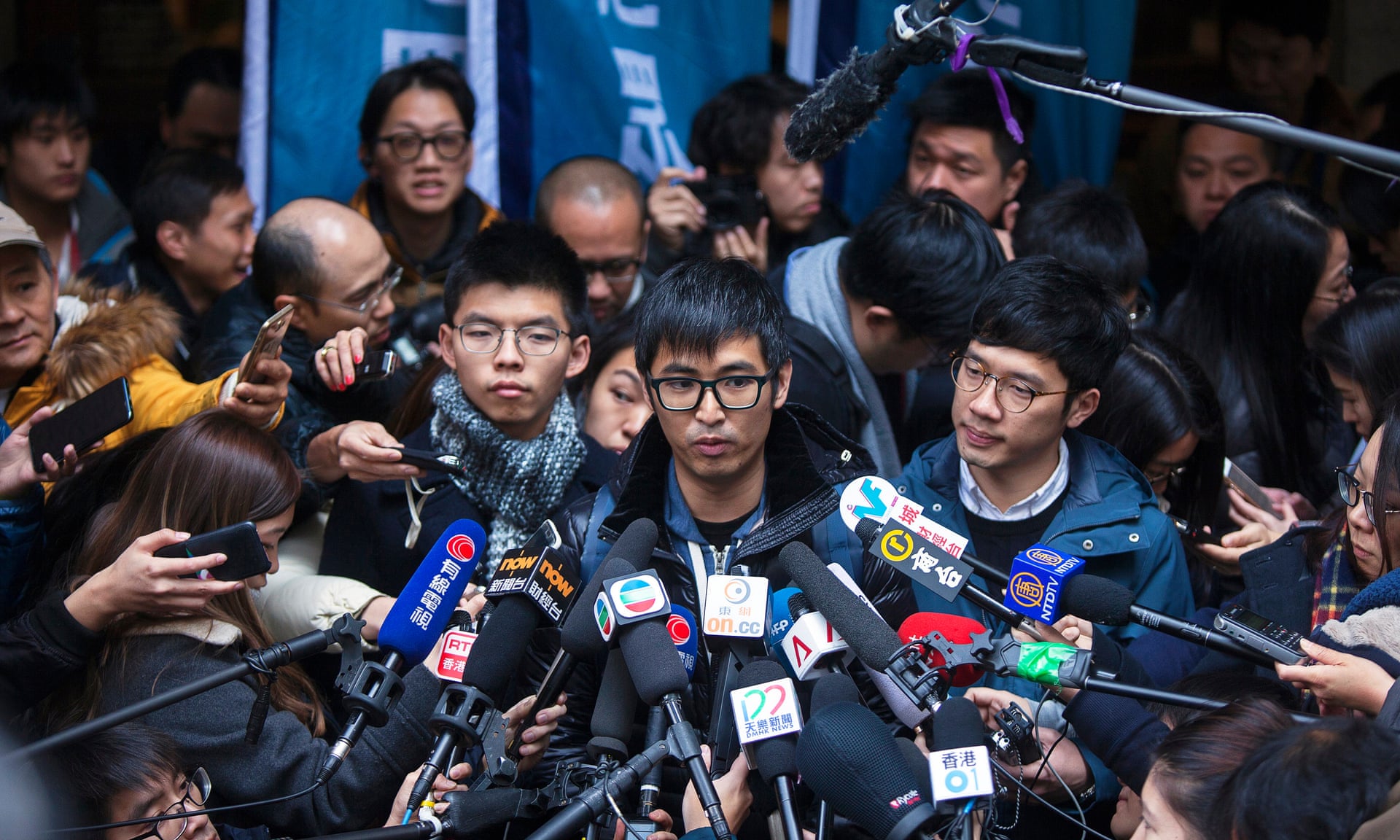
Wong (left), with Alex Chow (centre) and Nathan Law outside Hong Kong’s court of final appeal, February 2018. 

DAY 66 Saturday, 21 October 2017
There’s a huge variety of political views here.
The younger prisoners tend to be yellow ribbons.
Several of them have opened up to me about their involvement in the umbrella movement and subsequent protests.
But there are plenty of hardcore blue ribbons too.
Yesterday someone from the security unit pulled me aside and told me that some older guys in the workshop had heckled me and yelled “Traitor” when I walked past.
I received letters from a few university classmates today.
We started in the same year and now they’re about to graduate.
By summer next year they’ll be starting their first jobs, moving ahead in life.

DAY 68 Monday, 23 October 2017
My last day in prison came and went like any other.
By the time I’m released I’ll have spent 69 days behind bars.
They represent an important milestone in my seven-year journey in political activism.
I’ll come out of prison stronger and more committed to our cause than ever.

* * *
In June 2019, on the heels of the 30th anniversary of the Tiananmen Square massacre, a controversial fugitive transfer arrangement with China tabled by the government set off a fresh round of protests.
It felt as if it was the umbrella movement all over again, except this time protesters were angrier and more combative.
Young people’s voices went from loud to deafening as they refused to be brushed aside as they had in 2014. Street demonstrations escalated quickly after million person marches failed to move politicians. Peaceful rallies soon gave way to full-scale urban guerrilla warfare.
A new cold war is brewing between China and the rest of the democratic world, and Hong Kong is holding the line in one of its first battles.
Nothing captures that tension more vividly than the moments on 1 October 2019 when live coverage of the 70th anniversary celebrations in Beijing were shown side by side with scenes of demonstrators braving teargas and throwing eggs at Xi Jinping’s portraits on the streets of Hong Kong.
The contrast sends a clear message to the world that China’s tightening grip on Hong Kong is part of a much broader threat to global democracy.
In May 2019, I went to prison for the second time. 
I spent seven weeks at Lai Chi Kok Correctional Institution for violating a court injunction during the umbrella movement.
I tried to comfort my parents and joked that my biggest regret was having to miss the opening night of Avengers: Endgame, the sequel to Avengers: Infinity War. 
Before I headed to prison, a foreign reporter asked me for a soundbite about my second incarceration and China’s crackdown on pro-democracy activists in general.
I thought about the discussion I had with my parents and said: “This isn’t our endgame. Our fight against the CCP is an infinity war.”
The infinity war that has ravaged Hong Kong for years, I am afraid, may be coming soon to a political theatre near you.

• Edited extract from Unfree Speech by Joshua Wong and Jason Y Ng, published by WH Allen (RRP £9.99) on 30 January. To order a copy go to guardianbookshop.com. Free UK p&p over £15.

mardi 7 janvier 2020

Awash in Disinformation Before Vote, Taiwan Points Finger at China

Taiwan is on high alert for digital-age trickery and deception that Beijing is using to try to swing a crucial election.
By Raymond Zhong

TAIPEI, Taiwan — At first glance, the bespectacled YouTuber railing against Taiwan’s president, Tsai Ing-wen, just seems like a concerned citizen making an appeal to his fellow Taiwanese.
He speaks Taiwanese-accented Mandarin, with the occasional phrase in Taiwanese dialect.
His captions are written with the traditional Chinese characters used in Taiwan, not the simplified ones used in China.
With outrage in his voice, he accuses Ms. Tsai of selling out “our beloved land of Taiwan” to Japan and the United States.
The man, Zhang Xida, does not say in his videos whom he works for.
But other websites and videos make it clear: He is a host for China National Radio, the Beijing-run broadcaster.
As Taiwan gears up for a major election this week, officials and researchers worry that China is experimenting with social media manipulation to sway the vote.
Doing so would be easy, they fear, in the island’s rowdy democracy, where the news cycle is fast and voters are already awash in false or highly partisan information.
China has been upfront about its dislike for President Tsai, who opposes closer ties with Beijing.
The Communist Party claims Taiwan as part of China’s territory, and it has long deployed propaganda and intimidation to try to influence elections here.
Polls suggest, however, that Beijing’s heavy-handed ways might be backfiring and driving voters to embrace Ms. Tsai.
Thousands of Taiwan citizens marched last month against “red media,” or local news organizations influenced by the Chinese government.
That is why Beijing may be turning to subtler, digital-age methods to inflame and divide.
Recently, there have been Facebook posts saying falsely that Joshua Wong, a Hong Kong democracy activist who has fans in Taiwan, had attacked an old man.
There were posts about nonexistent protests outside Taiwan’s presidential house, and hoax messages warning that ballots for the opposition Kuomintang, or Chinese Nationalist Party, would be automatically invalidated.
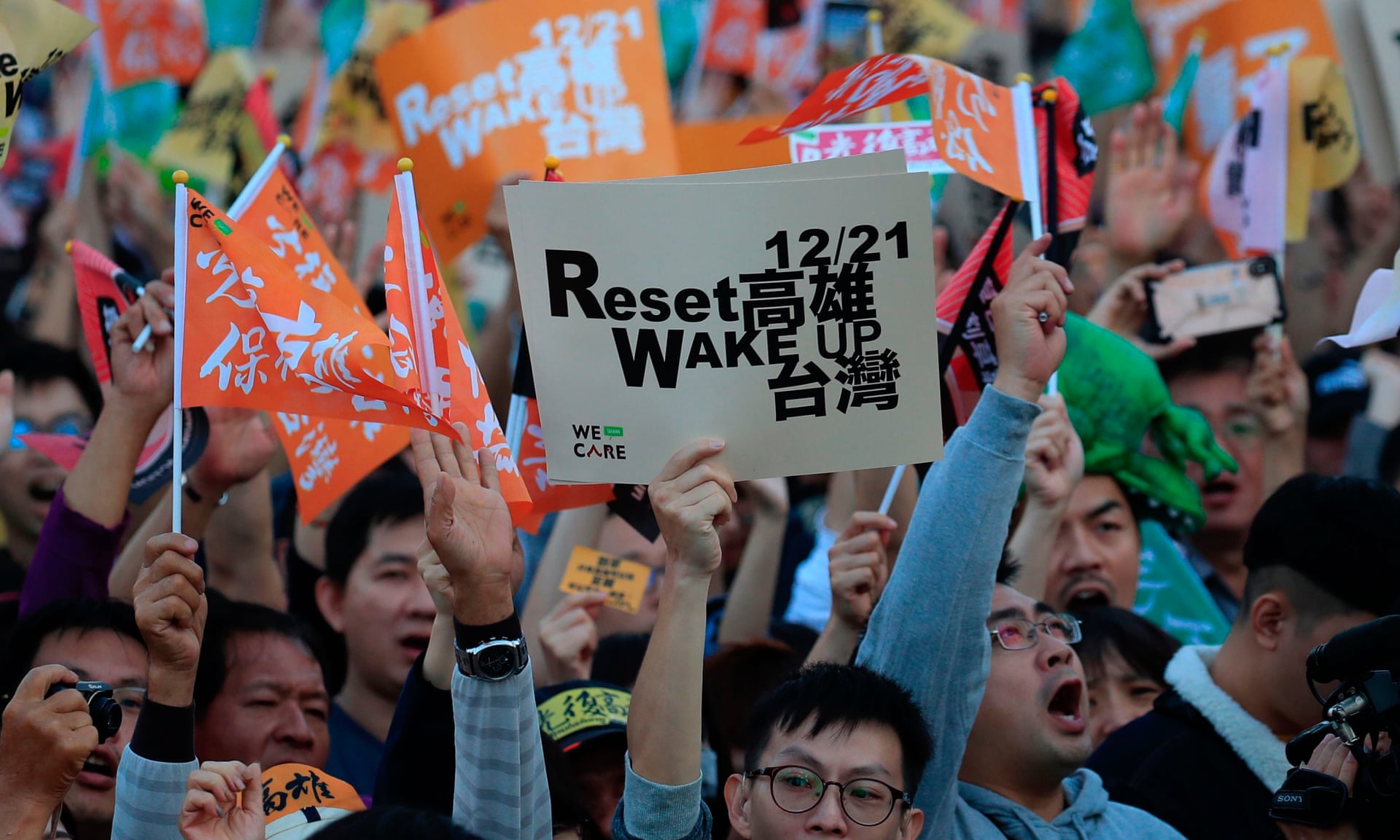
In the southern city of Kaohsiung, thousands marched at a Dec. 21 rally to oppose pro-Beijing Han Kuo-yu, the presidential candidate for the Kuomintang.

So many rumors and falsehoods circulate on Taiwanese social media that it can be hard to tell whether they originate in Taiwan or in China, and whether they are the work of private provocateurs or of state agents.
Taiwan’s National Security Bureau in May issued a downbeat assessment of Chinese-backed disinformation on the island, urging a “‘whole of government’ and ‘whole of society’ response.”
“False information is the last step in an information war,” the bureau’s report said.
“If you find false information, that means you have already been thoroughly infiltrated.”
Taiwanese society has woken up to the threat.
The government has strengthened laws against spreading harmful rumors.
Companies including Facebook, Google and the messaging service Line have agreed to police their platforms more stringently.
Government departments and civil society groups now race to debunk hoaxes as quickly as they appear.
The election will put these efforts — and the resilience of Taiwan’s democracy — to the test.
“The ultimate goal, just like what Russia tried to do in the United States, is to crush people’s confidence in the democratic system,” said Tzeng Yi-suo of the Institute for National Defense and Security Research, a think tank funded by the government of Taiwan.
In Taiwan, civil society groups such as FakenewsCleaner have worked to fact check social media posts and educate the public about disinformation.

Fears of Chinese meddling became acute in recent months after a man named Wang Liqiang sought asylum in Australia claiming he had worked for Chinese intelligence to fund pro-Beijing candidates in Taiwan, buy off media groups and conduct social media attacks.
And there are other signs that Beijing is working to upgrade its techniques of information warfare.
Twitter, which is blocked in mainland China, recently took down a vast network of accounts that it described as Chinese state-backed trolls trying to discredit Hong Kong’s protesters.
A 2018 paper in a journal linked to the United Front Work Department, a Communist Party organ that organizes overseas political networking, argued that Beijing had failed to shape Taiwanese public discourse in favor of unification with China.
In November, the United Front Work Department held a conference in Beijing on internet influence activities, according to an official social media account.
The department’s head, You Quan, said the United Front would help people such as social media influencers, live-streamers and professional e-sports players to “play an active role in guiding public opinion.”
“We understand that the people who are sowing discord are also building a community, that they are also learning from each other’s playbooks,” said Audrey Tang, Taiwan’s digital minister.
“There are new innovations happening literally every day.”
In Taiwan, Chinese internet trolls were once easily spotted because they posted using the simplified Chinese characters found only on the mainland.
That happens less these days, though there are still linguistic slip-ups.

Audrey Tang, the digital minister of Taiwan.

In one of the YouTube videos from Zhang, the China National Radio employee, a character in the description is incorrectly translated into traditional Chinese from simplified Chinese.
Zhang did not respond to a message seeking comment.
In December, Taiwan’s justice ministry warned about a fake government notice saying Taiwan was deporting protesters who had fled Hong Kong.
The hoax first appeared on the Chinese social platform Weibo, the ministry said, before spreading to a Chinese nationalist Facebook group.
Sometimes, Chinese trolls amplify rumors already floating around in Taiwan, Mr. Shen said.
He is also on the lookout for Taiwanese social media accounts that may be bought or supported by Chinese operatives.
Ahead of midterm elections in 2018, his team had been monitoring several YouTube channels that discussed Taiwanese politics.
The day after voting ended, the channels disappeared.
After Yu Hsin-Hsien was elected to the City Council that year in Taoyuan, a city near Taipei, mysterious strangers began inquiring about buying his Facebook page, which had around 280,000 followers.
Mr. Yu, 30, immediately suspected China.
His suspicions grew after he demanded an extravagantly high price and the buyers accepted.
Mr. Yu, who represents Ms. Tsai’s party, the Democratic Progressive Party, did not sell.
“Someone approaches a just-elected legislator and offers to buy his oldest weapon,” Mr. Yu said. “What’s his motive? To serve the public? It can’t be.”
Recently, internet users in Taiwan noticed a group of influencers, many of them pretty young women, posting messages on Facebook and Instagram with the hashtag #DeclareMyDeterminationToVote. The posts did not mention candidates or parties, but the people included selfies with a fist at their chest, a gesture often used by Han Kuo-yu, the Kuomintang’s presidential candidate.
Han’s campaign denied involvement.
But some have speculated that China’s United Front might be responsible.
The United Front Work Department did not respond to a fax requesting comment.
One line of attack against Ms. Tsai has added to the atmosphere of mistrust and high conspiracy ahead of this week’s vote.
Politicians and media outlets have questioned whether Ms. Tsai’s doctoral dissertation is authentic, even though her alma mater, the London School of Economics, has confirmed that it is.

lundi 6 janvier 2020

The ‘Infinity War’ in the Streets of Hong Kong

The rise of China threatens the free world. 
By Roger Cohen

Protests continued in Hong Kong through the Christmas holiday.

HONG KONG — Carrie Lam, the lame-duck Beijing-backed ruler of Hong Kong, is unhappy that Christmas has been “ruined by a group of reckless and selfish rioters.”
Joan Shang, who works in sustainable development and has joined the pro-democracy protests, takes a different view.
“It’s an ideological war and we are at the center of it,” she said of the near-seven-month campaign. Such struggles do not take a break for Santa.
I found Hong Kong, once home to the pragmatic apolitical pursuit of money, riven and shaken.
One consultant, who thinks the city is now “a base of subversion against the Chinese central government,” told me he’d arranged for his family to stay in New York because he does not want his teenage daughters breathing the “toxic air.”
He was not referring to tear gas, but to poisonous division.
Everything from co-op meetings to dinner conversation is charged with the tension between the “yellow” protesters’ camp and the “blue” Beijing bloc.
Dialogue is near nonexistent.
The yellow-blue ideological struggle pits Hong Kong’s rule of law against China’s “rule by law,” free societies against Xi Jinping’s intensifying surveillance-state autocracy.

Persistent Hong Kong protests threaten Xi Jinping’s authoritarian project.

The confrontation will not end soon.
To say the course of the 21st century hinges on this conflict’s outcome would be a stretch, but not an outlandish one. 
“This is the infinity war,” Joshua Wong, a prominent democracy activist, told me.
“When Xi says the ‘motherland,’ it leaves me flat,” Shang said over coffee.
“I have no ties to that country. We in Hong Kong are not an authoritarian society. Psychologically, China cannot understand young people prepared to hurt their own interests for democracy. To them it’s all about money.”
Newly acquired wealth and rapid development have been the glue of Chinese society in recent decades. 
Xi — concentrating power, abolishing term limits, extending technological tyranny — has left no doubt over his determination to prolong that cohesion through diktat.
The history of China has been marked by periods of unity followed by fracture.
Xi wants to put an end to that alternation.
His ruthless assertiveness has conjured that impossible thing: overwhelming bipartisan American congressional backing for a piece of legislation. 
Such was the support for the bill last month that authorizes sanctions on Chinese and Hong Kong officials responsible for human rights abuses in the city.
President Trump signed the bill reluctantly, but he signed.
China was furious.
The persistent Hong Kong protests threaten Xi’s authoritarian project.
The Chinese periphery looks frayed.
Taiwan, on the eve of elections next month, has taken note of the troubles in Hong Kong.
Unification on the basis of the chimera of “one country, two systems”?
No, thank you.
China has its red lines, and Hong Kong is treading close to them.
But the city is a special case; it’s dollars and oxygen.
Hong Kong affords mainland tycoons the ability to move “red capital” in and out. 
The city, the world’s third-largest financial center, provides access to international capital markets.
It even offers honest courts and judges.
And so China is likely to play a waiting game.
A second Tiananmen in Hong Kong would be a horrific gamble that perhaps only armed insurrection or an outright push for independence would provoke.
Gradual infiltration of the increasingly brutal Hong Kong police by mainland paramilitaries is an obvious alternative. 
But it’s not a solution.
Beijing’s dilemma is that “one country, two systems,” always an exercise in creative ambiguity, is broken.
The model, agreed upon for the British handover of sovereignty to China in 1997 and supposed to last until 2047, is now almost halfway through its putative life.
The limits of its internal contradictions have been reached.
It would have been one thing if China had moved in the liberal direction many expected; it’s quite another when Xi’s rule grows ever more repressive and an estimated one million Muslim Uighurs in China’s East Turkestan colony undergo Orwellian re-education in camps.
“The problem is the idea of a half-century of no change begins to feel like handcuffs,” Teresa Ma, a Hong Kong lawyer and mediator, told me.
“Our society has evolved, but our government is utterly unresponsive.”
Hong Kong’s restiveness has many roots: rising inequality, unaffordable housing, diminishing prospects for young people, dithering governance, a sense of marginalization as China rose.
The city represents 2.7 percent of Chinese gross domestic product today, compared with 18.4 percent in 1997.
Shenzhen, just over the border, was a cow town three decades ago; now it glistens and gleams, a high-tech hub.
Freedom versus repression is not the whole story of the protests.
Many frustrations have found an outlet in demonstrations that have turned violent at times.
But it is the essence of the story.
Only the tone-deaf insensitivity of Lam, the city’s chief executive, pushed Hong Kongers into open revolt in June.
Her administration’s proposal for an extradition bill would have meant game over for Hong Kong.
 This city knows as no other that the rule of law and an independent judiciary are the basis of its prosperity. 
Allowing "criminal" suspects to be sent into the one-party lawlessness of mainland China would have nixed that. 
“The spirit of the rule of law is in the blood of the Hong Kong people,” Benny Tai, an associate law professor at the University of Hong Kong, told me.
That’s why millions poured into the streets.
The bill was withdrawn, but too late.
Pandora’s box had been opened.
The genie that emerged was called freedom.
Lam, according to an audio tape obtained by Reuters, has conceded that the bill was “very unwise.” Her life, she said, “has been turned upside down.”
She’s paralyzed.
But she can’t quit.
The last thing Xi wants is a precedent for massive street protests leading to the ouster of a leader.
The protesters have five demands, including an independent investigation of police brutality and an amnesty for the thousands arrested. 
But the most intractable is insistence on the election of the chief executive through universal suffrage — in other words, real Hong Kong democracy.
The Basic Law of 1997 calls for “universal suffrage” as an “ultimate aim,” but in “accordance with the principle of gradual and orderly progress,” and “upon nomination by a broadly representative nominating committee in accordance with democratic procedures.”
Creative ambiguity, I said, otherwise known as an impenetrable verbal fudge.
This convoluted language worthy of a Soviet bureaucrat is fast withering into irrelevance. 
Lam was chosen by a 1,200-member election committee dominated by pro-Beijing factions.
That sure worked out well!
Wong, the 23-year-old democracy activist, put it bluntly: “The fundamental problem is that, from Beijing’s perspective, universal suffrage is not far from independence.”
Regina Ip, a Hong Kong legislator and a former secretary for security, thinks the fundamental problem lies elsewhere — in the maximalist demands of the protesters.
China, she told me, agreed to a “more democratic form of government in Hong Kong,” but “not a democracy as available to an independent political entity.”
The protests had morphed into “a serious attempt to overthrow the government and split Hong Kong from China.”
I don’t think the issue is independence.
The protests, largely leaderless, coordinated through social media, ranging from flash mobs in malls to massive marches, are the furious response of a frustrated population to Xi’s ominous repressive turn and Lam’s subservience to it.
Hong Kong’s culture has changed. Once intensely pragmatic, it is now intensely values-driven. 
That could happen one day on the mainland, too.
Millennials value values.
District council elections last month, in which democracy advocates took 87 percent of the seats, suggest where Hong Kong public opinion lies.
Impatience and irritation at the disruption of the protests in a business-driven city have grown, but are far from predominant.
Legislative elections next September are likely to reinforce the pro-democracy trend.
Tai, the law professor, was unsure whether to give me his card because the University of Hong Kong is trying to oust him over his role in the 2014 political protests and could succeed soon.
He spent a few months in prison this year after being convicted on public nuisance charges.
He is now out on bail.

Protesters in Hong Kong on Christmas Eve.

“Our fight for our rights will not end,” he told me.
“The rise of China is a threat to the free world and that is what Hong Kong is resisting.” 
The city is the avant-garde of a world awakening, with a mixture of anxiety and dismay, to the full implications of Chinese ascendancy.
The most significant, perhaps the only, foreign policy achievement of the Trump administration has been to get behind the Hong Kong protesters while pressuring Xi on trade and keeping channels open to the Chinese leader. 
This American pressure, which has made Trump popular in Hong Kong, must not relent.
Mike Bloomberg, who has said Xi “is not a dictator,” and Joe Biden, who has said China “is not competition for us,” should take another look.
Universal suffrage for Hong Kong is the only endgame I can see to the “one country, two systems” impasse, short of the People’s Liberation Army marching into the city and all hell breaking loose.

lundi 30 décembre 2019

Taiwan's citizens battle pro-China fake news campaigns as election nears

Contest is in effect a referendum on the future of the nation’s relationship with China
By Lily Kuo and Lillian Yang
Protesters against Taiwan’s pro-China KMT presidential candidate Han Kuo-yu during a protest in Kaohsiung.

Citizen groups in Taiwan are fighting a Russian-style influence and misinformation campaign that originated across the strait in mainland China with just weeks to go before it votes for its next president,
Taiwan goes to the polls on 11 January to decide between two main candidates, incumbent president Tsai Ing-Wen of the Democratic Progressive party (DPP) under whom ties with Beijing have become fraught, and Han Kuo-Yu of the Kuomintang party (KMT), which advocates closer engagement with China.
The contest is in large part a referendum on the future of Taiwan’s relationship with Beijing, which sees the independent nation as a renegade "province" that one day must return to the fold.
Han is Beijing’s favoured candidate while Tsai’s party has been campaigning on the slogan: “Resist China, Defend Taiwan”.
In a televised debate with her rivals for the job on Sunday, Tsai said China’s “expanding ambitions” were the biggest threat to its democracy. 

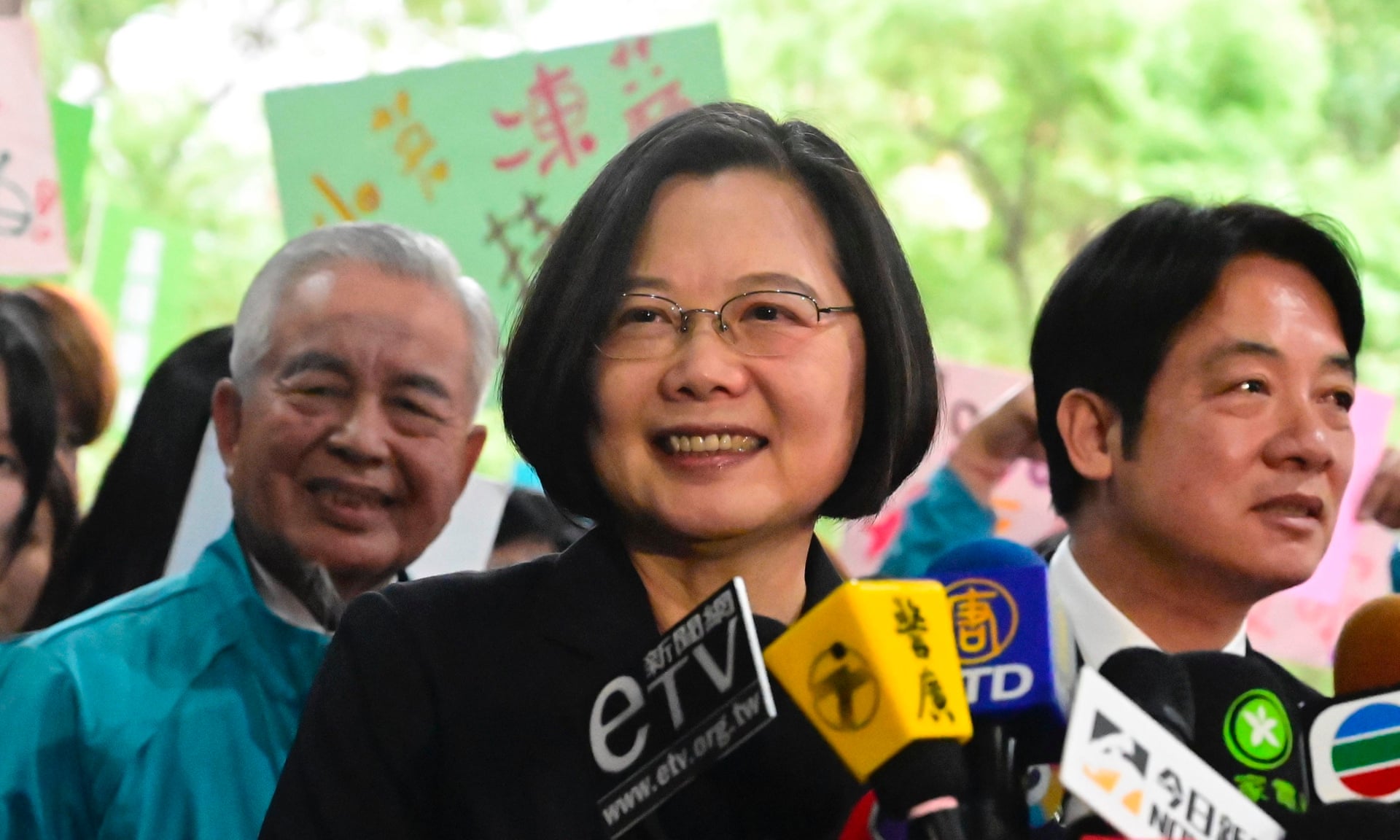
Taiwan’s President Tsai Ing-wen.

Citizen groups in Taiwan say the openness of one of the freest societies in Asia is being used against it by groups in China to wage an online disinformation campaign, made more potent by their shared language, Mandarin.
A recent study by the V-Dem Institute at the University of Gothenburg in Sweden found that Taiwan was the most exposed to foreign dissemination of false information.
False reports include claims Tsai’s doctorate degree was fake or that Hong Kong democracy activist Joshua Wong kicked an elderly man when he visited Taiwan in October and met members of the DPP.
“China has multiple ways of pushing misinformation. We’ve found that content mills are no longer simply producing fake information. More and more, they are manipulating opinions,” said Jarvis Chiu, senior manager for the Institute for Information Industry, which has been assisting government efforts to prevent disinformation.
According to Chiu, an army of trolls will leave thousands of comments under a candidate’s post or a news article, shifting the focus of the debate.
Fake social media accounts also share pro-Beijing content or inflate the number of likes such content gets.
“Subliminal attacks” include repeatedly searching for one candidate’s name to influence search algorithm results.
“China won’t give up this practice. It will only increase and because it is non-military, it won’t get much global attention,” Chiu said.
The uncertain status of Taiwan, functionally independent but not internationally recognised, has been an issue in every campaign since direct elections were introduced in the 1990s following decades of martial law under the KMT.
This year, the question of how Taiwan should deal with Beijing looms even larger after years of increasingly strident rhetoric from China.
On Thursday, China sailed its new aircraft carrier, Shandong, through the Taiwan Strait in a move critics described an effort to intimidate voters.
Months of witnessing Beijing’s inflexible response to protesters in Hong Kong have cast even more doubt on the city’s “one country, two systems” framework, once touted as a possible model for Taiwan.
“There’s a sword hanging over everyone all the time,” said Shelley Rigger, a professor of east Asian politics with a focus on Taiwan at Davidson College.
“It’s exhausting to know that you’re being threatened and that the entity that is threatening you is getting more and more powerful all the time.”
In an attempt to push back against the campaign, citizen watchdog groups are manning social media, debunking rumours and trying to trace questionable content back to its source.
Prosecutors have been charging those who spread disinformation.
The party in office is trying to pass a law that would prohibit support from foreign “infiltration sources” to a political party.
“Taiwanese people have only just started understanding what is happening. It’s still the very beginning,” said Summer Chen, of Taiwan FactCheck Center which works on debunking disinformation on Facebook.
“It is a crisis and all of Taiwan needs to be researching this.”
A series of snappy Youtube tutorials educate viewers on the nature and methods of disinformation warfare.
“Taiwan has become the main laboratory for information warfare from China. If China wants to practice its methods, Taiwan is the starting point,” Puma Shen, who runs DoubleThink Labs, which monitors how false information, explains in one of the videos.
Those working on the issue say it is difficult to definitely say these attacks originated in China or link them to Chinese state actors, which makes the work of raising awareness harder.
“I believe that there is cooperation with China, but how much China knows, how much of this is from the Chinese government or people in Taiwan who are pro-China, we don’t know,” said Vivian Chen, a recent graduate studying medicine from Taipei.
China’s efforts to influence events in Taiwan stretch a long way back and go beyond online information warfare, to include traditional media, incentives for citizens or businesses who cooperate with China, group trips and donations to temples and other grassroots organisations.
Last month when Chinese defector Wang Liqiang detailed ways he had been instructed to interfere in Taiwan’s midterm elections in 2018 as well as the upcoming race, few in Taiwan were surprised.
“The story was not as shocking in Taiwan as it was in other parts of the world,” said Lev Nachman, a PhD candidate at the University of California, Irvine, studying social movements and focusing on Taiwan.
“It is not news to Taiwanese people that China has been co-opting local organisations for political influence.”
Observers say it is unlikely efforts to influence voters will affect the outcome of the race, where voters will also choose representatives for the legislature.
According to polls, Tsai is ahead of her rival, helped by months of protests in Hong Kong and concerns about Beijing, and an improved economy.

vendredi 13 décembre 2019

Revolution of Our Times

Hong Kong young demonstrators shift back and forth between their old lives and their new ones– school uniforms and dinners with mom and dad, then pulling the masks over their faces once more. 
By TOM LASSETER

Fiona’s rebellion against the People’s Republic of China began slowly in the summer months, spreading across her 16-year-old life like a fever dream. 
The marches and protests, the standoffs with police, the lies to her parents. 
They’d all built on top of her old existence until she found herself, now, dressed in black, her face wrapped with a homemade balaclava that left only her eyes and a pale strip of skin visible. 
Her small hands were stained red.
It was just paint, she said, as she funneled liquid into balloons. 
The air around her stank of lighter fluid. 
Teenagers hurled Molotov cocktails toward police. 
Lines of archers roamed the grounds of the university they’d seized; sometimes, they stopped to release metal-tipped arrows into the darkness, let fly with the hopes of finding the flesh of a cop.
Down below Fiona, rows of police flanked an intersection. 
Within a stone’s throw, Chinese soldiers stood in riot gear behind the gates of an outpost of the People’s Liberation Army, one of the most powerful militaries on the planet.
Fiona joined her first march on June 9, a schoolgirl making her way to the city’s financial district on a sunny day as people called out for freedom. 
It was now November 16, and she was one of more than 1,000 protesters swarming around and barricaded inside Hong Kong Polytechnic University. 
Because of their young age and the danger of arrest, Reuters is withholding the full names of Fiona and her comrades.
Night was falling. 
They were wild and free with their violence, but on the verge of being surrounded and pinned down.
The kids, which is what most of them were, buzzed back and forth like hornets, cleaning glass bottles at one station, filling them with lighter fluid and oil in another. 
An empty swimming pool was commandeered to practice flinging the Molotov cocktails, leaving burn marks skidded everywhere.
When front-line decisions needed to be made, clumps of protesters came together to form a jittering black nest – almost everyone was dressed from hood to mask to pants in black – yelling about whether to charge or pull back.

A protester stands in front of smashed windows and graffiti saying “Liberty or Death” during the standoff at Hong Kong Polytechnic University.

They were becoming something different from what they were, a metamorphosis that would have been difficult to imagine in orderly Hong Kong, a city where you line up neatly for an elevator door and crowds don’t step into an empty street until the signal changes. 
With each slap up against the police, each scramble down the subway stairs to avoid arrest as tear gas ate at their eyes, they hardened. 
They shifted back and forth between their old lives and their new – school uniforms and dinners with mom and dad, then pulling the masks over their faces once more. 
It was a dangerous balance.
“We may all be killed by the police. Yes,” said Fiona.
At the crucible of Polytechnic University, Fiona and the others crossed a line. 
Their movement has embraced the slogan of “be water,” of pushing forward with dramatic action and then pulling back suddenly, but here, the protesters hunkered down, holding a large chunk of territory in the middle of Hong Kong. 
In doing so, Fiona found moments bigger than what her life was before. 
“We call the experience of protest, like at PolyU, a dream,” she later explained.
But to speak of such things out loud, without the mask that she hid behind, without the throbbing crowds that made it seem within reach, is not possible outside, in the real Hong Kong.
The protesters have left traces of their hopes, confessions and fears across the city, in graffiti scrawled on bank buildings and bus stops alike. 
One line that’s appeared: “There may be no winners in this revolution but please stay to bear witness.”
The impact of Hong Kong’s protests, as they pass the half-year mark, is this: Kids with rocks and bottles have fought their way to the sharp edge between two nation states expected to shape the 21st century.
The street unrest resembles an ongoing brawl between police and the young men and women in black. 
Police have fired about 16,000 rounds of tear gas and 10,000 rubber bullets. 
Since June, they’ve rounded up people from the ages of 11 to 84, making more than 6,000 arrests. 
About 500 officers have been wounded in the melee.
After the U.S. Congress was galvanized by the plight of the protesters, it passed the Hong Kong Human Rights and Democracy Act, which President Donald Trump signed last month. 
The law subjects Hong Kong to review by the U.S. State Department, at least once a year, on whether the city has clung to enough autonomy from Beijing to continue receiving favorable trading terms from America. 
It also provides for sanctions, including visa bans and asset freezes, against officials responsible for human rights violations in Hong Kong.
The protesters were delighted, carrying American flags and singing “The Star-Spangled Banner” in the streets of Hong Kong. 
Beijing was enraged. 
China has had sovereignty over Hong Kong since the British handed it over in 1997. 
The Chinese government quickly banned U.S. military ships from docking in Hong Kong, a traditional port of call in the region.
The protesters, including many as young as Fiona, had changed the course of aircraft carriers and guided-missile destroyers.
Reporter Tom Lasseter exchanges Telegram messages with Lee. 

The stakes for the kids of Hong Kong go well beyond a moment of geopolitical standoff. 
When Britain passed the city to China, like a pearl slipping from the hand of one merchant to another, there was a written understanding that for 50 years Hong Kong would enjoy a great deal of autonomy. Known as “one country, two systems,” the agreement suspended some of the blow of a global finance center coming under the rule of the Chinese Communist Party. 
The deal expires in 2047. 
For Fiona, this means that in her lifetime she will live not in the freewheeling city to which she was born, but, quite possibly, in a place that’s just another dot on the map of China.
Chants at marches revolve around five protester demands, such as universal suffrage, with “Not one less!” the automatic refrain. 
But conversations soon turn to a larger, more difficult topic at the root of their complaints. 
China.
During interviews with more than a dozen protesters at Polytechnic and another university besieged at the same time, and continued contact with many of them in the weeks that followed, the subject sprang up repeatedly. 
It’s never far, they said, the shadow of Beijing over the Hong Kong government’s policies.
“They’re all involved with this shit,” said Lee, who gave only her last name. 
The 20-year-old nursing student covered her mouth after the obscenity, embarrassed to have said it out loud in the middle of a cafe, and quickly continued. 
“Of course China is the big boss behind this.”
“If China is going to take over Hong Kong, we will lose our freedoms, we will lose our rights as humans,” she said. 
Police had taken down her information when she surrendered outside Polytechnic University. 
She didn’t yet know whether that would lead to an arrest on rioting charges, which could bring up to 10 years of prison.
“In my view, violence is the thing that protects us,” Lee said. 
“It is a warning to those, like the police, who think they can do anything to us.”
The acceptance of violence isn’t limited to the barricades. 
Joshua Wong, the global face of the movement’s lobbying efforts, said he understood the need for protesters “to defend themselves with force.”
As Wong spoke during an interview in Hong Kong on Wednesday, the headline on the front page of the South China Morning Post on the table next to his elbow read: “BOMB PLOTTERS ‘INTENDED TO TARGET POLICE AT MASS RALLY’”
If a group of protesters had indeed planned to bomb police, would that have been a step too far?
“I think the fundamental issue,” he said, “is we never can prove which strategy is the most effective or not-effective way to put pressure on Beijing.”

When Fiona first heard about a bill that would allow criminal suspects to be shipped from Hong Kong to mainland China, the initial trigger of the protests, she wasn’t concerned. 
It was the sort of thing that troublemakers worried about. 
“The extradition bill seemed good to me,” she said.
Her mother, a housewife from mainland China, is the product of a Communist education system that, as Fiona puts it, doesn’t “allow them to think about politics.” 
She is still unaware, for example, that there was a massacre around Beijing’s Tiananmen Square in 1989.
Fiona’s father, from Hong Kong, drives a minibus taxi. 
He has concerns about creeping mainland control, but his urge to “treasure our freedom” leaves him afraid of anything that might provoke Beijing’s wrath: “He keeps saying we should not do this and we should not do that.”
They live together in a sliver of a working-class district in Kowloon, the peninsula that juts above Hong Kong island. 
It is a place of tiny apartments and people just trying to get by.
It was much better, everyone in her household agreed, to avoid politics.
On weekends, Fiona, who has a cartoon sticker of Cinderella on the back of her iPhone, usually went shopping with girlfriends from high school. 
They looked for new outfits. 
They chatted and had tea together.
But when Fiona saw the news that more than 3,000 Hong Kong lawyers dressed in black had marched against the proposed extradition bill on June 6, she wondered what was going on.
She clicked through YouTube on her cell phone. 
She stopped on a Cantonese-language video uploaded about a week before by a young, handsome guy – hair cropped close on the sides and in a sort of thick flop on top – sitting on the edge of a bed. The video was speeded up so the presenter spoke in a fast blur, delivering on what he billed as, “Extradition bill 6 minute summary for dummies.”
The idea of the bill, on its face, wasn’t a problem, the young man said – public safety and rules are important. 
The issue was that the judiciary in the mainland and the judiciary in Hong Kong are two totally different things.
The Chinese Communist Party, he said, might use this new linkage between the court systems to come after ordinary people who were exercising their freedom of speech, something protected in Hong Kong but not Beijing: “You may be extradited to China because of telling a joke.”

Fiona was alarmed.
People walk inside the Legislative Council building after protesters stormed the building on the anniversary of Hong Kong’s handover to China on July 1. 

Just a few days after her YouTube awakening, on June 9, she took the subway with a group of friends from high school over to Hong Kong island. 
The crowd filled the march’s meeting point, Victoria Park, and soon flooded outside its boundaries. Between the glimmering towers of commerce, they yelled: “Fight for freedom! Stand with Hong Kong!” 
They yelled: “No China extradition! No evil law!” 
Fiona was astonished. 
She couldn’t believe so many people had shown up.
The swell of the crowd, the boom and crash of its noise, was adrenaline and inspiration – “all of us were having the same aim,” Fiona said.
The city’s leader, Beijing-backed Carrie Lam, would have to relent, Fiona thought. 
Faced with the will of so many citizens – a million came out that day, in a city of about 7.5 million – Lam had no choice but to meet with protesters and address their concerns.
That’s not what happened.
Three days later, the Hong Kong police shot rubber bullets and tear gas into a crowd.
On July 1, protesters wearing yellow construction hats and gauze masks stormed the city’s Legislative Council building on the 22nd anniversary of the handover from the British. 
They smashed through glass doors with hammers, poles and road barriers, spray-painting the walls as the chaos churned – “HONG KONG IS NOT CHINA.”

On the night of November 16, as Fiona sat on the terrace at Polytechnic, a teenager slouched at his post on a pedestrian bridge on the other side of the school. 
Reaching across a highway between the back of the university and a subway stop, the bridge could be a point of entry for police, the protesters feared.
The road underneath the bridge led to the Cross-Harbour Tunnel, a main artery linking Hong Kong island and the Kowloon Peninsula. 
The protesters had blocked that route, hoping to trigger a citywide strike. 
It was becoming clear that would not happen.
The teenager on the bridge, whose full name includes Pak and who sometimes goes by Paco, had the sleeves of his black Adidas windbreaker rolled up his arms. 
His glasses jutted out of the eye-opening of his ski mask. 
The 17-year-old, thick-set and volatile, recently had gotten kicked out of his house after arguing with his parents about the protests. 
They’re both from mainland China, Pak explained. 
“They always say, ‘Kill the protesters; the government is right.’”
There was a divide between him and his parents that couldn’t be crossed, he said. 
As a student in Hong Kong, he received a relatively liberal education at school, complete with the underpinnings of Western philosophical and political thought.
Pak, second from right, spent shifts guarding the bridge during the standoff at Polytechnic. 
A stockpile of arrows, bricks and umbrellas sits on a pedestrian bridge at Polytechnic University. 

“I was born in Hong Kong. I know what is freedom. I know what is democracy. I know what is freedom of speech,” Pak said, his voice rising with each sentence.
His parents, on the other hand, were educated and raised on the mainland. 
His shorthand for what that meant: “You know, we should love the Party, we should love Mao Zedong, blah, blah, blah.”
In his downtime, Pak hunched over an empty green Jolly Shandy Lemon bottle and poured lighter fluid inside. 
He gestured to containers of cooking and peanut oil and said he added them as well because they helped the fire both burn and stick once the glass exploded.
He couldn’t count how many he’d filled in the past two days at Polytechnic. 
Pak was working a shift as a lookout on the bridge. 
He guzzled soda and coffee to stay awake, lifting his mask to slurp, revealing a round chin and an adolescent’s light dusting of hair on his upper lip.
There was a mattress on the floor around the corner for quick naps. 
On a board leaning against the side of the walkway in front of him, a message was scrawled in capital letters: EYES OPEN!
Where did he think it was all headed? 
Pak put the bottle down and said he saw nothing but struggle ahead. 
“I think the violence of the protests will be increased; it will be upgraded,” he said. 
“But we have no choice.”
When Pak was 12 years old, he watched news coverage of a massive, peaceful protest in Hong Kong, the 2014 “Umbrella Revolution,” a sit-in that called for universal suffrage. 
The movement ended with protesters being hit by tear gas and hauled off to jail.
The nonviolent tactics, Pak said, got them nowhere.
Did he worry that the violence was taking place so near to a People’s Liberation Army barracks?
Not at all. 
That morning, a separate barracks in Hong Kong was in the news when some of its soldiers, in exercise shorts and T-shirts, walked out to the road carrying red buckets and helped clean up debris left by protesters near the city’s Baptist University. 
The event made both local and international headlines for the rarity of PLA soldiers’ appearance in public. 
Under the city’s mini-constitution, the Chinese military can be called by the Hong Kong government to help maintain public order, but they “shall not interfere” in local affairs.
“I think they are testing us. If we attack the PLA, the PLA can shoot us and say, ‘OK, we were defending ourselves,’” Pak said. 
“If we don’t attack the PLA, they will cross the line, again and again.”
But, he said, if the protesters continued ramping up violence against the cops, maybe the PLA would be called in. 
And that, he said, would hand the protest movement victory.
“Other countries like [the] British and America can protect human rights in Hong Kong by sending troops to protect us,” he said. 
It was, under any reading of the situation, a far-fetched idea. 
Hong Kong is by international law the domain of China; the Chinese Communist Party can send in troops to clamp down on civil unrest. 
There’s not been a hint of any Western power being interested in intervening on the ground.
Pak was right about one thing, though. 
Police officers later massed on the other side of the bridge, piling out of their vehicles and walking in a long file to the head of the structure. 
The protesters lit the bridge ablaze. 
People screamed. 
Flames leapt. 
A funnel of black smoke filled the air.
The next night, Pak didn’t reply to notes sent by Telegram, the encrypted messaging app he used. 
A day later, he still didn’t answer notes asking where he was. 
The day after that, the same. 
Pak was gone.

The young man lay his hands down on the table. 
They were bandaged and his fingers curved over in an unnatural crook. 
He’d not been out of his family’s house much in two weeks. 
Tommy, 19, shredded his hands on a rope when he squeezed it hard as his body whooshed down off a bridge on the side of Polytechnic University.
They were better now, his fingers. 
A photograph he sent just after, on November 20, showed a deep pocket of flesh ripped from his left pinkie, close to the bone by the look of it, and skin shredded across both hands. 
“I didn’t wear gloves,” he explained.
After hitting the ground, he’d rushed to a line of waiting vehicles, driven by “parents” – protester slang for volunteers who show up to whisk them away from dangerous situations.
On the morning of November 18, while still inside Polytechnic, he had sent a note saying his actual parents knew he was there and he couldn’t find a way out.
Reporter Tom Lasseter exchanges messages on Telegram with Tommy during and after the standoff. 

“Worst case might be the police coming in polyu arresting all the people inside and beat them up,” he said in a note on Telegram, the chat platform. 
“I’m like holy shit and i gotta be safe and not arrested.”
That evening, he was still there. 
He didn’t see a way to escape. 
Tommy went to the “front line” to face off with the police, not far from the ledge where Fiona sat a couple nights before. 
Tommy carried a makeshift shield, a piece of wood and then part of a plastic road barrier, to protect himself from the blasts of a water cannon. 
He didn’t make it very far.
Unlike most of the protesters who were around him, Tommy is a student at Polytechnic. 
He has worked hard to get there.
He’s a kid from a far-flung village up toward the border with the mainland, where both of his parents are from. 
Everyone in his village opposes the protests, he said, and there are “triads” in the area, members of organized-crime groups that are doing Beijing’s bidding.
Was he sorry that he’d put himself in danger?
“No regrets,” came the first text message response, at 7:29 p.m., even as police continued to mass outside Polytechnic and fears grew of a violent storming of the campus.
“They are wrong”
“We’re doing the right thing”
“It’s so unforgettable and good”
Hours later, he went down the rope.
Tommy, back to camera on the left, on the streets of Hong Kong a couple weeks after the standoff ended. 

Now, meeting to talk after a visit to a clinic for his hands, Tommy said he wasn’t sure what would come next for his city. 
Or himself. 
Although the university was still closed, he’d been keeping up with his studies, emailing professors and working on a paper about Hong Kong’s solid-waste treatment policy. 
Unable to go to the gym because of the hand injury – his athletic frame sheathed in an Adidas jogging suit – Tommy had been feeling restless.
It was obvious the troubles would continue, he said. 
“Carrie Lam will not accept the demands, the protesters will keep going, people will keep getting arrested,” he said. 
“The government wants to arrest all the people.”
But the future would still arrive and he had his own dreams: of a wife and a family, and being a man who provided for them. 
Tommy said he’d been thinking of applying for a government job after graduation. 
They’re steady and have good benefits.
He would also remain a part of the protest movement.
How could he manage both?
Tommy paused a moment before answering. 
Then, he said: “I have to become two people.”

On the afternoon of December 1, life was sunshine and breeze at the Hong Kong Cultural Centre. Inside, a youth orchestra was scheduled to play its annual concert, billed as “collaging Chinese music treasures from various soundscapes of China.” 
Out front, facing the water, a band played cover songs – belting out the lyrics to Bon Jovi’s “You Give Love a Bad Name.” 
Couples strolled on the boardwalk. 
The palms swayed. 
A shop sold ice cream.
And there was Pak, sitting on a bench. 
He’d been arrested trying to flee Polytechnic in the early morning hours of November 19. 
After a day spent in a police station, he made bail and moved back in with his parents.
Out in the open, in blue sweatpants and a grey sweatshirt, he was a pudgy teenager with the awkward habit of pushing his eyeglasses up the bridge of his nose as he spoke.
He had a couple pimples above his left eye. 
Also, he was now facing a rioting charge, and had to report back to the police station in a few weeks.
Since his disappearance, the siege at Polytechnic had ended. 
The protesters simmered down. 
There was an election for local district councillors, and pro-democracy candidates won nearly 90% of 452 seats.
Victorious pro-democracy candidates in district council local elections gather outside the campus of Polytechnic University. 

But two weeks after his arrest, Pak had shown up ready to protest again. 
A march was slated to start in a couple hours. 
He’d taken a bus down from one of Hong Kong’s poorest districts, with a black backpack that held his dark clothes and mask.
The lesson of the elections, he said, was that most Hong Kong citizens not only back the protests but “accept the violence level.” 
Otherwise, he said, they would have rebuked the reform ticket and cast their lot with pro-government candidates.
“I think,” he said, “the violence of the protesters needs to upgrade to setting off bombs.”
He’d been reading about the Russian Revolution and Vladimir Lenin
If he saw irony in studying the architect of the Soviet communist dictatorship while contemplating his own fight against the world’s preeminent Communist Party, he didn’t say so.
“The protesters, I think, will need some weapons, like rifles,” he said.
If it wasn’t possible to buy them, he said, it seemed easy enough to ransack police cars or even stations to steal them. 
He described how that could be done.
The protests that day veered back to confrontation. 
A black flag with the words “HONG KONG INDEPENDENCE” flapped above the crowd. 
The scene to the north, in Kowloon, “descended into chaos as rioters hijacked public order events and resorted to destructive acts like building barricades on roads, setting fires and vandalising public facilities,” according to a police account. 
Any hopes that the elections might bring peace seemed fragile. 
December was off to a turbulent start.

In the weeks after walking out of Polytechnic University, slipping past the police, Fiona kept coming back to the heat of the protests. 
An assembly to support those who protested at Polytechnic. 
A rally to stop the use of tear gas, which featured little children carrying yellow balloons and a march past the city’s Legislative Council building.
And on a Saturday afternoon, the last day of November, a gathering of students and the elderly at the city’s Chater Garden. 
The park sits among thick trappings of wealth and power – the private Hong Kong Club, rows of bank buildings and, just down the street, luxury laced across the store windows of Chanel and Cartier. Fiona was with a friend toward the back, on the top of a wall, out of sight of the TV cameras. 
Her face was hidden behind a mask, as usual. 
Even between protesters, they usually pass nicknames and nods, with nothing that identifies them in daily life.
Her friend, a boy who goes to the same high school, held forth on revolution and the perils of greater mainland China influence in Hong Kong. 
Fiona listened, quietly. 
She nodded her head. 
She looked out at the crowd. 
It felt good to see that she was not alone, Fiona said. 
Though, she said, it was hard to tell where the movement was headed.
It could grind into the sort of underground movement that Tommy hinted at. 
It could erupt in the boom of Pak’s bloody fantasy.
For Fiona, she knew there was always the danger that police might track down her earlier presence at Polytechnic, ending her precarious dance between homework and street unrest.
But sitting there, as the chants echoed and the sun began to slide down the sky over Hong Kong, Fiona said there was no choice but to keep fighting.
A week later, on Dec. 8, Fiona was at Victoria Park, almost six months to the day since her first protest started there. 
Hundreds of thousands of people had come for the march. 
It took Fiona an hour just to get out of the park as the throngs slowly squeezed onto the road outside.
When they saw messages on their cellphones that police had massed down one side street, Fiona and three friends threw on their respirator masks and goggles. 
As they jogged in that direction, a stranger in the crowd handed them an umbrella; another stranger gave them bottles of water. 
They joined a group of others, clutching umbrellas and advancing toward police lines, then coming to a halt.
No tear gas or rubber bullets came. 
The police looked to have taken a step back.
Fiona and her friends dawdled, unsure of what to do. 
They joined the march, a great mass of people churning through Hong Kong, at one point holding cell phones aloft, an ocean of bobbing lights. 
They screamed obscenities at police when they saw them, with Fiona showing a middle finger and calling for their families to die. 
They watched a man throw a hammer at the Bank of China building and heard the crash of breaking glass.
Someone pulled out a can of black spray paint. 
In the middle of the road, Fiona and her friends took turns writing on the pavement. 
They left a message: “If we burn, you burn with us!”
Fiona, on the left, watches as a friend paints graffiti across the road during the December 8 protest. 
jeudi 12 décembre 2019

A Defiant Stand for Freedom

Hong Kong’s struggle against tyranny, and why it matters
By Claudia Rosett


The last time a despotic power devastated Hong Kong was during World War II. 
On December 8, 1941, Imperial Japanese troops poured over the hills from China, overwhelmed the main line of British colonial defenses, and took up positions on the Kowloon peninsula, across the harbor from Hong Kong Island. 
From there, they shelled and bombed the island, then crossed the harbor and on Christmas Day completed a subjugation of the city that lasted until 1945, when Japan lost the war and Britain retook control.
Today, the tyranny ravaging Hong Kong is that of its own sovereign master, the People’s Republic of China. 
The tactics are less broadly lethal but brutal nonetheless, targeting the freedoms vital to the soul of this vibrant city. 
China is trying to grind down Hong Kong’s democracy movement, while preserving global-facing amenities like the airport and the banking system. 
It’s a campaign fought with propaganda, surveillance, arrests, and a local police force turned against Hong Kong’s own people. 
Beijing has threatened Hong Kong with “the abyss” and cautioned that “those who play with fire will perish by it.” 
Chinese dictator Xi Jinping warned in October, clearly aiming at Hong Kong’s protesters, that any attempt to divide China would end in “crushed bodies and shattered bones.”
Contrary to China’s claims, the Hong Kong crisis is not an internal matter. 
It is a violation of China’s treaty promise, after Britain’s 1997 handover of its former colony, that Hong Kong would be governed as an autonomous territory, entitled to all its accustomed rights and freedoms, for at least 50 years—a promise that China dubbed “one country, two systems.” 
It is also a warning to the world of how Beijing views frees societies and what Xi’s “China Dream” of global dominance has in store for them. 
Hong Kong is the only enclave under China’s flag with any freedom to speak out. 
At great risk, Hong Kong’s people have sounded alarms about the methods and ambitions of China’s ruling Communist Party. 
Americans needs to understand why, in this twenty-first-century contest of values, Hong Kong’s fight is our fight, too.
Hong Kong exemplifies the marvels of freedom. 
Built with free trade and minimal government, a haven in British colonial days for refugees fleeing Communist China, it is a mighty entrepôt conjured out of little more than a rocky island, a magnificent harbor, and generations of freewheeling human enterprise.
Until this year, Hong Kong figured on the world scene chiefly as a great place to do business. 
Home to 7.5 million people, with a large expatriate community, including more than 80,000 Americans, the city has long served as a crossroads of Asia and the main conduit for China’s financial dealings with world markets. 
Via Hong Kong, foreign investors in China could rely on the legacy of British law, vastly preferable to the vagaries of China’s Communist Party-driven system. 
China, in turn, could avail itself of Hong Kong’s banking system and trade, leveraging to its own benefit the privileges accorded to a territory operating as part of the free world, though under China’s flag.
At the time of the 1997 handover, many worried that China would plunder Hong Kong outright, killing the golden goose. 
But for more than two decades, no grand crisis materialized. 
Yes, Beijing was leaching away Hong Kong’s freedoms, reneging on the promise of free elections, overwhelming the city’s culture with mainland visitors— and threatening, disenfranchising, and, in some cases, jailing its most active pro-democracy figures. 
And yes, Hong Kong’s people pushed back, staging many demonstrations, some quite large—notably the 2014 Umbrella Movement’s 79-day occupation of Hong Kong’s Central business district. (Umbrellas became the symbol of the protests after they were used as protection from pepper spray.) But these protests were peaceful. 
The world yawned. 
Business carried on.
Then, in 2019, Hong Kong became a battleground. 
As it turned out, China had greatly underestimated the value Hong Kong’s people attached not solely to prosperity, but to freedom. 
In June, Hong Kong’s Beijing-installed Chief Executive Carrie Lam—a longtime Hong Kong civil servant with the political instincts of Marie Antoinette—tried to rush through Hong Kong’s rubberstamp Legislative Council (Legco) a law that would have allowed extradition to mainland China, breaching the protection afforded by Hong Kong’s separate and independent legal system. Faced with local objections that this would spell the end of whatever liberty and justice Hong Kong still enjoyed under the eroding promise of “one country, two systems,” Lam refused to reconsider.
Hong Kong erupted in the most massive protests the city had ever seen. 
It was heroic, given the risks; and heartbreaking, given the prospects. 
On June 9, a record 1 million people marched through the streets, mass protest being their only recourse in a system rigged by Beijing to deprive them of a direct say in their own government. 
Lam shrugged it off. 
Three days later, protesters physically blocked lawmakers from entering the legislature to pass the bill. 
Police responded with teargas, beatings, and arrests. 
When Lam then suspended passage of the bill but refused to withdraw it entirely, denouncing the protesters as rioters, an estimated 2 million people marched—more than one-quarter of the city’s population. 
Lam gave them nothing. 
This focused public attention on Lam herself, and the perils and injustice of a political setup that left Hong Kong’s people no way to choose or depose their own chief executive. 
In short order, Hong Kongers came up with an amplified list of demands, including universal suffrage.
A signal moment came on July 1, the anniversary of the 1997 handover, when protesters broke down doors and windows of the legislature, briefly occupied the main chamber, spray-painted black Hong Kong’s Beijing-imposed emblem of a Bauhinia flower, proclaimed a list of demands for justice and democracy, and graffitied a message in Chinese on the nearby premises: “It was you who taught me that peaceful protests are useless.”
A complex culture of protest rapidly developed, incorporating the lessons of the 2014 Umbrella Movement. 
Some brought their young children to huge, peaceful rallies and marches. 
Civil servants, bankers, teachers, and students participated in city-wide strikes and impromptu demonstrations. 
Old and young linked hands to form human chains for miles, calling for freedom and democracy and chanting the Cantonese slang phrase ga yau, meaning “add oil”—a call to keep going. 
Protesters came up with a haunting anthem, “Glory to Hong Kong,” and began singing it at sports matches, in shopping malls, and while they marched in protest through the streets.

Because leaders of the Umbrella Movement had gone to prison, the protesters of 2019 avoided anointing leaders. 
Crowdsourcing tactics online, under a slogan plucked from a Bruce Lee movie, “Be water,” they staged flash protests around the city. 
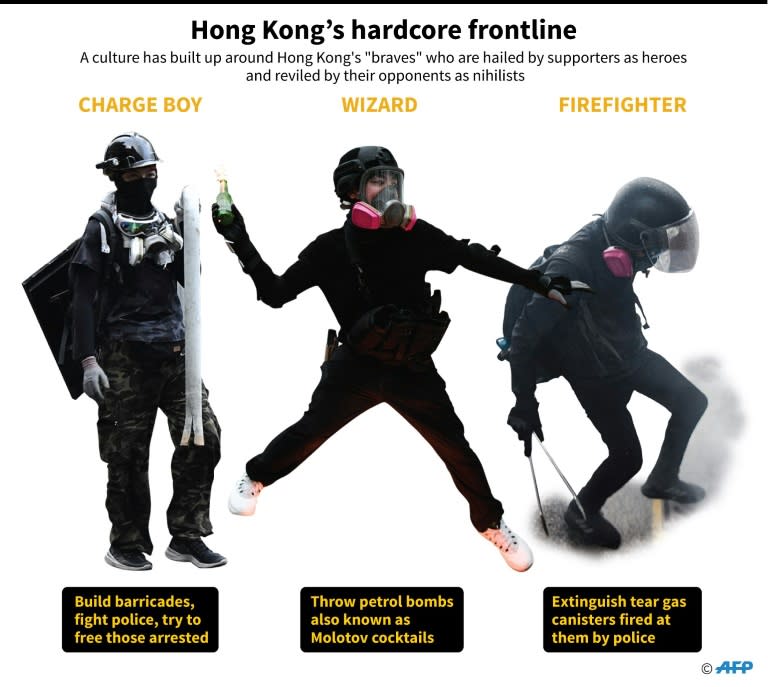
They developed a uniform of sorts and an order of battle. 
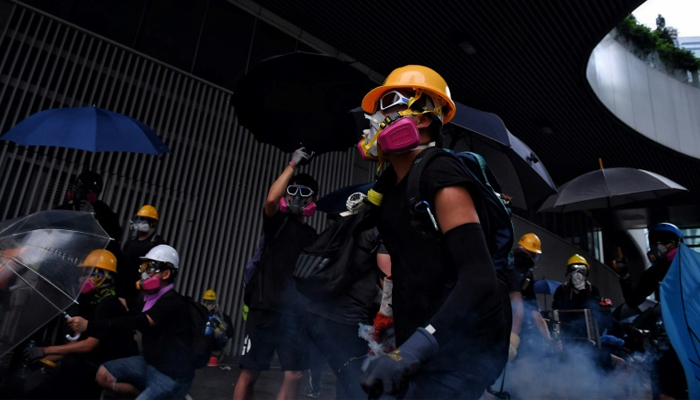
The “frontliners” wore helmets, goggles, gas masks, and black t-shirts, and wielded as weapons an ad hoc arsenal that escalated from umbrellas, laser pointers, and bricks to Molotov cocktails, slingshots, and flaming arrows. 
Support protesters, including volunteer medical teams and bucket brigades, resupplied the frontlines with everything from bottled water to first aid supplies. 
Across the city, donations rolled in to support the protests: money, food, drink, and protest gear. When police launched a dragnet in August, setting up subway and ferry checkpoints, anonymous Hong Kongers got in their cars and whisked protesters to safety in an impromptu vehicular operation they dubbed “Dunkirk.”
Instead of trying to defuse the protests with talks and compromise, Lam defaulted to the methods of a police state, dispatching Hong Kong’s cops to wield force. 
Hong Kong’s police, once regarded as among the finest in Asia, were transformed into shock troops for China, trying to beat, gas, and terrorize the democracy movement into submission. 
Police began referring to protesters as “cockroaches.” 


Stories circulated that ranks of local cops had been beefed up with members of China’s People’s Armed Police, overheard speaking mainland Mandarin rather than Hong Kong’s Cantonese dialect.
By early December, police had fired more than 15,000 rounds of tear gas, blitzing not only streets across much of the city but also subway stations, residential buildings, shopping malls, and universities. 
They pepper-sprayed pro-democracy lawmakers who were trying to reason with them, shot three protesters with live ammunition, drenched not only protesters but a Kowloon mosque with caustic blue dye from water cannons, and carried out more than 6,000 arrests. 
The protesters escalated their tactics to smashing the windows of pro-Beijing businesses and setting fire to subway entrances and street barricades. 
The police were caught on video beating and kicking trussed-up protesters and launching unprovoked attacks on bystanders and journalists. 
In November, an attempted police raid on Hong Kong’s Polytechnic University turned into a flaming battle, followed by a 12-day police siege from which some protesters escaped by abseiling from a pedestrian walkway or traversing the sewers.
Through it all, Lam remained cloistered in official surroundings, issuing periodic statements that there could be no serious dialogue until “calm and order” was restored. 
Never mind that it was precisely the lack of any genuine government dialogue or compromise that was driving the escalating havoc.
One of the most potent protests came in mid-summer, when thousands of protesters occupied the city’s airport, in a bid to force the government’s hand on a world stage, and in a venue where the police might surely hesitate to respond harshly. 
Hong Kong’s airport is one of the world’s busiest. 
Travelers transiting the outer halls of the huge building found themselves surrounded by Hong Kongers holding up signs in English and Chinese denouncing the encroaching tyranny of China. Protesters packed the arrival hall, their chant echoing through the vast atrium: “Fight for Freedom! Stand with Hong Kong!”
Near the departure desks, beneath an official sign welcoming visitors to “Asia’s World City,” protesters hung a huge banner, flanked by American flags, saying “President Trump Please Liberate Hong Kong.” 
They papered the walls, windows, and baggage carts with signs blasting police brutality and demanding justice. 
On the information desks, they replaced the brochures for shopping, dining, and Disneyland with pamphlets calling for democracy, apologizing to visitors for the inconvenience. 
One young man, wearing the protesters’ trademark black t-shirt and face mask, roamed the halls with a hand-lettered sign offering to explain the situation to baffled travelers: “Feel free to ask me, I do speak English!”
Hong Kong’s government, forced briefly to shut down the airport, finally ended the inconvenience with threats, riot police, pepper spray, arrests, and greatly constricted access. 
Large security cordons now control entry to the building, admitting only those with tickets and passports. 
Teams of security agents patrol the premises. 
Public transport to the airport is now closely monitored and sometimes greatly curtailed, to thwart any crowds heading that way.
This lockdown did nothing to address the protesters’ demands for liberty and justice, but for official purposes it fixed the problem at the airport. 
The government’s solution for the airport appears to be the template for the future. 
In Beijing’s scheme of calm and order, Hong Kong is not a polity of, by, and for the people; it is merely a large asset of China’s government. 
As such, it is the profitable utilities, not the people themselves, that the government would protect, under the cloying slogan: “Treasure Hong Kong: Our Home.”
I’ve loved Hong Kong since I first beheld it, during a family stopover decades ago. 
I lived and worked there from 1986 to 1993, as editorial-page editor of what was then the print edition of the Asian Wall Street Journal. 
With Hong Kong’s glorious sweep of hills and harbor, its kaleidoscopic street life, its savvy mix of Chinese and Western traditions, and the constant hum of commerce, it felt like the most invigorating city on the planet. 
You could fly out of Hong Kong to report on the region’s tyrannies, observing the strictures and enduring the minders of, say, China, Vietnam, or North Korea. 
Then you could return to Hong Kong, with its can-do culture and laissez-faire ways—and exhale. 
In the summer of 1989, returning to Hong Kong after reporting in Beijing on the June 4 Tiananmen massacre, I was speechless with relief. 
Hong Kong residents were staging huge protests against the repression in China. 
I was back in the free world.
That’s not how it feels today. 
In September, Lam finally announced that she would withdraw the despised extradition bill. 
But by then, her administration was importing some of the cruelties of China’s system wholesale.
During many weeks of reporting there since June, I found an atmosphere of defiance edged with fear; a city of people in face masks, keeping a wary eye out for advancing cordons of riot police. 
Under pressure from China, companies such as Hong Kong’s flagship airline, Cathay Pacific, carried out purges of personnel who had in any way shown sympathy with the protesters, an intimidation described locally as “white terror.” 
Hong Kongers, when they take their leave these days, are less likely to say “goodbye” than to warn, “take care.”
How did it come to this? 
The answer tracks back to the era of Queen Victoria, Britain’s Opium Wars, and unintended consequences, good and bad, played out over almost two centuries. 
The British did not set out to develop Hong Kong into a world-class metropolis of millions; they simply wanted a trading post, for the noxious purpose of selling opium into China. 
So they went to war to get it. 
In the 1842 Treaty of Nanjing, China ceded to Britain in perpetuity the island of Hong Kong, a name which in Cantonese means “Fragrant Harbor.” 
At the time, it was home to a fishing village, a war prize famously ridiculed by Britain’s foreign secretary, Lord Palmerston, as “a barren island with hardly a house upon it.”

The British turned it into a Crown Colony, named its harbor for their queen, and set up shop. 
They fought a second Opium War, and in 1860, China ceded the tip of the Kowloon peninsula, also in perpetuity. 
In 1898 Britain signed a 99-year lease with China for some adjacent turf, called the New Territories, stretching up to the hills that form a natural boundary with mainland China. 
That produced the full map of what we know as modern Hong Kong.
Out of this, about a half century later, came one of the great economic miracles of modern Asia. 
Hong Kong at the end of World War II was a shattered city with a population of less than 600,000. 
In 1949, Mao Zedong imposed his Communist revolution on China. 
Millions fled to Hong Kong, embracing its culture of enterprise and providing labor and talent that under British liberty and law created soaring wealth.
Not that the British permitted genuine democracy in Hong Kong; governors appointed in London ruled the colony. 
But behind that setup were the checks and balances of British democracy, to which the governors were ultimately accountable. 
Hong Kong’s people, post-World War II, had freedom of speech and assembly, and an independent judiciary based on British rule of law.
Hong Kong was a colony richly primed for democracy and independence, in an era when the British empire was breaking up and decolonization was sweeping the globe. 
The United Nations, founded at the end of World War II, compiled a list of colonies slated for eventual self-determination. 
Initially, Hong Kong was on it. 
But in the early 1970s, China swiped away that right. 
In 1971, during Richard Nixon’s rapprochement with China, Beijing’s Communist government took over the UN seat for China, held until then by the rival Nationalist government on Taiwan. 
China immediately joined the UN committee on decolonization. 
Within weeks, the committee removed Hong Kong from its list of colonies, on grounds that its fate was China’s affair. 
That was the end of any UN support for Hong Kong choosing its own future.
When China informed the British that there would be no renewal of the lease on the New Territories, due to expire in 1997, London had no appetite for a showdown over Hong Kong—considered indefensible without the New Territories, and dependent on China for its water supply. 
In 1984, Britain and China signed the Sino-British Joint Declaration, scheduling the handover for July 1, 1997. 
This treaty, deposited with the United Nations, stipulated that for 50 years following the handover, Hong Kong would be governed as a Special Administrative Region, enjoying a “high degree of autonomy,” with its people retaining their “Rights and freedoms, including those of the person, of speech, of the press, of assembly, of association, of travel”—and a host of others.
Thus did Hong Kong become the world’s only free society with a distinct shelf date. 
For Britain—handing over a substantially free population to a tyranny—the grace period allowed a face-saving retreat, bolstered by the bequest of a mini-constitution, or “Basic Law” for Hong Kong, hammered out with Beijing before the handover, in which China agreed to the “ultimate aim” of allowing Hong Kong’s people to elect their own chief executive and entire legislature via universal suffrage. 
Conveniently for Beijing, no date was spelled out for this goal.
For China, then miserably self-impoverished by decades of Communist central planning, acquiring Hong Kong was a colossal windfall. 
As a bonus, it carried the implied message that the world’s great democracies, under pressure from Beijing, would not defend their own.
If the promised half century of grace for Hong Kong sounded like a long time back in 1997, it doesn’t anymore. 
Officially, the clock has ticked down to 28 years remaining. 
In practice, if China has its way, the deadline will arrive much sooner. 
Meantime, a generation born in Hong Kong around the time of the handover has come of age. 
Many are descended from parents or grandparents who fled Communist repression in China. 
They describe themselves not as Chinese but as Hong Kongers. 
They are the vanguard of Hong Kong’s protests, and many say they are prepared to die for freedom.
This passion did not appear out of thin air. 
Nor is it a product—as China’s propaganda has charged—of foreign influence organized by sinister “black hands.” 
Hong Kong’s protesters today are heirs to a homegrown democracy movement that dates to British colonial days. 
It was fostered decades ago by leaders such as barrister and former lawmaker Martin Lee, who in 1997 greeted the handover with the defiant declaration: “The flame of democracy has been ignited and is burning in the hearts of our people. It will not be extinguished.” 
Then there’s self-made businessman Jimmy Lai, publisher since 1995 of Hong Kong’s widely circulated pro-democracy Chinese newspaper, Apple Daily, who told me in an interview this August: 
“We can’t give up. If we give up, we will have to endure the darkness of dictatorship.” 
Lee, now in his eighties, and Lai, now in his seventies, both marched at the front of some of this year’s protests.
Down the generations, this movement is packed with brave and articulate figures, including pro-democracy lawmakers whom police during the past six months of protest have tear-gassed, pepper-sprayed, and drenched with water cannon. 
Some of the youngest democracy advocates, such as Joshua Wong and Nathan Law, both in their mid-twenties, have served time in prison for their leadership of the 2014 Umbrella movement—and emerged to continue arguing the case for Hong Kong’s rights.
Hong Kong’s passion for democracy was on rich display in elections on November 24 to seats on the city’s district councils. 
These are relatively powerless positions, dealing with local matters such as bus routes and trash collection. 
But they’re the only elections in Hong Kong that entail a genuinely democratic process. 
Hong Kongers turned out in record numbers to send a message at the polls, delivering a landslide for pro-democracy candidates, who won control of 17 of the 18 district councils.
These are valiant achievements against fearful odds. 
Hong Kong’s freedom movement is up against the regime of Xi Jinping, who, since he became president in 2013, has been ratcheting up repression across China, styling himself as the modern Mao. 
Under the label of perfecting “socialism with Chinese characteristics,” the 66-year-old Xi has been establishing himself as president for life of a techno-authoritarian state. 
China’s system now includes a program of “social credit,” meant to engineer human behavior to please the party, and reeducation camps to brainwash Uyghur Muslims. 
Hong Kong’s protesters harbor well-grounded fears that Xi might have similar plans in store for them. 
“If this movement dies, we’ll be living in the Orwellian society that is coming,” says one Hong Kong academic.
Xi has thrown visible support for years behind Lam. 
In 2019, after Lam triggered the huge protests and then further enraged the public with her refusal to concede to any demands or corral the police, she was caught on a recording, leaked to Reuters, lamenting that she could no longer go to shopping malls or a hair salon for fear of “black-masked young people waiting for me.” 
A month later, she incited yet more public fury by invoking despotic emergency powers to ban face masks. 
The following month, Xi summoned her to an audience in Shanghai; Chinese state media reported that he still firmly supported her. 
By then, casualties in Hong Kong were extensive, rubble lined many of the streets, and Hong Kong’s economy had tipped into recession.
Should Americans care? 
Especially since the end of the Cold War, America has spent blood and treasure trying to foster free societies around the globe, on the reasonable theory that this tends toward a safer, more prosperous world. 
It’s a tall order. 
But in Hong Kong, with no grand programs of foreign aid and consultancies, and under the shadow these past 22 years of Chinese sovereignty, a free society has materialized, and its people are calling for us to stand with them against tyranny. 
If we do nothing but watch while China swallows Hong Kong whole, Beijing will learn the relevant lesson.
The endgame here is desperately uncertain. 
Neither America nor any other nation is likely to go to war in defense of Hong Kong. 
An armed conflict, even if meant to defend the city, would likely destroy it. 
But America can enforce its new Hong Kong Human Rights and Democracy Act, which President Trump signed into law last month, and which requires annual reports on whether China is respecting Hong Kong’s rights under “one country two systems”—and imposes penalties if China is not. 
We can expose the lies with which China tries to discredit Hong Kong’s democracy movement. 
We can sound the alarm generally on China’s maneuvers to undermine the democratic world, and we can build up the U.S. military both to counter directly China’s military rise and to give America’s leaders a stronger hand in dealing with Beijing. 
We could offer asylum to as many of Hong Kong’s people as America can absorb. 
Not least, we can look with respect and gratitude on a people who prize freedom so highly that, while they call for us to stand with them, they themselves, outnumbered and certainly outgunned, are facing down China’s tyranny on the frontlines, in the streets of their own city.