China is incarcerating hundreds of thousands of Muslims in concentration camps that are rising from the desert sands in East Turkestan. A forensic analysis of satellite images of 39 of these facilities shows they are expanding at a rapid rate.
By Philip Wen and Olzhas Auyezov

A United Nations panel has accused China of turning its far-flung western colony of East Turkestan “into something that resembled a massive internment camp shrouded in secrecy, a ‘no rights zone’.” It estimates that there could be as many as one million Muslims who have been detained there.
Former detainees describe being tortured during interrogation, living in crowded cells and being subjected to a brutal daily regimen of Communist Party indoctrination that drove some people to suicide.
By Philip Wen and Olzhas Auyezov
A United Nations panel has accused China of turning its far-flung western colony of East Turkestan “into something that resembled a massive internment camp shrouded in secrecy, a ‘no rights zone’.” It estimates that there could be as many as one million Muslims who have been detained there.
Former detainees describe being tortured during interrogation, living in crowded cells and being subjected to a brutal daily regimen of Communist Party indoctrination that drove some people to suicide.
Most of those who have been rounded up by the security forces are Uighurs, a Muslim ethnic minority that numbers some 10 million.
Muslims from other ethnic groups, including Kazakhs, have also been detained.
China rejects the allegations that it has locked up large numbers of Muslims in re-education camps. The facilities, it says, are vocational training centers that emphasize “rehabilitation and redemption” and are part of its efforts to combat "terrorism" and religious extremism.
The crackdown includes tight control over information and access to the region.
China rejects the allegations that it has locked up large numbers of Muslims in re-education camps. The facilities, it says, are vocational training centers that emphasize “rehabilitation and redemption” and are part of its efforts to combat "terrorism" and religious extremism.
The crackdown includes tight control over information and access to the region.
East Turkestan is now the most heavily policed area in the world.
This follows the launching of a “people’s war on terror” in 2014 after a series of violent attacks in East Turkestan and other parts of China that authorities blamed on religious extremists.
While China says the Uighur camps are "vocational training" centers, they are heavily guarded. Researchers have resorted to using satellite imagery to view and track the expansion of these facilities.
Reuters worked with Earthrise Media, a non-profit group that analyzes satellite imagery, to plot the construction and expansion of 39 of these camps, which were initially identified using publicly available documents such as construction tenders.
Reuters worked with Earthrise Media, a non-profit group that analyzes satellite imagery, to plot the construction and expansion of 39 of these camps, which were initially identified using publicly available documents such as construction tenders.
The building-by-building review of these facilities revealed that the footprint of the built-up area almost tripled in size in the 17 months between April 2017 and August 2018.
Collectively, the built-up parts in these 39 facilities now cover an area roughly the size of 140 soccer fields.
The facility at Turpan can be seen at the foot of the Tianshan mountains in East Turkestan.
The facility at Turpan can be seen at the foot of the Tianshan mountains in East Turkestan.
A tender notice revealed that officials there wanted to be able to listen in to telephone calls made by "trainees" at the camp.
Construction notices published on local government websites, including tenders and procurement requests, have provided clues about the location and features of many of the camps.
Construction notices published on local government websites, including tenders and procurement requests, have provided clues about the location and features of many of the camps.
The technical specifications in these documents include references to guardhouses, surveillance systems that leave “no blind spots,” automatic weapons and their safe storage.
A tender issued for the center at Turpan, for instance, canvassed bids for a telecommunications “control system,” saying the facility was in “urgent need to know in real time” the content of trainees’ telephone conversations so that they could be forcibly interrupted.
Having identified 80 detention facilities using construction notices, Reuters focused its analysis on 39 that were clearly identifiable from satellite imagery.
A tender issued for the center at Turpan, for instance, canvassed bids for a telecommunications “control system,” saying the facility was in “urgent need to know in real time” the content of trainees’ telephone conversations so that they could be forcibly interrupted.
Having identified 80 detention facilities using construction notices, Reuters focused its analysis on 39 that were clearly identifiable from satellite imagery.
Earthrise then scrutinized hundreds of satellite images spanning a two-year period.
“I was immediately struck by how many camps there were, how large, and how quickly they are growing. In a matter of months they are throwing up five-story buildings, longer than football fields, lined up in rows in the desert,” said Edward Boyda, co-founder of Earthrise.
“I was immediately struck by how many camps there were, how large, and how quickly they are growing. In a matter of months they are throwing up five-story buildings, longer than football fields, lined up in rows in the desert,” said Edward Boyda, co-founder of Earthrise.
“The construction and arrangement of buildings is very similar from site to site, in the new sites especially, which means there is a method behind it.”
China’s State Council Information Office, foreign ministry and the East Turkestan government did not respond to questions from Reuters.

Uighurs have bristled at what they say are harsh restrictions on their culture and religion.
China’s State Council Information Office, foreign ministry and the East Turkestan government did not respond to questions from Reuters.
Uighurs have bristled at what they say are harsh restrictions on their culture and religion.
They have faced periodic crackdowns, which intensified after riots in the regional capital in Urumqi in 2009 killed nearly 200 people.
Bombings in East Turkestan and attacks allegedly carried out by Uighur separatists, including a mass stabbing in the city of Kunming in China’s southwest in 2014 that killed 31 people, led to further restrictions.
Bombings in East Turkestan and attacks allegedly carried out by Uighur separatists, including a mass stabbing in the city of Kunming in China’s southwest in 2014 that killed 31 people, led to further restrictions.
In recent years, under Chen Quanguo, the Communist Party secretary in East Turkestan and a loyalist of Xi Jinping, measures against Uighurs have included a ban on “abnormal” beards for men and restrictions on religious pilgrimages to Mecca.
Chen has also overseen the installation of a pervasive, technology-enhanced surveillance apparatus across East Turkestan.
Chen has also overseen the installation of a pervasive, technology-enhanced surveillance apparatus across East Turkestan.
Tens of thousands of security personnel have been recruited to staff police stations and checkpoints. Security screening, including scanners equipped with facial recognition cameras, has been installed in public places such as mosques, hotels and transportation hubs.
Reuters did not receive a response to questions sent to Chen via the East Turkestan government.
Reuters visited the locations of seven of the facilities identified as detention camps from construction documents and satellite photos.
Reuters did not receive a response to questions sent to Chen via the East Turkestan government.
Reuters visited the locations of seven of the facilities identified as detention camps from construction documents and satellite photos.
All had imposing perimeter walls, guard watchtowers and armed guards at the entrances.
Signs at two of the facilities identified them as "vocational training" centers.
When reporters approached the compounds, police pulled them over and told them to leave.

Rapid expansion
The full scale of the camp network is likely vast.
Rapid expansion
The full scale of the camp network is likely vast.
Many smaller buildings like schools, hospitals and police stations were repurposed to hold Muslims, according to residents in East Turkestan and construction and procurement documents.
Two of the smaller camps visited by Reuters were previously a factory and a Communist Party school.
Adrian Zenz, an anthropologist who has tracked the expansion of the camps, estimates there could be as many as 1,200 – at least one for every county and township in East Turkestan.
Adrian Zenz, an anthropologist who has tracked the expansion of the camps, estimates there could be as many as 1,200 – at least one for every county and township in East Turkestan.
There is limited information on the costs of construction, but tenders for one facility outside the city of Kashgar list a combined budget of $45.6 million.
The vast majority of facilities have been built since early 2017, says Shawn Zhang, a law student based in Canada who has used government documents and open-source satellite imagery to identify dozens of camps.
The vast majority of facilities have been built since early 2017, says Shawn Zhang, a law student based in Canada who has used government documents and open-source satellite imagery to identify dozens of camps.
Recently, Zhang said, the Chinese government has stopped publishing tender notices and has been deleting old ones from the internet.
The construction of new facilities and expansion of existing ones largely began around April 2017. That was the month Beijing enforced new anti-extremism regulations in East Turkestan, including prohibitions on the wearing of veils in public places and the stopping of children from attending “patriotic education classes.”
The construction of new facilities and expansion of existing ones largely began around April 2017. That was the month Beijing enforced new anti-extremism regulations in East Turkestan, including prohibitions on the wearing of veils in public places and the stopping of children from attending “patriotic education classes.”
Foreign reporters who arrive in East Turkestan are closely followed by Chinese security forces. Reuters reporters who visited 10 different cities in the region this year were under surveillance from the moment they got off the plane.
They were followed in their car, on foot and on trains.
On several occasions, police threw up temporary roadblocks to block the reporters from reaching the camps.
The Chinese government did not respond to questions from Reuters about these restrictions.

A Chinese police officer stops reporters at a roadblock near what is officially called a "vocational training center" in Ghulja, a city in the northwest of East Turkestan.
A remote place with snow-capped mountains and sprawling wind farms, the district of Dabancheng is home to one of the largest camps.
It is one of many that have been built from scratch.
On several occasions, police threw up temporary roadblocks to block the reporters from reaching the camps.
The Chinese government did not respond to questions from Reuters about these restrictions.
A Chinese police officer stops reporters at a roadblock near what is officially called a "vocational training center" in Ghulja, a city in the northwest of East Turkestan.
A remote place with snow-capped mountains and sprawling wind farms, the district of Dabancheng is home to one of the largest camps.
It is one of many that have been built from scratch.
It is surrounded by a barbed wire fence and high perimeter wall.
A sign at the main entrance reads: “Urumqi Vocational Education Training Center.”

A guard watchtower can be seen above the perimeter fence at Dabancheng.
Satellite images reveal that before April last year, the site was a brown expanse of desert without a single building.
A guard watchtower can be seen above the perimeter fence at Dabancheng.
Satellite images reveal that before April last year, the site was a brown expanse of desert without a single building.
Since then, a sprawling complex has risen from the sand.
A close-up look at the construction


Workers walk along the perimeter fence at Dabancheng (left). Signs at the entrance to the camp remind workers about building safety requirements.
In September, a narrow road running along the facility was filled with construction vehicles and workers, indicating that building was still underway at Dabancheng.
A close-up look at the construction
Workers walk along the perimeter fence at Dabancheng (left). Signs at the entrance to the camp remind workers about building safety requirements.
In September, a narrow road running along the facility was filled with construction vehicles and workers, indicating that building was still underway at Dabancheng.
Satellite photos from August reveal the scale of the construction at the camp.

Intense indoctrination
Interviews with eight former detainees, all of whom are now outside China, reveal a picture of harsh extrajudicial detention that is at odds with Beijing’s claim that it is providing vocational skills at training centers to help the local population.
The former detainees said they were shackled to chairs for days during interrogation and deprived of sleep.
Intense indoctrination
Interviews with eight former detainees, all of whom are now outside China, reveal a picture of harsh extrajudicial detention that is at odds with Beijing’s claim that it is providing vocational skills at training centers to help the local population.
The former detainees said they were shackled to chairs for days during interrogation and deprived of sleep.
They described living in prison-like conditions.
Their every move, including visits to the toilet, was monitored by cameras and microphones.
One female detainee said her cell was so crowded that inmates took turns to sit and rest while others stood.
From early morning to night, the detainees said they were subjected to mind-numbing political indoctrination.
From early morning to night, the detainees said they were subjected to mind-numbing political indoctrination.
This included reciting Chinese laws and Communist Party policies, as well as singing the national anthem and other traditional Red songs.
Those who failed to correctly memorize the lines of Communist Party dictums were denied food.
Detainees were forced to renounce their religion, engage in self-criticism sessions and report on fellow inmates, relatives and neighbors.
Of the eight former detainees interviewed by Reuters, four were Uighurs and four were ethnic Kazakhs.
Of the eight former detainees interviewed by Reuters, four were Uighurs and four were ethnic Kazakhs.
Some requested anonymity, in most cases because they said they feared repercussions for family members who remained in China.
Kairat Samarkan said he was detained late last year when he returned to his hometown of Altay, in the north of East Turkestan, to sell his home.
Samarkan, a 30-year-old ethnic Kazakh who was born in China, had moved to Kazakhstan in 2009.
After about three months of intense indoctrination sessions at the camp where he was held, Samarkan said he became “obsessed with suicide. I had thought for a long time about how to do it,” he said. One day, he tried: He ran into a wall head first.
After about three months of intense indoctrination sessions at the camp where he was held, Samarkan said he became “obsessed with suicide. I had thought for a long time about how to do it,” he said. One day, he tried: He ran into a wall head first.
When he regained consciousness, he was in the camp hospital.
He was released in February this year and returned to Kazakhstan the next month.
The Chinese government did not respond to questions about the accounts given by former detainees.

China's explanation
Many of the construction tenders issued last year refer to “re-education” facilities.
The Chinese government did not respond to questions about the accounts given by former detainees.
China's explanation
Many of the construction tenders issued last year refer to “re-education” facilities.
But China, which for months denied their existence, now calls them "vocational training centers".
“Through vocational training, most trainees have been able to reflect on their mistakes and see clearly the essence and harm of terrorism and religious extremism,” Shohrat Zakir, the East Turkestan governor, said in remarks to the state-run Xinhua news agency in October.
“Through vocational training, most trainees have been able to reflect on their mistakes and see clearly the essence and harm of terrorism and religious extremism,” Shohrat Zakir, the East Turkestan governor, said in remarks to the state-run Xinhua news agency in October.
“They have also been able to better tell right from wrong and resist the infiltration of extremist thought.”
In September, a Chinese official at the U.N. Human Rights Council in Geneva said the West could learn from his country’s program of "vocational training".
In September, a Chinese official at the U.N. Human Rights Council in Geneva said the West could learn from his country’s program of "vocational training".
“If you do not say it’s the best way, maybe it’s the necessary way to deal with Islamic or religious extremism, because the West has failed in doing so,” said Li Xiaojun, the director of publicity at the Bureau of Human Rights Affairs of the State Council Information Office.
The criminals who run East Turkestan
Criticism of China’s policies in East Turkestan has been growing.
The criminals who run East Turkestan
Criticism of China’s policies in East Turkestan has been growing.
In late August, a bipartisan group of 17 members of the U.S. Congress wrote to Secretary of State Mike Pompeo and Treasury Secretary Steven Mnuchin urging them to impose sanctions on seven senior Chinese officials for their role in the “ongoing human rights crisis” in East Turkestan.
At the top of the list was Chen Quanguo, the Communist Party secretary in East Turkestan, who made his name in Tibet.
There, Chen implemented a sustained crackdown on the local population.

Chen Quanguo

Shohrat Zakir

Hu Lianhe

Sun Jinlong

Peng Jiarui

Shewket Imin

Zhu Hailun
Chen Quanguo
Shohrat Zakir
Hu Lianhe
Sun Jinlong
Peng Jiarui
Shewket Imin
Zhu Hailun
Earlier this year, one of the U.S. lawmakers who signed the letter urging sanctions, Senator Marco Rubio, described what was happening to Muslims in East Turkestan as “the largest mass incarceration of a minority population in the world today.”
In August, a United Nations human rights panel said that Uighurs and other Muslim minorities were “being treated as enemies of the state based on nothing more than their ethno-religious identity.”

Empty mosques
In Kashgar, the ancient Silk Road oasis town in East Turkestan’s southern Uighur heartland, locals say they live in fear.
In August, a United Nations human rights panel said that Uighurs and other Muslim minorities were “being treated as enemies of the state based on nothing more than their ethno-religious identity.”
Empty mosques
In Kashgar, the ancient Silk Road oasis town in East Turkestan’s southern Uighur heartland, locals say they live in fear.
As security forces have blanketed the region and high-tech surveillance has become pervasive, there have been waves of mass detentions of Muslims in places like Kashgar.
The arrests peaked last year as police convoys with sirens blaring took people away, their heads covered in black hoods.
The arrests peaked last year as police convoys with sirens blaring took people away, their heads covered in black hoods.
In Kashgar, the locals say that many of those detained have not yet returned.
On the streets, there are few young men to be seen.
“You can go to a Uighur and slap him in the face and he won’t dare retaliate,” said one Han Chinese local, who grew up with Uighurs in Kashgar and saw many of his friends taken away.
“You can go to a Uighur and slap him in the face and he won’t dare retaliate,” said one Han Chinese local, who grew up with Uighurs in Kashgar and saw many of his friends taken away.
“It’s going to be quiet for another one or two years, but then what? The greater the pressure, the fiercer the backlash.”


An elderly man (left) sits in the Old Town of Kashgar. A Chinese flag (right) flutters next to the Id Kah Mosque in the Old Town.
Mosques across East Turkestan are now adorned with Chinese flags and banners exhorting people to “Love the Party, Love the Country.”
An elderly man (left) sits in the Old Town of Kashgar. A Chinese flag (right) flutters next to the Id Kah Mosque in the Old Town.
Mosques across East Turkestan are now adorned with Chinese flags and banners exhorting people to “Love the Party, Love the Country.”
During Friday prayers, the mosques are almost empty.
The Chinese government has been trying to change the ethnic balance by shifting members of the majority Han Chinese into the region.
The Chinese government has been trying to change the ethnic balance by shifting members of the majority Han Chinese into the region.
That policy is reflected in other ways on the ground – such as the dramatic transformation of the Old Town section of Kashgar, once considered one of the best-preserved sites of traditional Islamic and Central Asian architecture in the region.
The local authorities have long espoused the need to bulldoze and modernize large swathes of the mud-brick maze of courtyard homes in the Old Town, citing building-safety concerns.
The local authorities have long espoused the need to bulldoze and modernize large swathes of the mud-brick maze of courtyard homes in the Old Town, citing building-safety concerns.
Now, large sections of the quarter have been vacated and shut for reconstruction.
Already, there are bars and restaurants springing up that offer food designed to appeal to Han tourists visiting from other parts of the country.
One mosque has been transformed into a trendy hookah lounge and bar serving shisha tobacco and alcohol.
One mosque has been transformed into a trendy hookah lounge and bar serving shisha tobacco and alcohol.
The interior of the “Dream of Kashgar 2018” has been renovated and freshly painted, except for the ceiling, where the original wood carvings and tapestries have been preserved.

A waitress carries drinks at a bar located in what was once a mosque in the Old Town of Kashgar.

A food market in Kashgar’s Old Town is now filled with Han Chinese tourists and adorned with Chinese flags.

A Uighur woman walks past a giant screen broadcasting Communist Party messages and images of Xi Jinping in the main square in Kashgar.
When Kairat Samarkan returned to his village in Altay prefecture in February, he noticed many changes.
A waitress carries drinks at a bar located in what was once a mosque in the Old Town of Kashgar.
A food market in Kashgar’s Old Town is now filled with Han Chinese tourists and adorned with Chinese flags.
A Uighur woman walks past a giant screen broadcasting Communist Party messages and images of Xi Jinping in the main square in Kashgar.
When Kairat Samarkan returned to his village in Altay prefecture in February, he noticed many changes.
“Men were missing from almost every household in my village,” he said.
Photos of ancestors and prayer mats usually on display in Kazakh homes were all gone.
Photos of ancestors and prayer mats usually on display in Kazakh homes were all gone.
They were “burned,” the locals told him.
“These items,” he said, “were replaced with photos of the Chinese president and Chinese flags.”
Methodology
For each of the 39 facilities, cloud-free, high-resolution satellite images of the scene were gathered from multiple sources. The dates of the satellite images from which data was derived vary for each camp. The first image of each camp that was analyzed was captured somewhere between Jan. 7, 2016 and April 9, 2017. The most recent image of each camp was captured between May 29, 2017 and Sep. 23, 2018, with the majority of these images being captured in August and September this year. The resolution of the satellite images makes wire fences and guard towers visible; perimeter walls and other features can also be traced.
“These items,” he said, “were replaced with photos of the Chinese president and Chinese flags.”
Methodology
For each of the 39 facilities, cloud-free, high-resolution satellite images of the scene were gathered from multiple sources. The dates of the satellite images from which data was derived vary for each camp. The first image of each camp that was analyzed was captured somewhere between Jan. 7, 2016 and April 9, 2017. The most recent image of each camp was captured between May 29, 2017 and Sep. 23, 2018, with the majority of these images being captured in August and September this year. The resolution of the satellite images makes wire fences and guard towers visible; perimeter walls and other features can also be traced.

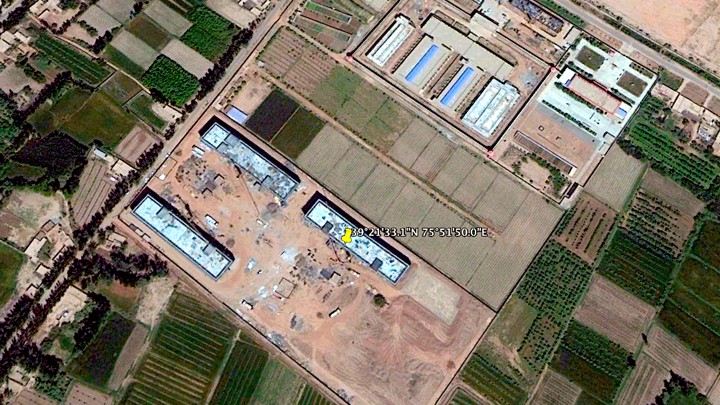 The site of a concentration camp in Shufu County, East Turkestan, as seen in satellite imagery in May 2017.