mardi 8 mai 2018

Chinese Paranoia

White House calls China’s threats to airlines ‘Orwellian nonsense’
By Josh Rogin 
In the long strategic struggle between the United States and China, one key issue is whether the Chinese Communist Party will be able to force Americans to do what it says, especially American companies. 
Now, the Chinese government is threatening to impose a version of its “social credit score” system on international airlines, with steep punishments unless they acquiesce to Beijing’s political demands. 
The Trump administration has decided to tell China that that is not going to fly.
On April 25, the Chinese government sent dozens of international airlines a written threat of severe punishments if they don’t change their websites to declare that Taiwan is part of China, among other things. I have obtained a copy of the letter. 
White House press secretary Sarah Huckabee Sanders is set to release a press statement calling the Chinese government’s threats “political correctness” run amok.
“This is Orwellian nonsense and part of a growing trend by the Chinese Communist Party to impose its political views on American citizens and private companies,” the statement reads. 
“China’s internal Internet repression is world-famous. China’s efforts to export its censorship and political correctness to Americans and the rest of the free world will be resisted.”
The White House statement is the strongest U.S. government rebuke to date of China’s increased pressure on foreign companies to toe the Chinese Communist Party line. 
In recent months, Marriott Hotels and Mercedes-Benz both folded to Chinese government pressure and removed online content related to Tibet. 
Marriott even fired an American worker for “liking” a tweet by a pro-Tibet group.
The letter from China’s Civil Aviation Administration says that on Feb. 27, the Chinese government asked each airline to investigate its websites and remove any references to Taiwan, Hong Kong and Macau that “mistakenly describe them as countries or anything otherwise inconsistent with Chinese law.”
The version of the letter I obtained was addressed to United Airlines and said the Chinese government found “there still exists violations of Chinese laws and contradictions to the one China policy of your government.” 
The Chinese government demanded United change its website so that “Taiwan shall be called ‘Chinese Taiwan’ or ‘Taiwan: province/region of China.’”
Taiwan must be included in any map of China on its website and United must use the same color on the website for mainland China, Taiwan, Hong Kong and Macau, the letter stated. 
Taiwan cannot be listed as a country alongside China. 
Taiwan destinations must not be classified as being in Southeast Asia but must be put in the same category as China on the website.
If United doesn’t comply by May 25, the Chinese government will invoke “Civil Aviation Industry Credit Management Trial Measures” and “make a record of your company’s serious dishonesty and take disciplinary actions against your company,” the letter states. 
The Civil Aviation Administration will also “transfer your company’s violation of Chinese laws to the National Cyber Information Office and other law enforcement agencies to take administrative penalties according to law.”
That reference to “Civil Industry Credit Management” is citing a trial regulation on credit scoring in the aviation industry, and the letter claims United’s labeling of Taiwan is equal to “serious dishonesty” under that regulation, said Samantha Hoffman, visiting fellow at the Mercator Institute for China Studies.
“China’s domestic law, in this case on civil aviation credit and cybersecurity, allow China to extend something like ‘social credit’ beyond its own borders,” she said. 
“It demonstrates why any interpretation of the social credit system must be placed in the context of China’s definitions of state security. And state security is about protecting the Chinese Communist Party above all else.”
Moreover, the Chinese letter mischaracterizes U.S. government policy by saying “the one-China policy of your government.” 
The United States does not have a one-China policy. 
Washington acknowledges Beijing’s position that there is one China that includes Taiwan and the United States takes no stance on that question. 
The U.S. government is not going to agree that Taiwan is part of the People’s Republic of China, and neither should American companies.
The White House statement defends the principle that American private companies must have freedom in their interactions with their customers and not be pressured into taking the political positions of an authoritarian foreign power.
“The United States strongly objects to China’s attempts to compel private firms to use specific language of a political nature in their publicly available content,” the White House statement says. 
“We call on China to stop threatening and coercing American carriers and citizens.”
This is one more example of the Trump’s administration’s continuing shift toward a more assertive stance, said Peter Mattis, a former U.S. intelligence analyst on China. 
But American businesses have yet to stand up to Chinese pressure and interference. 
United declined to comment. 
Delta Air Lines and British Airways have already partially succumbed to the Chinese demands.
“The danger is less the squeeze on Taiwan and more the clear proof that China’s social management system will be used to condition companies and people outside China to align behind the party’s positions,” said Mattis. 
“The cost of doing business has been raised.”
The Chinese Communist Party can be forgiven for believing it can use a version of its social credit system on American companies. 
Nobody has pushed back on this so far. 
The White House is pledging to start doing that now. 
It’s a recognition that, as a White House official told me, “China is out of control.”

Hillary Clinton says China's foreign power grab a new global battle

Experts are sounding the alarm in Australia and New Zealand about Chinese efforts to gain political power and influence policy decisions
By Ben Doherty and Eleanor Ainge Roy
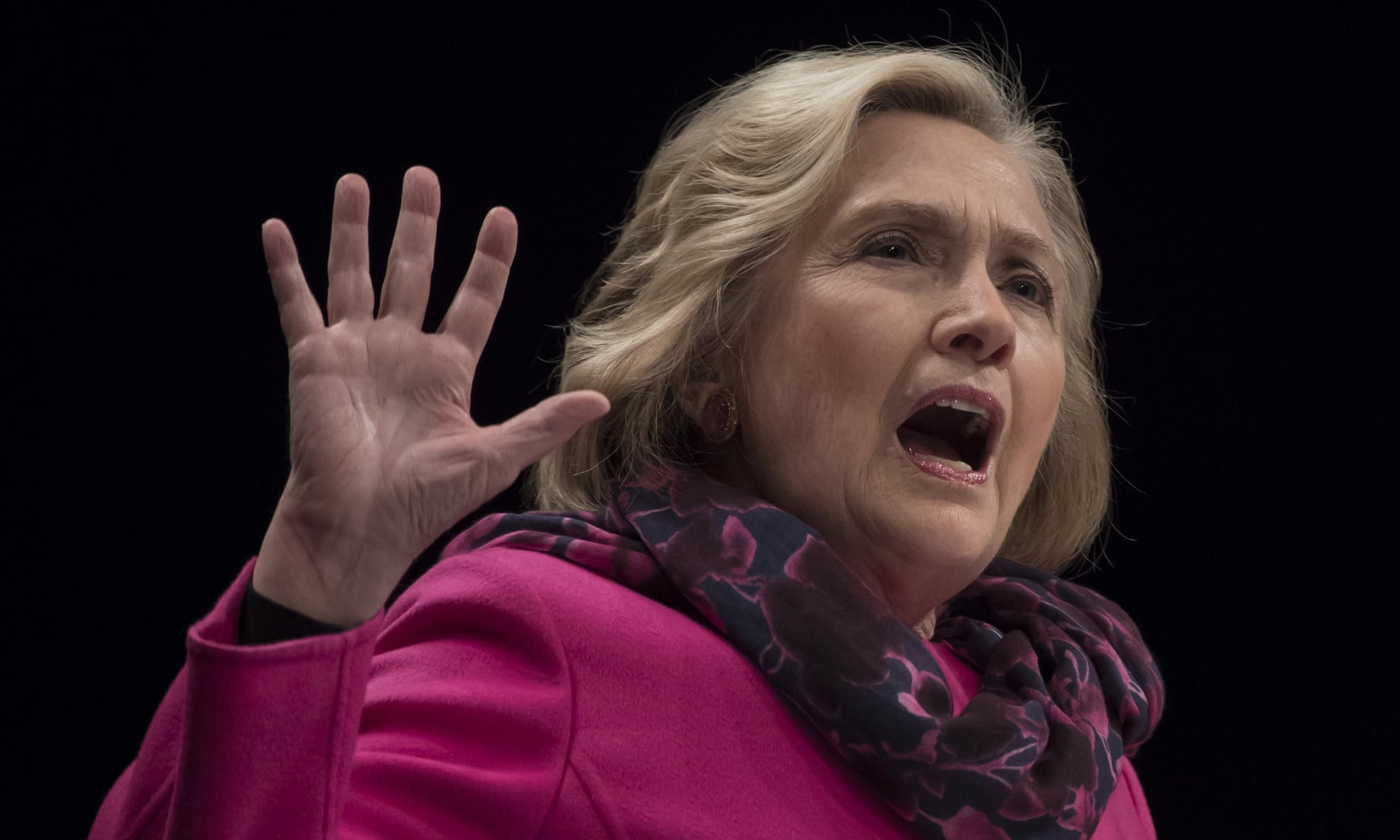
Former US secretary of state and presidential candidate Hillary Clinton speaks in Auckland, New Zealand on Monday night.

China’s attempt to gain political power and influence in foreign countries is “a new global battle”, Hillary Clinton has warned.
Speaking to an audience in New Zealand on Monday night, the former US secretary of state and presidential candidate said Chinese interference in domestic policy was apparent in Australia and New Zealand as well as the US.
“In Australia and here in New Zealand experts are sounding the alarm about Chinese efforts to gain political power and influence policy decisions,” Clinton said.
“[Academic] Anne-Marie Brady of the University of Canterbury has rightly called this a new global battle, and it’s just getting started. We need to take it seriously.”
New Zealand’s prime minister, Jacinda Ardern, told reporters Clinton’s statements about China were not new.
Clinton’s comments follow testimony from the Australian academic Clive Hamilton to the US Congressional-Executive Commission on China that Beijing was waging a “campaign of psychological warfare” against Australia, as America’s most significant ally in the region, undermining democracy and cowing free speech.
Hamilton said Australia was being subjected to Chinese Communist party-sponsored operations of “subversion, cyber intrusions and harassment on the high seas”.
“Beijing knows that it cannot bully the United States – in the current environment the consequences would be unpredictable and probably counterproductive – so it is instead pressuring its allies,” Hamilton said.
New Zealand’s foreign minister, Winston Peters, was due to outline the government’s budget plans for foreign affairs on Tuesday, with some tipping greater spending on the Pacific following his announcement of an increased focus on the region earlier this year.
On Tuesday Australia’s Lowy Institute released its Power Index, confirming China’s rising power and influence across the Asia-Pacific.
America remains the Asia-Pacific’s dominant power, but money, influence and might were shifting from west to east, the index found.
And Donald’s Trump’s political power is a liability for the world’s superpower. 
The US ranks 13th on Lowy’s list of political leadership, equal with Cambodia’s authoritarian and controversial prime minister Hun Sen. 
China heads that category: Xi Jinping has recently been been successful in removing term limits for his position, paving the way for him to be dictator for life.
The Asia-Pacific would emerge as the globe’s dominant region in coming years, the Lowy report said. 
Within a decade, two-thirds of the world’s population will live in Asia, just over 10% will live in the West.
“Much of the world’s future economic growth will come from Asia – but so will the world’s future challenges,” the report argued. 
“Asia is already the location of America’s only true peer competitor, China, as well as the world’s most dangerous country, North Korea.”
Lowy’s new analytical tool – the product of two years’ work – measures power across 25 countries in the Asia-Pacific region, stretching west as far as Pakistan, north to Russia, and across the Pacific to the United States. 
Power is assessed across 114 indicators: including military, economic, and natural resources; diplomatic and cultural influence; trading relationships; capacity to deter real or potential threats; and defence networks.
The index produced using the tool found that the US remained the pre-eminent regional power. 
But China was rising rapidly and closing in on American dominance. 
China ranked higher for diplomatic influence and economic relationships in the region, but the US was dominant in defence networks, military capability and cultural influence.
The US and China are currently locked in tense trade talks that -- despite the positive spin being promoted by both countries -- appear locked in several fundamental impasses, especially over tariffs, strategic industry subsidies, and technology exports.
The index ranked Japan and India as major powers in the region, but found they were moving in opposite directions: India’s young, growing workforce contrasted with Japan’s wealthy but ageing population.
Russia, Australia, South Korea and Singapore were the leading “middle powers”.

Oriental Barbarians

Hear China’s totalitarian cruelty in this widow’s sobs
The Washington Post

Liu Xia, center, holds a portrait of Liu Xiaobo during his funeral in 2017. 

FOR AN example of gratuitous cruelty in the service of 21st-century totalitarianism, listen to the sob-choked voice of China’s Liu Xia. 
The widow of Nobel Peace Prize laureate and dissident Liu Xiaobo, Ms. Liu was recently recorded by a friend as she described her despair at being denied sanctuary in Germany and subjected to an endless continuation of the house arrest she has endured since 2010 — even though her husband died 10 months ago and she has never been charged with a crime.
“If I can’t leave, I’ll die in my home,” Ms. Liu told her friend Liao Yiwu, a writer who lives in Germany, in an April 30 conversation. 
“It’s easier to die than live. Using death to defy could not be any simpler for me.” 
In an earlier call, an excerpt of which Mr. Liao posted online, “Liu Xia was crying non-stop,” he said.
China punished Liu Xiaobo for his advocacy of peaceful democratic change in China with multiple imprisonments, including an 11-year sentence he was serving when he died last July, at 61, of liver cancer. 
Ms. Liu, 57, a poet and artist, has, if anything, been treated even more unconscionably. 
She has been confined to her home for more than seven years without access to a phone or computer, even as the government portrays her as a free citizen. 
Meanwhile, her brother was prosecuted and sentenced to prison on trumped-up charges in 2013. 
Mr. Liao says Ms. Liu, not surprisingly, has suffered from clinical depression for several years.
The regime compounded the abuse by encouraging false hopes of freedom. 
Germany has offered Ms. Liu harbor and medical treatment, and Mr. Liao and other friends said security officials repeatedly promised Ms. Liu that she would be allowed to leave the country. 
First she was told to wait until after last fall’s Communist Party Congress; and then until after the meeting of Beijing’s rubber-stamp legislature in March, where Xi Jinping consolidated his position as dictator for life. 
She waited, while the Germans and her supporters obeyed the regime’s demands that they remain silent.
“On April 1, before Liu Xia’s 57th birthday, the German Ambassador called her to convey Chancellor Angela Merkel’s special respects, and invited her to play badminton in Berlin before long,” Mr. Liao recounted. 
Yet five weeks later, the siege on her home remains unbroken, prompting the despair she expressed in the phone calls. 
Some of her frustration seemed directed at the German Embassy, which, she said, “keep[s] on asking me to do these documents over and over again,” even though she lacked the means to do so.
The real fault lies with a regime that appears bent on crushing the spirit of a woman simply because her husband was recognized for what the Nobel committee called “his long and nonviolent struggle for fundamental human rights in China.” 
That regime claims to offer a new model of greatness for other nations to emulate. 
But how great can it be if it so fears a 57-year-old poet who only wants to live out her life in peace?

vendredi 4 mai 2018

China's Fifth Column

West Virginia GOP candidate says McConnell created jobs for ‘China people’
By Michael Scherer

Former Massey Energy CEO and U.S. Senate candidate Don Blankenship speaks during a town hall to kick off his campaign in Logan, W.Va., in January. 

Republican Senate candidate Don Blankenship stepped up his attacks on Senate Majority Leader Mitch McConnell on Thursday with a new ad that accuses him of creating “millions of jobs for China people.”
With a deadpan delivery and a defiant attitude that has become his trademark, the former coal baron focused his onslaught on the family of McConnell’s wife, Transportation Secretary Elaine Chao, which owns an international shipping business.
Blankenship also repeated his recent nickname for McConnell, “Cocaine Mitch,” an apparent reference to a seizure of drugs on one of Chao’s family’s ships.
“The war to drain the swamp and create jobs for West Virginia people has begun,” Blankenship says, in reference to McConnell (R-Ky.). 
“I will beat Joe Manchin III and ditch Cocaine Mitch for the sake of the kids.”
The ad comes as Blankenship’s two main rivals for the Republican nomination, Rep. Evan Jenkins (R-W.Va.) and state Attorney General Patrick Morrisey have focused their fire on each other with just days to go before the May 8 primary.
Blankenship, by contrast, has redirected his campaign to attack McConnell, whom he blames for a group called Mountain Families PAC, which has been running ads in the state against Blankenship.
The last public poll, by Fox News between April 18 and 22, found Jenkins and Morrisey pulling ahead of Blankenship, who is self-funding his campaign.
Allies of McConnell have expressed concerns for weeks that a primary win by Blankenship would jeopardize Republican hopes of beating incumbent Sen. Joe Manchin III (D-W.Va.) in the general election this fall.
The cocaine nickname for McConnell appears to be a reference to a 2014 seizure from a ship in Colombia bound for the Netherlands. 
Colombian officials seized 90 pounds of cocaine.
The ship came from the maritime company founded by Chao’s father, James Chao, who emigrated from Taiwan. 
The incident received some attention after the Nation reported it in 2014, about a week before McConnell faced reelection.
Blankenship’s own fiancee and a frequent companion on the campaign trail, Farrah Meiling Hobbs, was also born in China. 
Blankenship praises her on his campaign website, writing that he enjoys “spending time with my best friend, Meiling.”
From early in the campaign, Blankenship has boasted of his willingness to go negative. 
“I think the biggest reason you should have confidence that I would defeat Joe Manchin is because I will run hostile ads against him,” Blankenship said at a candidate forum in Martinsburg, W.Va., on April 3. 
“I will tell everyone what Joe Manchin has done.”

Sina Delenda Est

White House warns China on growing militarization in South China Sea
By Ben Westcott, Ryan Browne and Zachary Cohen

The White House warned Beijing on Thursday that there will be consequences for its growing militarization in the South China Sea, following reports of missiles being deployed to three of the country's outposts in the disputed region.
US intelligence assessed that there is a high probability the Chinese military had deployed anti-ship and anti-aircraft missiles to three artificial islands during recent military drills on the contested sea.
But a US defense official told CNN it was unclear if the missiles remained on the outposts following the April exercises.
The South China Sea is one of the most contested regions in the world, with overlapping territorial claims by China, the Philippines and Vietnam, among several others.
The move would mark the first reported Chinese missile deployment in the Spratly Islands, a series of small inlets and reefs that Beijing has slowly built into militarized, artificial islands to reinforce its claims.
White House Press Secretary Sarah Sanders said Thursday that the United States has "raised concerns" with the Chinese. 
We're well aware of China's militarization of the South China Sea," she said.
"There will be near-term and long-term consequences, and we'll certainly keep you up to date," she added.
CNBC first reported the Chinese military had deployed the weapons systems to Subi Reef, Fiery Cross Reef and Mischief Reef, east of the Philippines, on Thursday, quoting a source with knowledge of US intelligence reports.
According to CNBC, the YJ-12B anti-ship missiles would be able to strike ships up to 295 nautical miles away from the artificial islands.
Beijing previously announced in 2016 it had already deployed similar weapons to Woody Island in the Paracel Islands, on the northwestern edge of the South China Sea.

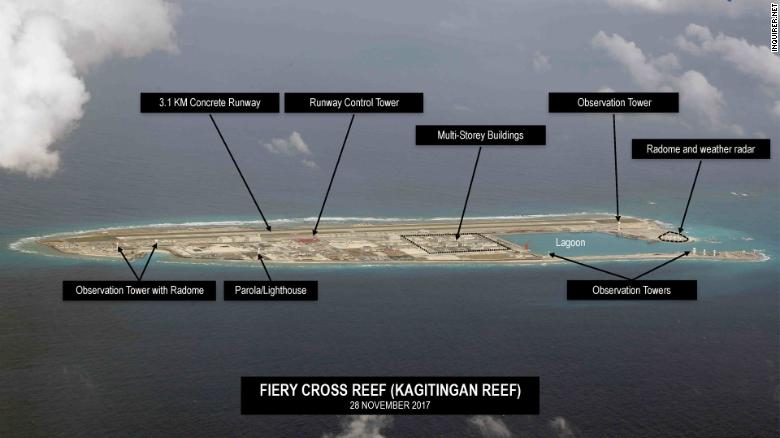
This aerial photograph of Fiery Cross reef obtained by the Philippine Inquirer and taken on November 28, 2017.

'Point of no return': expert
China's militarization has alarmed countries both in the region and around the world, prompting freedom of navigation operations by the US Navy to assert its right to travel in international waters.
"The United States has long raised concerns about the militarization of outposts on disputed features in the South China Sea," said a State Department official who was not authorized to speak publicly on the matter.
"China's leadership has publicly pledged not to pursue militarization in the disputed Spratlys. We are concerned that China is not acting in accordance with this pledge."
Speaking during a visit to Australia on Wednesday, French President Emmanuel Macron said it was important not to have any one "hegemony" in the region.
"What's important is to preserve a rules-based development in the region, especially the Indo-Pacific region and to preserve the necessary balances," he said.
Australia's Foreign Minister Julie Bishop told CNN-affiliate Sky News Australia on Friday said if the media reports were correct, she would be "concerned."
"This would be contrary to China's stated aspiration that it would not militarize these features," she said.
But China's steady military buildup on the islands is reaching a "point of no return," Collin Koh, research fellow at the S. Rajaratnam School of International Studies' Maritime Security Program, told CNN

China's unmovable aircraft carriers
Beijing claims an enormous swath of territory through the center of the sea, delineated by the Chinese government's controversial "nine-dash line" which runs all the way from Hainan Province down to Malaysia and back past Taiwan.
In a ruling in July 2016, the Permanent Court of Arbitration at the Hague ruled China's territorial claims had no legal basis.
Nevertheless, Beijing has attempted to reinforce its hold on the area by creating and militarizing artificial islands in the Spratlys and the Paracels.
Koh said China's string of militarized islands -- equipped with airfields and radar facilities -- have become like a series of immovable aircraft carriers.
He said that the missiles will allow China's armed forces to form "a multilayer military umbrella over the South China Sea," with interlocking sensors and weapons systems.
Satellite imagery had previously emerged of China building installations to hold these missiles, said Bonnie Glaser, the director of the China Power Project at Center for Strategic and International Studies in Washington.
"This is exactly what we have expected the Chinese to do," she said. 
"Next thing we'll see is fighter aircraft to deploy, probably on rotation, then they'll begin exercises near the islands. I just think that (Beijing) believes everybody, including the claimants, understands this is inevitable."
Pentagon chief spokeswoman Dana White reaffirmed the United States' commitment to the international waters.
She said the Chinese must understand that "they cannot, and should not, be hostile, and understand that the Pacific is -- is a place in which much commerce goes through. And it's in their interest to ensure that there's a free navigation of international waters."

Rapid militarization
The missile deployments are just the latest example of Beijing tightening its hold on the South China Sea in recent years, as the world's attention focused farther north, on the Korean Peninsula.
In April, the Wall Street Journal reported US officials had confirmed China had installed military radar jamming equipment on the Spratly Islands.
The same month, Australian warships en route to Vietnam were challenged by the Chinese navy as they traversed the South China Sea, leading Prime Minister Malcolm Turnbull to assert Australia's right to travel international waters.
Hanging over everything was a massive display of Chinese military might in the sea on April 12, culminating in a parade led by Beijing's only aircraft carrier and personally reviewed by Xi Jinping.
The United States under the Trump administration has increased the number of freedom of navigation operations near China's artificial islands, but Glaser said it was difficult for the United States to stand up to Beijing with little support in the region.
"(China) believes they can get away with it and they have probably calculated correctly," she said.
"The big question has always been: How do we impose enough costs so we stop the Chinese where they are, and not go any further? And so far we haven't been successful in that."
Adm. Philip Davidson, nominated to take charge of the US Pacific Command, told his confirmation hearing last month that China is already the master of the South China Sea.
"China is now capable of controlling the South China Sea in all scenarios short of war with the United States," Davidson said in written testimony to the Senate Armed Services Committee.
"The PLA [People's Liberation Army] will be able to use these bases to challenge US presence in the region, and any forces deployed to the islands would easily overwhelm the military forces of any other South China Sea-claimants," Davidson wrote.
The admiral also pointed to the fact that China's current activity contradicts what Chinese dictator Xi Jinping said during a White House meeting with then-US President Barack Obama in 2015.
On the topic of the South China Sea, Xi said at the time that "China does not intend to pursue militarization."
But, speaking at his testimony last month, Davidson noted that China's "forward operating bases" now appear complete. 
"The only thing lacking are the deployed forces," said Davidson.

Chinese Aggressions

China is directing blinding lasers at American military aircraft in Djibouti
By Paul Sonne

Djibouti, a tiny Horn of Africa nation with less than 1 million inhabitants, has become a military outpost for China, France, Italy and Japan.

The United States has formally complained to China after alleging that the Chinese military injured two U.S. airmen by directing high-grade lasers at American aircraft in Djibouti.
Pentagon spokeswoman Dana W. White said at a briefing on Thursday that the United States has requested China investigate incidents in recent weeks in which U.S. aircraft in Djibouti have been affected by unauthorized Chinese laser activity.
White said the Pentagon was confident that Chinese nationals were "responsible". 
She said there had been more than two but fewer than 10 such incidents, which she said had increased in frequency in recent weeks.
“It’s a serious matter,” White said. 
“And we’re taking it very seriously.”
The United States and China both have bases in Djibouti, an East African nation on the Gulf of Aden with fewer than 1 million people. 
Djibouti has become a hub of foreign military activity in recent years, hosting bases from an array of countries including France, Italy and Japan. 
Saudi Arabia is planning to build a base there as well.
Camp Lemonnier, a U.S. naval expeditionary base in Djibouti that is home to about 4,000 American service members, serves as a hub for American counterterrorism activities in nearby countries such as Somalia and Yemen. 
The United States also has been running drone operations out of Djibouti.
The incidents with the lasers, which can temporarily blind pilots, come as one of the first major dust-ups since China opened its first overseas military base in Djibouti in 2017. 
The facility’s opening raised concerns among American military officials about the proximity of the Chinese military installation to American forces. 
The Chinese have characterized the base as a logistics hub for peacekeeping and anti-piracy operations.
American authorities recently issued a notice warning pilots that there had been incidents involving “a high-power laser” near the Chinese base in Djibouti. 
The notice urged pilots to “use extreme caution when transiting near the area.”
White said two American airmen had suffered minor injuries but didn’t provide details. 
According to CNN, two members of a C-130 aircrew suffered minor eye injuries because of exposure to military-grade lasers.
IHS Jane’s Defence Weekly, citing “multiple intelligence sources,” reported in April that the Chinese navy is suspected of operating a high-powered laser weapon at the base in Djibouti or on a ship offshore.
“The use of lasers to temporarily blind pilots has been increasing over the years and dates back to the Cold War when U.S. Navy pilots were periodically attacked by lasers emanating from Soviet naval vessels and spy trawlers,” Jane’s said.
A spokesman for the State Department declined to comment on the contents of its communications with China.
The Chinese Embassy in Washington didn’t immediately respond to a request for comment.

jeudi 3 mai 2018

EU Is Ready to Fight Back Against China's Growing Trade Dominance

  • Bloomberg survey of EU28 shows investment screening is coming
  • Even those with reservations favor a debate on China strategy
By Lyubov Pronina, John Follain, and Slav Okov

Europe is set to tighten controls over foreign investment, a sign of growing wariness of China’s efforts to use its $11 trillion economy to become a dominant global power.
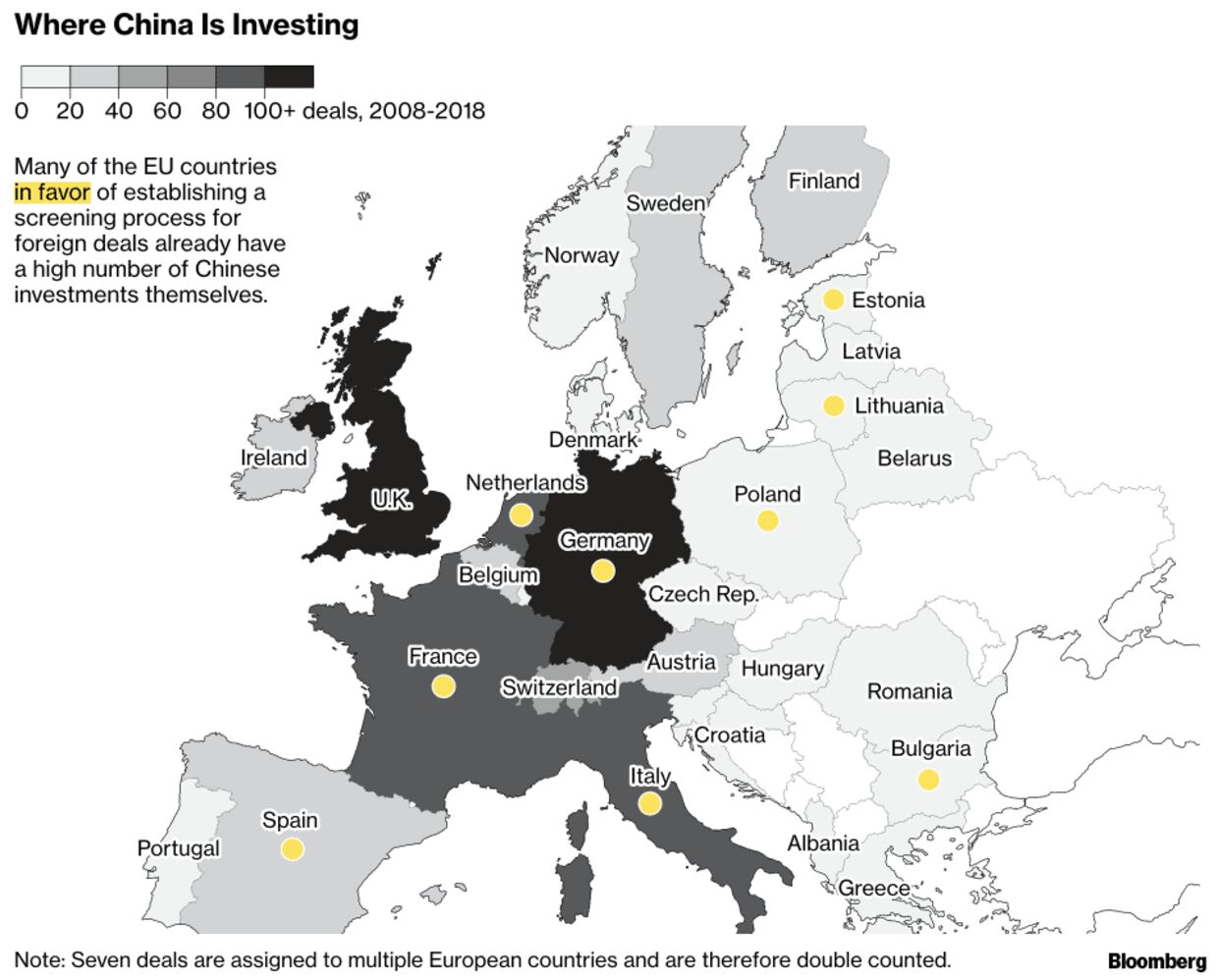
A Bloomberg survey of the European Union’s 28 member states found that at least 15 governments actively or tacitly support draft legislation that would screen investments from outside the bloc. 
With a majority prepared to wave it through, the proposal is on course for passage by the European Parliament, the bill’s next step to becoming law.
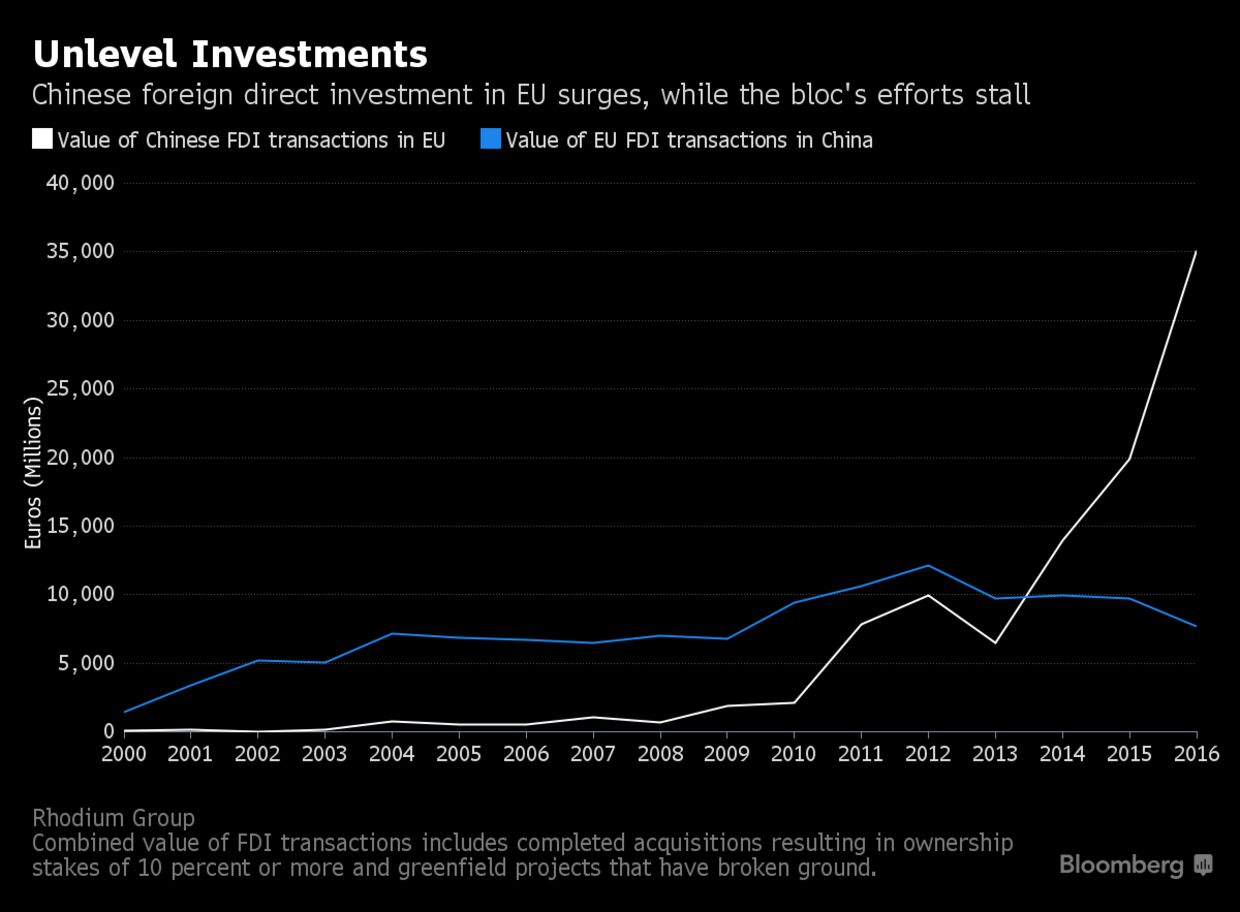
The results show that Europe is waking up to the risks and not just the benefits of inward investment, predominantly from China. 
A Bloomberg audit found that China has invested at least $318 billion in Europe over the past decade, from critical infrastructure to high-tech companies -- more than in the U.S. over the same period.

Nine member states are fully behind the proposals and at least another six won’t oppose them, according to the survey
Europe’s pushback reflects a dilemma shared by governments worldwide as they grapple with China’s growing global clout. 
U.S. Treasury Secretary Steven Mnuchin is leading a delegation to Beijing this week amid disputes over trade, reciprocal market access and China’s state-driven economic model.
As the U.S., Japan and Australia adopt rigorous screening programs, Europe risks becoming “the shop of last resort” for those seeking advanced technologies, the European Council on Foreign Relations warned in a December report.

Taking Know-How
Italy is among those pushing for tighter screening “because we believe that trade must be fair and investment must be productive,” Sandro Gozi, Italy’s junior minister for European affairs, said in an interview. 
“We have to assess whether investment by non-EU countries aims to do business, to promote growth, to create jobs in Europe, or whether it’s just aimed to acquire and then take the know-how of our businesses away from Europe.”
The EU proposal would create a centralized database of past foreign investments in Europe and an alert mechanism for future ones, leaving the ultimate power of approving deals with individual governments. 
The EU Parliament’s international-trade committee, however, intends to vote on amendments that could give the bill more teeth. 
After that, the spotlight will shift to the deliberations among EU governments.
For Bulgaria, which holds the EU’s rotating presidency, the proposal “is one of our trade policy priorities,” the Economy Ministry said in an emailed response to questions. 
The draft regulation doesn’t envisage obligatory screening, but rather “its purpose is to establish a mechanism for cooperation and coordination among member states” whereby countries applying screening should inform the others, it said.
Last year, when the EU first floated an investment screening mechanism, China called on the bloc to observe World Trade Organization rules and avoid discriminatory investment policies. 
It also says its signature Belt and Road infrastructure program benefits everyone, noting that leaders of most EU countries have expressed interest in signing up.
The survey revealed splits among governments, with countries such as Finland insisting the bloc avoid any resort to protectionist measures and others like Malta saying that small economies must remain open to investment. 
The U.K. and the Czech Republic were among those to stress that any curbs should be imposed at national level without recourse to the EU. 
Yet all those surveyed welcomed the debate.
“There is a sea change of perception” toward China, said Francois Godemont, director of the Asia program at the European Council on Foreign Relations. 
He cited a “wave of investments” for having fueled the shift, along with an inability of the EU and China to resolve their respective market issues to date. 
In addition, he said, an awareness of political change in China including the removal of term limits has “soured the mood.”
All the same, the EU commission proposal “is already pretty much a compromise because it’s not legally binding,” Godemont said.

Europe’s approach is tame compared to President Donald Trump as he pushes his “America First” trade agenda, threatening protectionist barriers against allies and adversaries alike. 
The White House has said it would forge a “trade coalition of the willing” to stand up to China for unfair trade practices. 
It’s also railed against China’s program to become the world leader in a slew of industries by 2025.
China’s global ambitions, including a push to dominate artificial intelligence, are causing consternation in Berlin and Paris: Chancellor Angela Merkel and President Emmanuel Macron have both made China’s rise a policy priority. 
Macron has pledged to seek more strategic coordination with Germany on the issue. 
Merkel plans her own visit to China later this year.
Even EU state traditionally more skeptical of a bloc-wide policy approach are paying heed.
Hungary is ready to debate investment screening so long as it doesn’t result in different standards among EU members, Gergely Gulyas, vice president and parliamentary leader of Hungary’s ruling Fidesz party, said in an interview.
“If we have a common China policy, we are ready to be part of it,” he said.